Works › The Paradise of the Soul
Volume 37 · ≈ pp. 472–473
Chapter XVI. On Constancy.
A marker with ≈ is an approximate page boundary, placed by measure of the text; the page photographs remain the authority. In the paired views, clicking a page marker brings that page into view.
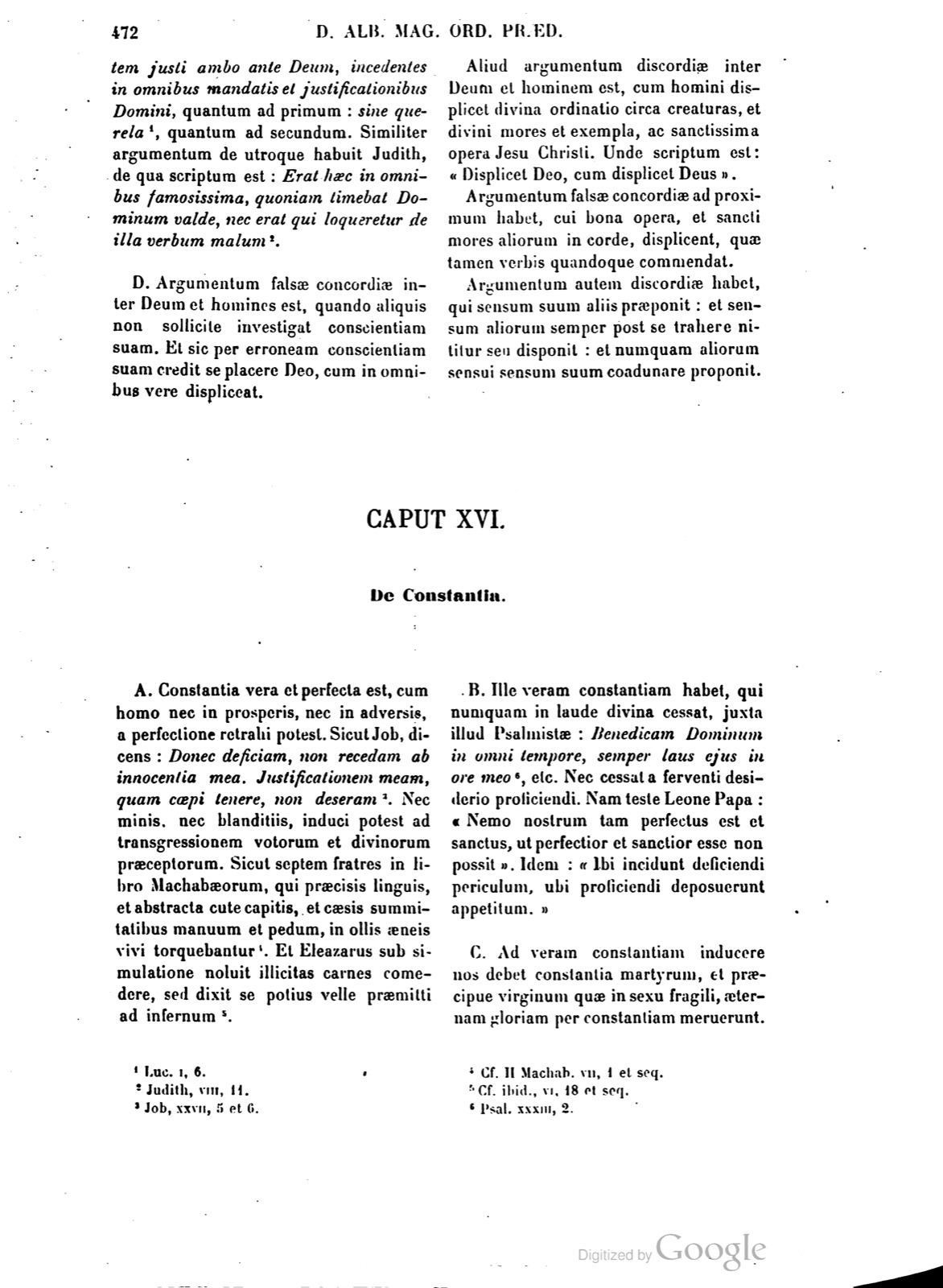
Caput XVI.
De Constantia.
A. Constantia vera et perfecta est, cum homo nec in prosperis, nec in adversis, a perfectione retrahi potest. Sicut Job, dicens: Donec deficiam, non recedam ab innocentia mea. Justificationem meam, quam coepi tenere, non deseram 1. Nec minis, nec blanditiis, induci potest ad transgressionem votorum et divinorum praeceptorum. Sicut septem fratres in libro Machabaeorum, qui praecisis linguis, et abstracta cute capitis, et caesis summitatibus manuum et pedum, in ollis aeneis vivi torquebantur 2. Et Eleazarus sub simulatione noluit illicitas carnes comedere, sed dixit se potius velle praemitti ad infernum 3.
B. Ille veram constantiam habet, qui numquam in laude divina cessat, juxta illud Psalmistae: Benedicam Dominum in omni tempore, semper laus ejus in ore meo 4, etc. Nec cessat a ferventi desiderio proficiendi. Nam teste Leone Papa: « Nemo nostrum tam perfectus est et sanctus, ut perfectior et sanctior esse non possit ». Idem: « Ibi incidunt deficiendi periculum, ubi proficiendi deposuerunt appetitum. »
C. Ad veram constantiam inducere nos debet constantia martyrum, et praecipue virginum quae in sexu fragili, aeternam gloriam per constantiam meruerunt. Sed amplius movere nos debet ad constantiam pertinacia Judaeorum et haereticorum, et perversorum hominum in malitiis suis temeritas: qui pro perfidia et pertinacia iniquitatum suarum, grave tormentum habent in conscientia sua in praesenti, et gravissimam poenam animae et corporis exspectant in futuro.
D. Argumentum verae constantiae est, cum aliquis, nec pro amissione corporis, neque rerum, cessat ab omnibus quae Deo placent. Sicut Tobias a sepultura mortuorum non cessavit: pro quo rex Sennacherib omnia ei bona abstulit, et insuper occidi praecepit 5. Sic Daniel ab oratione non cessavit 6. Sic Apostoli post resurrectionem Christi, nec propter flagellationem, nec propter timorem mortis, a manifestatione nominis Christi cessaverunt, dicentes adversariis Petrus et Joannes, an Deo magis obedire oportet, vos ipsi judicate. Si justum est in conspectu Dei vos potius audire quam Deum, judicate 7. Item, Petrus et Apostoli dixerunt ad illos: Obedire oportet Deo magis quam hominibus 8.
Chapter XVI.
On Constancy.
A. True and perfect constancy exists when a human being cannot be drawn back from perfection either in prosperities or in adversities. As Job says: Until I fail, I will not depart from my innocence. My justification, which I have begun to hold, I will not abandon 1. Nor can he be induced by threats or flattery to transgression of vows and divine precepts. As the seven brothers in the book of Maccabees, whose tongues were cut out, the skin of their heads torn away, and the extremities of hands and feet cut off, were tortured alive in bronze cauldrons 2. And Eleazar did not wish under simulation to eat illicit meats, but said that he wished rather to be sent ahead to hell 3.
B. He has true constancy who never ceases in divine praise, according to that of the Psalmist: I will bless the Lord at all times; his praise is always in my mouth 4, etc. Nor does he cease from fervent desire of advancing. For as Pope Leo testifies: "None of us is so perfect and holy that he cannot be more perfect and holier." Likewise: "They fall into the danger of failing where they have laid aside the appetite for advancing."
C. The constancy of the martyrs ought to induce us to true constancy, and especially of the virgins who in the fragile sex merited eternal glory through constancy. But the stubbornness of Jews and heretics, and the rashness of perverse human beings in their evils, ought to move us still more to constancy: for, because of the perfidy and stubbornness of their iniquities, they have grave torment in their conscience in the present and expect a most grave punishment of soul and body in the future.
D. The proof of true constancy is when someone, neither because of loss of body nor of possessions, ceases from all things that please God. Thus Tobias did not cease from the burial of the dead; because of this King Sennacherib took away all his goods and moreover ordered him to be killed 5. Thus Daniel did not cease from prayer 6. Thus the Apostles after the resurrection of Christ, neither because of scourging nor fear of death, ceased from the manifestation of the name of Christ, Peter and John saying to their adversaries: Whether it is necessary to obey God more, judge for yourselves. If it is just in the sight of God to hear you rather than God, judge 7. Likewise Peter and the Apostles said to them: It is necessary to obey God rather than human beings 8.
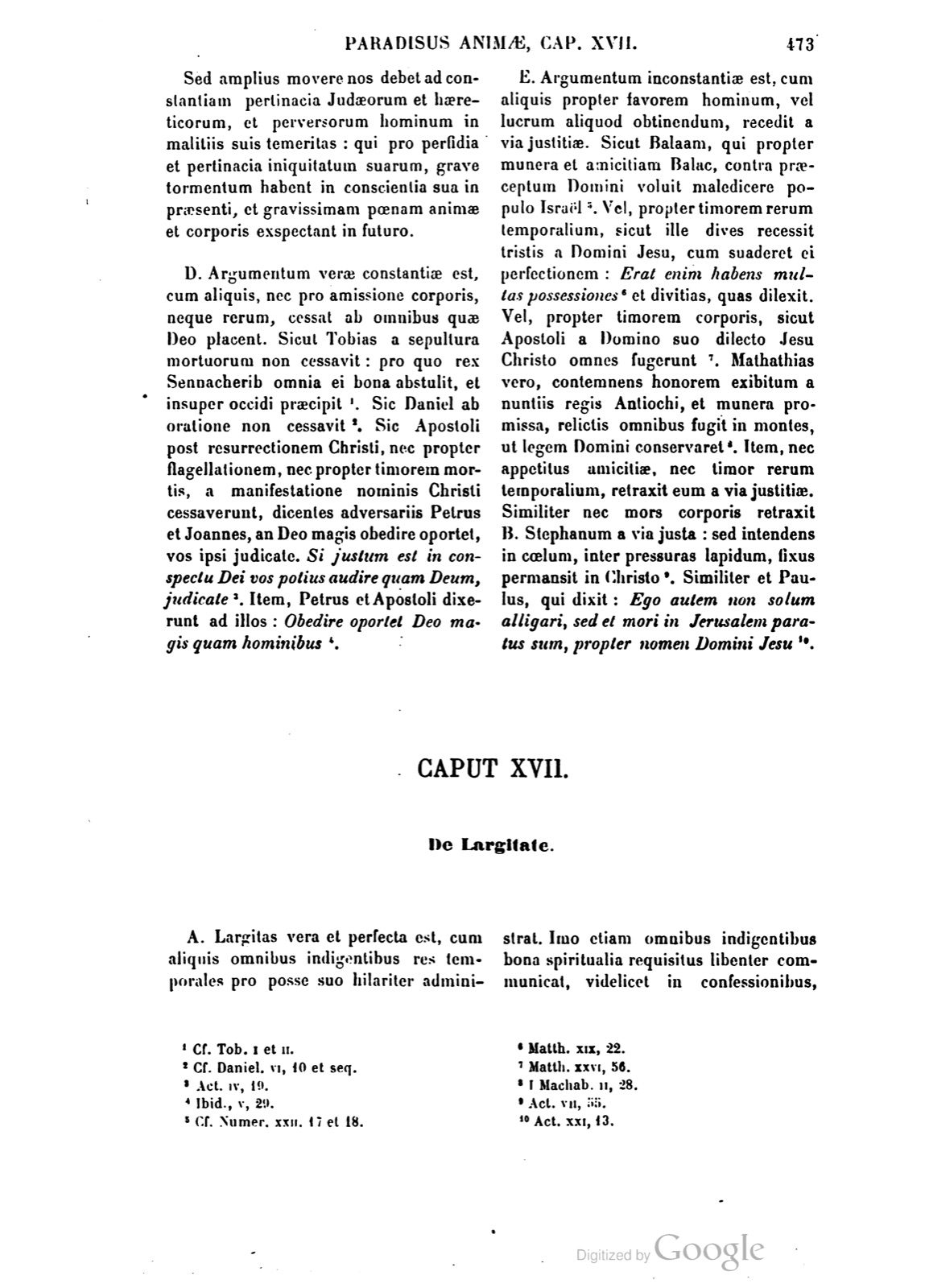
E. Argumentum inconstantiae est, cum aliquis propter favorem hominum, vel lucrum aliquod obtinendum, recedit a via justitiae. Sicut Balaam, qui propter munera et amicitiam Balac, contra praeceptum Domini voluit maledicere populo Israel 9. Vel, propter timorem rerum temporalium, sicut ille dives recessit tristis a Domino Jesu, cum suaderet ei perfectionem: Erat enim habens multas possessiones et divitias, quas dilexit 10. Vel, propter timorem corporis, sicut Apostoli a Domino suo dilecto Jesu Christo omnes fugerunt 11. Mathathias vero, contemnens honorem exhibitum a nuntiis regis Antiochi, et munera promissa, relictis omnibus fugit in montes, ut legem Domini conservaret 12. Item, nec appetitus amicitiae, nec timor rerum temporalium, retraxit eum a via justitiae. Similiter nec mors corporis retraxit B. Stephanum a via justa: sed intendens in coelum, inter pressuras lapidum, fixus permansit in Christo 13. Similiter et Paulus, qui dixit: Ego autem non solum alligari, sed et mori in Jerusalem paratus sum, propter nomen Domini Jesu 14.
E. The proof of inconstancy is when someone, because of human favor or some profit to be obtained, departs from the way of justice. Thus Balaam, because of the gifts and friendship of Balak, wished against the Lord's precept to curse the people Israel 9. Or because of fear of temporal things, as that rich man withdrew sad from the Lord Jesus when he advised perfection to him, for he had many possessions and riches, which he loved 10. Or because of fear of the body, as all the Apostles fled from their beloved Lord Jesus Christ 11. But Mattathias, despising the honor shown by the messengers of King Antiochus and the gifts promised, left all things and fled into the mountains to preserve the law of the Lord 12. Likewise, neither appetite for friendship nor fear of temporal things drew him back from the way of justice. Similarly, not even death of the body drew blessed Stephen back from the just way, but, gazing into heaven, amid the pressure of stones he remained fixed in Christ 13. Similarly also Paul, who said: I am ready not only to be bound, but also to die in Jerusalem for the name of the Lord Jesus 14.
Notes
- Job 27:5 and 6. (Job, XXVII, 5 et 6.) ↩
- Compare 2 Maccabees 7:1 and following. (Cf. II Machab. VII, 1 et seq.) ↩
- Compare the same, 7:18 and following. (Cf. ibid., VII, 18 et seq.) ↩
- Psalm 33:2. (Psal. XXXIII, 2.) ↩
- Compare Tobit 1 and 2. (Cf. Tob. I et II.) ↩
- Compare Daniel 6:10 and following. (Cf. Daniel. VI, 10 et seq.) ↩
- Acts 4:19. (Act. IV, 19.) ↩
- The same, 5:29. (Ibid., V, 29.) ↩
- Compare Numbers 22:17 and 18. (Cf. Numer. XXII, 17 et 18.) ↩
- Matthew 19:22. (Matth. XIX, 22.) ↩
- Matthew 26:56. (Matth. XXVI, 56.) ↩
- 1 Maccabees 2:28. (I Machab. II, 28.) ↩
- Acts 7:55. (Act. VII, 55.) ↩
- Acts 21:13. (Act. XXI, 13.) ↩
If a page does not appear, its photograph has not been uploaded yet.