Works › The Paradise of the Soul
Volume 37 · ≈ pp. 471–472
Chapter XV. On Concord.
A marker with ≈ is an approximate page boundary, placed by measure of the text; the page photographs remain the authority. In the paired views, clicking a page marker brings that page into view.
Caput XV.
De Concordia.
A. Vera concordia ad Deum est, uniri voluntati divinae in prosperis et adversis: et pro posse, divinis moribus et exemplis Jesu Christi conformari. Dicit enim D. Joannes episcopus, id est, Chrysostomus: « Nihil est dignius, quam ut homo sit auctoris sui imitator, et secundum modum propriae facultatis divini operis sit exsecutor 1. » Hanc unionem petit nobis Dominus in penultimo vitae suae instanti, dicens: Sicut tu, Pater, in me, et ego in te, ut et ipsi in nobis unum sint 2.
Item, Vera concordia ad proximos est, cum omnibus, in omnibus, idem sapere, idem sentire in iis quae sunt ad Deum. Sicut in primitiva Ecclesia: Multitudinis credentium erat cor unum et anima una 3: nempe quoad omnia quae spectant ad Deum. Item, Aliis conformari, in cibo, potu, somno, in moribus et operibus quae non sunt contra Deum, nec contra professionem suam, nec contra perfectionem, ut plures lucrifaciamus. Sicut Apostolus de se dicit: Factus sum infirmis infirmus, ut infirmos lucrifacerem: omnibus omnia factus sum, ut omnes facerem salvos 4.
B. Ad amorem verae concordiae nos inducere debet, quod valde laudabilis est Deo, et valde placita concordia fratrum, sicut ipse dixit per Salomonem: In tribus placitum est spiritui meo, quae sunt probata coram Deo et hominibus: Concordia fratrum, et amor proximorum, et vir et mulier bene sibi consentientes 5. Nam miseri et fragiles homines hoc servant in terris, quod Angeli noluerunt servare in coelis. Ad idem nos invitare debet Jesu Christi diligentia, ad faciendum concordiam inter homines et Deum: et inter Apostolos, cum esset inter eos contentio, quis eorum videretur esse major 6: et cum indignarentur Apostoli, scilicet de Jacobo et Joanne fratribus, eo quod ipsi volebant sedere ad dexteram et sinistram ejus 7. In his omnibus Christus eos concordavit.
Chapter XV.
On Concord.
A. True concord toward God is to be united to the divine will in prosperities and adversities, and, as far as one can, to be conformed to the divine manners and examples of Jesus Christ. For D. John the bishop, that is, Chrysostom, says: "Nothing is more worthy than that a human being should be an imitator of his author and, according to the measure of his own capacity, an executor of the divine work 1." The Lord asks this union for us at the penultimate instant of his life, saying: As you, Father, are in me, and I in you, that they also may be one in us 2.
Likewise, true concord toward neighbors is to think the same thing with all, in all things, and to feel the same thing in those things that are toward God. As in the primitive Church: The multitude of believers had one heart and one soul 3, namely with respect to all things that look toward God. Likewise, to conform oneself to others in food, drink, sleep, in morals and works that are not against God, nor against one's profession, nor against perfection, so that we may gain more people. As the Apostle says of himself: I became weak to the weak, that I might gain the weak; I became all things to all, that I might make all saved 4.
B. This ought to induce us to love of true concord, that concord of brothers is very praiseworthy to God and very pleasing, as he himself said through Solomon: In three things my spirit has been pleased, which are approved before God and human beings: the concord of brothers, and love of neighbors, and a man and woman agreeing well with each other 5. For miserable and fragile human beings preserve on earth what the angels did not wish to preserve in heaven. The diligence of Jesus Christ ought to invite us to the same, for making concord between human beings and God, and among the Apostles, when there was a contention among them as to which of them seemed to be greater 6, and when the Apostles were indignant, namely about the brothers James and John, because they wished to sit at his right and left hand 7. In all these things Christ brought them into concord.
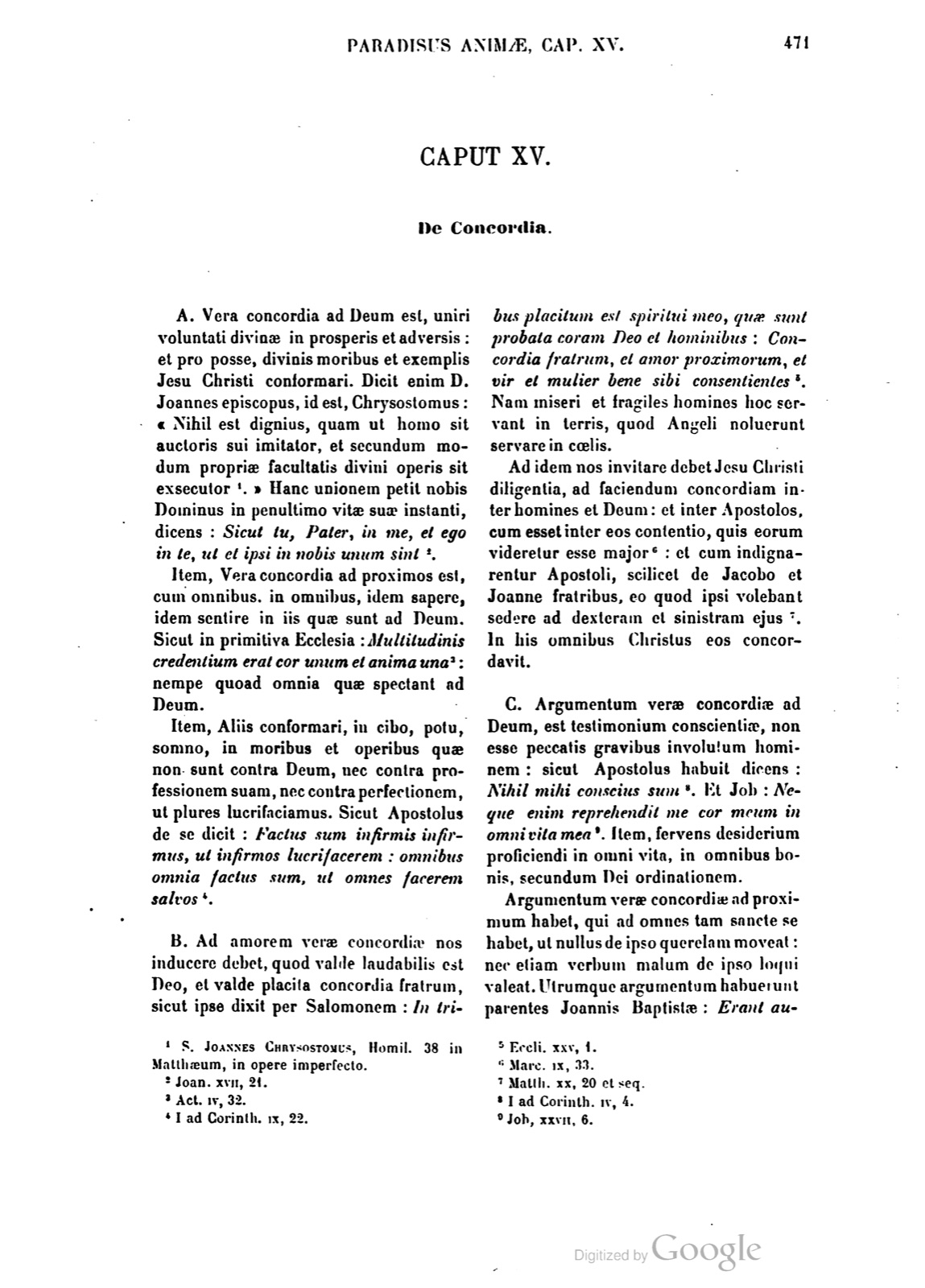
C. Argumentum verae concordiae ad Deum, est testimonium conscientiae, non esse peccatis gravibus involutum hominem: sicut Apostolus habuit dicens: Nihil mihi conscius sum 8. Et Job: Neque enim reprehendit me cor meum in omni vita mea 9. Item, fervens desiderium proficiendi in omni vita, in omnibus bonis, secundum Dei ordinationem.
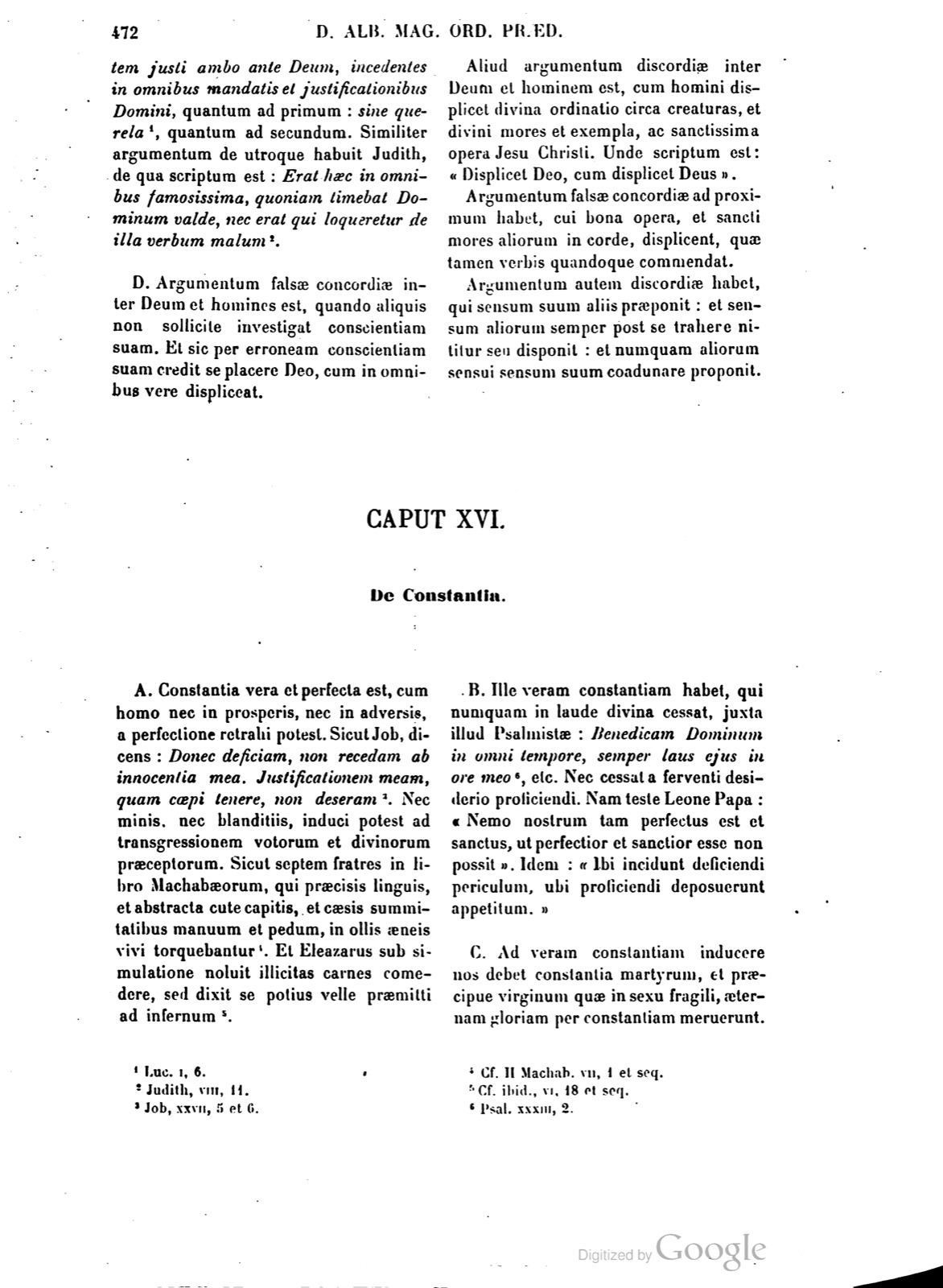
Argumentum verae concordiae ad proximum habet, qui ad omnes tam sancte se habet, ut nullus de ipso querelam moveat: nec etiam verbum malum de ipso loqui valeat. Utrumque argumentum habuerunt parentes Joannis Baptistae: Erant autem justi ambo ante Deum, incedentes in omnibus mandatis et justificationibus Domini, quantum ad primum: sine querela 10, quantum ad secundum. Similiter argumentum de utroque habuit Judith, de qua scriptum est: Erat haec in omnibus famosissima, quoniam timebat Dominum valde, nec erat qui loqueretur de illa verbum malum 11.
D. Argumentum falsae concordiae inter Deum et homines est, quando aliquis non sollicite investigat conscientiam suam. Et sic per erroneam conscientiam suam credit se placere Deo, cum in omnibus vere displiceat.
Aliud argumentum discordiae inter Deum et hominem est, cum homini displicet divina ordinatio circa creaturas, et divini mores et exempla, ac sanctissima opera Jesu Christi. Unde scriptum est: « Displicet Deo, cum displicet Deus ». Argumentum falsae concordiae ad proximum habet, cui bona opera, et sancti mores aliorum in corde, displicent, quae tamen verbis quandoque commendat. Argumentum autem discordiae habet, qui sensum suum aliis praeponit: et sensum aliorum semper post se trahere nititur seu disponit: et numquam aliorum sensui sensum suum coadunare proponit.
C. The proof of true concord toward God is the testimony of conscience that the human being is not entangled in grave sins, as the Apostle had when he said: I am conscious of nothing to myself 8. And Job: For my heart has not reproached me in my whole life 9. Likewise, fervent desire of advancing in every life, in all good things, according to the ordinance of God.
He has the proof of true concord toward neighbor who conducts himself toward all so holily that no one raises a complaint about him, nor is anyone able even to speak an evil word about him. The parents of John the Baptist had both proofs: They were both just before God, walking in all the commandments and justifications of the Lord, with respect to the first; without complaint 10, with respect to the second. Likewise Judith had the proof of both, about whom it is written: She was most renowned in all things, because she feared the Lord greatly, and there was no one who spoke an evil word about her 11.
D. The proof of false concord between God and human beings is when someone does not solicitously examine his conscience. And thus through his erroneous conscience he believes that he pleases God, when he truly displeases him in all things.
Another proof of discord between God and a human being is when the divine ordinance concerning creatures, and the divine manners and examples, and the most holy works of Jesus Christ displease the human being. Hence it is written: "It displeases God when God displeases." He has the proof of false concord toward neighbor to whom the good works and holy manners of others displease in his heart, which nevertheless he sometimes commends with words. But he has the proof of discord who sets his own sense before others, and always strives or arranges to draw the sense of others after himself, and never proposes to unite his own sense to the sense of others.
Notes
- St. John Chrysostom, Homily 38 on Matthew, in the imperfect work. (S. Joannes Chrysostomus, Homil. 38 in Matthaeum, in opere imperfecto.) ↩
- John 17:21. (Joan. XVII, 21.) ↩
- Acts 4:32. (Act. IV, 32.) ↩
- 1 Corinthians 9:22. (I ad Corinth. IX, 22.) ↩
- Ecclesiasticus 25:1. (Eccli. XXV, 1.) ↩
- Mark 9:33. (Marc. IX, 33.) ↩
- Matthew 20:20 and following. (Matth. XX, 20 et seq.) ↩
- 1 Corinthians 4:4. (I ad Corinth. IV, 4.) ↩
- Job 27:6. (Job, XXVII, 6.) ↩
- Luke 1:6. (Luc. I, 6.) ↩
- Judith 8:11. (Judith, VIII, 11.) ↩
If a page does not appear, its photograph has not been uploaded yet.