Works › The Paradise of the Soul
Volume 37 · ≈ pp. 469–470
Chapter XIV. On Mercy.
A marker with ≈ is an approximate page boundary, placed by measure of the text; the page photographs remain the authority. In the paired views, clicking a page marker brings that page into view.
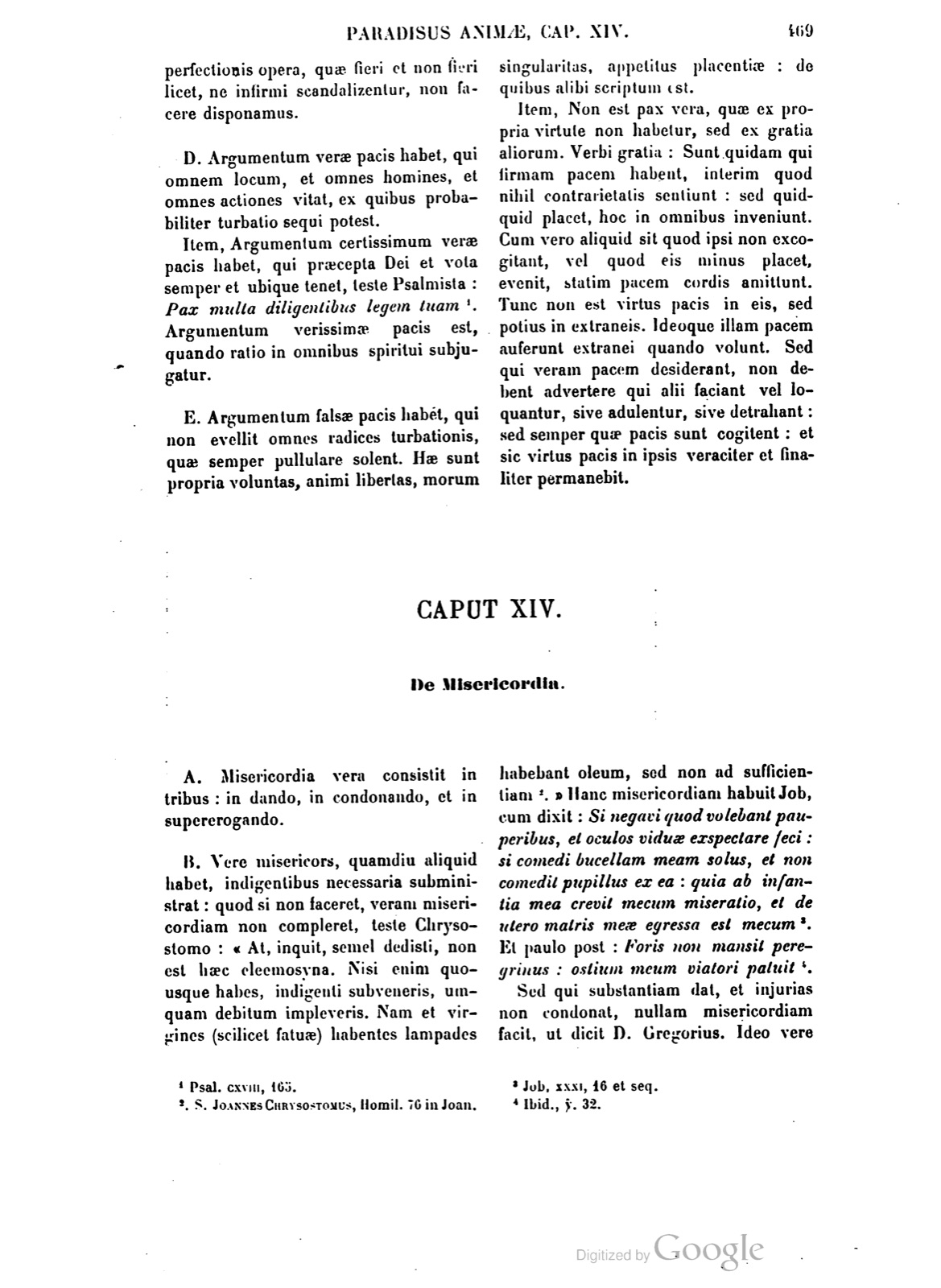
Caput XIV.
De Misericordia.
A. Misericordia vera consistit in tribus: in dando, in condonando, et in supererogando.
B. Vere misericors, quamdiu aliquid habet, indigentibus necessaria subministrat: quod si non faceret, veram misericordiam non compleret, teste Chrysostomo: « At, inquit, semel dedisti, non est haec eleemosyna. Nisi enim quousque habes, indigenti subveneris, umquam debitum impleveris. Nam et virgines, scilicet fatuae, habentes lampades habebant oleum, sed non ad sufficientiam 1. » Hanc misericordiam habuit Job, cum dixit: Si negavi quod volebant pauperibus, et oculos viduae exspectare feci: si comedi bucellam meam solus, et non comedit pupillus ex ea: quia ab infantia mea crevit mecum miseratio, et de utero matris meae egressa est mecum 2. Et paulo post: Foris non mansit peregrinus: ostium meum viatori patuit 3.
Sed qui substantiam dat, et injurias non condonat, nullam misericordiam facit, ut dicit D. Gregorius. Ideo vere misericors, sponte antequam rogatur, omnem injuriam ex corde remittit: numquam vindicaturus, nec per se, nec per alium. Imo vere misericors paratior est ad remittendum, quam sit injurians ad petendum. Nam vere misericors plus dolet de peccato injuriantis, quam de afflictione propria, quam ab injuriante suffert. Sic Semei maledicenti, et lapides contra se mittenti, David ex corde dimisit, etiam non petenti. Et ne per inimicos suos occideretur, prohibuit dicens: Dimittite eum ut maledicat juxta praeceptum Domini. Si forte respiciat Dominus afflictionem meam, et reddat mihi Dominus bonum pro maledictione hac hodierna 4. Sic etiam Joseph pepercit fratribus suis, antequam peterent, flendo super singulos 5.
Nec hoc sufficit vere misericordi, nisi etiam injuriantibus, suis precibus a Deo veniam obtineat. Sic Moyses Judaeis ipsum lapidare volentibus, gratiam impetravit, dicens: Aut dimitte eis hanc noxam, aut si non facis, dele me de libro tuo quem scripsisti 6. Sic Stephanus lapidantibus: sic Dominus Jesus crucifixoribus suis veniam et gratiam obtinuit 7. Cum uterque dixerit: Dimitte illis, non enim sciunt quid faciunt 8. Ubi valde injuriantes excusantur: quasi dicerent: Non habent sensum, non enim sciunt quid faciunt: ideoque ipsis merito non est imputandum, sed clementer parcendum.
Chapter XIV.
On Mercy.
A. True mercy consists in three things: in giving, in forgiving, and in supererogating.
B. The truly merciful person, as long as he has anything, supplies necessary things to those in need; if he did not do this, he would not fulfill true mercy, as Chrysostom testifies: "But," he says, "you have given once; this is not almsgiving. For unless, as long as you have, you help the needy person, you will never fulfill the debt. For the virgins, namely the foolish ones, having lamps, had oil, but not sufficiently 1." Job had this mercy when he said: If I denied to the poor what they wished, and made the eyes of the widow wait; if I ate my morsel alone, and the orphan did not eat from it; because from my infancy pity grew up with me, and it came forth with me from my mother's womb 2. And a little later: The stranger did not remain outside; my door lay open to the traveler 3.
But one who gives substance and does not forgive injuries does no mercy, as D. Gregory says. Therefore the truly merciful person, spontaneously before he is asked, remits every injury from the heart, never about to avenge it, neither by himself nor through another. Indeed the truly merciful person is readier to remit than the injurer is to ask. For the truly merciful person grieves more over the sin of the one doing injury than over his own affliction, which he suffers from the one doing injury. Thus David from the heart forgave Shimei, who was cursing him and throwing stones against him, even though he did not ask. And lest he be killed by David's enemies, David forbade it, saying: Let him go, that he may curse according to the command of the Lord. Perhaps the Lord will look upon my affliction, and the Lord will render good to me for this curse today 4. So also Joseph spared his brothers before they asked, weeping over each 5.
Nor does this suffice for the truly merciful person, unless he also obtains pardon from God by his prayers for those doing injury. Thus Moses obtained grace for the Jews who wished to stone him, saying: Either forgive them this fault, or if you do not, blot me out of your book that you have written 6. So Stephen obtained pardon for those stoning him; so the Lord Jesus obtained pardon and grace for his crucifiers 7. Since each said: Forgive them, for they do not know what they are doing 8. Here those greatly doing injury are excused, as if they were saying: They have no sense, for they do not know what they are doing; and therefore it should deservedly not be imputed to them, but they should be mercifully spared.
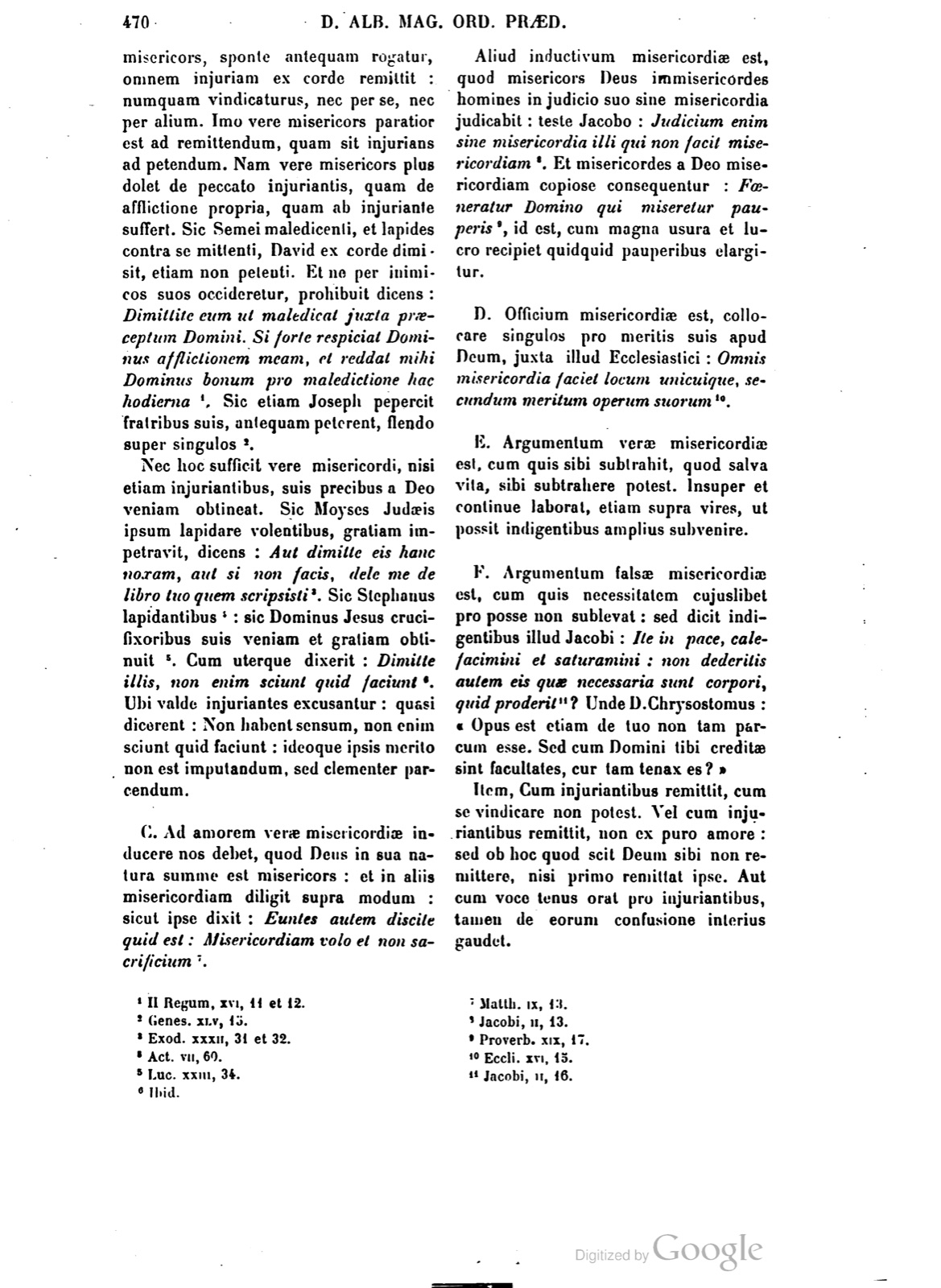
C. Ad amorem verae misericordiae inducere nos debet, quod Deus in sua natura summe est misericors: et in aliis misericordiam diligit supra modum: sicut ipse dixit: Euntes autem discite quid est: Misericordiam volo et non sacrificium 9. Aliud inductivum misericordiae est, quod misericors Deus immisericordes homines in judicio suo sine misericordia judicabit: teste Jacobo: Judicium enim sine misericordia illi qui non facit misericordiam 10. Et misericordes a Deo misericordiam copiose consequentur: Foeneratur Domino qui miseretur pauperis 11, id est, cum magna usura et lucro recipiet quidquid pauperibus elargitur.
D. Officium misericordiae est, collocare singulos pro meritis suis apud Deum, juxta illud Ecclesiastici: Omnis misericordia faciet locum unicuique, secundum meritum operum suorum 12.
E. Argumentum verae misericordiae est, cum quis sibi subtrahit, quod salva vita, sibi subtrahere potest. Insuper et continue laborat, etiam supra vires, ut possit indigentibus amplius subvenire.
F. Argumentum falsae misericordiae est, cum quis necessitatem cujuslibet pro posse non sublevat: sed dicit indigentibus illud Jacobi: Ite in pace, calefacimini et saturamini: non dederitis autem eis quae necessaria sunt corpori, quid proderit 13? Unde D. Chrysostomus: « Opus est etiam de tuo non tam parcum esse. Sed cum Domini tibi creditae sint facultates, cur tam tenax es? » Item, Cum injuriantibus remittit, cum se vindicare non potest. Vel cum injuriantibus remittit, non ex puro amore: sed ob hoc quod scit Deum sibi non remittere, nisi primo remittat ipse. Aut cum voce tenus orat pro injuriantibus, tamen de eorum confusione interius gaudet.
C. This ought to induce us to love of true mercy, that God in his own nature is supremely merciful, and loves mercy in others beyond measure, as he himself said: But go and learn what this is: I will mercy and not sacrifice 9. Another inducement of mercy is that the merciful God in his judgment will judge without mercy unmerciful human beings, as James testifies: For judgment without mercy is for him who does not do mercy 10. And the merciful will copiously obtain mercy from God: He lends to the Lord who has mercy on the poor 11, that is, with great interest and profit he will receive whatever is bestowed on the poor.
D. The office of mercy is to place each person before God according to his merits, according to that of Ecclesiasticus: Every mercy will make a place for each one, according to the merit of his works 12.
E. The proof of true mercy is when someone withdraws from himself what, with life preserved, he can withdraw from himself. In addition he continually labors, even beyond his strength, so that he can help the needy more fully.
F. The proof of false mercy is when someone does not relieve the necessity of anyone as far as he can, but says to the needy that saying of James: Go in peace, be warmed and filled; but if you have not given them the things necessary for the body, what will it profit 13? Hence D. Chrysostom says: "There is need also not to be so sparing from your own. But since resources of the Lord have been entrusted to you, why are you so tenacious?" Likewise, when someone forgives those doing injury when he cannot avenge himself; or when he forgives those doing injury not from pure love, but because he knows that God will not forgive him unless he himself first forgives; or when with the voice alone he prays for those doing injury, yet inwardly rejoices over their confusion.
Notes
- St. John Chrysostom, Homily 76 on John. (S. Joannes Chrysostomus, Homil. 76 in Joan.) ↩
- Job 31:16 and following. (Job, XXXI, 16 et seq.) ↩
- The same, verse 32. (Ibid., v. 32.) ↩
- 2 Samuel 16:11 and 12. (II Regum, XVI, 11 et 12.) ↩
- Genesis 45:15. (Genes. XLV, 15.) ↩
- Exodus 32:31 and 32. (Exod. XXXII, 31 et 32.) ↩
- Acts 7:60. (Act. VII, 60.) ↩
- Luke 23:34. (Luc. XXIII, 34.) ↩
- Matthew 9:13. (Matth. IX, 13.) ↩
- James 2:13. (Jacobi, II, 13.) ↩
- Proverbs 19:17. (Proverb. XIX, 17.) ↩
- Ecclesiasticus 16:15. (Eccli. XVI, 15.) ↩
- James 2:16. (Jacobi, II, 16.) ↩
If a page does not appear, its photograph has not been uploaded yet.