Works › The Paradise of the Soul
Volume 37 · ≈ pp. 468–469
Chapter XIII. On Peace.
A marker with ≈ is an approximate page boundary, placed by measure of the text; the page photographs remain the authority. In the paired views, clicking a page marker brings that page into view.
Caput XIII.
De Pace.
A. Pax vera ad Deum est, cum quinque sensus, et membrorum omnium usus, et omnia interiora et exteriora opera, ad nutum rationis disponuntur: cumque omnes cogitationes, affectiones, voluntates, intentiones, et omnia exteriora, secundum ordinationem rationis fiunt: et illa ratio secundum voluntatem Dei penitus ordinatur. Quotiescumque vero sine consensu rationis bene dispositae quidquam agitur, statim pax pectoris perturbatur.
B. Ille veram pacem cum Deo habet, ut dicit Glossa super illud: Justificati ex fide, pacem habeamus ad Deum 1: « Qui adversus mandata Dei contraria voluntate non litigat: qui sequitur jussa Domini, et ad praeceptum divinum suum flectit arbitrium. Pax enim vera est, concordare cum probis moribus, et litigare cum vitiis. » Ille veram pacem cum proximo habet, qui toto nisu cavet ne quemquam ex proposito, quacumque occasione perturbet. Qui enim ex deliberatione aliquem perturbat, sine perturbatione nullatenus aliqua hora esse potest. Aut enim turbatus, si potest, se vindicat: aut si vindicare non potest, dissimulat. Ex perturbatione tamen facta, stimulum et remorsum conscientiae semper secum portat.
Ille veram pacem quaerit, qui continue seipsum tantum considerat: et unumquemque proprio relinquens judicio, omnibus postpositis curis transitoriis et temporalibus, in sola Dei contemplatione quiescit. Ibi enim solummodo pax vera invenitur, teste Augustino dicente: « Fecisti nos ad te, Domine, et inquietum est cor nostrum, donec requiescat in te 2. »
C. Ad amorem verae pacis inducere nos debet duplex utilitas: scilicet suavitas, et quies mentis quae pacem sequitur. Quae suavitas est quasi pars et initium quietis et suavitatis aeternae. Vel, quia aeternam et continuam habitationem Deo praeparat in anima: qui propter nimiam mansuetudinem suam, tantum in corde quieto locum habet et requiescit, ipso teste: In pace in idipsum dormiam, et requiescam 3. Et iterum Psalmista: Factus est in pace locus ejus 4. Quod etiam testatur Apostolus, dicens: Pacem habete, et Deus pacis et dilectionis erit vobiscum 5.
Chapter XIII.
On Peace.
A. True peace toward God exists when the five senses, the use of all the members, and all interior and exterior works are disposed at the nod of reason; and when all thoughts, affections, wills, intentions, and all exterior things are done according to the ordering of reason; and that reason is wholly ordered according to the will of God. But whenever anything is done without the consent of well-disposed reason, immediately the peace of the breast is disturbed.
B. He has true peace with God, as the Gloss says on that verse, Justified by faith, let us have peace toward God 1, "who does not contend against God's commands with a contrary will, who follows the Lord's commands and bends his choice to the divine precept. For true peace is to agree with upright morals and to fight with vices." He has true peace with neighbor who with his whole effort guards lest, by any occasion, he disturb anyone deliberately. For one who deliberately disturbs someone cannot by any means be without disturbance for any hour. For either, having been disturbed, if he can, he avenges himself, or if he cannot avenge himself, he dissimulates. Yet from the disturbance made he always carries with himself the sting and remorse of conscience.
He seeks true peace who continually considers only himself, and, leaving each person to his own judgment, after all transitory and temporal cares have been set aside, rests in the sole contemplation of God. For there alone true peace is found, as Augustine testifies, saying: "You have made us for yourself, Lord, and our heart is restless until it rests in you 2."
C. A twofold usefulness ought to induce us to love of true peace: namely sweetness and rest of mind that follows peace. This sweetness is as it were a part and beginning of eternal rest and sweetness. Or because it prepares for God an eternal and continual dwelling in the soul; because of his exceeding meekness he has a place and rests only in a quiet heart, as he himself testifies: In peace in the selfsame thing I will sleep and I will rest 3. And again the Psalmist says: His place has been made in peace 4. The Apostle also testifies to this, saying: Have peace, and the God of peace and love will be with you 5.
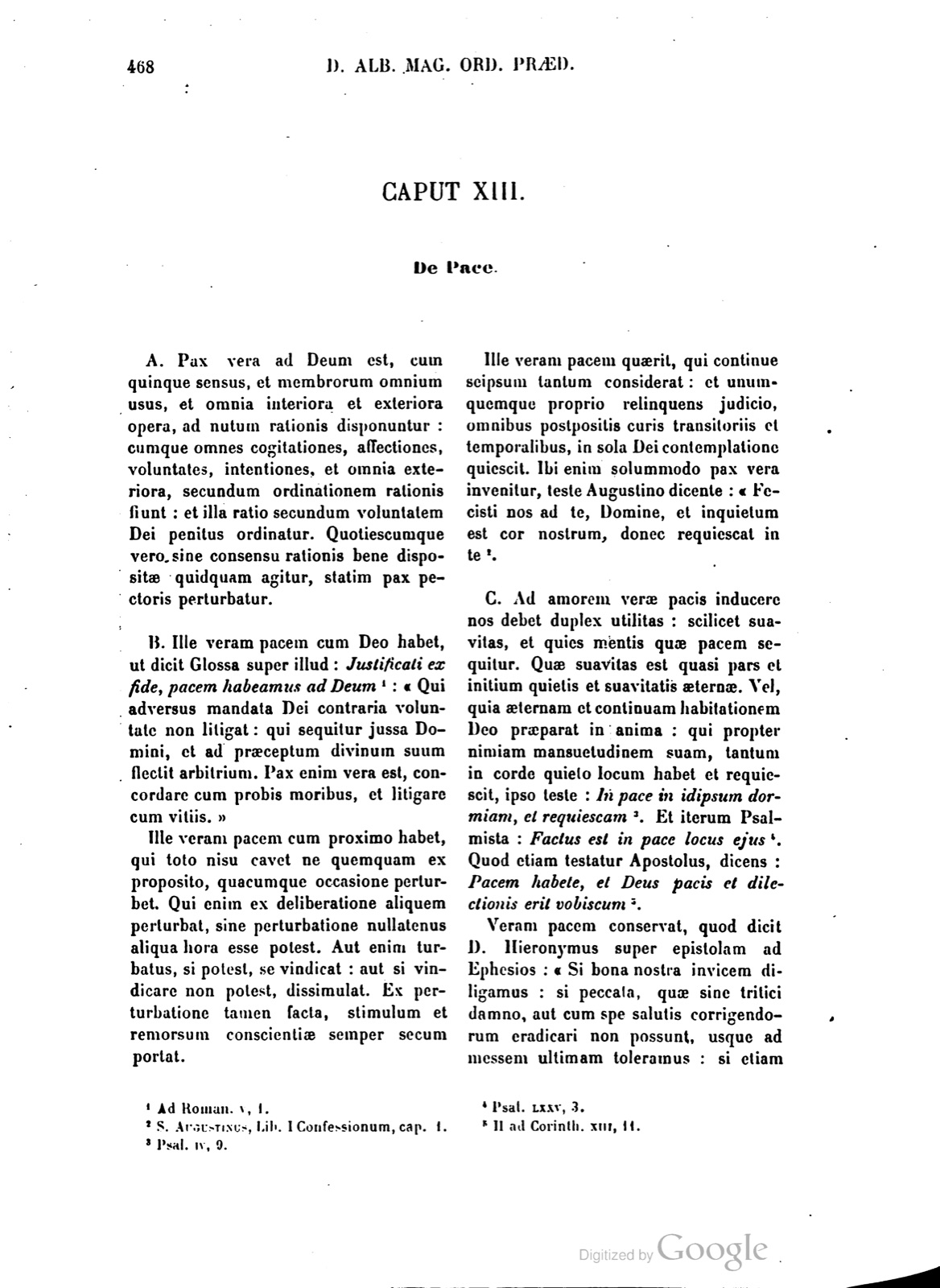
Veram pacem conservat, quod dicit D. Hieronymus super epistolam ad Ephesios: « Si bona nostra invicem diligamus: si peccata, quae sine tritici damno, aut cum spe salutis corrigendorum eradicari non possunt, usque ad messem ultimam toleramus: si etiam perfectionis opera, quae fieri et non fieri licet, ne infirmi scandalizentur, non facere disponamus. »
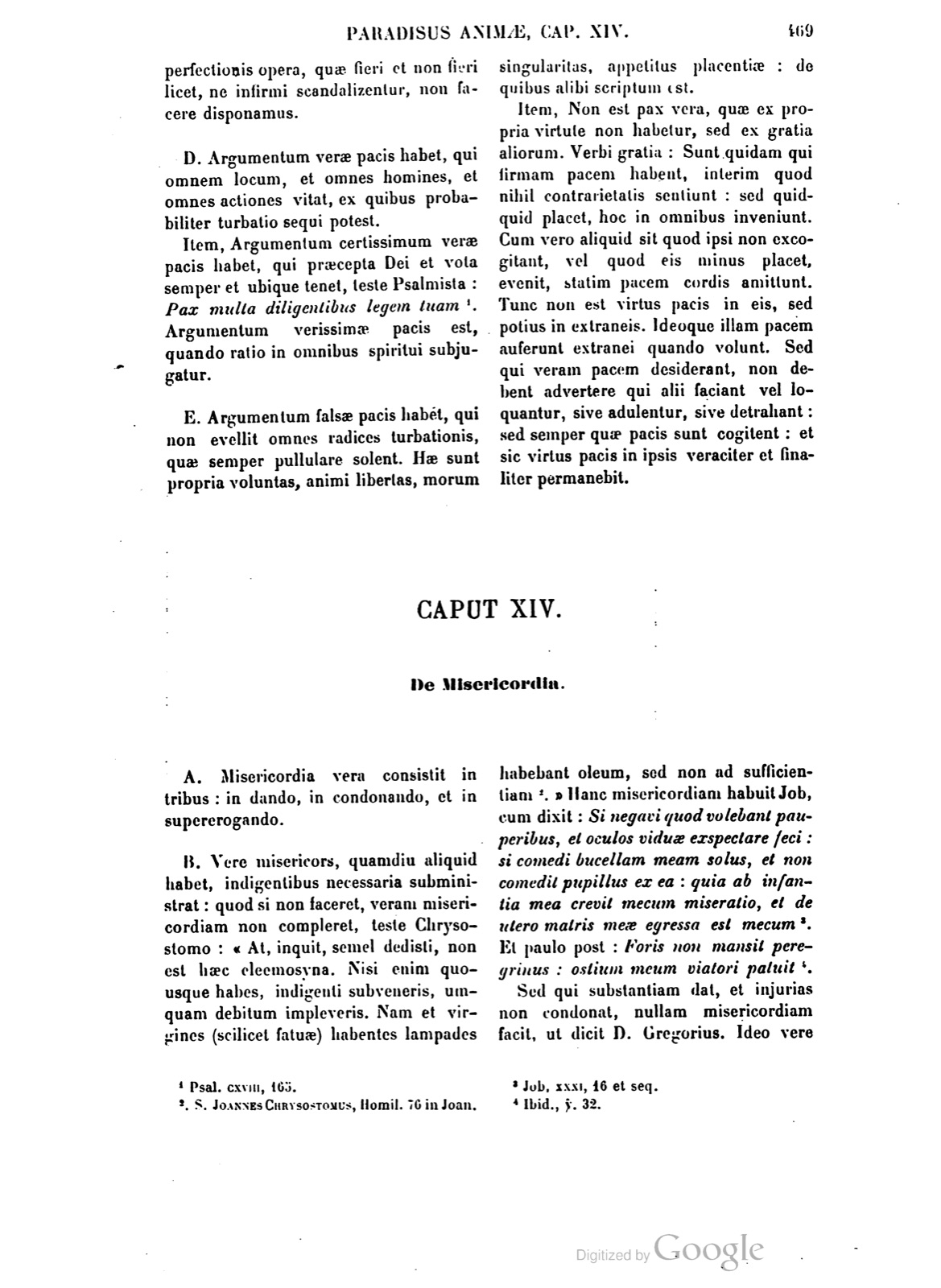
D. Argumentum verae pacis habet, qui omnem locum, et omnes homines, et omnes actiones vitat, ex quibus probabiliter turbatio sequi potest. Item, Argumentum certissimum verae pacis habet, qui praecepta Dei et vota semper et ubique tenet, teste Psalmista: Pax multa diligentibus legem tuam 6. Argumentum verissimae pacis est, quando ratio in omnibus spiritui subjugatur.
E. Argumentum falsae pacis habet, qui non evellit omnes radices turbationis, quae semper pullulare solent. Hae sunt propria voluntas, animi libertas, morum singularitas, appetitus placentiae: de quibus alibi scriptum est. Item, Non est pax vera, quae ex propria virtute non habetur, sed ex gratia aliorum. Verbi gratia: Sunt quidam qui firmam pacem habent, interim quod nihil contrarietatis sentiunt: sed quidquid placet, hoc in omnibus inveniunt. Cum vero aliquid sit quod ipsi non excogitant, vel quod eis minus placet, evenit, statim pacem cordis amittunt. Tunc non est virtus pacis in eis, sed potius in extraneis. Ideoque illam pacem auferunt extranei quando volunt. Sed qui veram pacem desiderant, non debent advertere qui alii faciant vel loquantur, sive adulentur, sive detrahant: sed semper quae pacis sunt cogitent: et sic virtus pacis in ipsis veraciter et finaliter permanebit.
What D. Jerome says on the Epistle to the Ephesians preserves true peace: "If we love our good things mutually; if we tolerate until the last harvest sins that cannot be rooted out without damage to the wheat or with hope of correcting those to be saved; if also, lest the weak be scandalized, we decide not to do works of perfection that it is lawful to do and not to do."
D. He has the proof of true peace who avoids every place, all persons, and all actions from which disturbance can probably follow. Likewise, he has the most certain proof of true peace who always and everywhere keeps the precepts of God and vows, as the Psalmist testifies: Much peace have those who love your law 6. The proof of the truest peace is when reason in all things is subjected to the spirit.
E. He has the proof of false peace who does not tear out all the roots of disturbance, which are always accustomed to sprout. These are one's own will, freedom of spirit, singularity of morals, and appetite for pleasantness, concerning which it has been written elsewhere. Likewise, peace is not true which is not had from one's own virtue but from the grace of others. For example, there are some who have firm peace so long as they feel nothing contrary, but they find in all things whatever pleases them. But when something occurs that they themselves do not think up, or that pleases them less, immediately they lose peace of heart. Then the virtue of peace is not in them, but rather in outsiders. And therefore outsiders take away that peace when they wish. But those who desire true peace ought not attend to what others do or say, whether they flatter or detract, but always think the things of peace; and thus the virtue of peace will remain truly and finally in them.
If a page does not appear, its photograph has not been uploaded yet.