Works › The Paradise of the Soul
Volume 37 · ≈ pp. 466–468
Chapter XII. On Compassion.
A marker with ≈ is an approximate page boundary, placed by measure of the text; the page photographs remain the authority. In the paired views, clicking a page marker brings that page into view.
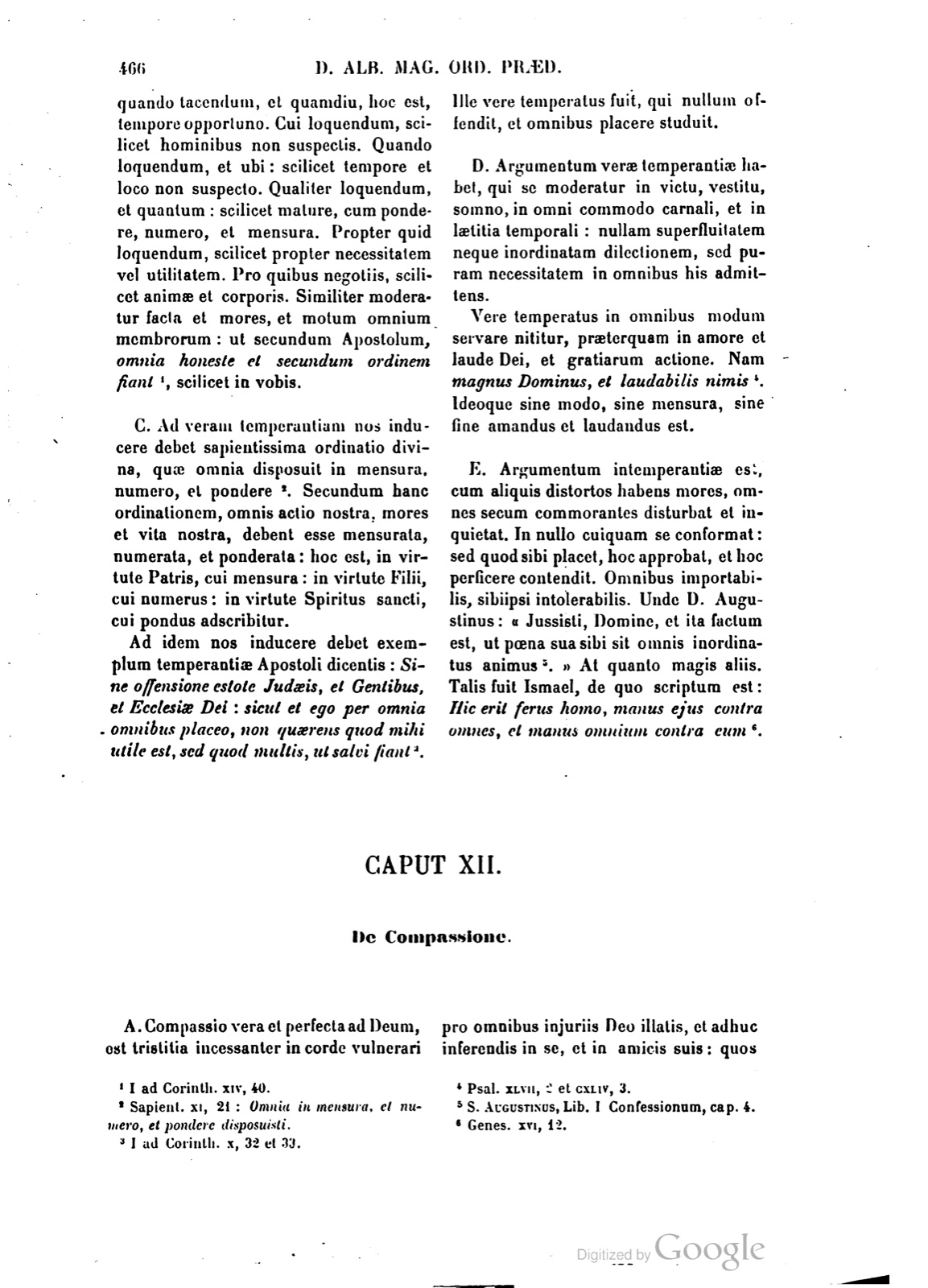
Caput XII.
De Compassione.
A. Compassio vera et perfecta ad Deum, est tristitia incessanter in corde vulnerari pro omnibus injuriis Deo illatis, et adhuc inferendis in se, et in amicis suis: quos qui tangit, quasi qui tangit pupillam oculi sui 1. Omnia enim elementa compassu fuerunt Christo in cruce morienti 2.
B. Ad proximum vera compassio, est condolere medullitus afflictionibus proximorum, tam spiritualibus quam corporalibus. Exemplo Apostoli dicentis: Quis infirmatur, et ego non infirmor 3? Ubi dicit Glossa: Quis infirmatur vel in fide, vel in aliqua virtute: et ego non infirmor? id est, non condoleo de eo, sicut de me ipso? Quis scandalizatur de aliqua molestia: et ego non uror igne compassionis?
Ad proximos autem qui sunt in purgatorio, vera compassio est vehementer affligi pro acerbitate poenarum quas sustinent. Et praecipue quod a visione et fruitione Dei interim separantur: et Deus interim plenarie ab ipsis non laudatur. Et in illa afflictione et compassione, incessanter et ardenter Deo supplicare, ut eos a tanta acerbitate et asperitate dignetur eripere.
Chapter XII.
On Compassion.
A. True and perfect compassion toward God is sadness being unceasingly wounded in the heart for all injuries inflicted on God, and still to be inflicted on him in himself and in his friends; whoever touches them is as one who touches the pupil of his eye 1. For all the elements suffered with Christ as he was dying on the cross 2.
B. True compassion toward neighbor is to suffer from the marrow with the afflictions of neighbors, both spiritual and bodily, after the example of the Apostle saying: Who is weak, and I am not weak 3? Here the Gloss says: Who is weak either in faith or in some virtue, and I am not weak? that is, do I not suffer with him as with myself? Who is scandalized by some trouble, and I am not burned with the fire of compassion?
Toward neighbors who are in purgatory, true compassion is to be vehemently afflicted for the bitterness of the punishments that they sustain, and especially because meanwhile they are separated from the vision and enjoyment of God, and meanwhile God is not fully praised by them. And in that affliction and compassion one must unceasingly and ardently supplicate God, that he may deign to snatch them away from such bitterness and roughness.
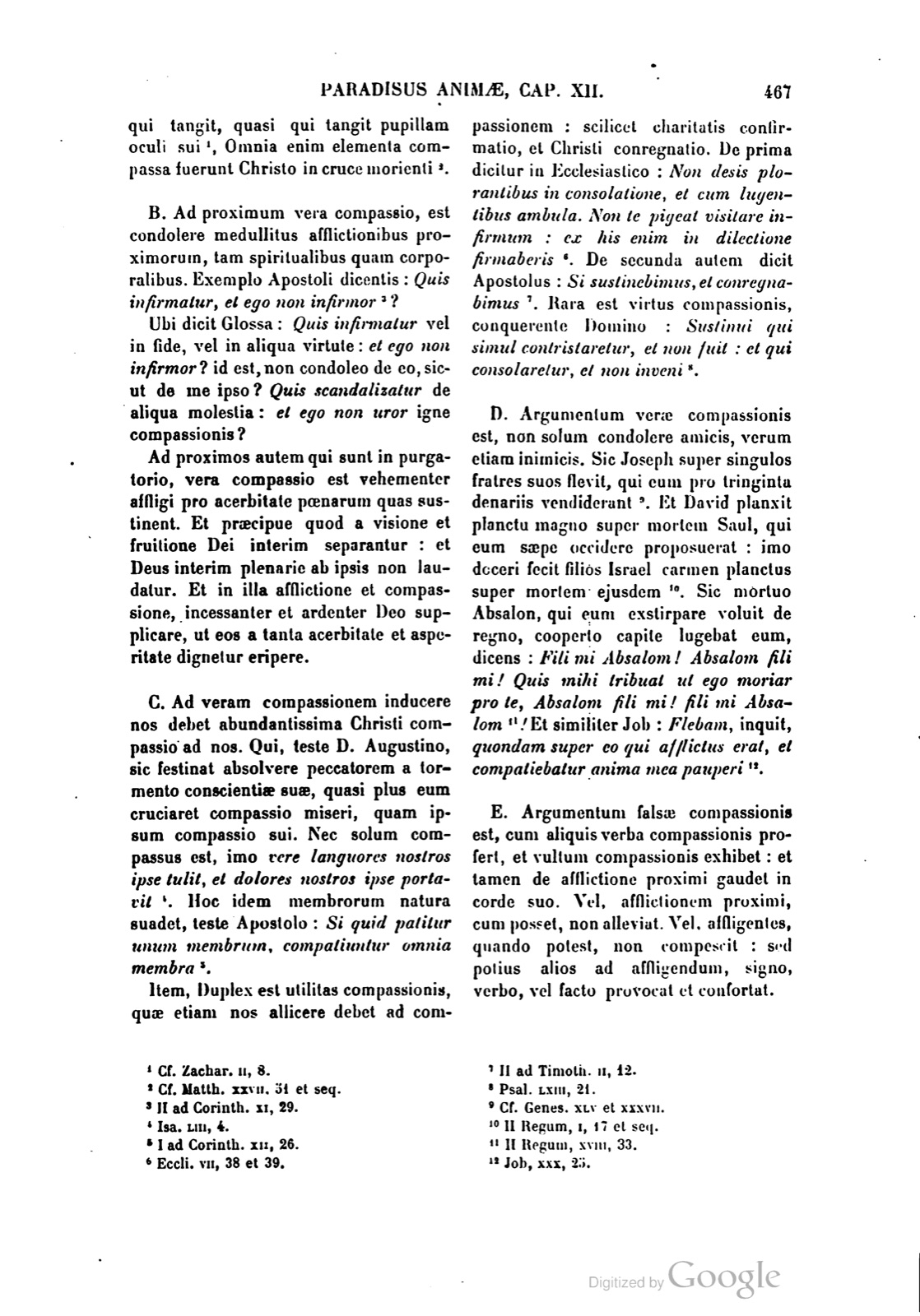
C. Ad veram compassionem inducere nos debet abundantissima Christi compassio ad nos. Qui, teste D. Augustino, sic festinat absolvere peccatorem a tormento conscientiae suae, quasi plus eum cruciaret compassio miseri, quam ipsum compassio sui. Nec solum compassus est, imo vere languores nostros ipse tulit, et dolores nostros ipse portavit 4. Hoc idem membrorum natura suadet, teste Apostolo: Si quid patitur unum membrum, compatiuntur omnia membra 5.
Item, Duplex est utilitas compassionis, quae etiam nos allicere debet ad compassionem: scilicet charitatis confirmatio, et Christi conregnatio. De prima dicitur in Ecclesiastico: Non desis plorantibus in consolatione, et cum lugentibus ambula. Non te pigeat visitare infirmum: ex his enim in dilectione firmaberis 6. De secunda autem dicit Apostolus: Si sustinebimus, et conregnabimus 7. Rara est virtus compassionis, conquerente Domino: Sustinui qui simul contristaretur, et non fuit: et qui consolaretur, et non inveni 8.
C. The most abundant compassion of Christ toward us ought to induce us to true compassion. As D. Augustine testifies, he hastens so to absolve a sinner from the torment of his conscience as though compassion for the miserable person tortured him more than compassion for himself tortured the miserable person. Nor did he only suffer with us; indeed he himself truly took our weaknesses and he himself bore our sorrows 4. The same nature of members counsels this, as the Apostle testifies: If one member suffers anything, all the members suffer with it 5.
Likewise, the usefulness of compassion is twofold, and ought also to entice us to compassion: namely confirmation of charity and reigning together with Christ. Of the first it is said in Ecclesiasticus: Do not fail those weeping in consolation, and walk with those mourning. Let it not weary you to visit the sick; for by these things you will be strengthened in love 6. Of the second the Apostle says: If we endure, we shall also reign together 7. The virtue of compassion is rare, the Lord complaining: I awaited one who would be saddened together with me, and there was none; and one who would console, and I did not find 8.
D. Argumentum verae compassionis est, non solum condolere amicis, verum etiam inimicis. Sic Joseph super singulos fratres suos flevit, qui eum pro triginta denariis vendiderant 9. Et David planxit planctu magno super mortem Saul, qui eum saepe occidere proposuerat: imo doceri fecit filios Israel carmen planctus super mortem ejusdem 10. Sic mortuo Absalon, qui eum exstirpare voluit de regno, cooperto capite lugebat eum, dicens: Fili mi Absalom! Absalom fili mi! Quis mihi tribuat ut ego moriar pro te, Absalom fili mi! fili mi Absalom 11! Et similiter Job: Flebam, inquit, quondam super eo qui afflictus erat, et compatiebatur anima mea pauperi 12.
E. Argumentum falsae compassionis est, cum aliquis verba compassionis profert, et vultum compassionis exhibet: et tamen de afflictione proximi gaudet in corde suo. Vel, afflictionem proximi, cum posset, non alleviat. Vel, affligentes, quando potest, non compescit: sed potius alios ad affligendum, signo, verbo, vel facto provocat et confortat.
D. The proof of true compassion is not only to suffer with friends, but also with enemies. Thus Joseph wept over each of his brothers, who had sold him for thirty denarii 9. And David lamented with great lamentation over the death of Saul, who had often proposed to kill him; indeed he had the children of Israel taught a song of lament over his death 10. So when Absalom died, who had wished to uproot him from the kingdom, he mourned him with covered head, saying: My son Absalom! Absalom my son! Who would grant me that I might die for you, Absalom my son! my son Absalom 11! And similarly Job says: I once wept over him who was afflicted, and my soul suffered with the poor man 12.
E. The proof of false compassion is when someone utters words of compassion and shows a face of compassion, and nevertheless rejoices in his heart over the affliction of his neighbor. Or when he does not alleviate the affliction of his neighbor when he could. Or when he does not restrain those afflicting, when he can, but rather provokes and strengthens others to afflict by sign, word, or deed.
Notes
- Compare Zechariah 2:8. (Cf. Zachar. II, 8.) ↩
- Compare Matthew 27:51 and following. (Cf. Matth. XXVII, 51 et seq.) ↩
- 2 Corinthians 11:29. (II ad Corinth. XI, 29.) ↩
- Isaiah 53:4. (Isa. LIII, 4.) ↩
- 1 Corinthians 12:26. (I ad Corinth. XII, 26.) ↩
- Ecclesiasticus 7:38 and 39. (Eccli. VII, 38 et 39.) ↩
- 2 Timothy 2:12. (II ad Timoth. II, 12.) ↩
- Psalm 68:21. (Psal. LXVIII, 21.) ↩
- Compare Genesis 45 and 37. (Cf. Genes. XLV et XXXVII.) ↩
- 2 Samuel 1:17 and following. (II Regum, I, 17 et seq.) ↩
- 2 Samuel 18:33. (II Regum, XVIII, 33.) ↩
- Job 30:25. (Job, XXX, 25.) ↩
If a page does not appear, its photograph has not been uploaded yet.