Works › The Paradise of the Soul
Volume 37 · ≈ pp. 465–466
Chapter XI. On Temperance.
A marker with ≈ is an approximate page boundary, placed by measure of the text; the page photographs remain the authority. In the paired views, clicking a page marker brings that page into view.
Caput XI.
De Temperantia.
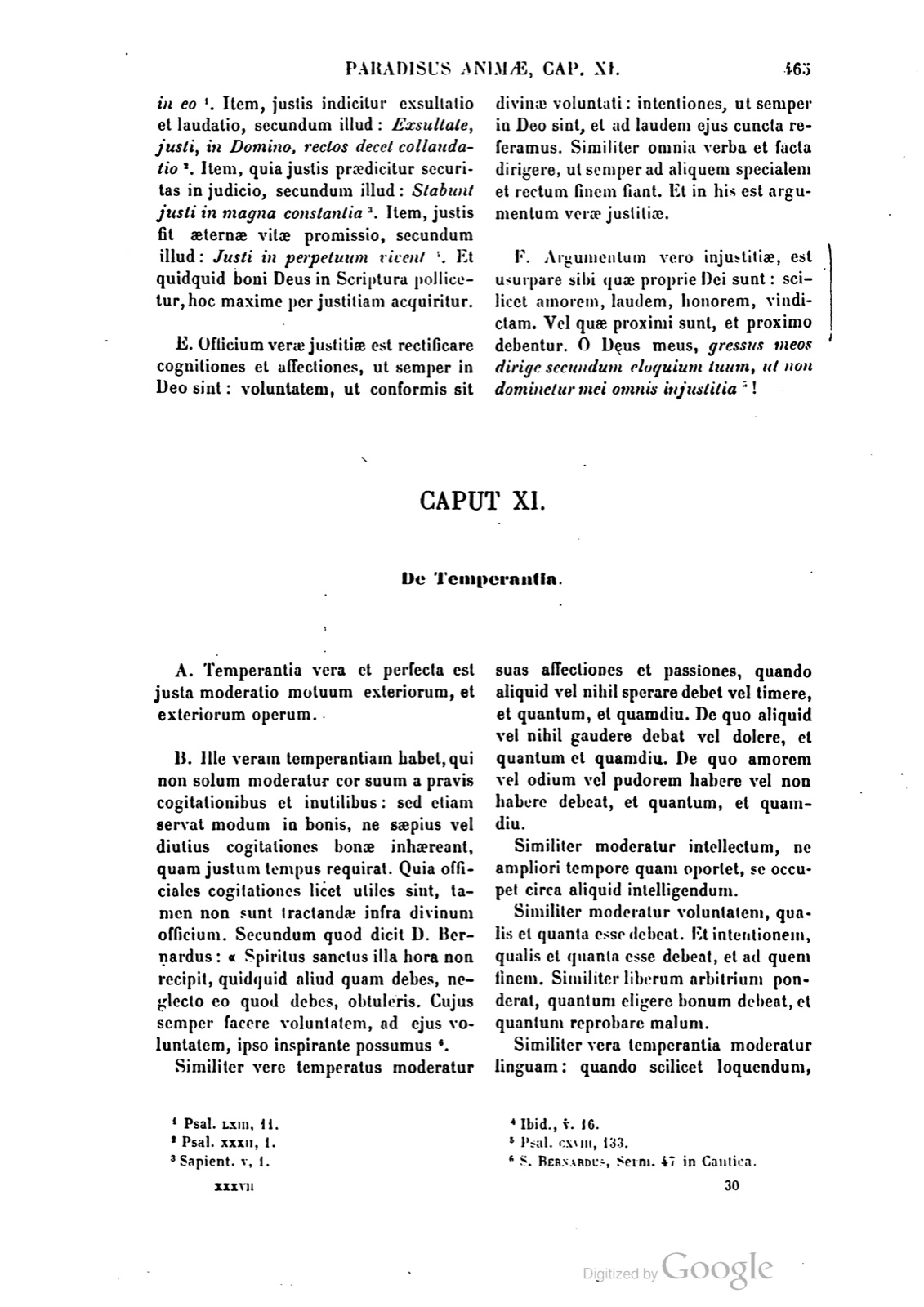
A. Temperantia vera et perfecta est justa moderatio motuum exteriorum, et exteriorum operum.
B. Ille veram temperantiam habet, qui non solum moderatur cor suum a pravis cogitationibus et inutilibus: sed etiam servat modum in bonis, ne saepius vel diutius cogitationes bonae inhaereant, quam justum tempus requirat. Quia officiales cogitationes licet utiles sint, tamen non sunt tractandae infra divinum officium. Secundum quod dicit D. Bernardus: « Spiritus sanctus illa hora non recipit, quidquid aliud quam debes, neglecto eo quod debes, obtuleris. Cujus semper facere voluntatem, ad ejus voluntatem, ipso inspirante possumus 1. » Similiter vere temperatus moderatur suas affectiones et passiones, quando aliquid vel nihil sperare debet vel timere, et quantum, et quamdiu. De quo aliquid vel nihil gaudere debeat vel dolere, et quantum et quamdiu. De quo amorem vel odium vel pudorem habere vel non habere debeat, et quantum, et quamdiu.
Similiter moderatur intellectum, ne ampliori tempore quam oportet, se occupet circa aliquid intelligendum. Similiter moderatur voluntatem, qualis et quanta esse debeat. Et intentionem, qualis et quanta esse debeat, et ad quem finem. Similiter liberum arbitrium ponderat, quantum eligere bonum debeat, et quantum reprobare malum. Similiter vera temperantia moderatur linguam: quando scilicet loquendum, quando tacendum, et quamdiu, hoc est, tempore opportuno. Cui loquendum, scilicet hominibus non suspectis. Quando loquendum, et ubi: scilicet tempore et loco non suspecto. Qualiter loquendum, et quantum: scilicet mature, cum pondere, numero, et mensura. Propter quid loquendum, scilicet propter necessitatem vel utilitatem. Pro quibus negotiis, scilicet animae et corporis. Similiter moderatur facta et mores, et motum omnium membrorum: ut secundum Apostolum, omnia honeste et secundum ordinem fiant 2, scilicet in vobis.
Chapter XI.
On Temperance.
A. True and perfect temperance is the just moderation of exterior movements and exterior works.
B. He has true temperance who not only moderates his heart from depraved and useless thoughts, but also keeps measure in good ones, lest good thoughts cling more often or longer than just time requires. For official thoughts, although useful, are nevertheless not to be treated during the divine office. According to what D. Bernard says: "At that hour the Holy Spirit does not receive whatever else than what you owe you have offered, neglecting what you owe. By his inspiration we can always do his will according to his will 1." Similarly, the truly temperate person moderates his affections and passions: when he ought to hope or fear something or nothing, and how much and how long; concerning what he ought to rejoice or grieve something or nothing, and how much and how long; concerning what he ought or ought not to have love, hatred, or shame, and how much and how long.
Similarly he moderates the intellect, lest it occupy itself about understanding something for a longer time than is fitting. Similarly he moderates the will, what kind and how great it ought to be; and intention, what kind and how great it ought to be and toward what end. Similarly he weighs free choice, how much it ought to choose good and how much to reject evil. Likewise true temperance moderates the tongue: namely when one must speak, when be silent, and how long, that is, at an opportune time; to whom one must speak, namely to persons not suspect; when to speak and where, namely at a time and place not suspect; how and how much one must speak, namely maturely, with weight, number, and measure; why one must speak, namely because of necessity or usefulness; for what business, namely of soul and body. Similarly it moderates deeds and morals and the motion of all members, so that, according to the Apostle, all things may be done honorably and according to order 2, namely among you.
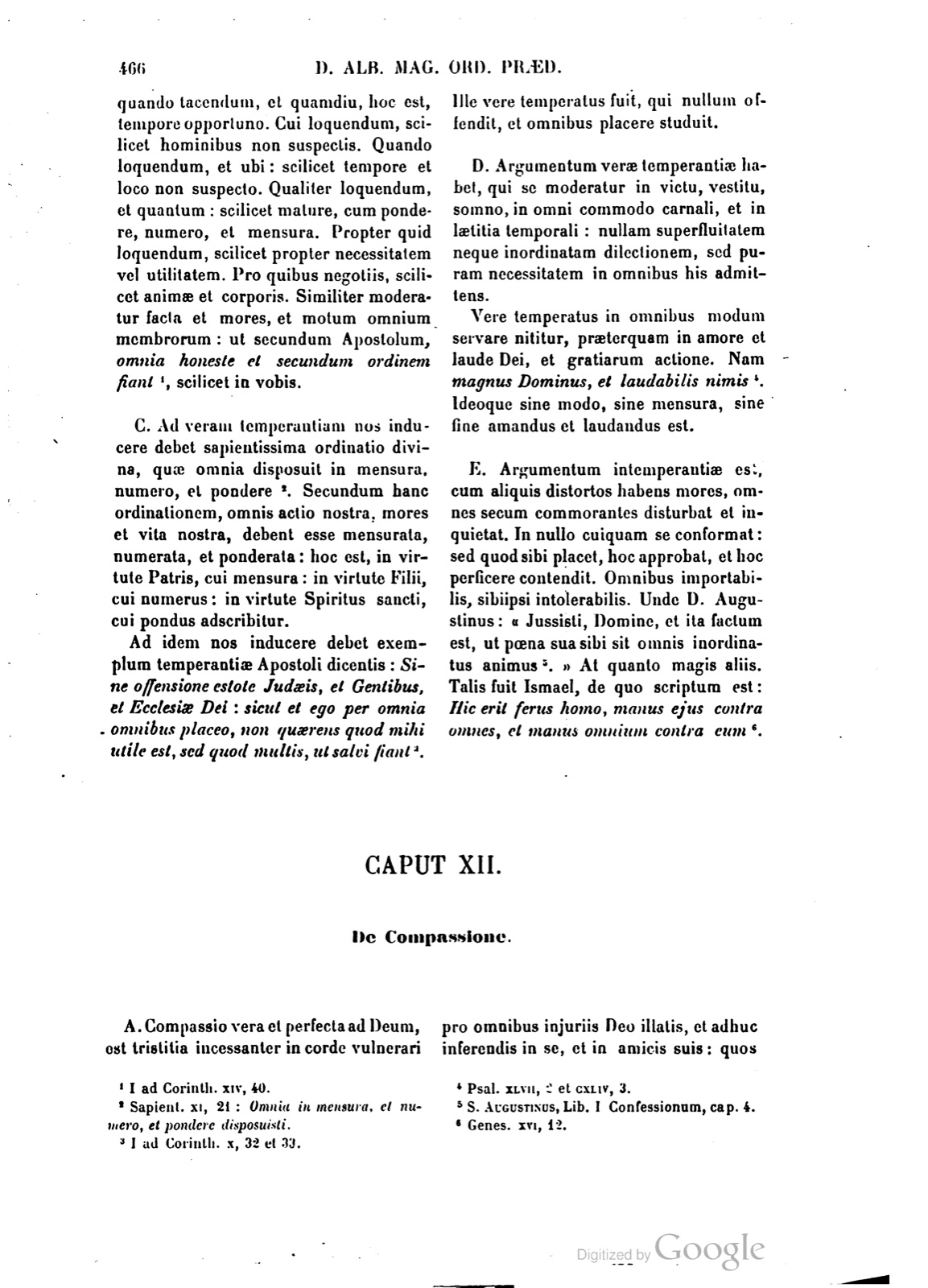
C. Ad veram temperantiam nos inducere debet sapientissima ordinatio divina, quae omnia disposuit in mensura, numero, et pondere 3. Secundum hanc ordinationem, omnis actio nostra, mores et vita nostra, debent esse mensurata, numerata, et ponderata: hoc est, in virtute Patris, cui mensura: in virtute Filii, cui numerus: in virtute Spiritus sancti, cui pondus adscribitur.
Ad idem nos inducere debet exemplum temperantiae Apostoli dicentis: Sine offensione estote Judaeis, et Gentibus, et Ecclesiae Dei: sicut et ego per omnia omnibus placeo, non quaerens quod mihi utile est, sed quod multis, ut salvi fiant 4. Ille vere temperatus fuit, qui nullum offendit, et omnibus placere studuit.
D. Argumentum verae temperantiae habet, qui se moderatur in victu, vestitu, somno, in omni commodo carnali, et in laetitia temporali: nullam superfluitatem neque inordinatam dilectionem, sed puram necessitatem in omnibus his admittens. Vere temperatus in omnibus modum servare nititur, praeterquam in amore et laude Dei, et gratiarum actione. Nam magnus Dominus, et laudabilis nimis 5. Ideoque sine modo, sine mensura, sine fine amandus et laudandus est.
E. Argumentum intemperantiae est, cum aliquis distortos habens mores, omnes secum commorantes disturbat et inquietat. In nullo cuiquam se conformat: sed quod sibi placet, hoc approbat, et hoc perficere contendit. Omnibus importabilis, sibiipsi intolerabilis. Unde D. Augustinus: « Jussisti, Domine, et ita factum est, ut poena sua sibi sit omnis inordinatus animus 6. » At quanto magis aliis. Talis fuit Ismael, de quo scriptum est: Hic erit ferus homo, manus ejus contra omnes, et manus omnium contra eum 7.
C. The most wise divine ordering, which disposed all things in measure, number, and weight 3, ought to induce us to true temperance. According to this ordering, every action of ours, our morals and our life, ought to be measured, numbered, and weighed: that is, in the virtue of the Father, to whom measure is ascribed; in the virtue of the Son, to whom number is ascribed; in the virtue of the Holy Spirit, to whom weight is ascribed.
The example of the Apostle's temperance ought to induce us to the same, when he says: Be without offense to Jews, Gentiles, and the Church of God, just as I also please all in all things, not seeking what is useful to me, but what is useful to many, that they may be saved 4. He was truly temperate who offended no one and strove to please all.
D. He has the proof of true temperance who moderates himself in food, clothing, sleep, every carnal convenience, and temporal joy, admitting no superfluity nor disordered love, but pure necessity in all these. The truly temperate person strives to keep measure in all things except in love and praise of God and thanksgiving. For great is the Lord and exceedingly praiseworthy 5. Therefore he is to be loved and praised without mode, without measure, without end.
E. The proof of intemperance is when someone, having distorted morals, disturbs and disquiets all who live with him. He conforms himself to no one in anything, but what pleases himself he approves, and this he strives to accomplish. He is unbearable to all, intolerable to himself. Hence D. Augustine says: "You commanded, Lord, and so it was done, that every disordered soul should be its own punishment 6." And how much more to others. Ishmael was such, of whom it is written: He will be a wild man, his hand against all, and the hands of all against him 7.
Notes
- St. Bernard, Sermon 47 on the Song of Songs. (S. Bernardus, Serm. 47 in Cantica.) ↩
- 1 Corinthians 14:40. (I ad Corinth. XIV, 40.) ↩
- Wisdom 11:21: You have disposed all things in measure, and number, and weight. (Sapient. XI, 21: Omnia in mensura, et numero, et pondere disposuisti.) ↩
- 1 Corinthians 10:32 and 33. (I ad Corinth. X, 32 et 33.) ↩
- Psalm 47, and 144:3. (Psal. XLVII, et CXLIV, 3.) ↩
- St. Augustine, Confessions, book 1, chapter 4. (S. Augustinus, Lib. I Confessionum, cap. 4.) ↩
- Genesis 16:12. (Genes. XVI, 12.) ↩
If a page does not appear, its photograph has not been uploaded yet.