Works › The Paradise of the Soul
Volume 37 · ≈ pp. 462–464
Chapter IX. On Fortitude.
A marker with ≈ is an approximate page boundary, placed by measure of the text; the page photographs remain the authority. In the paired views, clicking a page marker brings that page into view.
Caput IX.
De Fortitudine.
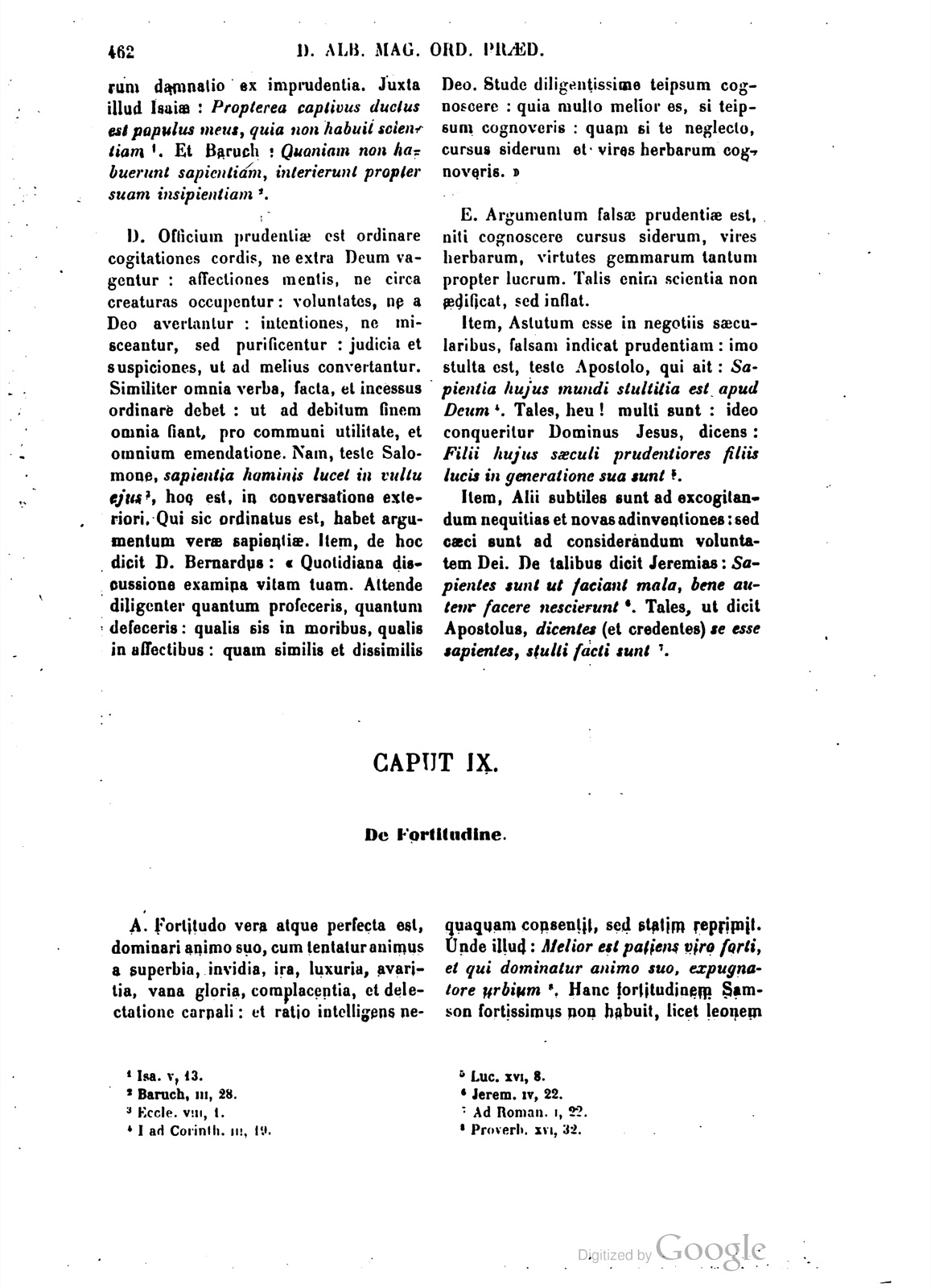
A. Fortitudo vera atque perfecta est, dominari animo suo, cum tentatur animus a superbia, invidia, ira, luxuria, avaritia, vana gloria, complacentia, et delectatione carnali: et ratio intelligens nequaquam consentit, sed statim reprimit. Unde illud: Melior est patiens viro forti, et qui dominatur animo suo, expugnatore urbium 1. Hanc fortitudinem Samson fortissimus non habuit, licet leonem dilaniaverit et cum mandibula asini, mille viros straverit. Quia post, propter concupiscentiam mulieris, omni fortitudine privatus est 2.
B. Ille veram fortitudinem habet, qui ab illicitis membra sua, sensusque suos reprimit. Illam David non habuit, qui ursum et leonem occidit, et Goliath interfecit: tamen oculos suos ab illicito visu non cohibuit 3. Eia, quantae sunt fortitudinis quidam ad jejunandum, vigilandum, castigandum corpora sua ciliciis et flagellis: nec tamen refraenare possunt pedes suos a vitiis noxiis: manus suas ab opere et tactu illicito: aures ab auditu nocivo: et praecipue linguam a verbis damnosis, beato Jacobo dicente: Omnis natura bestiarum, et volucrum, et serpentium, et caeterorum, domantur et domita sunt a natura humana: linguam autem nullus hominum domare potest: inquietum malum, plena veneno mortifero 4, scilicet est lingua. Tamen sine hac refraenatione non est vera religio, sicut idem dicit: Si quis autem putat se religiosum esse, non refraenans linguam suam, sed seducens cor suum, hujus vana est religio 5.
Chapter IX.
On Fortitude.
A. True and perfect fortitude is to rule one's own soul when the soul is tempted by pride, envy, anger, lust, avarice, vainglory, complacency, and carnal delight, and the understanding reason in no way consents, but immediately represses. Hence that saying: The patient man is better than the strong man, and he who rules his own soul than the conqueror of cities 1. Samson, though very strong, did not have this fortitude, although he tore apart the lion and struck down a thousand men with the jawbone of an ass, because afterwards, because of desire for a woman, he was deprived of all fortitude 2.
B. He has true fortitude who restrains his members and his senses from illicit things. David did not have that fortitude, though he killed the bear and the lion and slew Goliath; nevertheless he did not restrain his eyes from illicit sight 3. Ah, of how much strength some are for fasting, watching, chastising their bodies with hair-shirts and scourges, and nevertheless they cannot restrain their feet from harmful vices, their hands from illicit work and touch, their ears from harmful hearing, and especially their tongue from damaging words, as blessed James says: Every nature of beasts, birds, serpents, and the rest are tamed and have been tamed by human nature, but no human being can tame the tongue; it is a restless evil, full of deadly poison 4, namely the tongue. Yet without this restraint there is no true religion, as the same James says: If anyone thinks himself to be religious, not restraining his tongue but deceiving his heart, this man's religion is vain 5.
C. Inductivum verae fortitudinis, est degustatio spiritualis suavitatis. Haec enim roborat mentem ad faciendum bona, ad tolerandum adversa, et ad vincendum vitia, omniaque nociva. Hanc praefiguravit Jonathas, qui gustans parum mellis, illuminatus et confortatus est ad persequendum inimicos 6. Sic Moyses percipiens suavitatem mentis ex visione et collocutione divina, tantum confortatus est, ut per quadraginta dies corporali alimento non indigeret 7.
D. Officium fortitudinis, est firmare intellectum in cognitione Dei, et affectum in dilectione Dei et proximi: roborare mentem inter adversa, ne terreatur: et inter prospera, ne mulceatur. Item, mentem animare, ut semper exerceatur in bonis: confortare ipsam, ne umquam vincatur in malis. Primam fortitudinem Paulus habuit, et Stephanus. Secundam Mathathias et Eleazarus, Job et Daniel. Tertiam, Tobias. Qui hoc in se sentit, de argumento verae fortitudinis securus est.
C. The inducement of true fortitude is the tasting of spiritual sweetness. For this strengthens the mind for doing good things, tolerating adversities, and conquering vices and all harmful things. Jonathan prefigured this, for tasting a little honey, he was enlightened and strengthened to pursue enemies 6. So Moses, receiving sweetness of mind from divine vision and conversation, was so strengthened that for forty days he did not need bodily food 7.
D. The office of fortitude is to make firm the intellect in knowledge of God and the affection in love of God and neighbor; to strengthen the mind amid adversities, lest it be terrified, and amid prosperities, lest it be softened. Likewise, to animate the mind so that it may always be exercised in good things, and to strengthen it so that it may never be conquered in evils. Paul and Stephen had the first fortitude. Mattathias and Eleazar, Job and Daniel had the second. Tobias had the third. Whoever feels this in himself is secure concerning the proof of true fortitude.
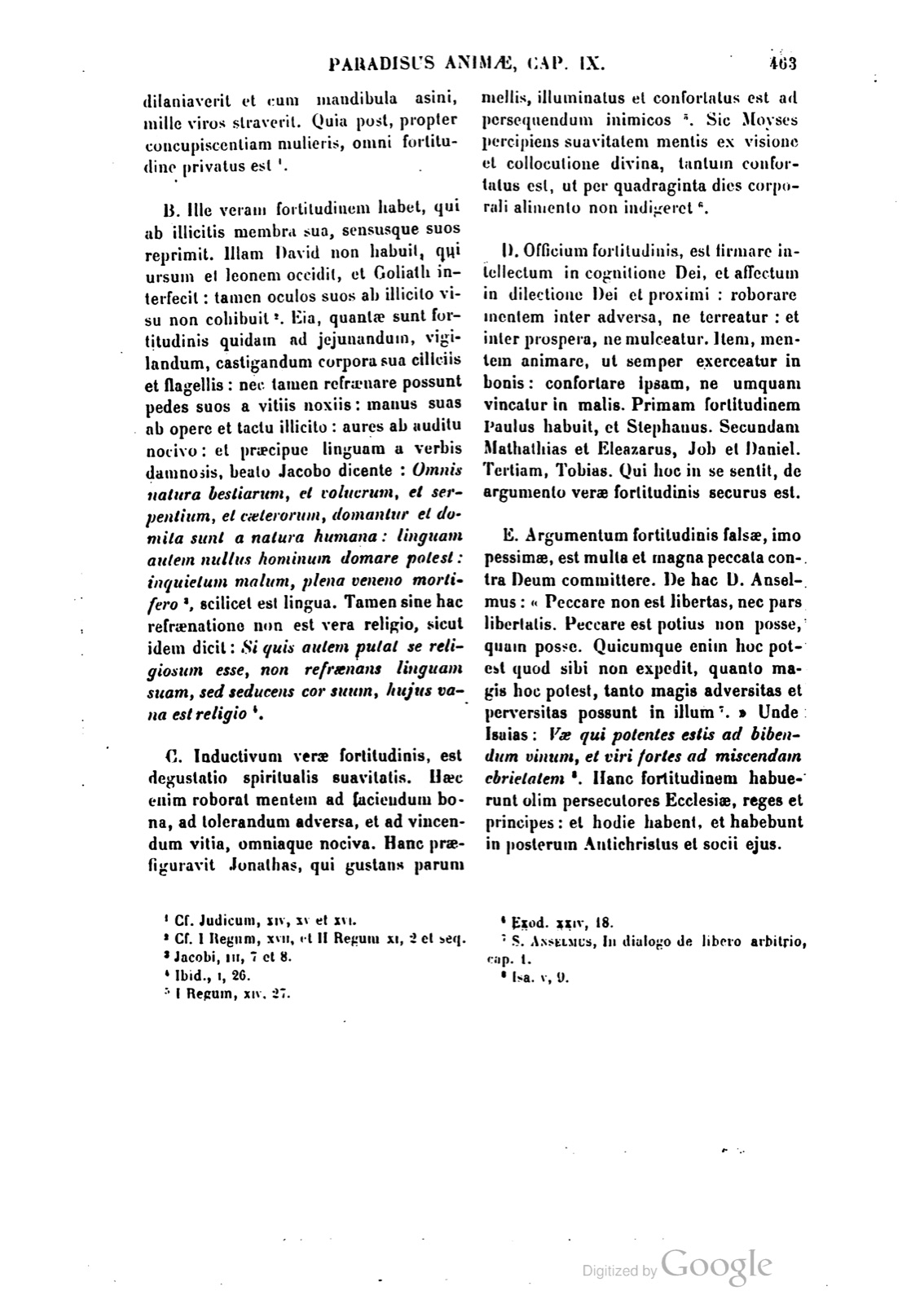
E. Argumentum fortitudinis falsae, imo pessimae, est multa et magna peccata contra Deum committere. De hac D. Anselmus: « Peccare non est libertas, nec pars libertatis. Peccare est potius non posse, quam posse. Quicumque enim hoc potest quod sibi non expedit, quanto magis hoc potest, tanto magis adversitas et perversitas possunt in illum. » Unde Isaias: Vae qui potentes estis ad bibendum vinum, et viri fortes ad miscendam ebrietatem 8. Hanc fortitudinem habuerunt olim persecutores Ecclesiae, reges et principes: et hodie habent, et habebunt in posterum Antichristus et socii ejus.
E. The proof of false, indeed worst, fortitude is to commit many and great sins against God. D. Anselm says concerning this: "To sin is not liberty, nor part of liberty. To sin is rather not to be able, than to be able. For whoever can do what is not expedient for himself, the more he can do this, the more adversity and perversity can act upon him." Hence Isaiah says: Woe to you who are powerful for drinking wine and strong men for mixing drunkenness 8. The persecutors of the Church, kings and princes, once had this fortitude; and today Antichrist and his companions have it and will have it in the future.
Notes
- Proverbs 16:32. (Proverb. XVI, 32.) ↩
- Compare Judges 14, 15, and 16. (Cf. Judicum, XIV, XV et XVI.) ↩
- Compare 1 Samuel 17, and 2 Samuel 11:2 and following. (Cf. I Regum, XVII, et II Regum XI, 2 et seq.) ↩
- James 3:7 and 8. (Jacobi, III, 7 et 8.) ↩
- The same, 1:26. (Ibid., I, 26.) ↩
- 1 Samuel 14:27. (I Regum, XIV, 27.) ↩
- Exodus 24:18. (Exod. XXIV, 18.) ↩
- Isaiah 5:9. (Isa. V, 9.) ↩
If a page does not appear, its photograph has not been uploaded yet.