Works › The Paradise of the Soul
Volume 37 · ≈ pp. 461–462
Chapter VIII. On Prudence.
A marker with ≈ is an approximate page boundary, placed by measure of the text; the page photographs remain the authority. In the paired views, clicking a page marker brings that page into view.
Caput VIII.
De Prudentia.
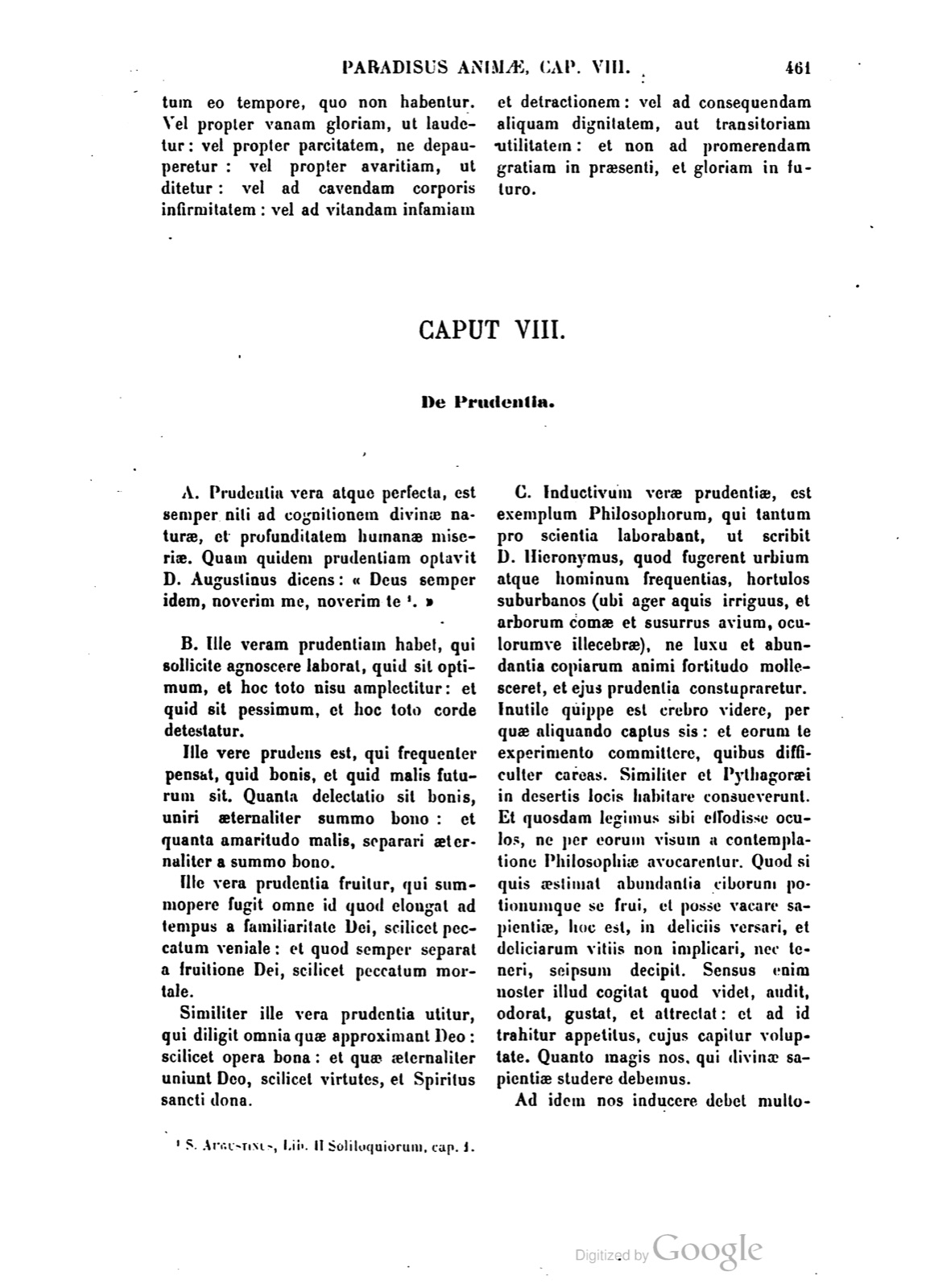
A. Prudentia vera atque perfecta, est semper niti ad cognitionem divinae naturae, et profunditatem humanae miseriae. Quam quidem prudentiam optavit D. Augustinus dicens: « Deus semper idem, noverim me, noverim te 1. »
B. Ille veram prudentiam habet, qui sollicite agnoscere laborat, quid sit optimum, et hoc toto nisu amplectitur: et quid sit pessimum, et hoc toto corde detestatur. Ille vere prudens est, qui frequenter pensat, quid bonis, et quid malis futurum sit. Quanta delectatio sit bonis, uniri aeternaliter summo bono: et quanta amaritudo malis, separari aeternaliter a summo bono. Ille vera prudentia fruitur, qui summopere fugit omne id quod elongat ad tempus a familiaritate Dei, scilicet peccatum veniale: et quod semper separat a fruitione Dei, scilicet peccatum mortale. Similiter ille vera prudentia utitur, qui diligit omnia quae approximant Deo: scilicet opera bona: et quae aeternaliter uniunt Deo, scilicet virtutes, et Spiritus sancti dona.
C. Inductivum verae prudentiae, est exemplum Philosophorum, qui tantum pro scientia laborabant, ut scribit D. Hieronymus, quod fugerent urbium atque hominum frequentias, hortulos suburbanos (ubi ager aquis irriguus, et arborum comae et susurrus avium, oculorumve illecebrae), ne luxu et abundantia copiarum animi fortitudo mollesceret, et ejus prudentia constupraretur. Inutile quippe est crebro videre, per quae aliquando captus sis: et eorum te experimento committere, quibus difficulter careas. Similiter et Pythagoraei in desertis locis habitare consueverunt. Et quosdam legimus sibi effodisse oculos, ne per eorum visum a contemplatione Philosophiae avocarentur. Quod si quis aestimat abundantia ciborum potionumque se frui, et posse vacare sapientiae, hoc est, in deliciis versari, et deliciarum vitiis non implicari, nec teneri, seipsum decipit. Sensus enim noster illud cogitat quod videt, audit, odorat, gustat, et attrectat: et ad id trahitur appetitus, cujus capitur voluptate. Quanto magis nos, qui divinae sapientiae studere debemus.
Chapter VIII.
On Prudence.
A. True and perfect prudence is always to strive toward knowledge of the divine nature and the depth of human misery. D. Augustine desired this prudence, saying: "O God, always the same, may I know myself, may I know you 1."
B. He has true prudence who solicitously labors to know what is best, and embraces this with his whole effort, and what is worst, and detests this with his whole heart. He is truly prudent who frequently weighs what is to come for the good and what for the evil; how great a delight it is for the good to be united eternally to the highest good, and how great a bitterness for the evil to be separated eternally from the highest good. He enjoys true prudence who flees above all every thing that separates for a time from familiarity with God, namely venial sin, and that which always separates from the enjoyment of God, namely mortal sin. Likewise he uses true prudence who loves all things that bring one near to God, namely good works, and the things that unite eternally to God, namely the virtues and gifts of the Holy Spirit.
C. The inducement of true prudence is the example of the philosophers, who labored so much for knowledge that, as D. Jerome writes, they fled the crowds of cities and people, and suburban little gardens, where the field is watered by streams, and the foliage of trees and whispering of birds, or enticements of the eyes, lest by luxury and abundance of resources the strength of the soul should be softened and its prudence defiled. For it is useless to see often those things by which you have at some time been captured, and to commit yourself to experience of those things which you can hardly do without. Similarly the Pythagoreans were accustomed to dwell in desert places. And we read that some dug out their own eyes, lest through the sight of them they be called away from contemplation of philosophy. But if someone thinks that he enjoys abundance of foods and drinks and can be free for wisdom, that is, to live amid delights and not be entangled or held by the vices of delights, he deceives himself. For our sense thinks on what it sees, hears, smells, tastes, and handles, and appetite is drawn to that by whose pleasure it is captured. How much more we, who ought to study divine wisdom.
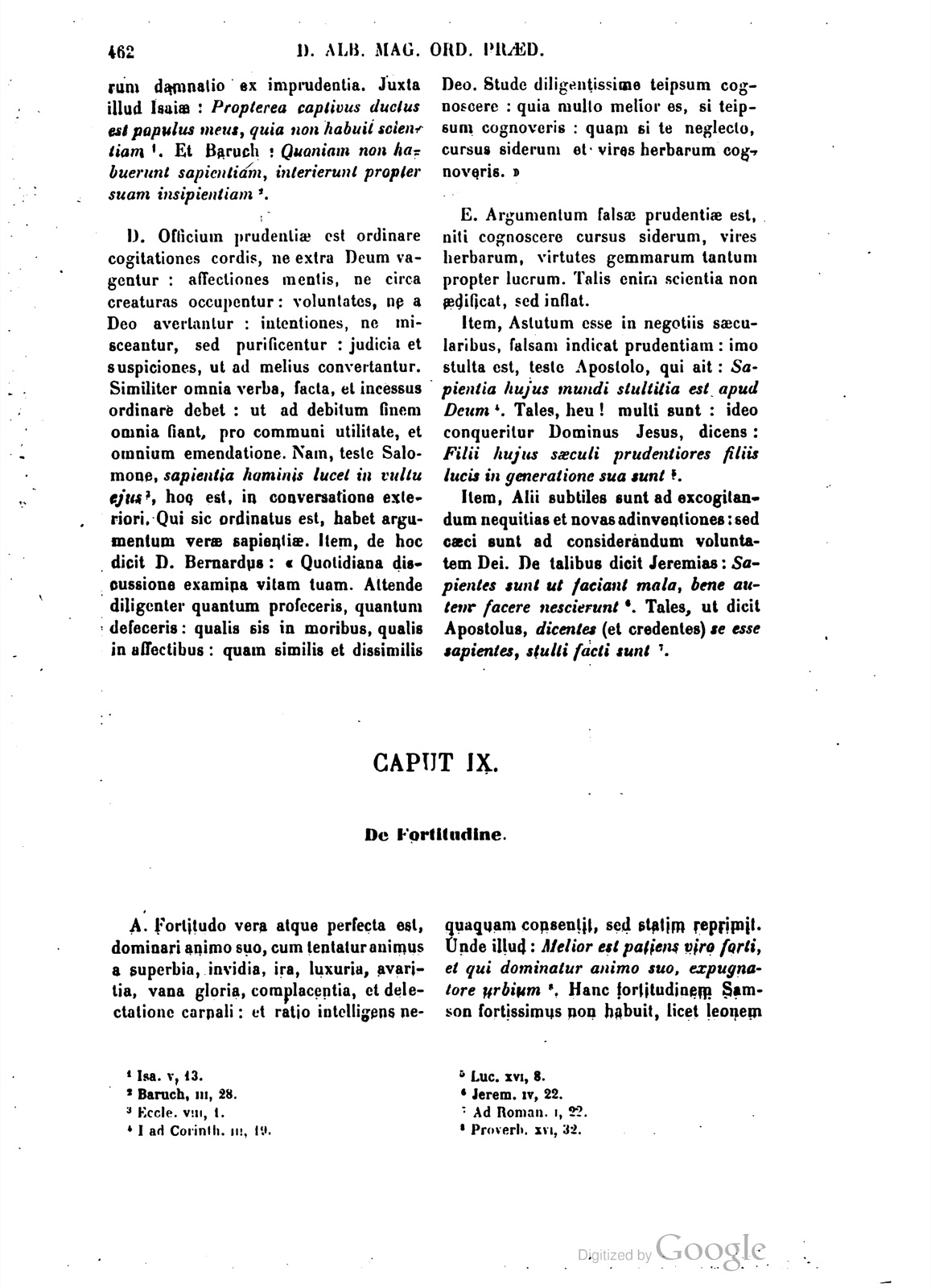
Ad idem nos inducere debet multorum damnatio ex imprudentia. Juxta illud Isaia: Propterea captivus ductus est populus meus, quia non habuit scientiam 2. Et Baruch: Quoniam non habuerunt sapientiam, interierunt propter suam insipientiam 3.
D. Officium prudentiae est ordinare cogitationes cordis, ne extra Deum vagentur: affectiones mentis, ne circa creaturas occupentur: voluntates, ne a Deo avertantur: intentiones, ne misceantur, sed purificentur: judicia et suspiciones, ut ad melius convertantur. Similiter omnia verba, facta, et incessus ordinare debet: ut ad debitum finem omnia fiant, pro communi utilitate, et omnium emendatione. Nam, teste Salomone, sapientia hominis lucet in vultu ejus 4, hoc est, in conversatione exteriori. Qui sic ordinatus est, habet argumentum verae sapientiae. Item, de hoc dicit D. Bernardus: « Quotidiana discussione examina vitam tuam. Attende diligenter quantum profeceris, quantum defeceris: qualis sis in moribus, qualis in affectibus: quam similis et dissimilis Deo. Stude diligentissime teipsum cognoscere: quia multo melior es, si teipsum cognoveris: quam si te neglecto, cursus siderum et vires herbarum cognoveris. »
E. Argumentum falsae prudentiae est, niti cognoscere cursus siderum, vires herbarum, virtutes gemmarum tantum propter lucrum. Talis enim scientia non aedificat, sed inflat. Item, Astutum esse in negotiis saecularibus, falsam indicat prudentiam: imo stulta est, teste Apostolo, qui ait: Sapientia hujus mundi stultitia est apud Deum 5. Tales, heu! multi sunt: ideo conqueritur Dominus Jesus, dicens: Filii hujus saeculi prudentiores filiis lucis in generatione sua sunt 6. Item, Alii subtiles sunt ad excogitandum nequitias et novas adinventiones: sed caeci sunt ad considerandum voluntatem Dei. De talibus dicit Jeremias: Sapientes sunt ut faciant mala, bene autem facere nescierunt 7. Tales, ut dicit Apostolus, dicentes et credentes se esse sapientes, stulti facti sunt 8.
The damnation of many through imprudence ought to induce us to the same. According to that of Isaiah: Therefore my people were led captive, because they did not have knowledge 2. And Baruch: Because they did not have wisdom, they perished through their own foolishness 3.
D. The office of prudence is to order the thoughts of the heart, lest they wander outside God; the affections of the mind, lest they be occupied about creatures; the wills, lest they be turned away from God; intentions, lest they be mixed, but purified; judgments and suspicions, so that they may be turned to the better. Likewise it ought to order all words, deeds, and gait, so that all things may be done for the due end, for common usefulness and the correction of all. For, as Solomon testifies, the wisdom of a human being shines in his face 4, that is, in exterior conduct. One so ordered has the proof of true wisdom. Likewise, D. Bernard says of this: "By daily discussion examine your life. Attend diligently how much you have advanced, how much you have fallen back; what kind you are in morals, what kind in affections; how like and unlike God. Study most diligently to know yourself, because you are much better if you have known yourself than if, neglecting yourself, you have known the courses of the stars and the powers of herbs."
E. The proof of false prudence is to strive to know the courses of the stars, the powers of herbs, and the virtues of gems only for profit. For such knowledge does not build up, but puffs up. Likewise, to be crafty in secular business indicates false prudence; indeed it is foolish, as the Apostle testifies, who says: The wisdom of this world is foolishness before God 5. Alas, many are such; therefore the Lord Jesus complains, saying: The children of this age are more prudent than the children of light in their generation 6. Likewise, others are subtle for thinking up wickednesses and new inventions, but blind for considering the will of God. Jeremiah says of such: They are wise to do evils, but they have not known how to do good 7. Such persons, as the Apostle says, saying and believing themselves to be wise, have become foolish 8.
Notes
- St. Augustine, Soliloquies, book 2, chapter 1. (S. Augustinus, Lib. II Soliloquiorum, cap. 1.) ↩
- Isaiah 5:13. (Isa. V, 13.) ↩
- Baruch 3:28. (Baruch, III, 28.) ↩
- Ecclesiastes 8:1. (Eccle. VIII, 1.) ↩
- 1 Corinthians 3:19. (I ad Corinth. III, 19.) ↩
- Luke 16:8. (Luc. XVI, 8.) ↩
- Jeremiah 4:22. (Jerem. IV, 22.) ↩
- Romans 1:22. (Ad Roman. I, 22.) ↩
If a page does not appear, its photograph has not been uploaded yet.