Works › The Paradise of the Soul
Volume 37 · ≈ pp. 454–456
Chapter IV. On Patience.
A marker with ≈ is an approximate page boundary, placed by measure of the text; the page photographs remain the authority. In the paired views, clicking a page marker brings that page into view.
Caput IV.
De Patientia.
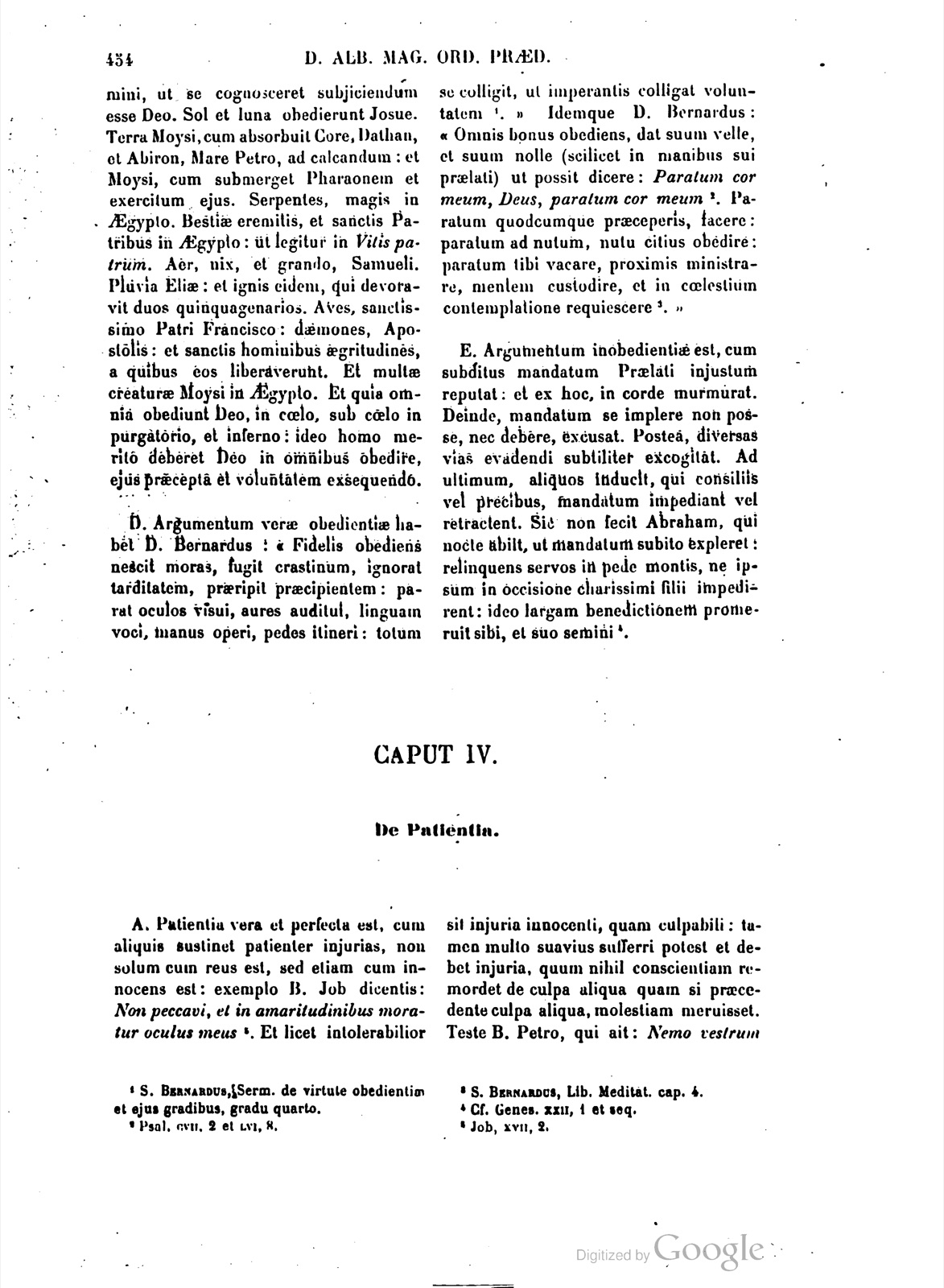
A. Patientia vera et perfecta est, cum aliquis sustinet patienter injurias, non solum cum reus est, sed etiam cum innocens est: exemplo B. Job dicentis: Non peccavi, et in amaritudinibus moratur oculus meus 1. Et licet intolerabilior sit injuria innocenti, quam culpabili: tamen multo suavius sufferri potest et debet injuria, quum nihil conscientiam remordet de culpa aliqua quam si praecedente culpa aliqua, molestiam meruisset. Teste B. Petro, qui ait: Nemo vestrum patiatur ut homicida, aut fur, aut maledicus, aut alienorum appetitor. Si autem ut christianus, non erubescat, glorificet autem Deum in isto nomine 2. Et supra: Melius est enim benefacientes (si voluntas Dei velit) pati, quam malefacientes 3. Iterum, supra: Quae enim est gloria, si peccantes et colaphizati suffertis? Sed si benefacientes patienter sustinetis, haec est gratia apud Deum 4.
B. Laudabilis est illa patientia, quae non tantum a malis, sed etiam ab eis qui videntur esse boni et amici: nec tantum pro malis operibus, verum etiam pro benefactis, sibi illatas patienter suffert injurias. Tunc anima amica Dei est inter filias, sicut lilium inter spinas 5. Lilium enim quamvis pungatur a spinis, candorem tamen retinet: fortiorem emittens odorem, quam si non pungeretur. Sic anima sponsa Dei, si ab eis qui videntur esse de numero filiorum Dei et consortio, pungatur: non tamen ad impatientiam provocatur, sed candorem bonae conscientiae, et bonae famae odorem diligentissime servare conatur.
Chapter IV.
On Patience.
A. True and perfect patience exists when someone patiently sustains injuries, not only when he is guilty, but also when he is innocent, after the example of blessed Job saying: I have not sinned, and my eye remains in bitternesses 1. And although injury is more intolerable to the innocent than to the guilty, nevertheless injury can and ought to be borne much more sweetly when nothing bites the conscience concerning any fault than if, some fault preceding, he had merited the trouble. Blessed Peter testifies, saying: Let none of you suffer as a homicide, or thief, or slanderer, or one coveting the things of others. But if as a Christian, let him not be ashamed, but let him glorify God in this name 2. And above: For it is better, doing good, if the will of God should will it, to suffer than doing evil 3. Again above: For what glory is it if, sinning and being buffeted, you endure? But if, doing good, you endure patiently, this is grace before God 4.
B. That patience is praiseworthy which patiently bears injuries brought upon it not only by evil persons, but also by those who seem to be good and friends; and not only for evil works, but truly also for benefits. Then the soul that is a friend of God is among daughters like a lily among thorns 5. For although a lily is pierced by thorns, nevertheless it retains its whiteness, emitting a stronger scent than if it were not pierced. So the soul, bride of God, if it is pierced by those who seem to be of the number and fellowship of God's children, is nevertheless not provoked to impatience, but tries most diligently to preserve the whiteness of a good conscience and the scent of a good reputation.
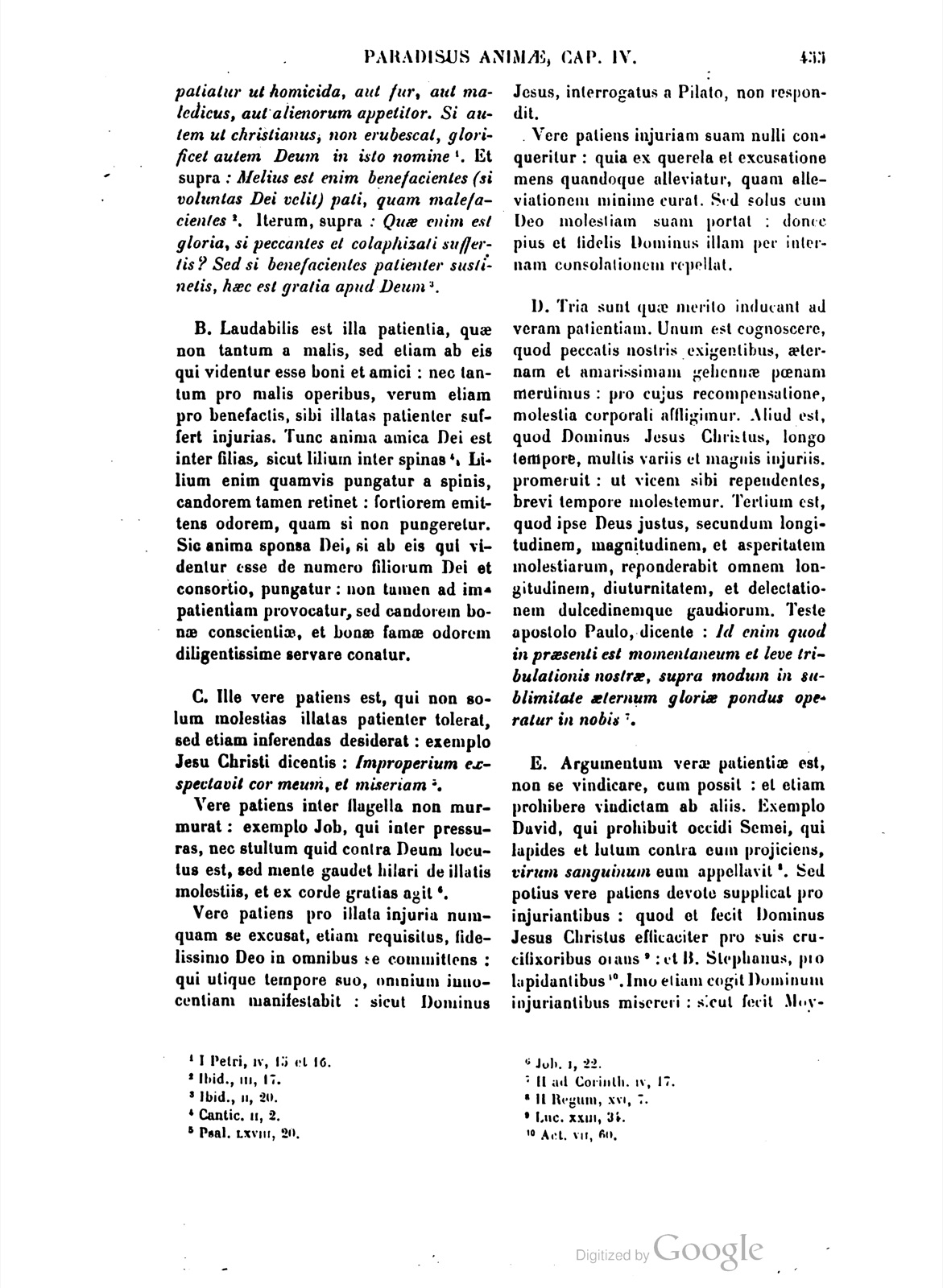
C. Ille vere patiens est, qui non solum molestias illatas patienter tolerat, sed etiam inferendas desiderat: exemplo Jesu Christi dicentis: Improperium exspectavit cor meum, et miseriam 6. Vere patiens inter flagella non murmurat: exemplo Job, qui inter pressuras, nec stultum quid contra Deum locutus est, sed mente gaudet hilari de illatis molestiis, et ex corde gratias agit 7. Vere patiens pro illata injuria numquam se excusat, etiam requisitus, fidelissimo Deo in omnibus se committens: qui utique tempore suo, omnium innocentiam manifestabit: sicut Dominus Jesus, interrogatus a Pilato, non respondit. Vere patiens injuriam suam nulli conqueritur: quia ex querela et excusatione mens quandoque alleviatur, quam alleviationem minime curat. Sed solus cum Deo molestiam suam portat: donec pius et fidelis Dominus illam per internam consolationem repellat.
D. Tria sunt quae merito inducant ad veram patientiam. Unum est cognoscere, quod peccatis nostris exigentibus, aeternam et amarissimam gehennae poenam meruimus: pro cujus recompensatione, molestia corporali affligimur. Aliud est, quod Dominus Jesus Christus, longo tempore, multis variis et magnis injuriis, promeruit: ut vicem sibi rependentes, brevi tempore molestemur. Tertium est, quod ipse Deus justus, secundum longitudinem, magnitudinem, et asperitatem molestiarum, reponderabit omnem longitudinem, diuturnitatem, et delectationem dulcedinemque gaudiorum. Teste apostolo Paulo, dicente: Id enim quod in praesenti est momentaneum et leve tribulationis nostrae, supra modum in sublimitate aeternum gloriae pondus operatur in nobis 8.
C. He is truly patient who not only patiently tolerates troubles brought upon him, but also desires troubles to be brought, after the example of Jesus Christ saying: My heart has awaited reproach and misery 6. The truly patient person does not murmur amid lashes, after the example of Job, who amid pressures neither spoke any foolish thing against God, but rejoices with a cheerful mind over the troubles brought upon him and gives thanks from the heart 7. The truly patient person never excuses himself for an injury brought upon him, even when asked, committing himself in all things to the most faithful God, who surely in his own time will manifest the innocence of all; as the Lord Jesus, questioned by Pilate, did not answer. The truly patient person complains to no one about his injury, because the mind is sometimes lightened by complaint and excuse, and he does not care at all for that lightening. But alone with God he carries his trouble until the kind and faithful Lord drives it away by inward consolation.
D. There are three things that rightly induce to true patience. One is to know that, as our sins require, we have merited the eternal and most bitter punishment of Gehenna; in recompense for this we are afflicted with bodily trouble. Another is that the Lord Jesus Christ, over a long time, deserved many, various, and great injuries, so that, repaying him in turn, we may be troubled for a short time. The third is that God himself, the just one, according to the length, magnitude, and roughness of troubles, will repay every length, duration, and delight and sweetness of joys. The apostle Paul testifies, saying: For that which is at present momentary and light in our tribulation works in us above measure, in sublimity, an eternal weight of glory 8.
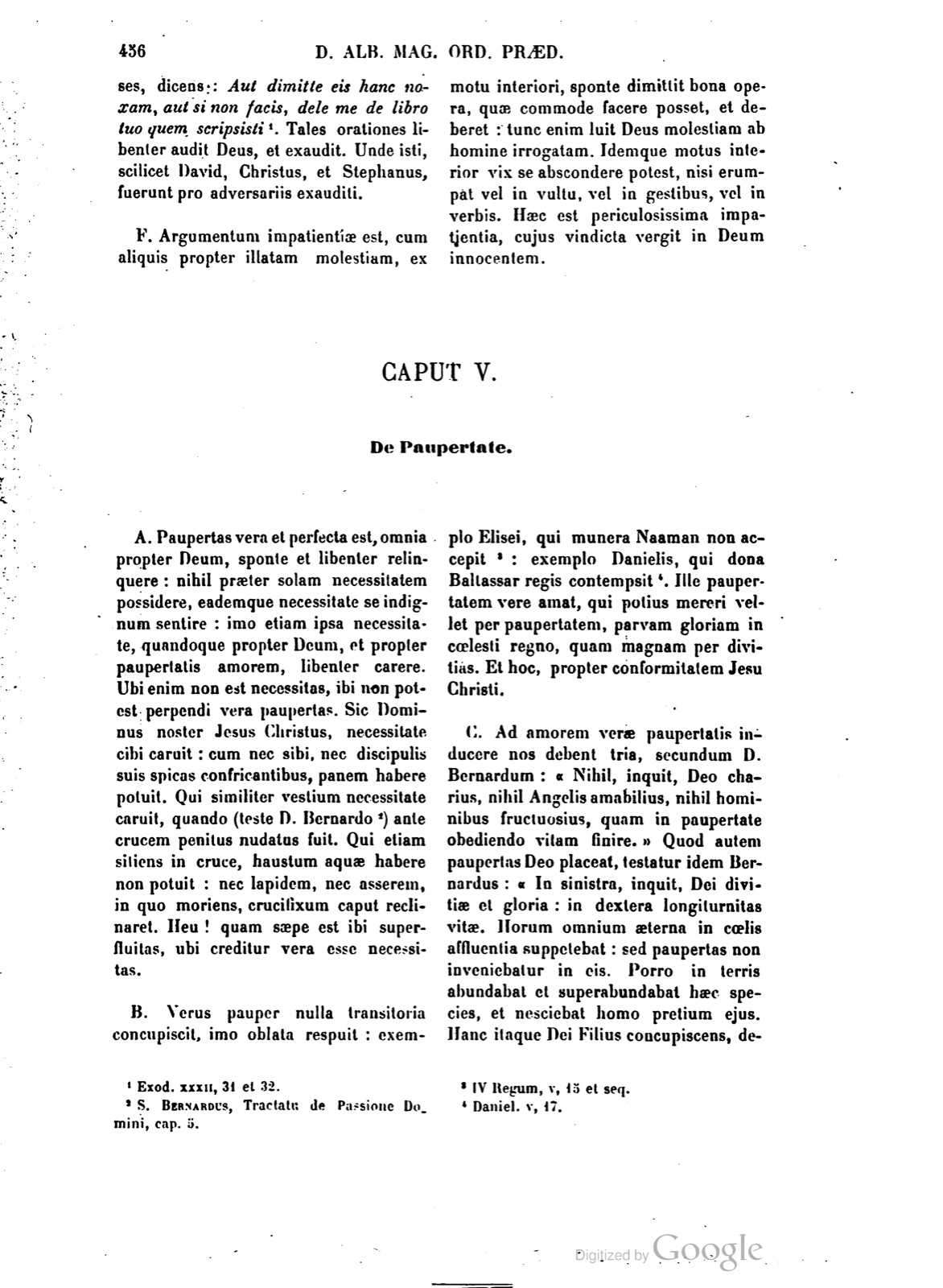
E. Argumentum verae patientiae est, non se vindicare, cum possit: et etiam prohibere vindictam ab aliis. Exemplo David, qui prohibuit occidi Semei, qui lapides et lutum contra eum projiciens, virum sanguinum eum appellavit 9. Sed potius vere patiens devote supplicat pro injuriantibus: quod et fecit Dominus Jesus Christus efficaciter pro suis crucifixoribus orans 10: et B. Stephanus, pro lapidantibus 11. Imo etiam cogit Dominum injuriantibus misereri: sicut fecit Moyses, dicens: Aut dimitte eis hanc noxam, aut si non facis, dele me de libro tuo quem scripsisti 12. Tales orationes libenter audit Deus, et exaudit. Unde isti, scilicet David, Christus, et Stephanus, fuerunt pro adversariis exauditi.
F. Argumentum impatientiae est, cum aliquis propter illatam molestiam, ex motu interiori, sponte dimittit bona opera, quae commode facere posset, et deberet: tunc enim luit Deus molestiam ab homine irrogatam. Idemque motus interior vix se abscondere potest, nisi erumpat vel in vultu, vel in gestibus, vel in verbis. Haec est periculosissima impatientia, cujus vindicta vergit in Deum innocentem.
E. The proof of true patience is not to vindicate oneself when one can, and also to prohibit vengeance by others. After the example of David, who forbade Shimei to be killed, who, throwing stones and mud against him, called him a man of blood 9. Rather, the truly patient person devoutly supplicates for those doing injury; the Lord Jesus Christ did this efficaciously, praying for his crucifiers 10, and blessed Stephen for those stoning him 11. Indeed he also compels the Lord to pity those doing injury, as Moses did, saying: Either forgive them this fault, or if you do not, blot me out of your book that you have written 12. God gladly hears such prayers and grants them. Hence these, namely David, Christ, and Stephen, were heard for their adversaries.
F. The proof of impatience is when someone, because of trouble brought upon him, from an interior movement spontaneously omits good works that he conveniently could and ought to do; for then God pays the trouble inflicted by a human being. And the same interior movement can scarcely hide itself unless it breaks out either in countenance, or in gestures, or in words. This is the most dangerous impatience, whose vengeance turns against innocent God.
Notes
- Job 17:2. (Job, XVII, 2.) ↩
- 1 Peter 4:15 and 16. (I Petri, IV, 15 et 16.) ↩
- The same, 3:17. (Ibid., III, 17.) ↩
- The same, 2:20. (Ibid., II, 20.) ↩
- Song of Songs 2:2. (Cantic. II, 2.) ↩
- Psalm 68:20. (Psal. LXVIII, 20.) ↩
- Job 1:22. (Job. I, 22.) ↩
- 2 Corinthians 4:17. (II ad Corinth. IV, 17.) ↩
- 2 Samuel 16:7. (II Regum, XVI, 7.) ↩
- Luke 23:34. (Luc. XXIII, 34.) ↩
- Acts 7:60. (Act. VII, 60.) ↩
- Exodus 32:31 and 32. (Exod. XXXII, 31 et 32.) ↩
If a page does not appear, its photograph has not been uploaded yet.