Works › The Paradise of the Soul
Volume 37 · ≈ pp. 452–454
Chapter III. On obedience toward God.
A marker with ≈ is an approximate page boundary, placed by measure of the text; the page photographs remain the authority. In the paired views, clicking a page marker brings that page into view.
Caput III.
§ 1. De Obedientia ad Deum.
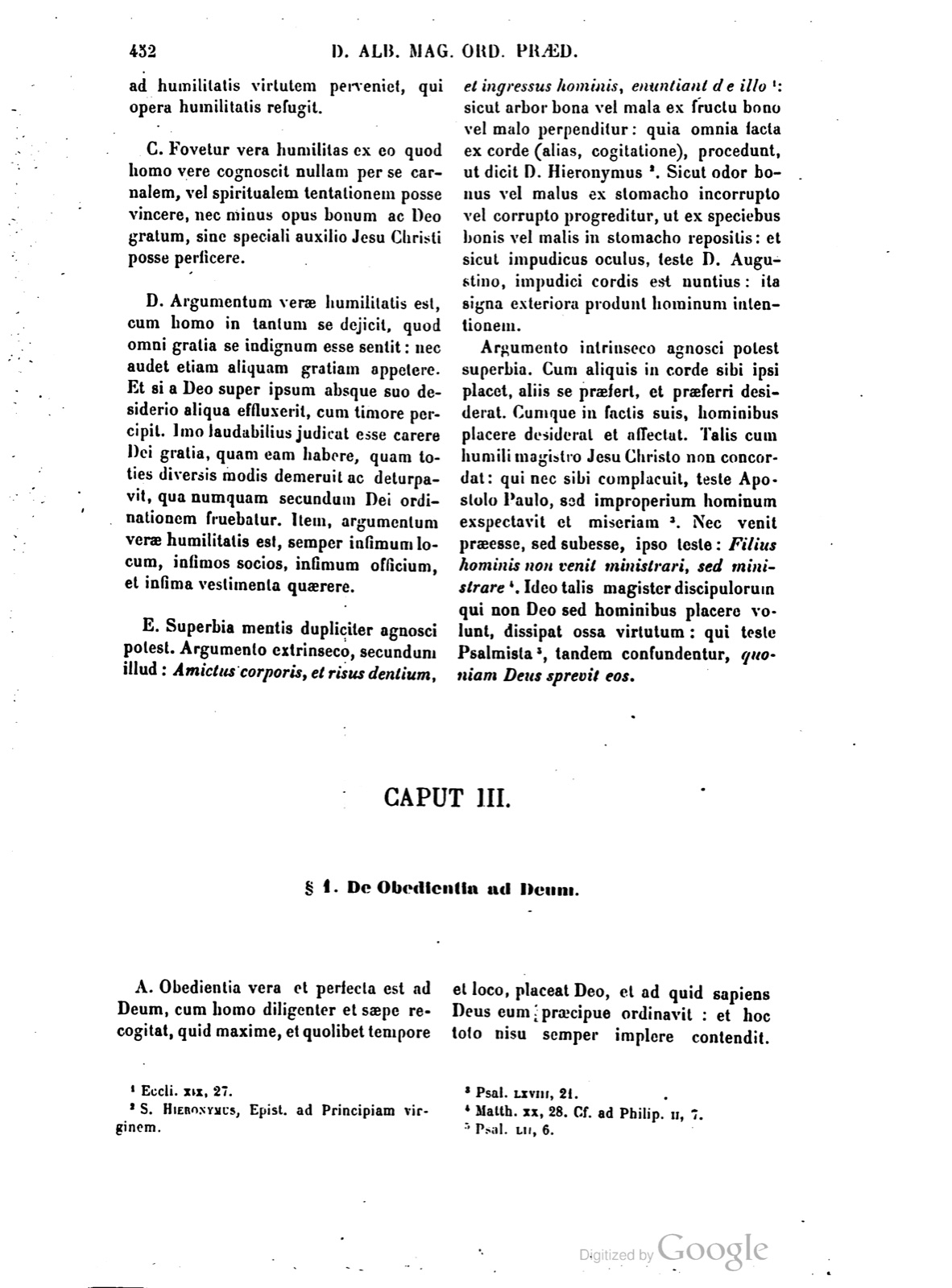
A. Obedientia vera et perfecta est ad Deum, cum homo diligenter et saepe recogitat, quid maxime, et quolibet tempore et loco, placeat Deo, et ad quid sapiens Deus eum praecipue ordinavit: et hoc toto nisu semper implere contendit.
§ 2. De obedientia ad Superiores.
B. Sed vera obedientia ad vicarios Jesu Christi, scilicet Praelatos, est, cum subditus quod sibi maxime contrarium est, fideliter et libenter exsequitur: numquam manifestans signo, verbo, vel facto, quod sibi contrarium sit praeceptum. Sed ibi vera obedientia non potest perpendi, ubi subditus praeceptum excogitat: et opus quod sibi placuerit, ipse dictat: dicente D. Augustino: « Optimus minister tuus est, Domine, qui non magis intuetur hoc a te audire quod ipse voluerit, sed potius hoc velle quod a te audierit 1. »
Verus obediens numquam praeceptum exspectat: sed solum voluntatem Praelati sciens vel credens ferventer exsequitur pro praecepto: exemplo Domini nostri Jesu Christi, cui voluntas et complacentia Patris summum mandatum fuit.
Verus obediens numquam de factis suis ordinat: nec secundum sensum suum judicat: nec cuiquam de factis suis sensum suum indicat: cum nec velle habeat, nec nolle. Sed omnem ordinationem circa se, simpliciter et secure, Deo committit et Praelato.
Verus obediens non discernit, utrum bonum vel malum. Sicut Abraham non discrevit, utrum bonum vel malum esset occidere filium suum, Domino jubente. Nec discernit inter bonum et melius: nam semper optimum esse judicat, etiam in dubio, quod jubetur: nisi manifeste appareret iniquum esse mandatum. Tunc namque secundum D. Gregorii consilium, « sciendum est, quod numquam per obedientiam malum fieri, aliquando autem debet per obedientiam bonum quod agitur, intermitti 2. » Iterum, D. Gregorius: « Sed quia nonnumquam nobis hujus mundi prospera, nonnumquam vero jubentur adversa, sciendum summopere est, quod obedientia aliquando, si de suo aliquid habeat, nulla est. Aliquando autem, si de suo aliquid non habeat, minima. Nam cum hujus mundi successus praecipitur, cum locus superior imperatur, is qui ad percipienda haec obedit, obedientiae sibi virtutem evacuat, si ad haec etiam ex proprio desiderio anhelat. Neque enim se sub obedientia dirigit, qui ad accipienda hujus vitae prospera, libidini propriae ambitionis servit. Rursum, cum mundi despectus praecipitur: cum probra adipisci et contumeliae jubentur, nisi ex seipso animus haec appetat, obedientiae sibi meritum minuit: quia ad ea quae in hac vita despecta sunt, invitus nolensque descendit 3. » Et paulo post: « Debet ergo obedientia et in adversis ex suo aliquid habere, et rursum in prosperis ex suo aliquid omnimodo non habere. Quatenus et in adversis, tanto sit gloriosior, quanto divino ordini etiam ex desiderio jungitur. Et in prosperis, tanto sit verior, quanto a praesenti ipsa, quam divinitus percipit, gloria, funditus ex mente separatur. »
Chapter III.
§ 1. On obedience toward God.
A. True and perfect obedience toward God exists when a human being diligently and often reconsiders what most pleases God, and at any time and place, and to what the wise God has especially ordered him; and with his whole effort he always strives to fulfill this.
§ 2. On obedience toward superiors.
B. But true obedience toward the vicars of Jesus Christ, that is, prelates, exists when the subject faithfully and gladly executes what is most contrary to himself, never manifesting by sign, word, or deed that the precept is contrary to him. But true obedience cannot be discerned there where the subject thinks up the precept and himself dictates the work that has pleased him, as D. Augustine says: "Your best minister, O Lord, is he who does not look more to hear from you what he himself has wished, but rather to will what he has heard from you 1."
The truly obedient person never waits for a precept, but knowing or believing only the will of the prelate, he fervently executes it as a precept, after the example of our Lord Jesus Christ, to whom the will and good pleasure of the Father was the highest command.
The truly obedient person never arranges concerning his own deeds, nor judges according to his own sense, nor indicates his sense about his deeds to anyone, since he has neither willing nor unwilling. But every ordering concerning himself he simply and securely commits to God and to the prelate.
The truly obedient person does not discern whether it is good or bad. Thus Abraham did not discern whether to kill his son, at the Lord's command, was good or bad. Nor does he discern between good and better, for he always judges what is commanded, even in doubt, to be best, unless the command should manifestly appear to be unjust. Then, according to the counsel of D. Gregory, "it must be known that evil must never be done through obedience, but sometimes a good that is being done ought to be omitted through obedience 2." Again, D. Gregory says: "But because sometimes the prosperous things of this world, and sometimes adverse things, are commanded to us, it must be known above all that obedience sometimes, if it has something of its own, is nothing. But sometimes, if it does not have something of its own, it is least. For when success of this world is commanded, when a higher place is ordered, the one who obeys so as to receive these things empties out for himself the virtue of obedience if he also pants after these things from his own desire. For he does not direct himself under obedience who, for receiving the prosperous things of this life, serves the lust of his own ambition. Again, when contempt of the world is commanded, when reproaches and insults are ordered to be obtained, unless the soul seeks these things from itself, it diminishes the merit of obedience for itself, because it descends unwilling and reluctant to those things that are despised in this life 3." And a little later: "Therefore obedience ought both in adversities to have something of its own, and again in prosperities to have absolutely nothing of its own. Thus in adversities it may be the more glorious insofar as it is joined even by desire to the divine order; and in prosperities it may be the truer insofar as it is thoroughly separated in mind from that present glory itself, which it receives divinely."
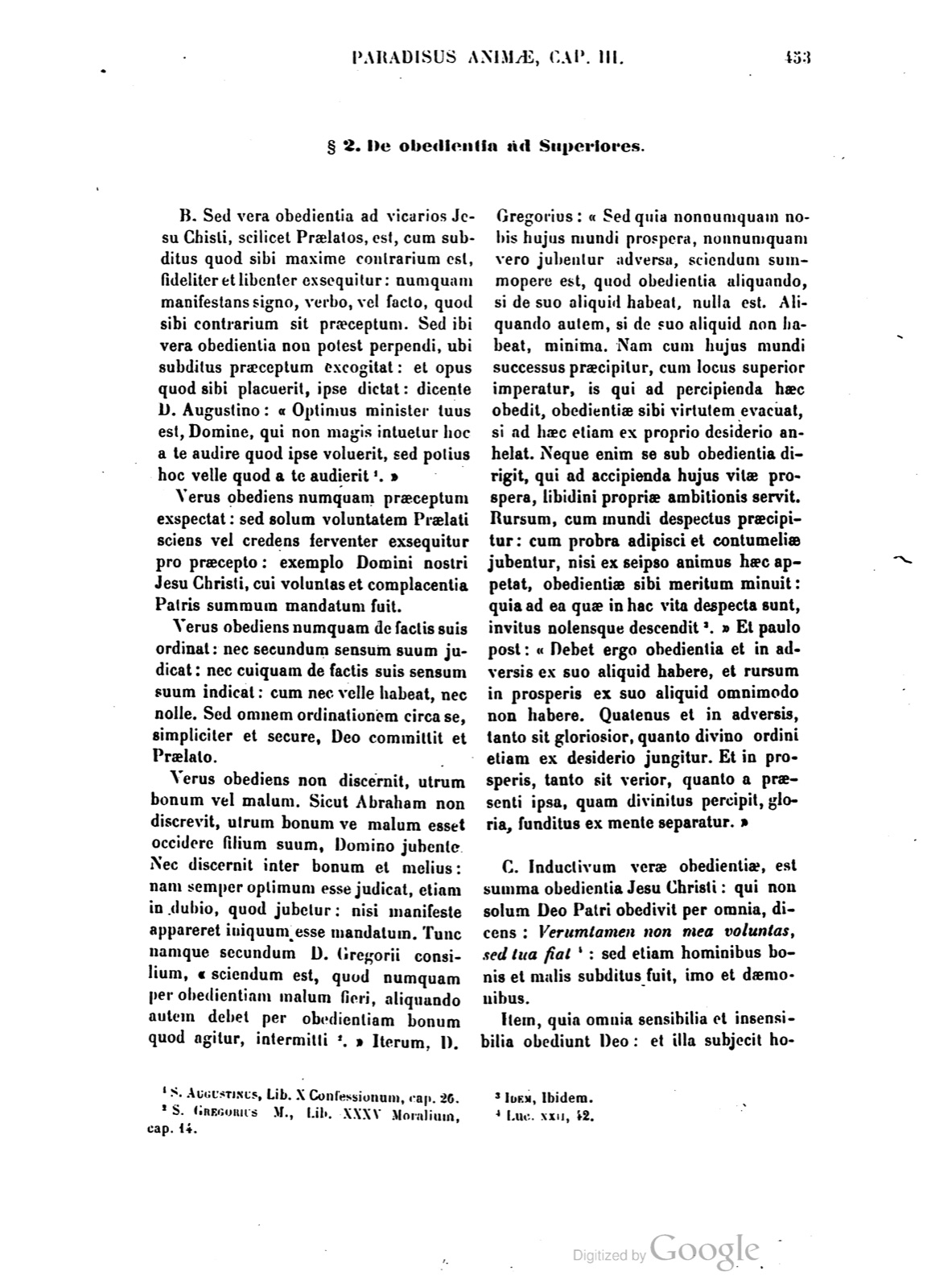
C. Inductivum verae obedientiae, est summa obedientia Jesu Christi: qui non solum Deo Patri obedivit per omnia, dicens: Verumtamen non mea voluntas, sed tua fiat 4: sed etiam hominibus bonis et malis subditus fuit, imo et daemonibus.
Item, quia omnia sensibilia et insensibilia obediunt Deo: et illa subjecit homini, ut se cognosceret subjiciendum esse Deo. Sol et luna obedierunt Josue. Terra Moysi, cum absorbuit Core, Dathan, et Abiron, Mare Petro, ad calcandum: et Moysi, cum submerget Pharaonem et exercitum ejus. Serpentes, magis in Aegypto. Bestiae eremitis, et sanctis Patribus in Aegypto: ut legitur in Vitis patrum. Aer, nix, et grando, Samueli. Pluvia Eliae: et ignis eidem, qui devoravit duos quinquagenarios. Aves, sanctissimo Patri Francisco: daemones, Apostolis: et sanctis hominibus aegritudines, a quibus eos liberaverunt. Et multae creaturae Moysi in Aegypto. Et quia omnia obediunt Deo, in caelo, sub caelo in purgatorio, et inferno: ideo homo merito deberet Deo in omnibus obedire, ejus praecepta et voluntatem exsequendo.
C. The inducement of true obedience is the highest obedience of Jesus Christ, who not only obeyed God the Father through all things, saying, Nevertheless not my will, but yours be done 4, but was also subject to good and bad human beings, indeed even to demons.
Likewise, because all sensible and insensible things obey God, and he subjected those things to the human being so that he might know that he must be subjected to God. The sun and moon obeyed Joshua. The earth obeyed Moses when it swallowed Korah, Dathan, and Abiram; the sea obeyed Peter for walking, and Moses when it submerged Pharaoh and his army. Serpents obeyed the magi in Egypt. Beasts obeyed hermits and the holy Fathers in Egypt, as is read in the Lives of the Fathers. Air, snow, and hail obeyed Samuel. Rain obeyed Elijah, and fire likewise obeyed him, which devoured two captains of fifty. Birds obeyed the most holy Father Francis; demons obeyed the Apostles; and illnesses obeyed holy men, by whom they were delivered. And many creatures obeyed Moses in Egypt. And because all things obey God in heaven, under heaven in purgatory, and in hell, therefore a human being ought deservedly to obey God in all things, by carrying out his precepts and will.
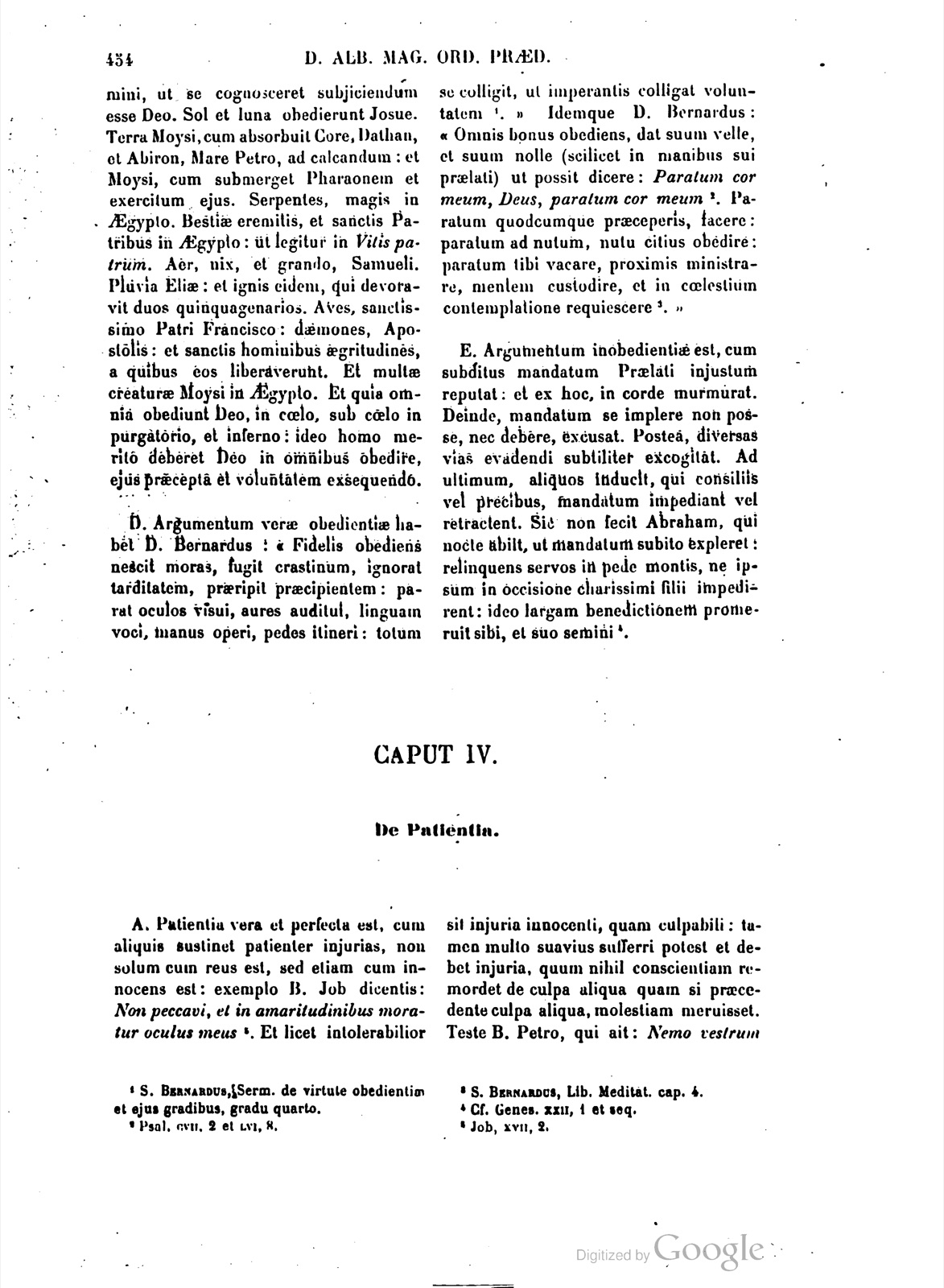
D. Argumentum verae obedientiae habet D. Bernardus: « Fidelis obediens nescit moras, fugit crastinum, ignorat tarditatem, praeripit praecipientem: parat oculos visui, aures auditui, linguam voci, manus operi, pedes itineri: totum se colligit, ut imperantis colligat voluntatem 5. » Idemque D. Bernardus: « Omnis bonus obediens, dat suum velle, et suum nolle (scilicet in manibus sui praelati) ut possit dicere: Paratum cor meum, Deus, paratum cor meum 6. Paratum quodcumque praeceperis, facere: paratum ad nutum, nutu citius obedire: paratum tibi vacare, proximis ministrare, mentem custodire, et in coelestium contemplatione requiescere 7. »
E. Argumentum inobedientiae est, cum subditus mandatum Praelati injustum reputat: et ex hoc, in corde murmurat. Deinde, mandatum se implere non posse, nec debere, excusat. Postea, diversas vias evadendi subtiliter excogitat. Ad ultimum, aliquos inducit, qui consiliis vel precibus, mandatum impediant vel retractent. Sic non fecit Abraham, qui nocte abiit, ut mandatum subito expleret: relinquens servos in pede montis, ne ipsum in occisione charissimi filii impedirent: ideo largam benedictionem promereuit sibi, et suo semini 8.
D. D. Bernard has the proof of true obedience: "The faithful obedient person knows no delays, flees tomorrow, is ignorant of tardiness, anticipates the one commanding: he prepares eyes for sight, ears for hearing, tongue for voice, hands for work, feet for the journey; he gathers his whole self, so that he may gather the will of the one commanding 5." And the same D. Bernard says: "Every good obedient person gives his willing and his unwilling, namely into the hands of his prelate, so that he can say: My heart is ready, O God, my heart is ready 6. Ready to do whatever you command; ready at a nod, more quickly than a nod, to obey; ready to be free for you, to minister to neighbors, to guard the mind, and to rest in contemplation of heavenly things 7."
E. The proof of disobedience is when a subject considers the mandate of the prelate unjust and, because of this, murmurs in his heart. Then he excuses himself that he cannot and ought not fulfill the mandate. Afterwards he subtly thinks up diverse ways of escape. Finally he brings in some who by counsels or prayers may impede or retract the mandate. Abraham did not do so; he went by night so that he might fulfill the command suddenly, leaving the servants at the foot of the mountain lest they impede him in the killing of his dearest son; therefore he won a large blessing for himself and for his seed 8.
Notes
- St. Augustine, Confessions, book 10, chapter 26. (S. Augustinus, Lib. X Confessionum, cap. 26.) ↩
- St. Gregory the Great, Moralia, book 35, chapter 14. (S. Gregorius M., Lib. XXXV Moralium, cap. 14.) ↩
- The same, in the same place. (Idem, Ibidem.) ↩
- Luke 22:42. (Luc. XXII, 42.) ↩
- St. Bernard, Sermon on the virtue of obedience and its degrees, fourth degree. (S. Bernardus, Serm. de virtute obedientiae et ejus gradibus, gradu quarto.) ↩
- Psalm 107:2 and 56:8. (Psal. CVII, 2 et LVI, 8.) ↩
- St. Bernard, Book of Meditations, chapter 4. (S. Bernardus, Lib. Meditat. cap. 4.) ↩
- Compare Genesis 22:1 and following. (Cf. Genes. XXII, 1 et seq.) ↩
If a page does not appear, its photograph has not been uploaded yet.