Works › The Paradise of the Soul
Volume 37 · ≈ pp. 450–452
Chapter II. On Humility.
A marker with ≈ is an approximate page boundary, placed by measure of the text; the page photographs remain the authority. In the paired views, clicking a page marker brings that page into view.
Caput II.
De Humilitate.
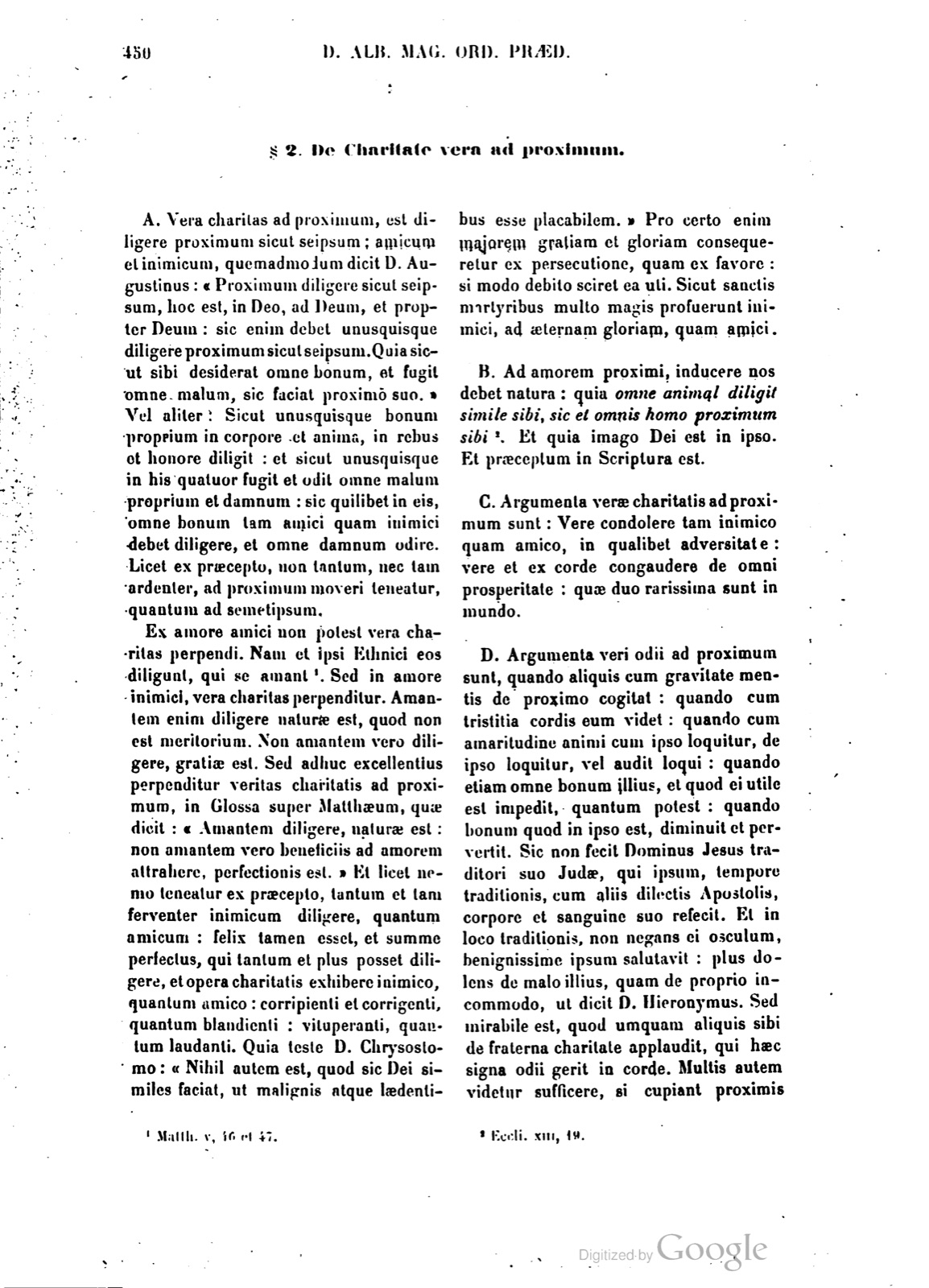
A. Humilitas vera et perfecta est, cum gloria contemnitur exhibita, nec appetitur exhibenda. Vere humilis semper timet, ne sibi aliqua gloria exhibeatur: et cum sibi exhibita fuerit, expavescens medullitus contristatur: sciens quod soli Deo gloria et honor debentur. Vere humilis numquam de aliqua gloria vel gratia gloriatur: nisi ex hoc audientibus confidentiam ad Deum praestare intendat. Sed si de ipso gloriosum aliquid, vel aliqua gratia recitatur, hoc cum dolore cordis, et dejectione sui audit: sciens solius Dei esse, quod sibi adscribitur, cui soli danda est gloria 1.
Vere humilis, nec majori, nec minori, nec aequali, se comparat: imo, nullum inferiorem se credit: nullum omnino spernit: et nisi se solum ex corde despicit, atque ab omnibus despici ferventer appetit, gaudetque vehementer cum despectus fuerit. Talis nullam timet contumeliam, quia nullam amat gloriam. Est qui nequiter humiliat se, et interiora ejus plena sunt dolo 2. Sed verus humilis, teste D. Bernardo 3, vilis vult reputari, non humilis praedicari. Amans humilitatem, debet radicem humilitatis in corde suo plantare, hoc est, propriam fragilitatem agnoscere: ut se reputet non solum quam vilis sit, sed etiam quam vilis esse possit. Imo etiam, quam vilis hodie fieret, nisi Deus violenter eum a peccatis retraxisset, et nisi illi tentationes subtraheret. Ibi quilibet se cognoscere potest: atque etiam ex sua fragilitate se esse dispositum ad abyssum et voraginem omnium vitiorum, juxta illud Michaeae, vi, 14: Humiliatio tua in medio tui.
Chapter II.
On Humility.
A. True and perfect humility exists when glory already shown is despised and glory to be shown is not sought. The truly humble person always fears lest some glory be shown to him, and when it has been shown to him, shuddering, he is saddened in his marrow, knowing that glory and honor are due to God alone. The truly humble person never glories in any glory or grace, unless from this he intends to provide hearers with confidence toward God. But if something glorious about him, or some grace, is recited, he hears this with grief of heart and dejection of himself, knowing that what is ascribed to him belongs to God alone, to whom alone glory is to be given 1.
The truly humble person compares himself neither to a greater, nor to a lesser, nor to an equal; indeed, he believes no one inferior to himself, utterly despises no one, and unless he despises himself alone from the heart, and fervently desires to be despised by all, he greatly rejoices when he has been despised. Such a person fears no insult, because he loves no glory. There is one who wickedly humbles himself, and his inward parts are full of deceit 2. But the truly humble person, as D. Bernard testifies 3, wishes to be thought vile, not to be proclaimed humble. One who loves humility ought to plant the root of humility in his heart, that is, to know his own frailty, so that he considers not only how vile he is, but also how vile he could be. Indeed also how vile he would become today, unless God violently drew him back from sins and withdrew temptations from him. There each person can know himself, and also from his frailty know himself to be disposed toward the abyss and whirlpool of all vices, according to that of Micah 6:14: Your humiliation is in your midst.
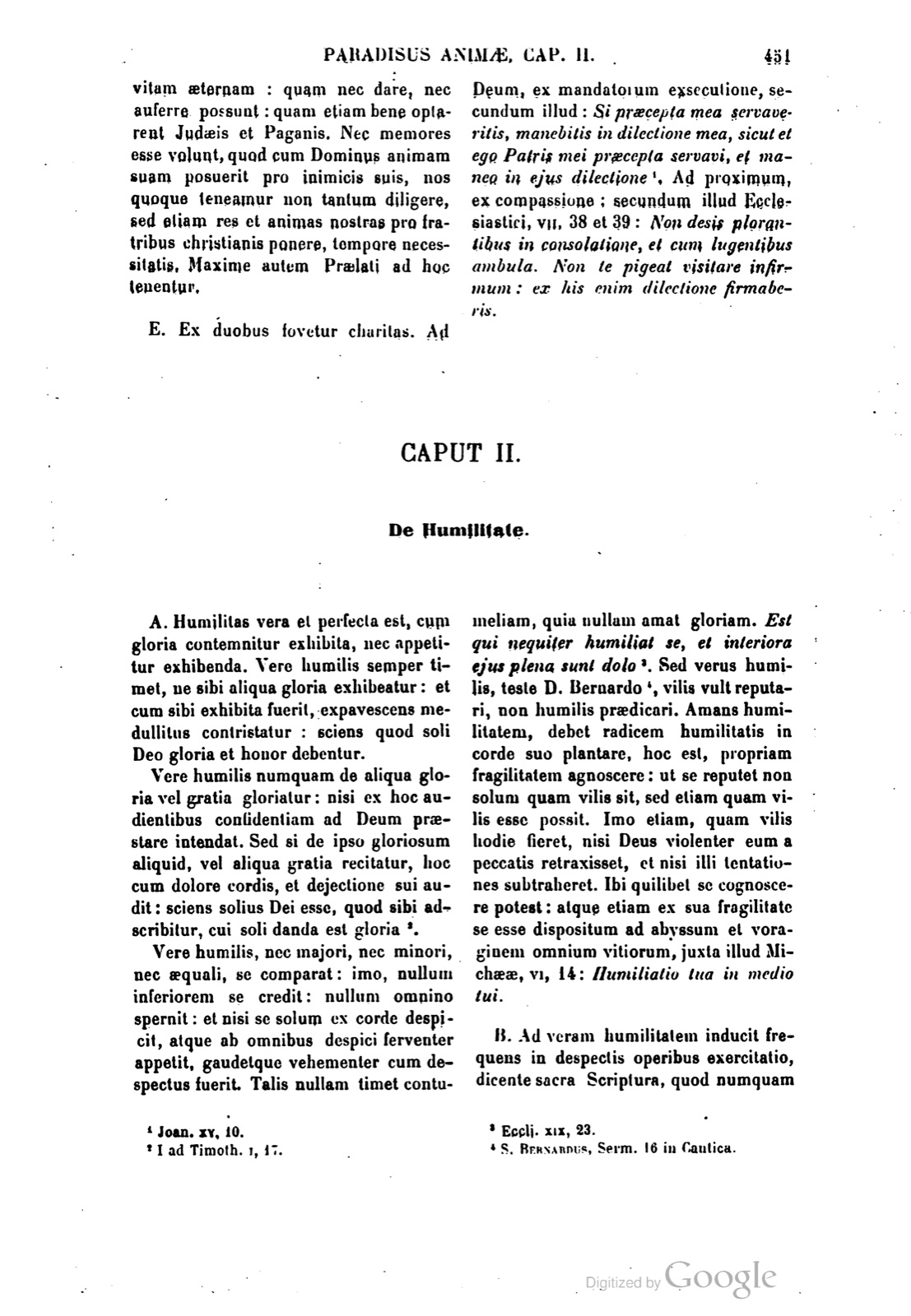
B. Ad veram humilitatem inducit frequens in despectis operibus exercitatio, dicente sacra Scriptura, quod numquam ad humilitatis virtutem perveniet, qui opera humilitatis refugit.
C. Fovetur vera humilitas ex eo quod homo vere cognoscit nullam per se carnalem, vel spiritualem tentationem posse vincere, nec minimum opus bonum ac Deo gratum, sine speciali auxilio Jesu Christi posse perficere.
D. Argumentum verae humilitatis est, cum homo in tantum se dejicit, quod omni gratia se indignum esse sentit: nec audet etiam aliquam gratiam appetere. Et si a Deo super ipsum absque suo desiderio aliqua effluxerit, cum timore percipit. Imo laudabilius judicat esse carere Dei gratia, quam eam habere, quam toties diversis modis demeruit ac deturpavit, qua numquam secundum Dei ordinationem fruebatur. Item, argumentum verae humilitatis est, semper infimum locum, infimos socios, infimum officium, et infima vestimenta quaerere.
B. Frequent exercise in despised works induces one to true humility, sacred Scripture saying that he who flees works of humility will never arrive at the virtue of humility.
C. True humility is fostered from this, that a human being truly knows that by himself he can conquer no carnal or spiritual temptation, nor can he complete even the least good work pleasing to God without the special help of Jesus Christ.
D. The proof of true humility is when a human being casts himself down so far that he feels himself unworthy of every grace, and does not even dare to desire any grace. And if some grace from God has flowed upon him without his desire, he receives it with fear. Indeed he judges it more praiseworthy to lack the grace of God than to have it, since he has so often in diverse ways demerited and defiled it, and never enjoyed it according to the ordinance of God. Likewise, a proof of true humility is always to seek the lowest place, the lowest companions, the lowest office, and the lowest garments.
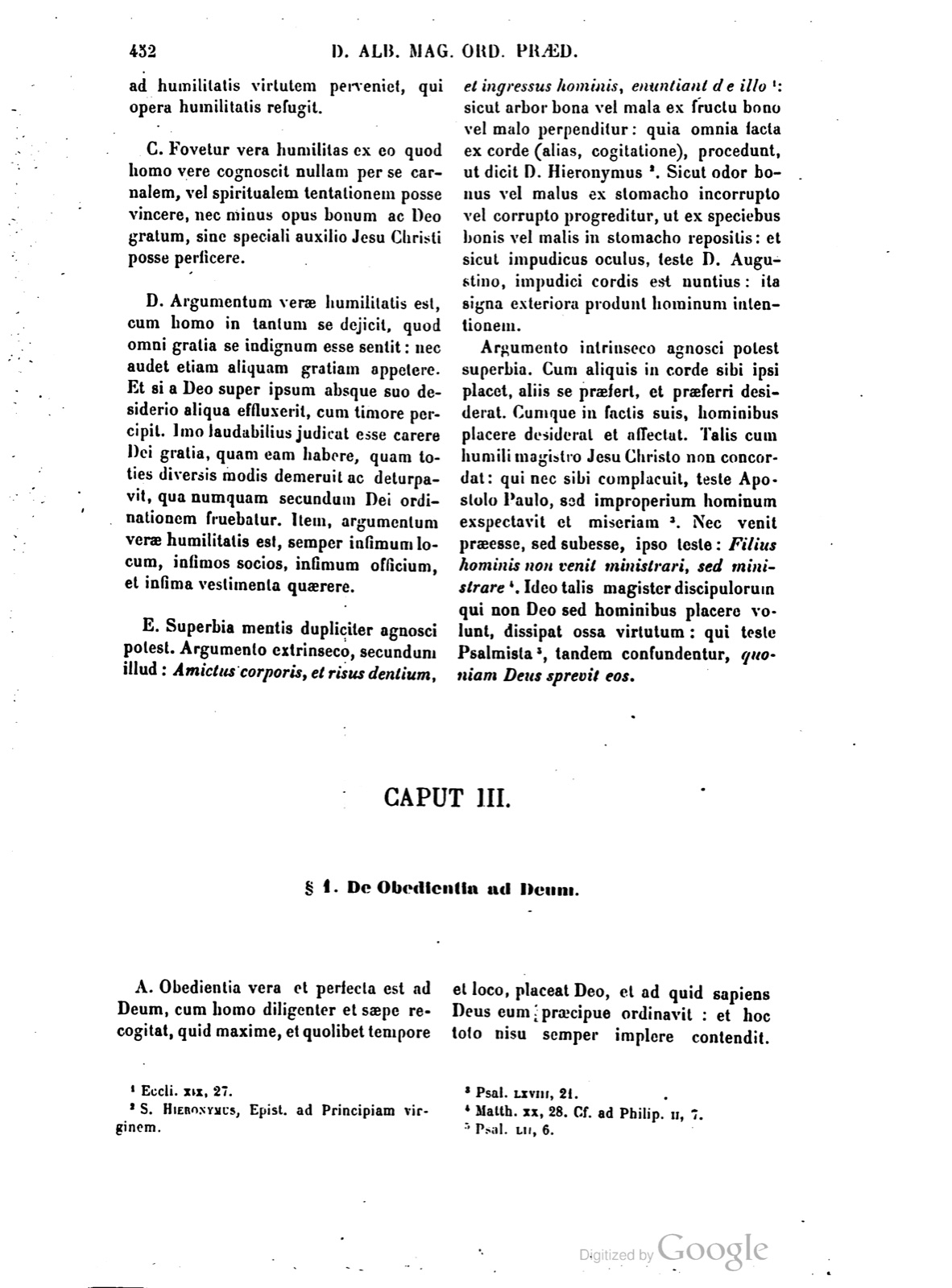
E. Superbia mentis dupliciter agnosci potest. Argumento extrinseco, secundum illud: Amictus corporis, et risus dentium, et ingressus hominis, enuntiant de illo 4: sicut arbor bona vel mala ex fructu bono vel malo perpenditur: quia omnia facta ex corde (alias, cogitatione), procedunt, ut dicit D. Hieronymus 5. Sicut odor bonus vel malus ex stomacho incorrupto vel corrupto progreditur, ut ex speciebus bonis vel malis in stomacho repositis: et sicut impudicus oculus, teste D. Augustino, impudici cordis est nuntius: ita signa exteriora produnt hominum intentionem.
Argumento intrinseco agnosci potest superbia. Cum aliquis in corde sibi ipsi placet, aliis se praefert, et praeferri desiderat. Cumque in factis suis, hominibus placere desiderat et affectat. Talis cum humili magistro Jesu Christo non concordat: qui nec sibi complacuit, teste Apostolo Paulo, sed improperium hominum exspectavit et miseriam 6. Nec venit praeesse, sed subesse, ipso teste: Filius hominis non venit ministrari, sed ministrare 7. Ideo talis magister discipulorum qui non Deo sed hominibus placere volunt, dissipat ossa virtutum: qui teste Psalmista, tandem confundentur, quoniam Deus sprevit eos 8.
E. Pride of mind can be recognized in two ways. By an extrinsic proof, according to that: The clothing of the body, the laughter of the teeth, and the gait of a human being declare concerning him 4; as a good or bad tree is discerned from good or bad fruit, because all deeds proceed from the heart, or, in another reading, from thought, as D. Jerome says 5. As a good or bad odor comes forth from an uncorrupted or corrupted stomach, as from good or bad spices placed in the stomach; and as an immodest eye, as D. Augustine testifies, is the messenger of an immodest heart, so exterior signs betray the intention of human beings.
Pride can be recognized by an intrinsic proof when someone in his heart is pleased with himself, prefers himself to others, and desires to be preferred; and when in his deeds he desires and affects to please human beings. Such a person does not agree with the humble master Jesus Christ, who did not please himself, as the Apostle Paul testifies, but awaited the reproach of men and misery 6. Nor did he come to be over others, but to be under them, as he himself testifies: The Son of Man did not come to be ministered to, but to minister 7. Therefore such a master scatters the bones of disciples who wish to please not God but human beings; these, as the Psalmist testifies, will at last be confounded, because God has despised them 8.
Notes
- 1 Timothy 1:17. (I ad Timoth. I, 17.) ↩
- Ecclesiasticus 19:23. (Eccli. XIX, 23.) ↩
- St. Bernard, Sermon 16 on the Song of Songs. (S. Bernardus, Serm. 16 in Cantica.) ↩
- Ecclesiasticus 20:27. (Eccli. XX, 27.) ↩
- St. Jerome, Letter to the virgin Principia. (S. Hieronymus, Epist. ad Principiam virginem.) ↩
- Psalm 68:21. (Psal. LXVIII, 21.) ↩
- Matthew 20:28. Compare Philippians 2:7. (Matth. XX, 28. Cf. ad Philip. II, 7.) ↩
- Psalm 52:6. (Psal. LII, 6.) ↩
If a page does not appear, its photograph has not been uploaded yet.