Works › The Paradise of the Soul
Volume 37 · ≈ pp. 448–450
Chapter I. On charity toward God.
A marker with ≈ is an approximate page boundary, placed by measure of the text; the page photographs remain the authority. In the paired views, clicking a page marker brings that page into view.
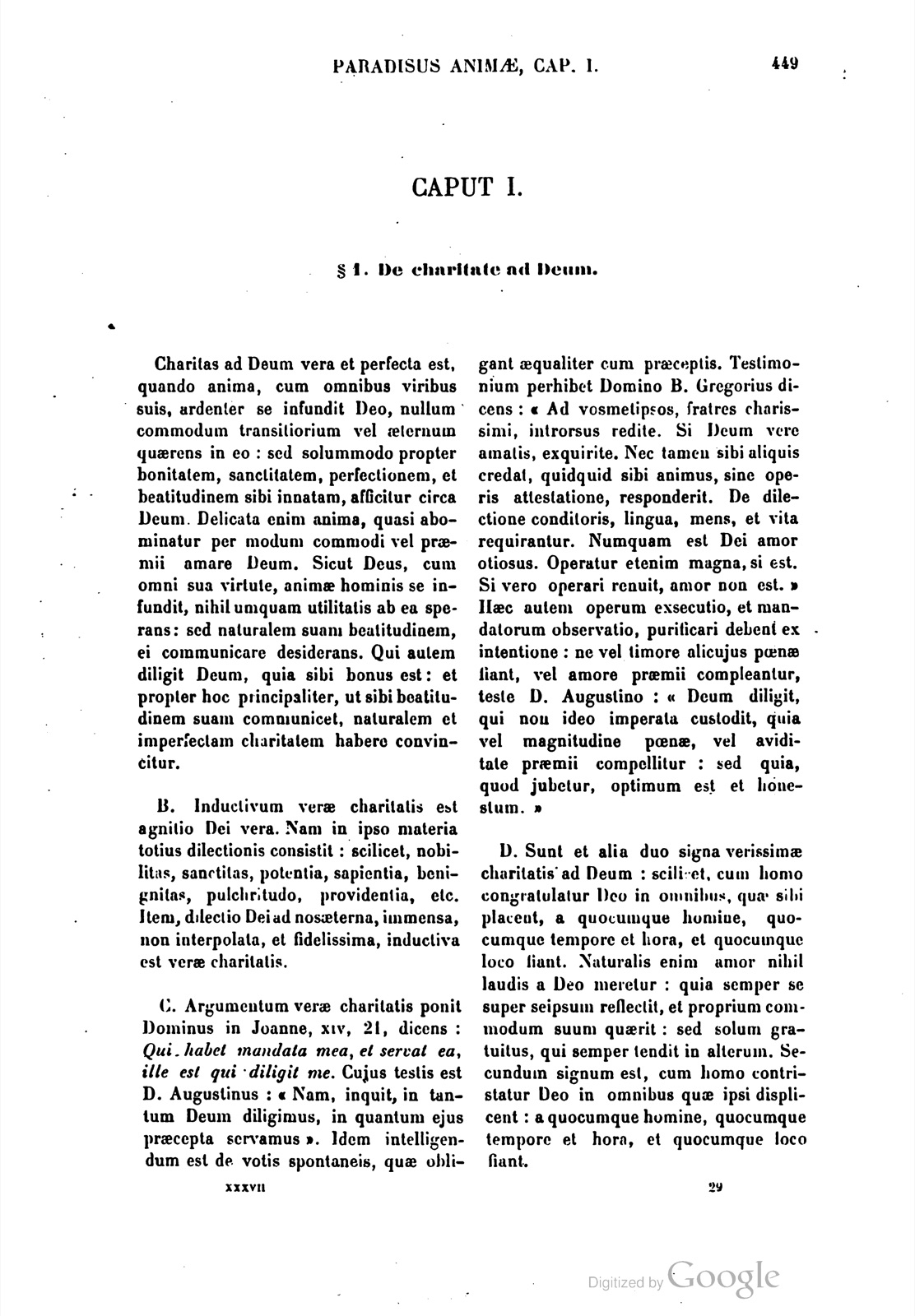
Caput I.
§ 1. De charitate ad Deum.
Charitas ad Deum vera et perfecta est, quando anima, cum omnibus viribus suis, ardenter se infundit Deo, nullum commodum transitorium vel aeternum quaerens in eo: sed solummodo propter bonitatem, sanctitatem, perfectionem, et beatitudinem sibi innatam, afficitur circa Deum. Delicata enim anima, quasi abominatur per modum commodi vel praemii amare Deum. Sicut Deus, cum omni sua virtute, animae hominis se infundit, nihil umquam utilitatis ab ea sperans: sed naturalem suam beatitudinem, ei communicare desiderans. Qui autem diligit Deum, quia sibi bonus est: et propter hoc principaliter, ut sibi beatitudinem suam communicet, naturalem et imperfectam charitatem habere convincitur.
B. Inductivum verae charitatis est agnitio Dei vera. Nam in ipso materia totius dilectionis consistit: scilicet, nobilitas, sanctitas, potentia, sapientia, benignitas, pulchritudo, providentia, etc. Item, dilectio Dei ad nos aeterna, immensa, non interpolata, et fidelissima, inductiva est verae charitatis.
C. Argumentum verae charitatis ponit Dominus in Joanne, xiv, 21, dicens: Qui habet mandata mea, et servat ea, ille est qui diligit me. Cujus testis est D. Augustinus: « Nam, inquit, in tantum Deum diligimus, in quantum ejus praecepta servamus ». Idem intelligendum est de votis spontaneis, quae obligant aequaliter cum praeceptis. Testimonium perhibet Domino B. Gregorius dicens: « Ad vosmetipsos, fratres charissimi, introrsus redite. Si Deum vere amatis, exquirite. Nec tamen sibi aliquis credat, quidquid sibi animus, sine operis attestatione, responderit. De dilectione conditoris, lingua, mens, et vita requirantur. Numquam est Dei amor otiosus. Operatur etenim magna, si est. Si vero operari renuit, amor non est. » Haec autem operum exsecutio, et mandatorum observatio, purificari debent ex intentione: ne vel timore alicujus poenae fiant, vel amore praemii compleantur, teste D. Augustino: « Deum diligit, qui non ideo imperata custodit, quia vel magnitudine poenae, vel aviditate praemii compellitur: sed quia, quod jubetur, optimum est et honestum. »
D. Sunt et alia duo signa verissimae charitatis ad Deum: scilicet, cum homo congratulatur Deo in omnibus, quae sibi placent, a quocumque homine, quocumque tempore et hora, et quocumque loco fiant. Naturalis enim amor nihil laudis a Deo meretur: quia semper se super seipsum reflectit, et proprium commodum suum quaerit: sed solum gratuitus, qui semper tendit in alterum. Secundum signum est, cum homo contristatur Deo in omnibus quae ipsi displicent: a quocumque homine, quocumque tempore et hora, et quocumque loco fiant.
Chapter I.
§ 1. On charity toward God.
True and perfect charity toward God exists when the soul, with all its powers, ardently pours itself into God, seeking in him no transitory or eternal advantage, but is affected toward God solely because of the goodness, holiness, perfection, and blessedness innate in him. For a delicate soul almost abominates loving God by way of advantage or reward. As God, with all his virtue, pours himself into the soul of a human being, never hoping for any usefulness from it, but desiring to communicate his natural blessedness to it. But one who loves God because he is good to him, and principally for this, that he may communicate his blessedness to him, is shown to have natural and imperfect charity.
B. The inducement of true charity is the true knowledge of God. For in him the matter of the whole affection consists: namely, nobility, holiness, power, wisdom, kindness, beauty, providence, etc. Likewise, the eternal, immeasurable, uninterrupted, and most faithful love of God toward us is inducive of true charity.
C. The Lord sets down the proof of true charity in John 14:21, saying: He who has my commandments and keeps them, he it is who loves me. D. Augustine is witness of this: "For," he says, "we love God insofar as we keep his precepts." The same must be understood of spontaneous vows, which bind equally with precepts. Blessed Gregory bears testimony to the Lord, saying: "Return inwardly to yourselves, dearest brothers. If you truly love God, examine it. Yet let no one believe himself, whatever his mind may have answered him without the attestation of work. Concerning love of the Creator, let tongue, mind, and life be examined. The love of God is never idle. For it works great things, if it exists. But if it refuses to work, it is not love." But this execution of works and observance of commandments must be purified in intention, lest they be done either from fear of some punishment or be fulfilled from love of reward, as D. Augustine testifies: "He loves God who keeps the things commanded, not because he is compelled either by the greatness of punishment or by greed for reward, but because what is commanded is best and honorable."
D. There are also two other signs of the truest charity toward God: namely, when a human being rejoices with God in all things that please him, by whatever person, at whatever time and hour, and in whatever place they are done. For natural love merits no praise from God, because it always bends back upon itself and seeks its own proper advantage; but only gratuitous love merits praise, which always tends into the other. The second sign is when a human being is saddened with God in all things that displease him, by whatever person, at whatever time and hour, and in whatever place they are done.
§ 2. De Charitate vera ad proximum.
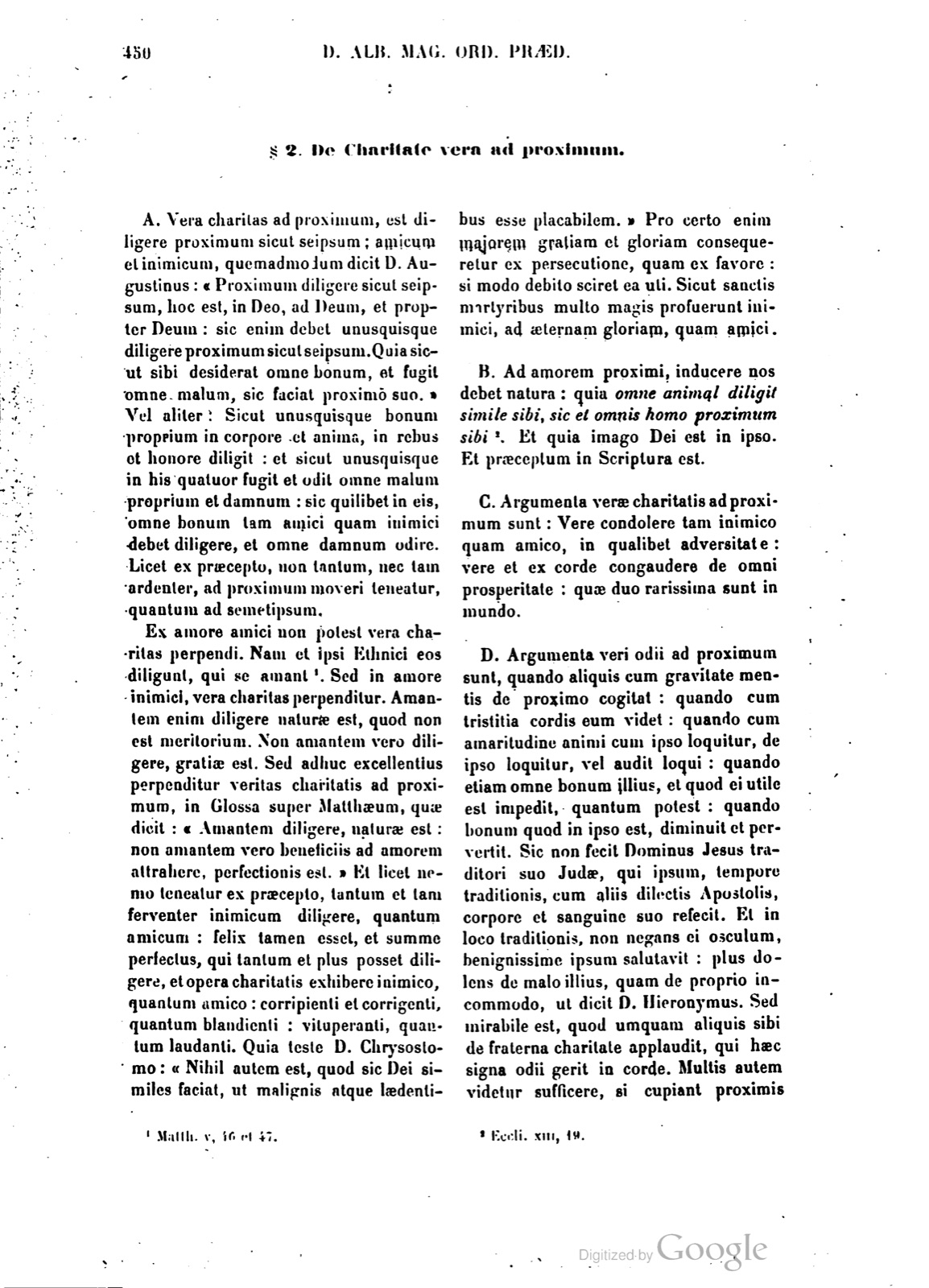
A. Vera charitas ad proximum, est diligere proximum sicut seipsum; amicum et inimicum, quemadmodum dicit D. Augustinus: « Proximum diligere sicut seipsum, hoc est, in Deo, ad Deum, et propter Deum: sic enim debet unusquisque diligere proximum sicut seipsum. Quia sicut sibi desiderat omne bonum, et fugit omne malum, sic faciat proximo suo. » Vel aliter: Sicut unusquisque bonum proprium in corpore et anima, in rebus et honore diligit: et sicut unusquisque in his quatuor fugit et odit omne malum proprium et damnum: sic quilibet in eis, omne bonum tam amici quam inimici debet diligere, et omne damnum odire. Licet ex praecepto, non tantum, nec tam ardenter, ad proximum moveri teneatur, quantum ad semetipsum.
Ex amore amici non potest vera charitas perpendi. Nam et ipsi Ethnici eos diligunt, qui se amant 1. Sed in amore inimici, vera charitas perpenditur. Amantem enim diligere naturae est, quod non est meritorium. Non amantem vero diligere, gratiae est. Sed adhuc excellentius perpenditur veritas charitatis ad proximum, in Glossa super Matthaeum, quae dicit: « Amantem diligere, naturae est: non amantem vero beneficiis ad amorem attrahere, perfectionis est. » Et licet nemo teneatur ex praecepto, tantum et tam ferventer inimicum diligere, quantum amicum: felix tamen esset, et summe perfectus, qui tantum et plus posset diligere, et opera charitatis exhibere inimico, quantum amico: corripienti et corrigenti, quantum blandienti: vituperanti, quantum laudanti. Quia teste D. Chrysostomo: « Nihil autem est, quod sic Dei similes faciat, ut malignis atque laedentibus esse placabilem. » Pro certo enim majorem gratiam et gloriam consequeretur ex persecutione, quam ex favore: si modo debito sciret ea uti. Sicut sanctis martyribus multo magis profuerunt inimici, ad aeternam gloriam, quam amici.
§ 2. On true charity toward one's neighbor.
A. True charity toward one's neighbor is to love one's neighbor as oneself, friend and enemy, as D. Augustine says: "To love one's neighbor as oneself, this is in God, unto God, and for the sake of God; for thus each person ought to love his neighbor as himself. For just as he desires every good for himself and flees every evil, so let him do for his neighbor." Or otherwise: as each person loves his own good in body and soul, in possessions and honor, and as each person in these four flees and hates every evil and loss of his own, so each person ought in these things to love every good of both friend and enemy, and to hate every loss. Although by precept he is not bound to be moved toward his neighbor as much, nor as ardently, as toward himself.
From love of a friend true charity cannot be discerned. For even the heathen love those who love them 1. But in love of an enemy true charity is discerned. For to love one loving us belongs to nature, which is not meritorious. But to love one not loving us belongs to grace. But still more excellently the truth of charity toward neighbor is discerned in the Gloss on Matthew, which says: "To love one loving us belongs to nature; but to draw one not loving us to love by benefits belongs to perfection." And although no one is bound by precept to love an enemy as much and as fervently as a friend, nevertheless happy and supremely perfect would he be who could love as much and more, and exhibit works of charity to an enemy as much as to a friend: to one reproving and correcting as much as to one flattering; to one insulting as much as to one praising. For as D. Chrysostom testifies: "There is nothing that makes one so like God as to be placable toward the malicious and those who harm." For certainly he would obtain greater grace and glory from persecution than from favor, if only he knew how to use these things in due manner. Thus enemies profited the holy martyrs much more for eternal glory than friends did.
B. Ad amorem proximi, inducere nos debet natura: quia omne animal diligit simile sibi, sic et omnis homo proximum sibi 2. Et quia imago Dei est in ipso. Et praeceptum in Scriptura est.
C. Argumenta verae charitatis ad proximum sunt: Vere condolere tam inimico quam amico, in qualibet adversitate: vere et ex corde congaudere de omni prosperitate: quae duo rarissima sunt in mundo.
D. Argumenta veri odii ad proximum sunt, quando aliquis cum gravitate mentis de proximo cogitat: quando cum tristitia cordis eum videt: quando cum amaritudine animi cum ipso loquitur, de ipso loquitur, vel audit loqui: quando etiam omne bonum illius, et quod ei utile est impedit, quantum potest: quando bonum quod in ipso est, diminuit et pervertit. Sic non fecit Dominus Jesus traditori suo Judae, qui ipsum, tempore traditionis, cum aliis dilectis Apostolis, corpore et sanguine suo refecit. Et in loco traditionis, non negans ei osculum, benignissime ipsum salutavit: plus dolens de malo illius, quam de proprio incommodo, ut dicit D. Hieronymus. Sed mirabile est, quod umquam aliquis sibi de fraterna charitate applaudit, qui haec signa odii gerit in corde. Multis autem videtur sufficere, si cupiant proximis vitam aeternam: quam nec dare, nec auferre possunt: quam etiam bene optarent Judaeis et Paganis. Nec memores esse volunt, quod cum Dominus animam suam posuerit pro inimicis suis, nos quoque teneamur non tantum diligere, sed etiam res et animas nostras pro fratribus christianis ponere, tempore necessitatis. Maxime autem Praelati ad hoc tenentur.
E. Ex duobus fovetur charitas. Ad Deum, ex mandatorum exsecutione, secundum illud: Si praecepta mea servaveritis, manebitis in dilectione mea, sicut et ego Patris mei praecepta servavi, et maneo in ejus dilectione 3. Ad proximum, ex compassione; secundum illud Ecclesiastici, VII, 38 et 39: Non desis plorantibus in consolatione, et cum lugentibus ambula. Non te pigeat visitare infirmum: ex his enim dilectione firmaberis.
B. Nature ought to induce us to love of neighbor, because every animal loves what is like itself, so also every human being loves a neighbor like himself 2. And because the image of God is in him. And the commandment is in Scripture.
C. The proofs of true charity toward neighbor are: truly to suffer with both enemy and friend in any adversity; truly and from the heart to rejoice together over every prosperity; these two things are very rare in the world.
D. The proofs of true hatred toward neighbor are when someone thinks of his neighbor with heaviness of mind; when he sees him with sadness of heart; when with bitterness of spirit he speaks with him, speaks about him, or hears him spoken about; when also he impedes every good of his, and what is useful to him, as much as he can; when he diminishes and perverts the good that is in him. The Lord Jesus did not do so to his betrayer Judas, for at the time of betrayal he refreshed him with his body and blood along with the other beloved apostles. And in the place of betrayal, not denying him a kiss, he greeted him most kindly, grieving more over his evil than over his own disadvantage, as D. Jerome says. But it is marvelous that anyone ever applauds himself concerning fraternal charity who bears these signs of hatred in his heart. It seems sufficient to many if they wish eternal life for their neighbors, which they can neither give nor take away, and which they would even wish well for Jews and pagans. Nor do they wish to remember that since the Lord laid down his soul for his enemies, we also are bound not only to love, but also to lay down our goods and our souls for Christian brothers in time of necessity. Prelates especially are bound to this.
E. Charity is fostered by two things. Toward God, by execution of the commandments, according to that: If you keep my precepts, you will remain in my love, as I also have kept my Father's precepts and remain in his love 3. Toward neighbor, by compassion, according to that of Ecclesiasticus 7:38 and 39: Do not fail those who weep in consolation, and walk with those who mourn. Let it not weary you to visit the sick; for by these things you will be strengthened in love.
If a page does not appear, its photograph has not been uploaded yet.