Works › The Mariale: Questions on “Missus est”
Volume 37 · pp. 320–321
Question 230 and Response to Questions 229 and 230
A marker with ≈ is an approximate page boundary, placed by measure of the text; the page photographs remain the authority. In the paired views, clicking a page marker brings that page into view.
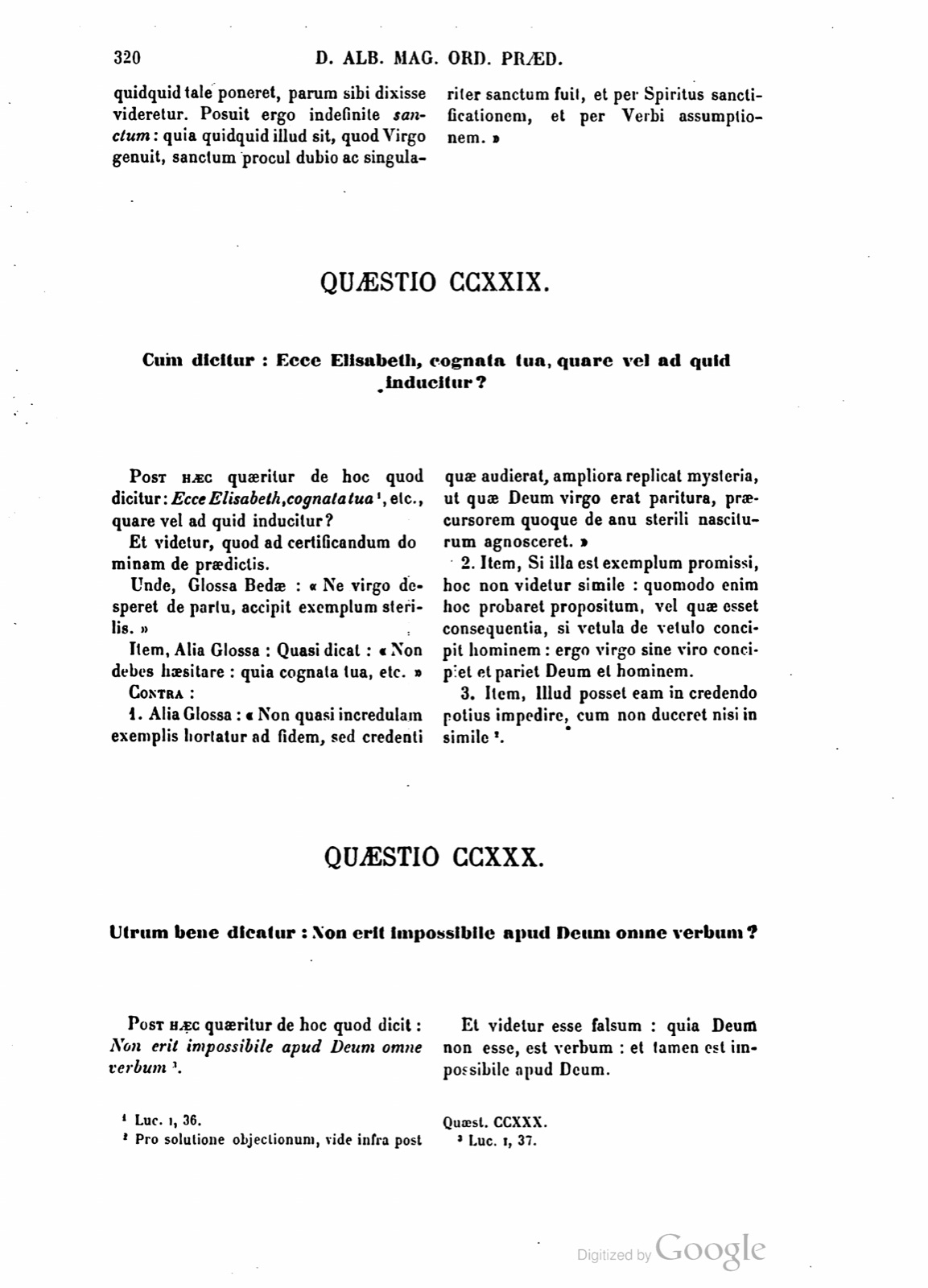
QUAESTIO CCXXX. Utrum bene dicatur: Non erit impossibile apud Deum omne verbum?
Post haec quaeritur de hoc quod dicit: Non erit impossibile apud Deum omne verbum 1. Et videtur esse falsum: quia Deum non esse, est verbum: et tamen est impossibile apud Deum.
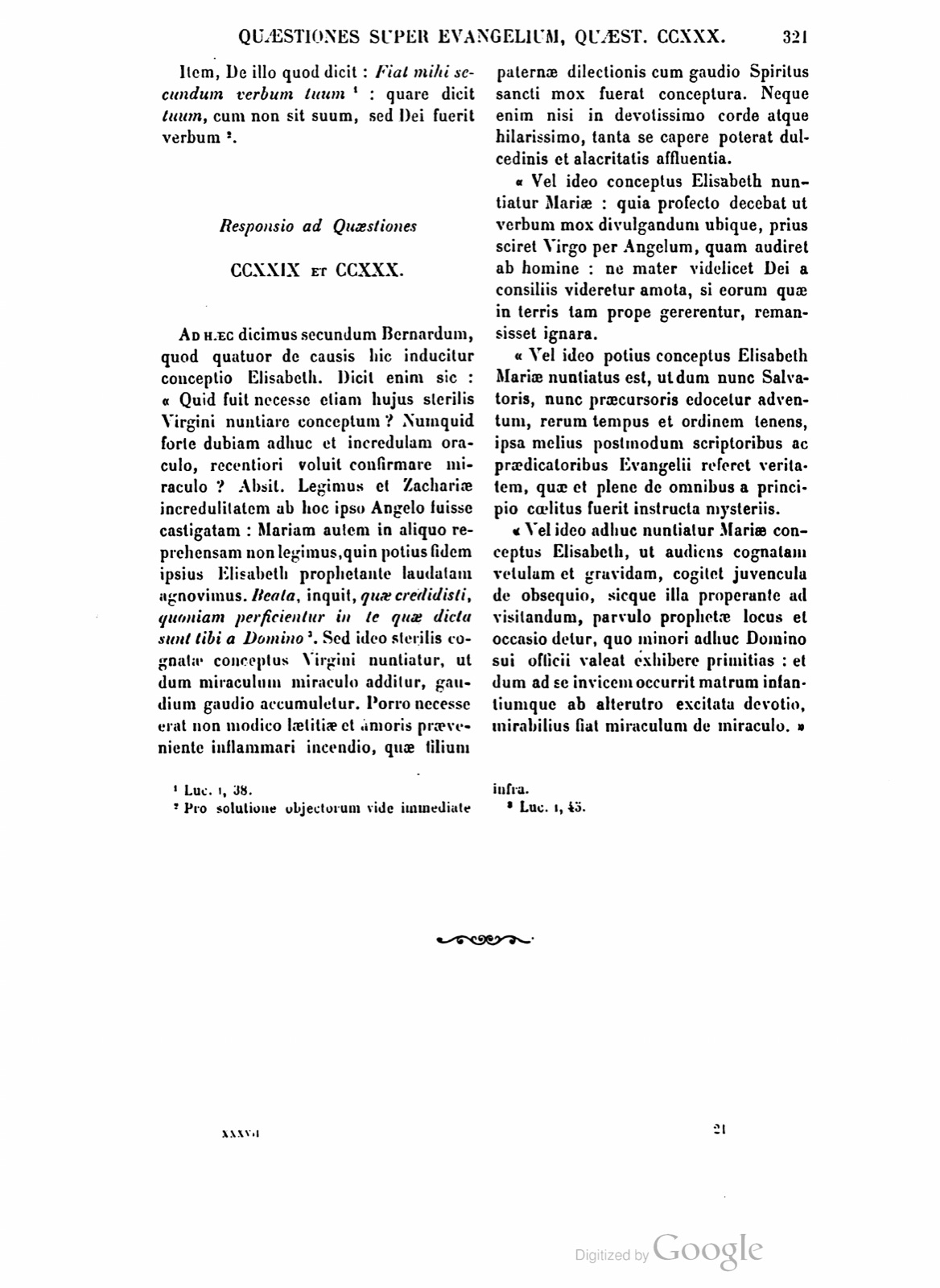
Item, De illo quod dicit: Fiat mihi secundum verbum tuum 2: quare dicit tuum, cum non sit suum, sed Dei fuerit verbum 3.
Responsio ad Quaestiones CCXXIX et CCXXX.
Ad haec dicimus secundum Bernardum, quod quatuor de causis hic inducitur conceptio Elisabeth. Dicit enim sic: "Quid fuit necesse etiam hujus sterilis Virgini nuntiare conceptum? Numquid forte dubiam adhuc et incredulam oraculo, recentiori voluit confirmare miraculo? Absit. Legimus et Zachariae incredulitatem ab hoc ipso Angelo fuisse castigatam: Mariam autem in aliquo reprehensam non legimus, quin potius fidem ipsius Elisabeth prophetante laudatam agnovimus. Beata, inquit, quae credidisti, quoniam perficientur in te quae dicta sunt tibi a Domino 4. Sed ideo sterilis cognatae conceptus Virgini nuntiatur, ut dum miraculum miraculo additur, gaudium gaudio accumulatur. Porro necesse erat non modico laetitiae et amoris praeveniente inflammari incendio, quae filium paternae dilectionis cum gaudio Spiritus sancti mox fuerat conceptura. Neque enim nisi in devotissimo corde atque hilarissimo, tanta se capere poterat dulcedinis et alacritatis affluentia.
QUESTION 230. Whether it is well said: No word will be impossible with God?
After these things inquiry is made concerning this which he says: No word will be impossible with God 1. And it seems to be false, because for God not to be is a word, and nevertheless it is impossible with God.
Likewise, concerning that which she says: Let it be done to me according to your word 2: why does she say your, since it was not his word but God's word 3?
Response to Questions 229 and 230.
To these things we say according to Bernard that the conception of Elizabeth is introduced here for four causes. For he says thus: "What need was there also to announce to the Virgin the conception of this sterile woman? Perhaps did he wish to confirm her, still doubtful and incredulous toward the oracle, by a more recent miracle? Far from it. We read that even the incredulity of Zachary was chastised by this same Angel; but we do not read that Mary was reprehended in anything; rather we know that her faith was praised by Elizabeth prophesying. Blessed, she says, are you who have believed, because the things said to you by the Lord will be fulfilled in you 4. But the conception of the sterile kinswoman is announced to the Virgin for this reason, so that while miracle is added to miracle, joy is heaped upon joy. Moreover it was necessary that she be inflamed beforehand by no small fire of joy and love, who soon was going to conceive the Son of paternal love with the joy of the Holy Spirit. For such an abundance of sweetness and gladness could not contain itself except in a most devout and most joyful heart.
"Vel ideo conceptus Elisabeth nuntiatur Mariae: quia profecto decebat ut verbum mox divulgandum ubique, prius sciret Virgo per Angelum, quam audiret ab homine: ne mater videlicet Dei a consiliis videretur amota, si eorum quae in terris tam prope gererentur, remansisset ignara.
"Vel ideo potius conceptus Elisabeth Mariae nuntiatus est, ut dum nunc Salvatoris, nunc praecursoris edocetur adventum, rerum tempus et ordinem tenens, ipsa melius postmodum scriptoribus ac praedicatoribus Evangelii referet veritatem, quae et plene de omnibus a principio caelitus fuerit instructa mysteriis.
"Vel ideo adhuc nuntiatur Mariae conceptus Elisabeth, ut audiens cognatam vetulam et gravidam, cogitet juvencula de obsequio, sicque illa properante ad visitandum, parvulo prophetae locus et occasio detur, quo minori adhuc Domino sui officii valeat exhibere primitias: et dum ad se invicem occurrit matrum infantiumque ab alterutro excitata devotio, mirabilius fiat miraculum de miraculo."
"Or the conception of Elizabeth is announced to Mary for this reason: because surely it was fitting that the Virgin should know through the Angel, before she heard from a human being, the word that would soon be spread everywhere, lest the Mother of God seem removed from the counsels if she had remained ignorant of those things which were being done so near on earth.
"Or rather the conception of Elizabeth was announced to Mary for this reason, that while she is taught now of the coming of the Savior, now of the forerunner, holding the time and order of things, she herself afterward may better report the truth to the writers and preachers of the Gospel, she who was also fully instructed from the beginning from heaven concerning all the mysteries.
"Or still the conception of Elizabeth is announced to Mary for this reason, so that, hearing that her old kinswoman is pregnant, the young woman may think about service, and thus, while she hastens to visit, place and occasion may be given to the little prophet by which he may be able to exhibit the first-fruits of his office to the Lord still smaller; and while the devotion of mothers and infants, stirred by one another, runs to meet itself mutually, a miracle may be made more wonderful from a miracle."
If a page does not appear, its photograph has not been uploaded yet.