Works › The Mariale: Questions on “Missus est”
Volume 37 · p. 320
Question 229. When it is said: Behold Elizabeth, your kinswoman, why or for what purpose is it introduced?
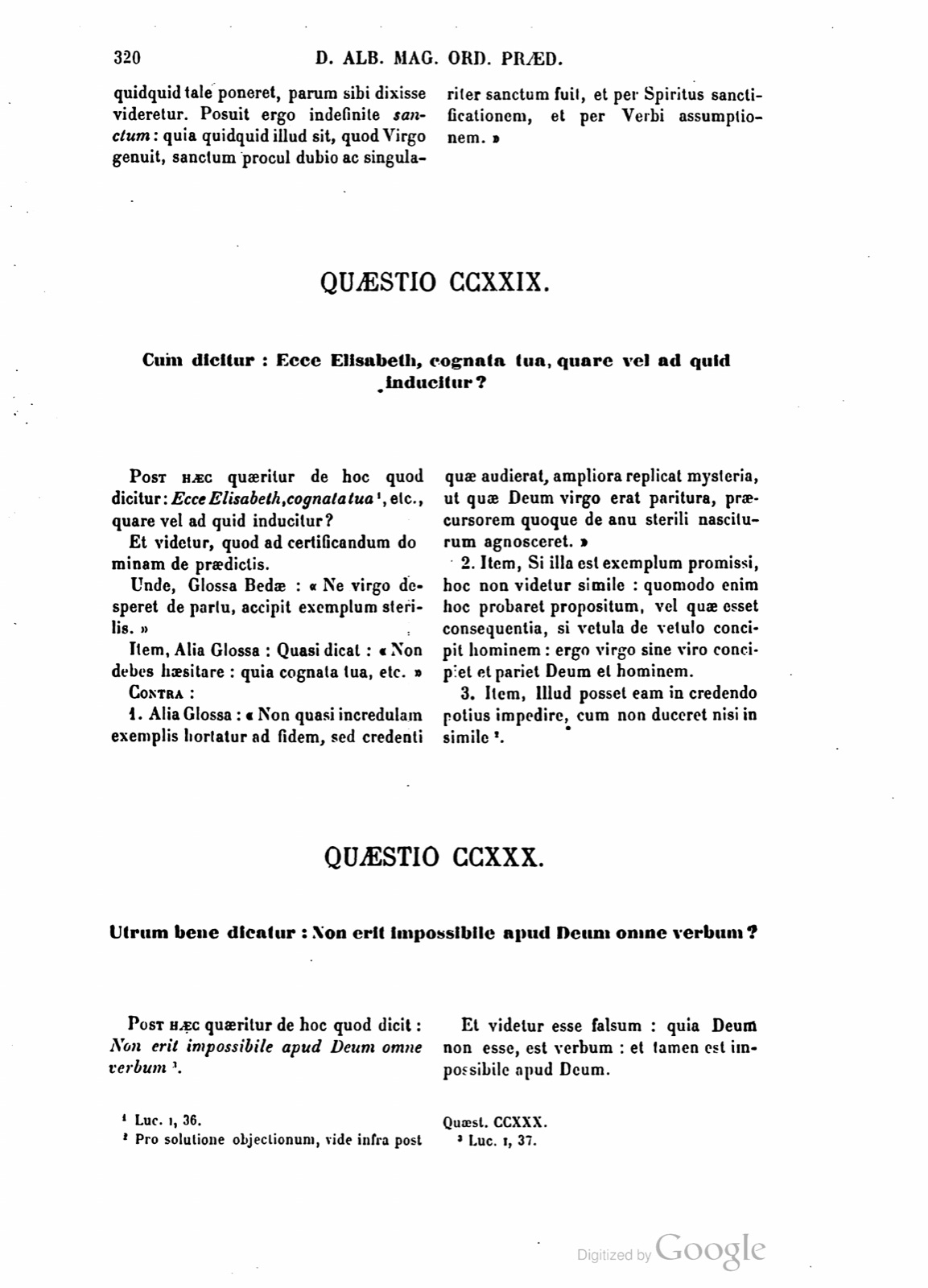
QUAESTIO CCXXIX. Cum dicitur: Ecce Elisabeth, cognata tua, quare vel ad quid inducitur?
Post haec quaeritur de hoc quod dicitur: Ecce Elisabeth, cognata tua 1, etc., quare vel ad quid inducitur?
Et videtur, quod ad certificandum dominam de praedictis.
Unde, Glossa Bedae: "Ne virgo desperet de partu, accipit exemplum sterilis."
Item, Alia Glossa: Quasi dicat: "Non debes haesitare: quia cognata tua, etc."
Contra:
1. Alia Glossa: "Non quasi incredulam exemplis hortatur ad fidem, sed credenti quae audierat, ampliora replicat mysteria, ut quae Deum virgo erat paritura, praecursorem quoque de anu sterili nasciturum agnosceret."
2. Item, Si illa est exemplum promissi, hoc non videtur simile: quomodo enim hoc probaret propositum, vel quae esset consequentia, si vetula de vetulo concipit hominem: ergo virgo sine viro concipiet et pariet Deum et hominem.
3. Item, Illud posset eam in credendo potius impedire, cum non duceret nisi in simile 2.
QUESTION 229. When it is said: Behold Elizabeth, your kinswoman, why or for what purpose is it introduced?
After these things inquiry is made concerning this which is said: Behold Elizabeth, your kinswoman 1, etc., why or for what purpose it is introduced.
And it seems that it is for certifying the Lady about the aforesaid things.
Whence the Gloss of Bede says: "Lest the virgin despair concerning birth, she receives the example of a sterile woman."
Likewise, another Gloss says, as if saying: "You ought not to hesitate, because your kinswoman, etc."
To the contrary:
1. Another Gloss says: "He does not exhort her, as though incredulous, to faith by examples, but to the one believing what she had heard he unfolds greater mysteries, so that she who, a virgin, was going to bear God might also recognize that the forerunner would be born from a sterile old woman."
2. Likewise, if that is an example of the thing promised, this does not seem similar. For how would this prove the proposed thing, or what would the consequence be, if an old woman conceives a human being from an old man: therefore a virgin without a man will conceive and bear God and man?
3. Likewise, that could rather impede her in believing, since it would lead only to something similar 2.
Notes
- Luke 1:36. (Luc. I, 36.) ↩
- For the solution of the objections, see below after Question 230. (Pro solutione objectionum, vide infra post Quaest. CCXXX.) ↩
If a page does not appear, its photograph has not been uploaded yet.