Works › The Mariale: Questions on “Missus est”
Volume 37 · pp. 301–302
Continuation of Question 213 and Response to Questions 205, 206, etc.
A marker with ≈ is an approximate page boundary, placed by measure of the text; the page photographs remain the authority. In the paired views, clicking a page marker brings that page into view.
ceptione, fuit delectatio: ergo in divisione quae facta est in partu, est dolor.
Contra:
1. Peperit sine dolore.
2. Item, Isa. LXVI, 7: Antequam parturiret, peperit.
3. Item, Ante partum tantum reficiebatur secundum intellectum et tactum, nunc autem secundum intellectum et omnem sensum: ergo modo majorata est sua delectatio 1.
Responsio ad Quaestiones CCV, CCVI, etc.
Ad praedicta secundum ordinem solvendo dicimus, quod haec conceptio est opus Trinitatis, appropriabile tantum Spiritui sancto rationibus assignatis. Patri autem congruit generatio quae est in identitate substantiae: omnis enim pater generat in identitate naturae suae, ut Deus Deum, homo hominem.
Item, Generatio temporalis quamvis habeat cum aeterna convenientiam remotam, non tamen propinquam: in ista enim temporali est differentia ejusdem naturae et essentiae secundum speciem inter matrem et filium: in aeterna autem non est differentia ejusdem naturae et essentiae inter patrem et filium: unde hoc non appropriatur Patri, sed Spiritui sancto cujus est donorum distributio.
Item, Non est idem Filium dare et incarnationem facere: quia posset Filium dare non existentem in carne, ut dicit Augustinus in libro quarto de Trinitate. Item, cum recreatio et glorificatio habeant se ad invicem sicut causa ad causatum, sicut unum appropriatur Spiritui sancto, ita et reliquum. Item, generatum efficere est dupliciter, per modum efficientis, et per modum materialis. Primum istorum habet rationem patris.
Unde autem materialiter facta sit ista conceptio, dicimus cum Damasceno, quod non tantum de sanguine, sed et de sanguinibus et carnibus beatissimae Virginis. Et dicimus, quod duplex est humiditas sive sanguis in corpore. Una nutrimentalis, quae venit a cibo: et haec non est corpus vel corporis pars, sed potest bene uniri et pars fieri, vel transmitti ad generationem corporis alterius. Praeter hanc est ibi humiditas substantialis, quae est actualiter in omnibus membris, et est pars essentialis corporis, vel essentialibus partibus generantibus conjuncta, vel per nutrimentum in corpus conversa, et illi unita. Et ex his utrisque fit decisio vel propagatio. Et hoc est quod subtiliter tangit Philosophus in libro de Anima, dicens quod humiditas est generationis factivum. Et hoc duobus modis. Uno modo: quia ex superfluitate ipsius in ultima digestione fit pars seminis et rei generatae. Alio modo: quia per alimentum membra suscipiunt completam quantitatem et substantiam, ut possint ex ipsis descindere essentialiorem et veriorem partem seminis et rei generatae: alias si nutrimentum tantum esset materia seminis et non factivum, non bene diceret Philosophus factivum, quod dicit potentiam activam. Nunc autem est nutrimentum et materia seminis quantum ad majorem partem ipsius seminis, et est causa efficiens et conferens membris complementum ad descindendum de se partem seminis essentialiorem et veriorem.
ception, there was delight; therefore in the division that was made in birth, there is pain.
To the contrary:
1. She gave birth without pain.
2. Likewise, Isaiah 66:7: Before she travailed, she gave birth.
3. Likewise, before birth she was refreshed only according to intellect and touch, but now according to intellect and every sense; therefore now her delight is increased 1.
Response to Questions 205, 206, etc.
In solving the aforesaid in order, we say that this conception is the work of the Trinity, appropriable only to the Holy Spirit for the reasons assigned. But generation which is in identity of substance befits the Father; for every father generates in the identity of his own nature, as God generates God, and a human being a human being.
Likewise, although temporal generation has a remote agreement with eternal generation, it does not have a near one. For in this temporal generation there is a difference of the same nature and essence according to species between mother and son; but in eternal generation there is no difference of the same nature and essence between Father and Son. Whence this is not appropriated to the Father, but to the Holy Spirit, to whom the distribution of gifts belongs.
Likewise, to give the Son and to make the incarnation are not the same, because he could give the Son not existing in the flesh, as Augustine says in book four On the Trinity. Likewise, since recreation and glorification are related to each other as cause to caused, as one is appropriated to the Holy Spirit, so also is the remaining one. Likewise, to effect a generated thing is twofold: by way of efficient cause and by way of material cause. The first of these has the character of father.
But whence this conception was made materially, we say with Damascene that it was not only from blood, but also from the bloods and flesh of the most blessed Virgin. And we say that there is a twofold moisture or blood in the body. One is nutritional, which comes from food; and this is not body or part of the body, but it can well be united and become a part, or be transmitted to the generation of another body. Besides this there is there a substantial moisture, which is actually in all the members, and is an essential part of the body, either joined to the essential generating parts, or converted into body through nourishment and united to it. And from both of these separation or propagation occurs. And this is what the Philosopher subtly touches on in the book On the Soul, saying that moisture is productive of generation. And this in two ways. In one way, because from its superfluity in the last digestion there becomes a part of the seed and of the thing generated. In another way, because through food the members receive complete quantity and substance, so that they can cut off from themselves a more essential and truer part of the seed and of the thing generated; otherwise, if nourishment were only the matter of seed and not productive, the Philosopher would not well say productive, which expresses active power. But now nourishment is both the matter of seed as regards the greater part of the seed itself, and it is an efficient cause giving the members completion for cutting off from themselves a more essential and truer part of the seed.
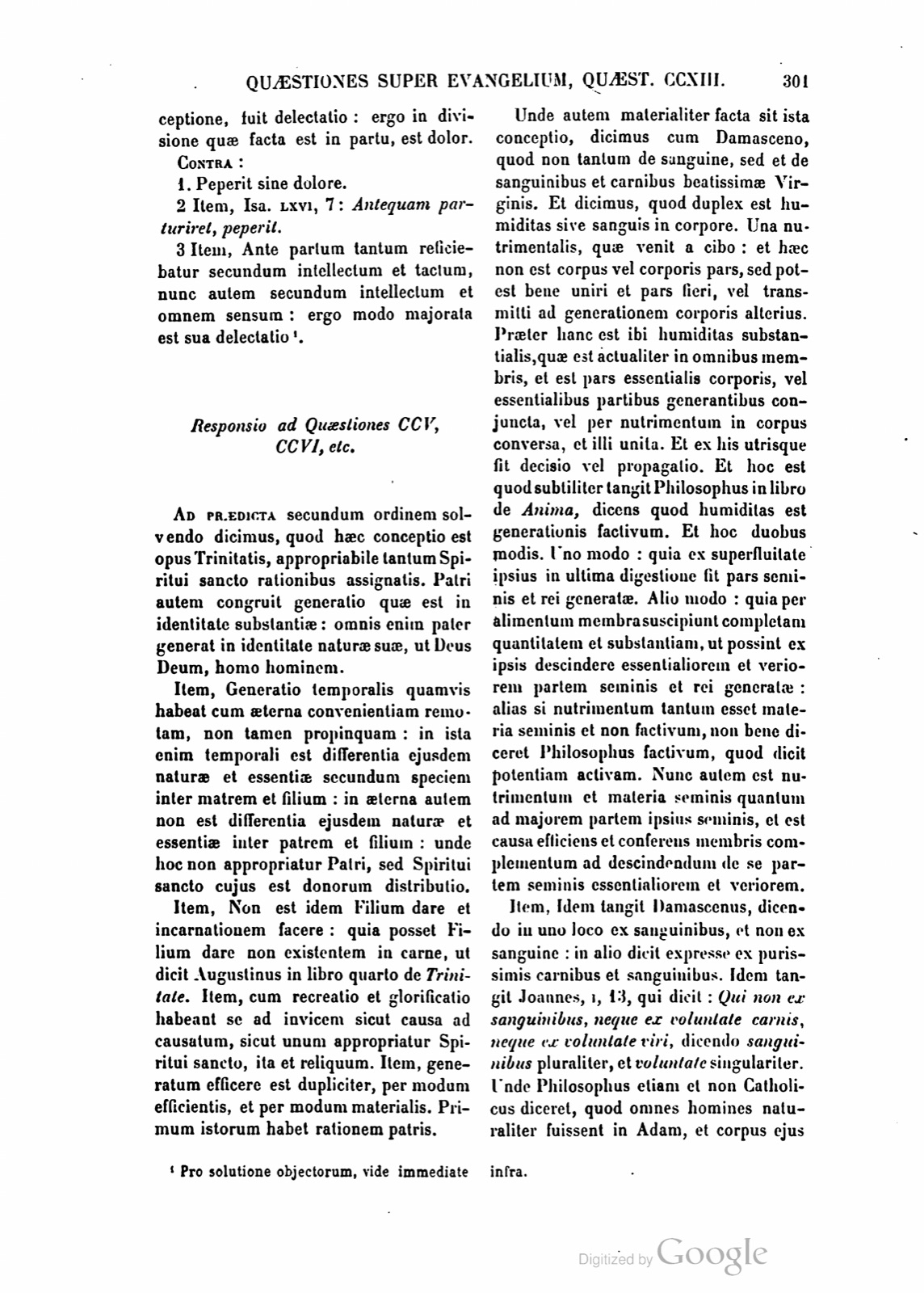
Item, Idem tangit Damascenus, dicendo in uno loco ex sanguinibus, et non ex sanguine: in alio dicit expresse ex purissimis carnibus et sanguinibus. Idem tangit Joannes, I, 13, qui dicit: Qui non ex sanguinibus, neque ex voluntate carnis, neque ex voluntate viri, dicendo sanguinibus pluraliter, et voluntate singulariter. Unde Philosophus etiam et non Catholicus diceret, quod omnes homines naturaliter fuissent in Adam, et corpus ejus continuum fuisset divisibile in semper divisibilia, et numquam fuisset status divisionis ex parte rei divisae: et sic homo comestus habet pro veritate humanae naturae illud quod contraxit in sua conceptione a parentibus: reliquum autem quod postmodum sibi per nutrimentum et ante animationem vel post est unitum, cedet tertio: et sic quilibet habet suam propriam humanae naturae veritatem.
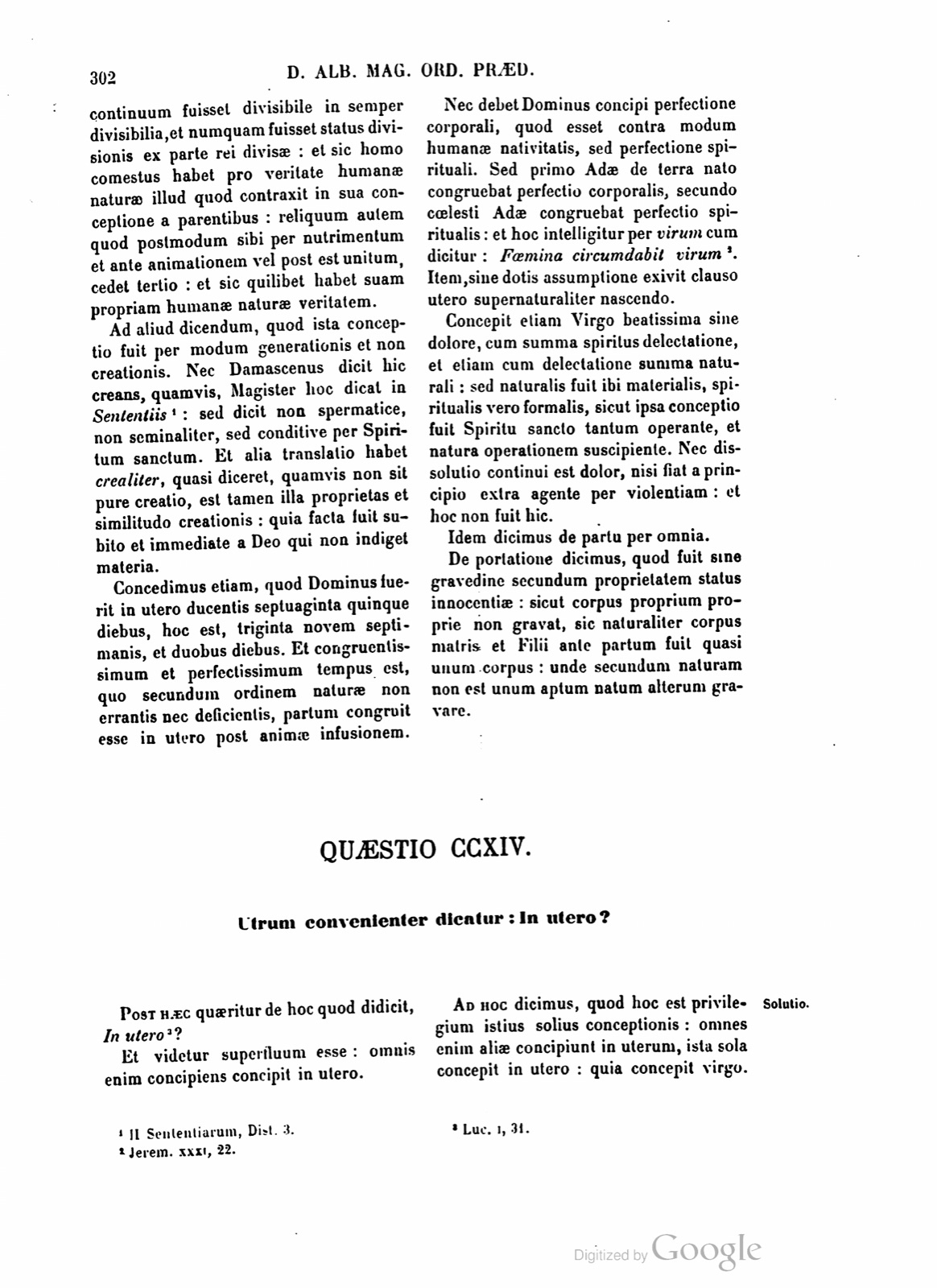
Ad aliud dicendum, quod ista conceptio fuit per modum generationis et non creationis. Nec Damascenus dicit hic creans, quamvis Magister hoc dicat in Sententiis 2: sed dicit non spermatice, non seminaliter, sed conditive per Spiritum sanctum. Et alia translatio habet crealiter, quasi diceret, quamvis non sit pure creatio, est tamen illa proprietas et similitudo creationis: quia facta fuit subito et immediate a Deo qui non indiget materia.
Concedimus etiam, quod Dominus fuerit in utero ducentis septuaginta quinque diebus, hoc est, triginta novem septimanis, et duobus diebus. Et congruentissimum et perfectissimum tempus est, quo secundum ordinem naturae non errantis nec deficientis, partum congruit esse in utero post animae infusionem.
Nec debet Dominus concipi perfectione corporali, quod esset contra modum humanae nativitatis, sed perfectione spirituali. Sed primo Adae de terra nato congruebat perfectio corporalis, secundo caelesti Adae congruebat perfectio spiritualis: et hoc intelligitur per virum cum dicitur: Foemina circumdabit virum 3. Item, sine dotis assumptione exivit clauso utero supernaturaliter nascendo.
Concepit etiam Virgo beatissima sine dolore, cum summa spiritus delectatione, et etiam cum delectatione summa naturali: sed naturalis fuit ibi materialis, spiritualis vero formalis, sicut ipsa conceptio fuit Spiritu sancto tantum operante, et natura operationem suscipiente. Nec dissolutio continui est dolor, nisi fiat a principio extra agente per violentiam: et hoc non fuit hic.
Idem dicimus de partu per omnia.
De portatione dicimus, quod fuit sine gravedine secundum proprietatem status innocentiae: sicut corpus proprium proprie non gravat, sic naturaliter corpus matris et Filii ante partum fuit quasi unum corpus: unde secundum naturam non est unum aptum natum alterum gravare.
Likewise, Damascene touches on the same thing by saying in one place from bloods and not from blood; in another place he expressly says from most pure flesh and bloods. John touches on the same thing, John 1:13, who says: Who not from bloods, nor from the will of the flesh, nor from the will of a man, saying bloods in the plural and will in the singular. Whence even the Philosopher, and not a Catholic, would say that all human beings naturally were in Adam, and that his body would have been a continuum divisible into things always divisible, and that there never would have been a stopping point of division on the part of the divided thing. And thus the eaten human being has for the truth of human nature that which he contracted in his conception from his parents; but the remaining thing which afterward was united to him by nourishment and before animation or after will yield to the third; and thus anyone has his own proper truth of human nature.
To the other it must be said that this conception was by way of generation and not creation. Nor does Damascene here say creating, although the Master says this in the Sentences 2; but he says not spermatically, not seminally, but constitutively through the Holy Spirit. And another translation has creatively, as though he were saying that although it is not pure creation, nevertheless that property and likeness of creation is there, because it was made suddenly and immediately by God, who does not need matter.
We also grant that the Lord was in the womb for two hundred seventy-five days, that is, thirty-nine weeks and two days. And that is the most fitting and most perfect time in which, according to the order of nature not erring and not deficient, it is fitting for the birth to be in the womb after the infusion of the soul.
Nor ought the Lord to be conceived with bodily perfection, which would be contrary to the mode of human birth, but with spiritual perfection. But bodily perfection befitted the first Adam, born from the earth; spiritual perfection befitted the second, heavenly Adam. And this is understood by the word man when it is said: A woman will encompass a man 3. Likewise, without assuming a dowry, he went out from the closed womb by being born supernaturally.
The most blessed Virgin also conceived without pain, with the highest delight of spirit, and also with the highest natural delight. But the natural delight was there material, and the spiritual formal, just as the conception itself was by the Holy Spirit alone operating and nature receiving the operation. Nor is dissolution of the continuous pain unless it is done by a principle acting from outside through violence; and this was not here.
We say the same about the birth in every respect.
Concerning carrying, we say that it was without heaviness according to the property of the state of innocence. Just as one's own body properly does not weigh one down, so naturally the body of the mother and of the Son before birth was as it were one body. Whence according to nature one is not apt by nature to weigh down the other.
If a page does not appear, its photograph has not been uploaded yet.