Works › The Mariale: Questions on “Missus est”
Volume 37 · pp. 226–227
Question 155. Whether she had the properties of Principalities?
A marker with ≈ is an approximate page boundary, placed by measure of the text; the page photographs remain the authority. In the paired views, clicking a page marker brings that page into view.
QUAESTIO CLV. Utrum habuerit proprietates Principatuum?
Tertius est ordo Principatuum, qui similiter tres habent proprietates.
Prima est primi principii imitativum. Secunda est principalium virtutum ordinativum. Tertia est inferiorum ad ipsum princificum principium reductivum.
Primam habuit beatissima Virgo in summo: imitatur enim primum principium in tribus, in mali immunitate, juxta illud Sapientiae, VI, 20: Incorruptio facit esse proximum Deo. In bonorum communicatione: mater enim bonorum omnium est: venerunt autem mihi omnia bona pariter cum illa, et innumerabilis honestas per manus illius, sicut dicitur, Sapient. VII, 11. In communicanda bonorum operum communicatione: est enim oliva speciosa in campis 1: et praeoccupat qui se concupiscunt: et dignos se ipsa circuit quaerens, etc. 2. Eccli. XXIV, 26: Transite ad me, omnes qui concupiscitis me, et a generationibus meis implemini. Est igitur primi principii immutativa in summo.
QUESTION 155. Whether she had the properties of Principalities?
The third is the order of Principalities, which likewise have three properties.
The first is to imitate the first principle. The second is to order principal virtues. The third is to lead inferiors back to the principating principle itself.
The most blessed Virgin had the first in the highest degree, for she imitates the first principle in three things: in immunity from evil, according to Wisdom 6:20: Incorruption makes one to be near to God; in communication of goods, for she is mother of all good things: all good things came to me together with her, and innumerable honor through her hands, as is said in Wisdom 7:11; and in communicating the communication of good works, for she is a beautiful olive in the fields 1, and she anticipates those who desire her, and goes about seeking those worthy of her, etc. 2. Ecclesiasticus 24:26: Pass over to me, all you who desire me, and be filled from my generations. Therefore she imitates the first principle in the highest degree.
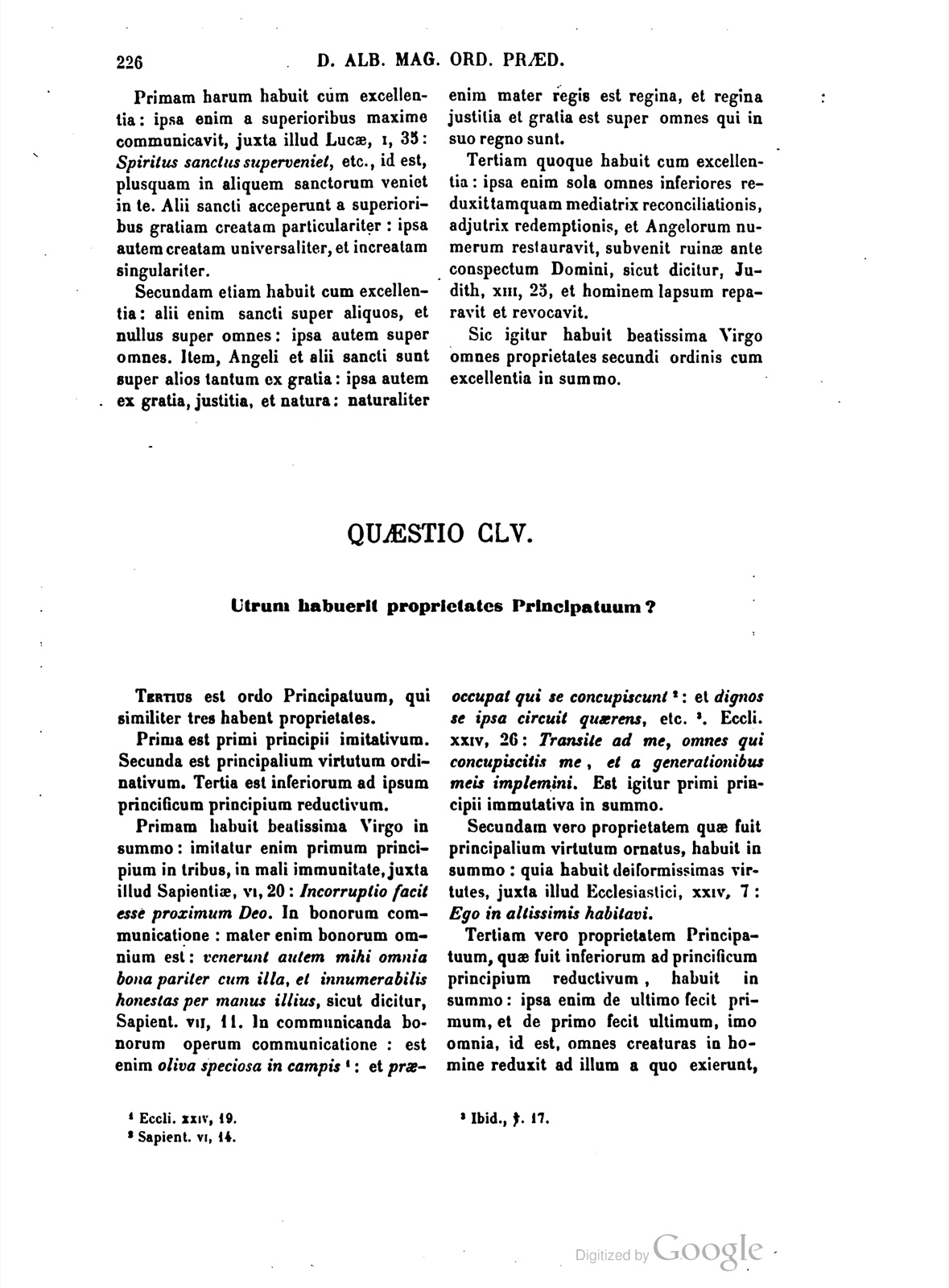
Secundam vero proprietatem quae fuit principalium virtutum ornatus, habuit in summo: quia habuit deiformissimas virtutes, juxta illud Ecclesiastici, XXIV, 7: Ego in altissimis habitavi.
Tertiam vero proprietatem Principatuum, quae fuit inferiorum ad princificum principium reductivum, habuit in summo: ipsa enim de ultimo fecit primum, et de primo fecit ultimum, imo omnia, id est, omnes creaturas in homine reduxit ad illum a quo exierunt, illi personaliter uniendo: unde est illa mulier fortis, de qua dicitur, Proverb. XXXI, 10, cujus pretium de ultimis finibus, id est, de divinitate et humanitate conjunctis hominem perditum redemit.
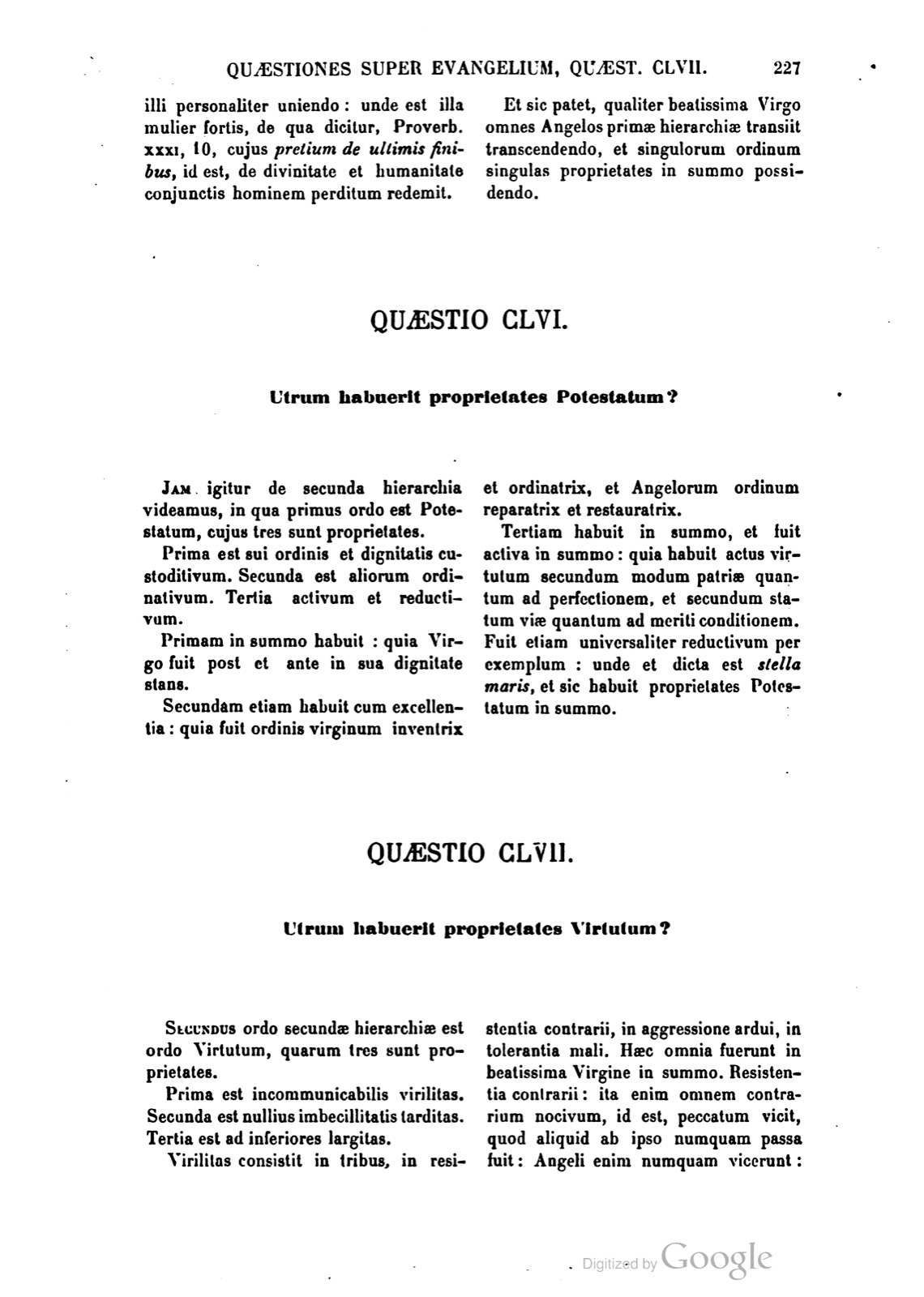
Et sic patet, qualiter beatissima Virgo omnes Angelos primae hierarchiae transiit transcendendo, et singulorum ordinum singulas proprietates in summo possidendo.
But she had the second property, which was the adornment of principal virtues, in the highest degree, because she had most God-formed virtues, according to Ecclesiasticus 24:7: I dwelt in the highest places.
But she had the third property of the Principalities, which was to lead inferiors back to the principating principle, in the highest degree. For she made the last first, and made the first last, indeed all things, that is, all creatures in man, she led back to him from whom they went out, by uniting them personally to him. Whence she is that strong woman of whom Proverbs 31:10 says that her price is from the farthest ends, that is, from divinity and humanity joined together she redeemed lost man.
And thus it is clear how the most blessed Virgin passed beyond all Angels of the first hierarchy by transcending them, and by possessing in the highest degree the individual properties of the individual orders.
If a page does not appear, its photograph has not been uploaded yet.