Works › The Mariale: Questions on “Missus est”
Volume 37 · pp. 182–184
Question 131. Whether the Blessed Virgin underwent death without pain?
A marker with ≈ is an approximate page boundary, placed by measure of the text; the page photographs remain the authority. In the paired views, clicking a page marker brings that page into view.
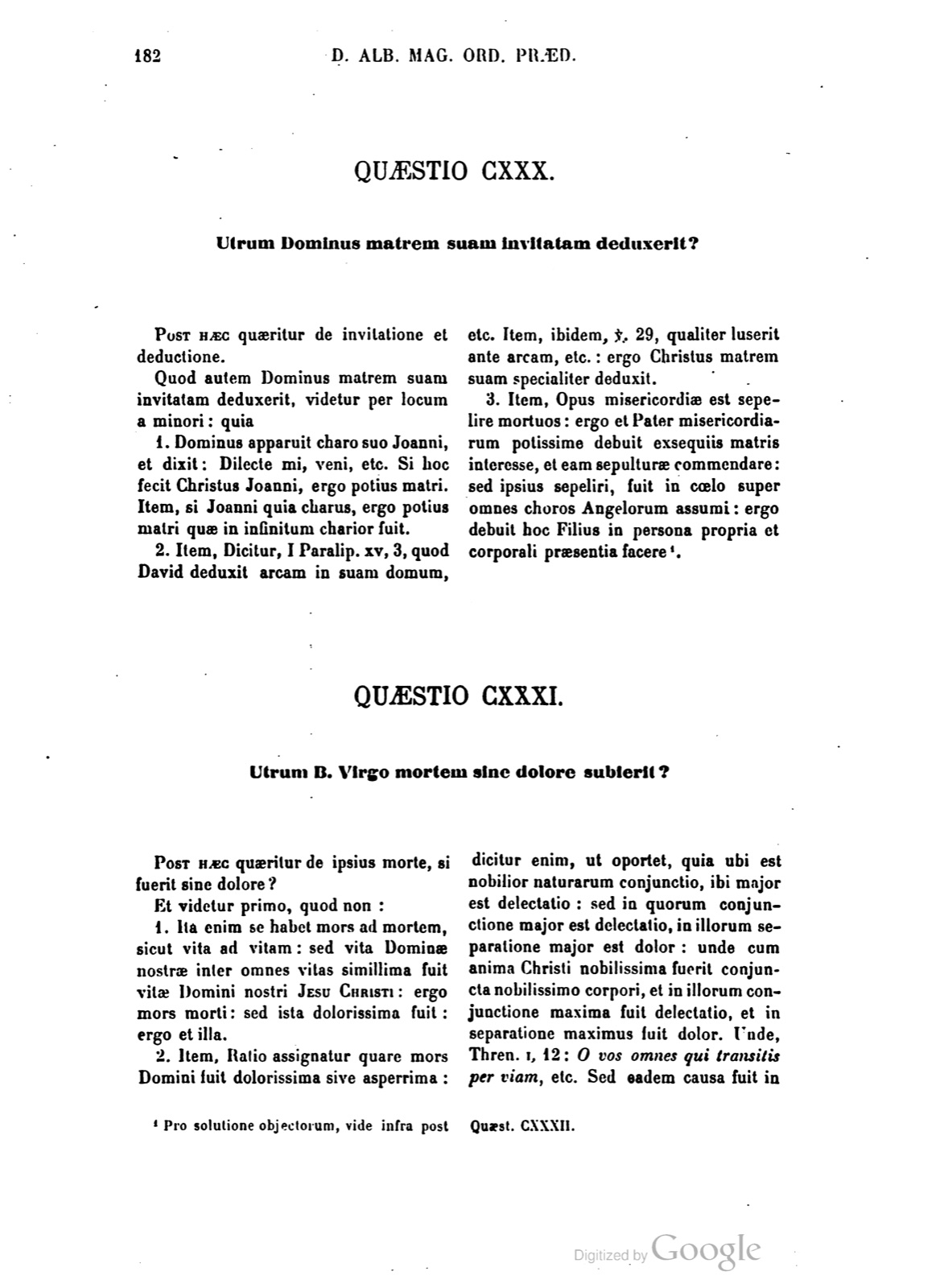
QUAESTIO CXXXI. Utrum B. Virgo mortem sine dolore subierit?
Post haec quaeritur de ipsius morte, si fuerit sine dolore?
Et videtur primo, quod non:
1. Ita enim se habet mors ad mortem, sicut vita ad vitam: sed vita Dominae nostrae inter omnes vitas simillima fuit vitae Domini nostri Jesu Christi: ergo mors morti: sed ista dolorissima fuit: ergo et illa.
2. Item, Ratio assignatur quare mors Domini fuit dolorissima sive asperrima: dicitur enim, ut oportet, quia ubi est nobilior naturarum conjunctio, ibi major est delectatio: sed in quorum conjunctione major est delectatio, in illorum separatione major est dolor: unde cum anima Christi nobilissima fuerit conjuncta nobilissimo corpori, et in illorum conjunctione maxima fuit delectatio, et in separatione maximus fuit dolor. Unde, Thren. I, 12: O vos omnes qui transitis per viam, etc. Sed eadem causa fuit in beatissima Virgine secundo loco in summo. Ergo in ipsius morte maximus fuit dolor post dolorem Christi.
3. Item, Inter quaecumque major est pax, illorum delectabilior est commansio: sed in corpore beatissimae Virginis et in anima sua maxima pax fuit ad invicem, quia spiritus adversus carnem non concupivit, nec e converso: ergo et delectabilior commansio: ergo et maximus in separatione dolor.
In contrarium est quod:
1. Legitur in prologo super Joannem de Joanne, quod facta oratione positus est ad patres suos, tam extraneus a dolore mortis, quam a corruptione carnis: sed improportionabiliter beata Virgo aliena fuit a corruptione carnis: ergo improportionabiliter plus debuit esse aliena a dolore mortis.
QUESTION 131. Whether the Blessed Virgin underwent death without pain?
After this inquiry is made concerning her death, whether it was without pain.
And first it seems that it was not:
1. For death is related to death as life is related to life. But the life of our Lady among all lives was most similar to the life of our Lord Jesus Christ. Therefore her death was similar to his death. But that death was most painful. Therefore so also hers.
2. Likewise, a reason is assigned why the Lord’s death was most painful or most bitter. For it is said, as is fitting, that where there is a nobler conjunction of natures, there is greater delight; but in the separation of those in whose conjunction there is greater delight, there is greater pain. Hence since the soul of Christ, most noble, was joined to a most noble body, and in their conjunction there was the greatest delight, in their separation there was the greatest pain. Hence Lamentations 1:12: O all you who pass by the way, etc. But the same cause was in the most blessed Virgin in the highest degree in second place. Therefore in her death there was the greatest pain after the pain of Christ.
3. Likewise, between whatever things there is greater peace, their dwelling together is more delightful. But in the body of the most blessed Virgin and in her soul there was the greatest mutual peace, because the spirit did not desire against the flesh, nor conversely. Therefore their dwelling together was more delightful; therefore also in their separation there was the greatest pain.
To the contrary is this:
1. In the prologue on John it is read concerning John that, when prayer had been made, he was placed with his fathers, as foreign to the pain of death as to the corruption of the flesh. But the blessed Virgin was disproportionately foreign to corruption of the flesh. Therefore disproportionately more she ought to have been foreign to the pain of death.
2. Item, Damascenus: « Sed ipsa beata et super naturam donorum digna effecta dolores quos effugit pariens, illos tempore passionis sustinuit, ex materna compassione viscerum, lacerum reparturiens: et quem Deum per nativitatem agnovit, illum ut maleficum interfectum videns, tamquam gladio cogitationibus decerpitur. Et hoc est: Tuam ipsius animam pertransibit gladius 1. » Ex hac auctoritate infertur, quod si dicimus, quia Dominus non judicabit bis in idipsum, et ille dolor reputatur ei gladius. Ergo sicut post gladium non est dolor, ita nec post istum gladium debuit sustinere dolorem mortis.
3. Item, Ille gladius reputatur ei per aequipollentiam pro martyrio: sed post martyrium non est dolor mortis: ergo neque post hunc gladium qui aequipollet ei.
4. Item, Ratione hujus doloris debetur ei aureola martyrum: ergo post hunc non est dolor mortis.
5. Item, Moyses propter abstractionem spiritus secundum actum a viribus inferioribus non sensit defectum sitis et famis quadraginta diebus et noctibus 2. Similiter et Elias 3. Ergo si delectatio spiritus talis et tanta taliter et tantum abstraxit hic sensum passionis, et tantum et tamdiu interrupit: ergo major magis abstrahit et magis interrumpit, et improportionabiliter major improportionabiliter magis abstrahit et interrumpit: sed improportionabiliter abstrahi a corpore super illud abstrahi quod est secundum actum, est istud abstrahi quod est secundum substantiam, et improportionabiliter interrumpi quod est semper, est super illud interrumpi quod est ad tempus: ergo improportionabiliter delectatio major potest abstrahere animam a corpore secundum substantiam et excludere omnem poenam: ergo beatissima Virgo mortua fuit prae amore sine dolore.
2. Likewise, Damascene says: “But she herself, made blessed and worthy of gifts above nature, sustained at the time of the Passion the pains which she escaped when giving birth, from maternal compassion of her inward parts, bringing him forth again as torn; and seeing him whom she knew as God through his nativity slain as an evildoer, she is cut down in her thoughts as by a sword. And this is: A sword shall pass through your own soul 1.” From this authority it is inferred that if we say that the Lord will not judge twice for the same thing, and that pain is reckoned to her as a sword, then as after a sword there is no pain, so after that sword she ought not to have sustained the pain of death.
3. Likewise, that sword is reckoned to her by equivalence as martyrdom. But after martyrdom there is no pain of death. Therefore neither after this sword which is equivalent to it.
4. Likewise, by reason of this pain the aureole of martyrs is owed to her. Therefore after this there is no pain of death.
5. Likewise, Moses, because of the abstraction of the spirit according to act from the lower powers, did not feel the lack of thirst and hunger for forty days and nights 2. Similarly also Elijah 3. Therefore if such and so great delight of spirit in such a way and to such an extent here abstracted the sense of suffering, and interrupted it so much and for so long, then greater delight abstracts more and interrupts more, and disproportionately greater delight disproportionately abstracts and interrupts more. But to be abstracted from the body disproportionately beyond that abstraction which is according to act is this abstraction which is according to substance; and to be interrupted disproportionately, namely permanently, is beyond that interruption which is for a time. Therefore disproportionately greater delight can abstract the soul from the body according to substance and exclude every punishment. Therefore the most blessed Virgin died from love and without pain.
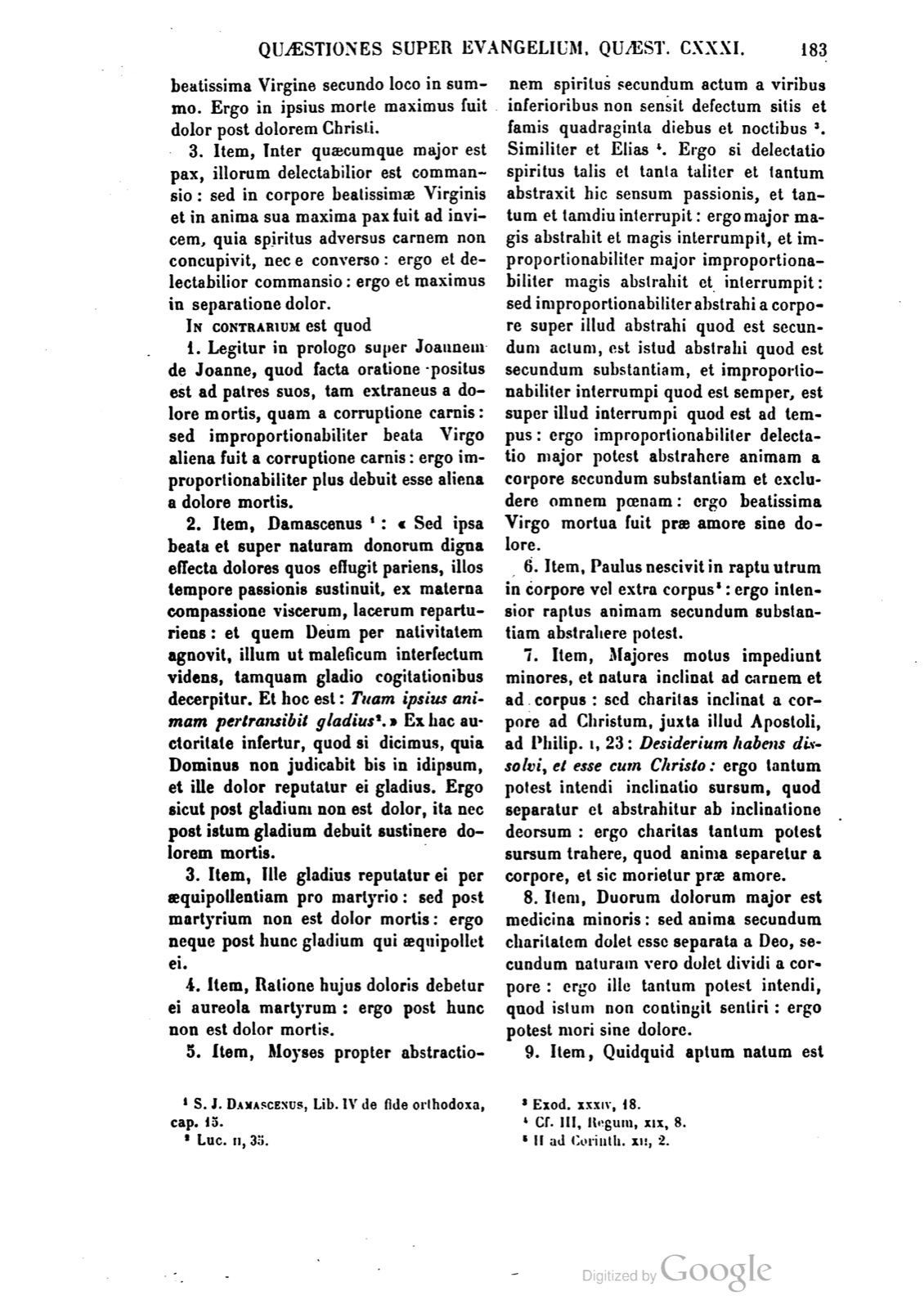
6. Item, Paulus nescivit in raptu utrum in corpore vel extra corpus 4: ergo intensior raptus animam secundum substantiam abstrahere potest.
7. Item, Majores motus impediunt minores, et natura inclinat ad carnem et ad corpus: sed charitas inclinat a corpore ad Christum, juxta illud Apostoli, ad Philip. I, 23: Desiderium habens dissolvi, et esse cum Christo: ergo tantum potest intendi inclinatio sursum, quod separatur et abstrahitur ab inclinatione deorsum: ergo charitas tantum potest sursum trahere, quod anima separetur a corpore, et sic morietur prae amore.
8. Item, Duorum dolorum major est medicina minoris: sed anima secundum charitatem dolet esse separata a Deo, secundum naturam vero dolet dividi a corpore: ergo ille tantum potest intendi, quod istum non contingit sentiri: ergo potest mori sine dolore.
9. Item, Quidquid aptum natum est inducere languorem si continuetur et intendatur, potest inducere mortem: sed amor potest inducere languorem: ergo et mortem. Minor patet, Cantic. II, 5: Quia amore langueo. Glossa: « Prae amoris magnitudine omnia temporalia fastidio. »
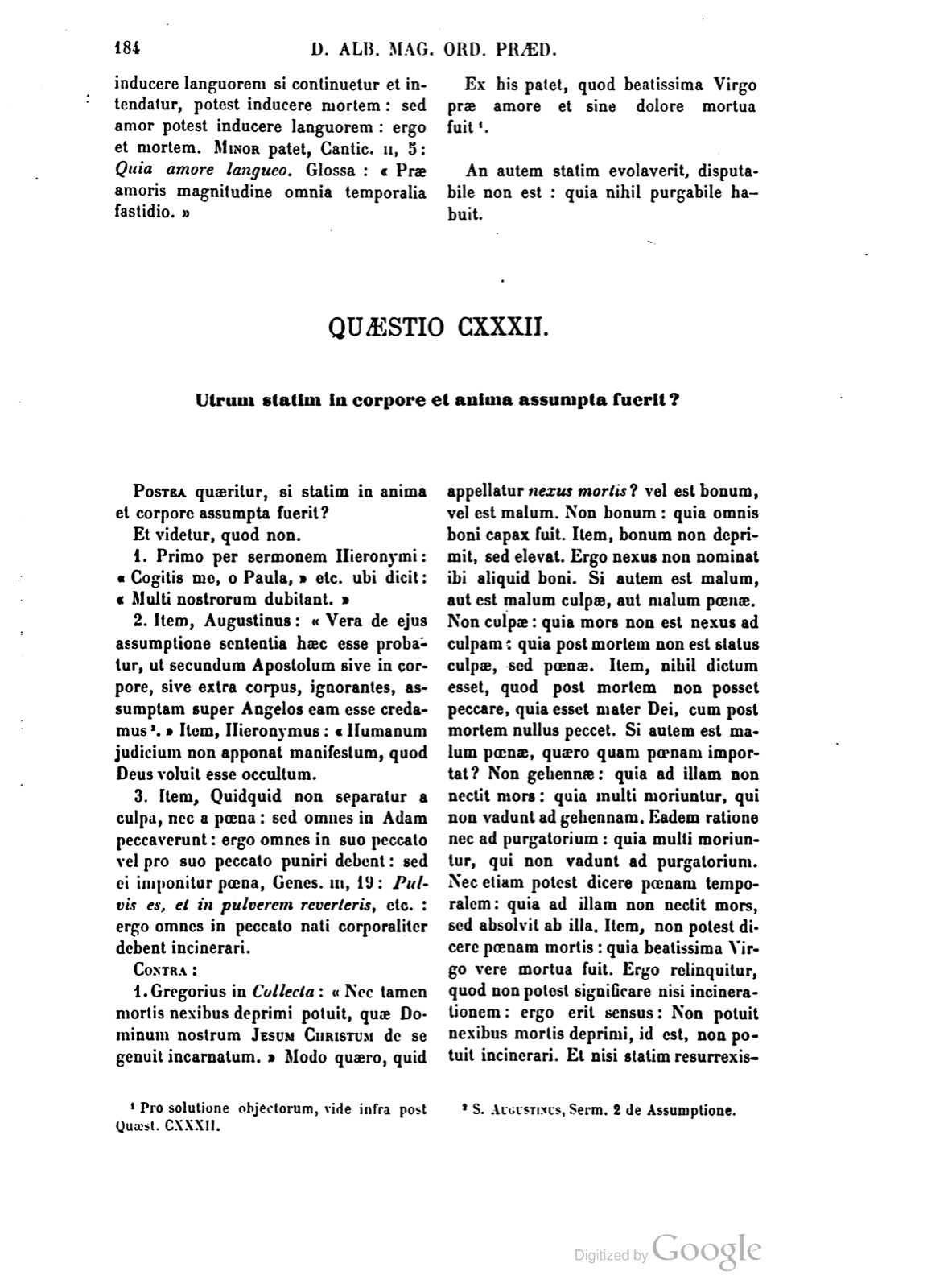
Ex his patet, quod beatissima Virgo prae amore et sine dolore mortua fuit 5.
An autem statim evolaverit, disputabile non est: quia nihil purgabile habuit.
6. Likewise, Paul in rapture did not know whether he was in the body or outside the body 4. Therefore a more intense rapture can abstract the soul according to substance.
7. Likewise, greater motions impede lesser motions, and nature inclines to flesh and to the body; but charity inclines from the body to Christ, according to that saying of the Apostle, Philippians 1:23: Having a desire to be dissolved and to be with Christ. Therefore the upward inclination can be intensified so much that it is separated and abstracted from the downward inclination. Therefore charity can draw upward so much that the soul is separated from the body, and thus one will die from love.
8. Likewise, of two pains the greater is the medicine of the lesser. But the soul according to charity grieves to be separated from God, but according to nature grieves to be divided from the body. Therefore the former can be intensified so much that the latter does not happen to be felt. Therefore she can die without pain.
9. Likewise, whatever is apt by nature to induce languor if it is continued and intensified can induce death. But love can induce languor. Therefore it can also induce death. The minor is clear from Song of Songs 2:5: Because I languish with love. The Gloss says: “Because of the greatness of love I disdain all temporal things.”
From these things it is clear that the most blessed Virgin died from love and without pain 5.
But whether she immediately flew forth is not disputable, because she had nothing purgable.
If a page does not appear, its photograph has not been uploaded yet.