Works › The Mariale: Questions on “Missus est”
Volume 37 · pp. 179–180
Question 127. Whether she was sanctified in the womb?
A marker with ≈ is an approximate page boundary, placed by measure of the text; the page photographs remain the authority. In the paired views, clicking a page marker brings that page into view.
QUAESTIO CXXVII. Utrum fuerit in utero sanctificata?
Post haec probatur, quod fuerit in utero sanctificata, hoc modo:
1. Ecclesia celebrando festivat ejus nativitatem: ergo fuit sancta quando fuit nata: ergo fuit sanctificata in utero.
2. Item, Joannes fuit sanctificatus in utero: ergo et beata Virgo. Prima patet, Luc. I, 15: Et Spiritu sancto replebitur adhuc ex utero matris suae.
Item, Jeremias fuit sanctificatus in utero. Ergo et beatissima Virgo. Prima patet, Jerem. I, 5: Priusquam te formarem in utero, novi te: et antequam exires de vulva, sanctificavi te.
3. Item, Omnis sanctificatus in utero, ordinatur ad sanctum in utero: ergo quod immediatiorem et propinquiorem relationem habet ad sanctum in utero, illud potissimum debet sanctificari in utero: sed non potuit immediatior esse revelatio ejus quod uniebatur verbo ad aliquid aliud quam ad illud unde sumebatur illud sanctum quod uniebatur: hoc potissimum fuit beata Virgo: ergo potissimum fuit et debuit in utero sanctificari.
4. Item, Jeremias dicitur in utero sanctificatus propter expressiorem prophetiam de sancto in utero. Item, Joannes in utero sanctificatus propter digiti demonstrationem. Ergo multo fortius beatissima Virgo propter ipsius conceptionem et generationem.
5. Item, Dicit Anselmus: « Ea puritate beata Virgo nitebat, qua major sub caelo nequit intelligi 1. » Sed puritas Dei hominis est peccatum originale nec habere nec umquam habuisse: major quidem post illam est originale habuisse, sed statim et ab illo omnino mundatum esse: ergo beata Virgo debuit quidem in originali concipi, sed statim ab illo mundari: ergo debuit in utero sanctificari.
QUESTION 127. Whether she was sanctified in the womb?
After this it is proved that she was sanctified in the womb, in this way:
1. The Church, by celebrating, keeps festival for her nativity. Therefore she was holy when she was born. Therefore she was sanctified in the womb.
2. Likewise, John was sanctified in the womb. Therefore so also the blessed Virgin. The first is clear, Luke 1:15: And he will be filled with the Holy Spirit even from his mother’s womb.
Likewise, Jeremiah was sanctified in the womb. Therefore so also the most blessed Virgin. The first is clear, Jeremiah 1:5: Before I formed you in the womb, I knew you; and before you came forth from the womb, I sanctified you.
3. Likewise, everyone sanctified in the womb is ordered to the holy one in the womb. Therefore that which has a more immediate and nearer relation to the holy one in the womb ought especially to be sanctified in the womb. But there could not be a more immediate revelation of that which was united to the Word to anything else than to that from which that holy thing which was united was taken. This was especially the blessed Virgin. Therefore she especially was, and ought to have been, sanctified in the womb.
4. Likewise, Jeremiah is said to have been sanctified in the womb because of the more express prophecy concerning the holy one in the womb. Likewise, John was sanctified in the womb because of the pointing of the finger. Therefore much more the most blessed Virgin because of his conception and generation.
5. Likewise, Anselm says: “The blessed Virgin shone with that purity than which a greater cannot be understood under heaven 1.” But the purity of the God-man is neither to have original sin nor ever to have had it; next after that, indeed, the greater purity is to have had original sin, but immediately and entirely to have been cleansed from it. Therefore the blessed Virgin indeed ought to have been conceived in original sin, but immediately to have been cleansed from it. Therefore she ought to have been sanctified in the womb.
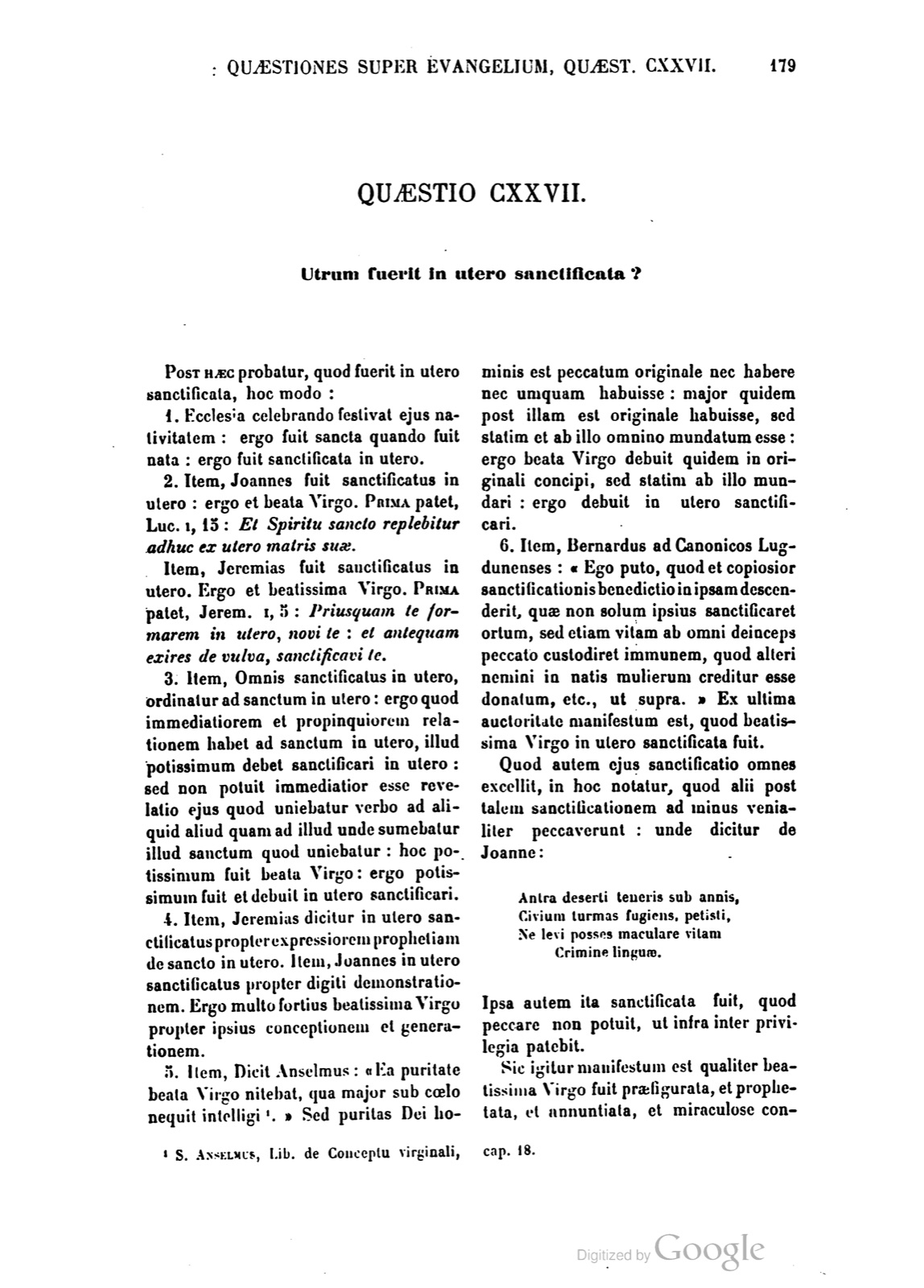
6. Item, Bernardus ad Canonicos Lugdunenses: « Ego puto, quod et copiosior sanctificationis benedictio in ipsam descenderit, quae non solum ipsius sanctificaret ortum, sed etiam vitam ab omni deinceps peccato custodiret immunem, quod alteri nemini in natis mulierum creditur esse donatum, etc., ut supra. » Ex ultima auctoritate manifestum est, quod beatissima Virgo in utero sanctificata fuit.
Quod autem ejus sanctificatio omnes excellit, in hoc notatur, quod alii post talem sanctificationem ad minus venialiter peccaverunt: unde dicitur de Joanne:
Antra deserti teneris sub annis, Civium turmas fugiens, petisti, Ne levi posses maculare vitam Crimine linguae.
Ipsa autem ita sanctificata fuit, quod peccare non potuit, ut infra inter privilegia patebit.
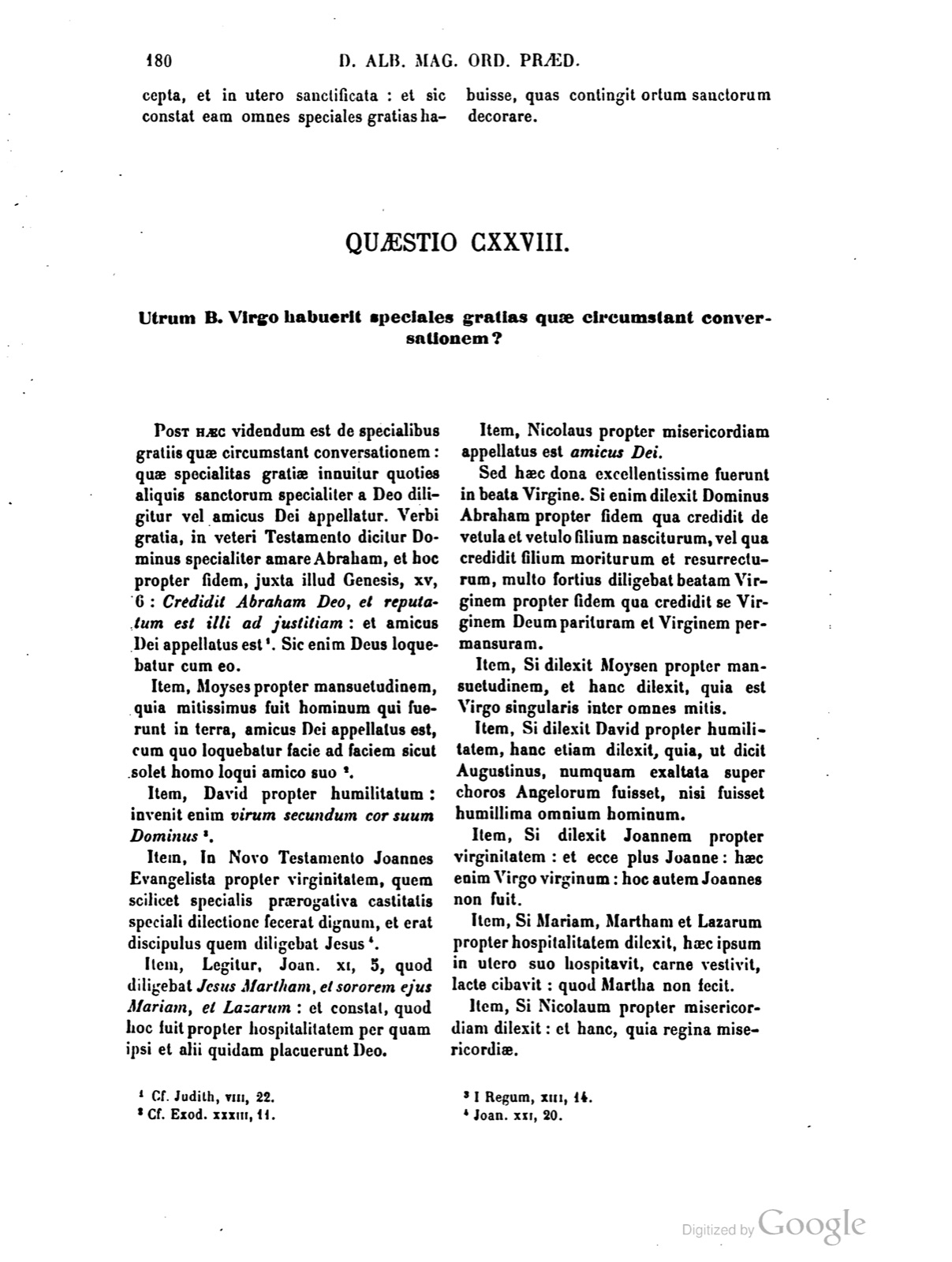
Sic igitur manifestum est qualiter beatissima Virgo fuit praefigurata, et prophetata, et annuntiata, et miraculose concepta, et in utero sanctificata: et sic constat eam omnes speciales gratias habuisse, quas contingit ortum sanctorum decorare.
6. Likewise, Bernard to the Canons of Lyons says: “I think that a more abundant blessing of sanctification descended into her, which not only sanctified her birth, but also guarded her life thenceforth immune from every sin, which is believed to have been given to no other among those born of women, etc., as above.” From this last authority it is manifest that the most blessed Virgin was sanctified in the womb.
But that her sanctification surpasses all is noted in this, that others after such sanctification sinned at least venially. Hence it is said of John:
The caves of the desert in tender years, Fleeing the crowds of citizens, you sought, Lest you could stain your life With a light fault of the tongue.
But she herself was so sanctified that she could not sin, as will be clear below among the privileges.
Thus therefore it is manifest in what way the most blessed Virgin was prefigured, and prophesied, and announced, and miraculously conceived, and sanctified in the womb; and thus it is certain that she had all special graces which happen to adorn the birth of saints.
Notes
- St. Anselm, Book On the Virginal Conception, chapter 18. (S. Anselmus, Lib. de Conceptu virginali, cap. 18.) ↩
If a page does not appear, its photograph has not been uploaded yet.