Works › The Mariale: Questions on “Missus est”
Volume 37 · p. 162
Question 104. Whether the quadrivial sciences were in the Blessed Virgin?
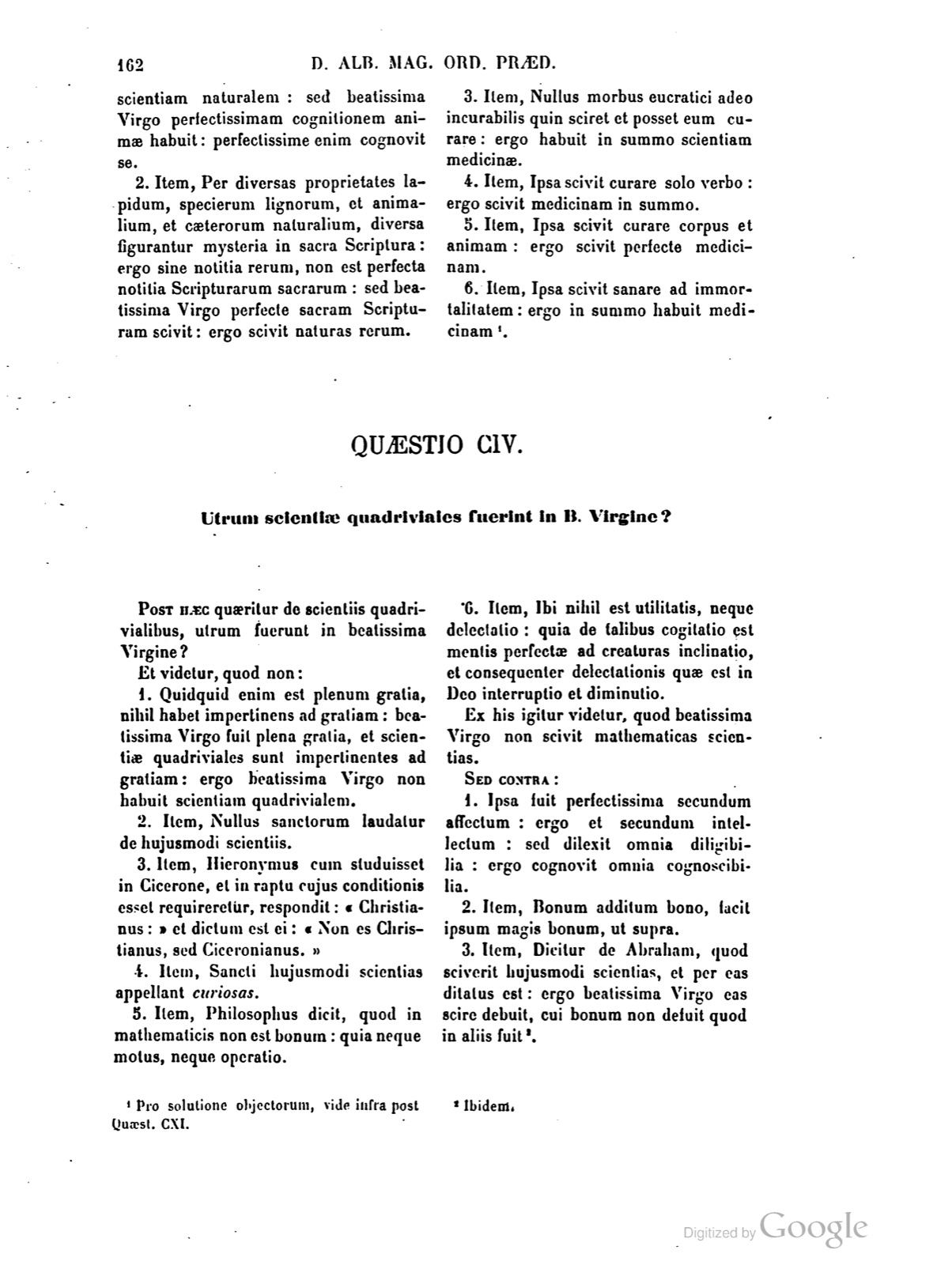
QUAESTIO CIV. Utrum scientiae quadriviales fuerint in B. Virgine?
Post haec quaeritur de scientiis quadrivialibus, utrum fuerunt in beatissima Virgine?
Et videtur, quod non:
1. Quidquid enim est plenum gratia, nihil habet impertinens ad gratiam: beatissima Virgo fuit plena gratia, et scientiae quadriviales sunt impertinentes ad gratiam: ergo beatissima Virgo non habuit scientiam quadrivialem.
2. Item, Nullus sanctorum laudatur de hujusmodi scientiis.
3. Item, Hieronymus cum studuisset in Cicerone, et in raptu cujus conditionis esset requireretur, respondit: « Christianus: » et dictum est ei: « Non es Christianus, sed Ciceronianus. »
4. Item, Sancti hujusmodi scientias appellant curiosas.
5. Item, Philosophus dicit, quod in mathematicis non est bonum: quia neque motus, neque operatio.
6. Item, Ibi nihil est utilitatis, neque delectatio: quia de talibus cogitatio est mentis perfectae ad creaturas inclinatio, et consequenter delectationis quae est in Deo interruptio et diminutio.
Ex his igitur videtur, quod beatissima Virgo non scivit mathematicas scientias.
Sed contra:
1. Ipsa fuit perfectissima secundum affectum: ergo et secundum intellectum: sed dilexit omnia diligibilia: ergo cognovit omnia cognoscibilia.
2. Item, Bonum additum bono, facit ipsum magis bonum, ut supra.
3. Item, Dicitur de Abraham, quod sciverit hujusmodi scientias, et per eas ditatus est: ergo beatissima Virgo eas scire debuit, cui bonum non defuit quod in aliis fuit 1.
QUESTION 104. Whether the quadrivial sciences were in the Blessed Virgin?
After this inquiry is made about the quadrivial sciences, whether they were in the most blessed Virgin.
And it seems that they were not:
1. For whatever is full of grace has nothing irrelevant to grace. The most blessed Virgin was full of grace, and the quadrivial sciences are irrelevant to grace. Therefore the most blessed Virgin did not have quadrivial knowledge.
2. Likewise, none of the saints is praised for sciences of this kind.
3. Likewise, when Jerome had studied in Cicero, and in a rapture was asked of what condition he was, he answered, “A Christian”; and it was said to him, “You are not a Christian, but a Ciceronian.”
4. Likewise, the saints call sciences of this kind curious.
5. Likewise, the Philosopher says that in mathematics there is no good, because there is neither motion nor operation.
6. Likewise, there there is nothing of usefulness, nor delight, because thought about such things is an inclination of a perfect mind toward creatures, and consequently an interruption and diminution of the delight which is in God.
From these things therefore it seems that the most blessed Virgin did not know the mathematical sciences.
But to the contrary:
1. She herself was most perfect according to affection; therefore also according to intellect. But she loved all lovable things. Therefore she knew all knowable things.
2. Likewise, a good added to a good makes it more good, as above.
3. Likewise, it is said concerning Abraham that he knew sciences of this kind and was enriched through them. Therefore the most blessed Virgin ought to have known them, to whom no good was lacking that was in others 1.
Notes
- In the same place. (Ibidem.) ↩
If a page does not appear, its photograph has not been uploaded yet.