Works › The Mariale: Questions on “Missus est”
Volume 37 · p. 137
Question 80. Whether the aureole of virgins was in her
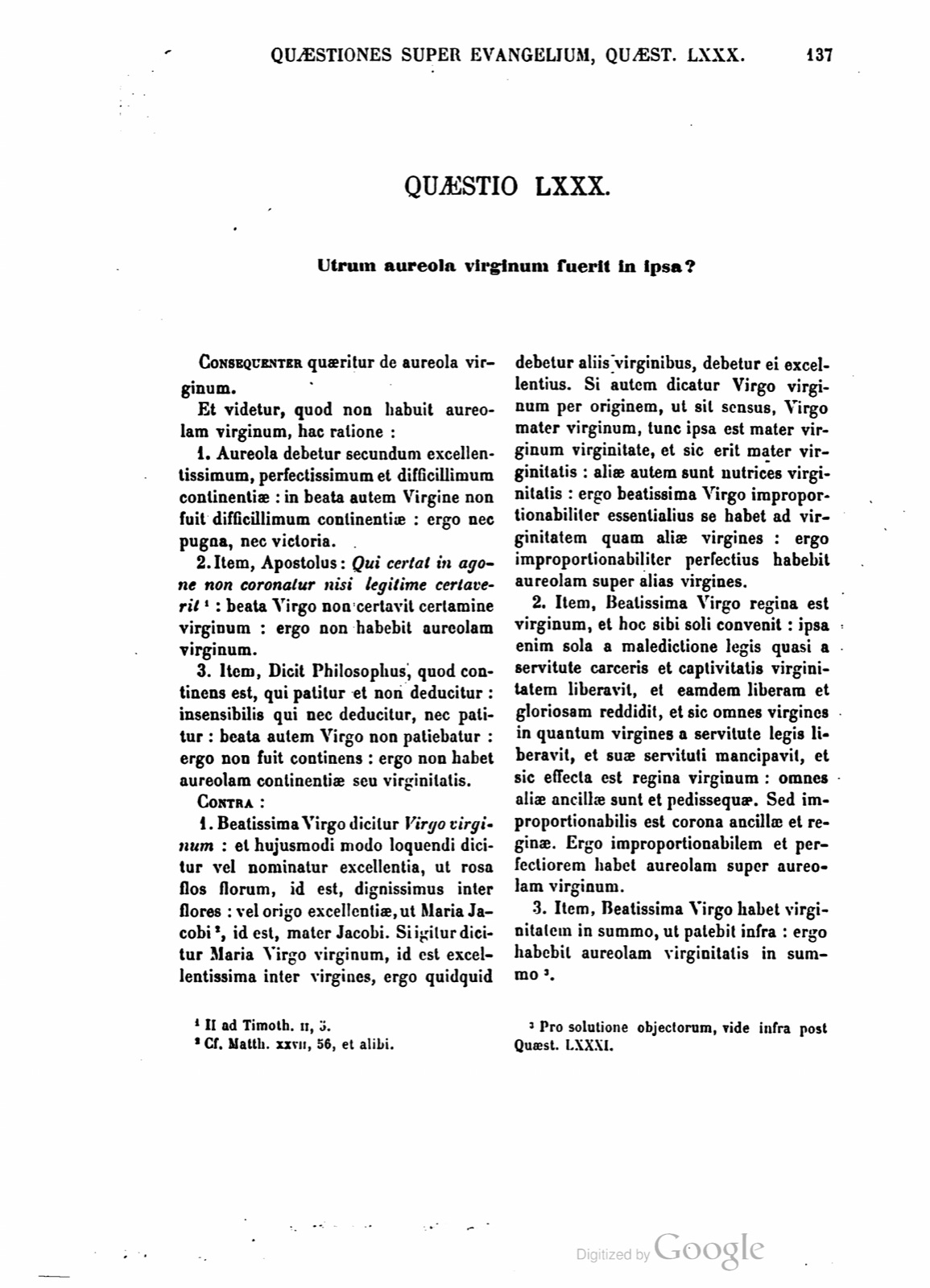
QUAESTIO LXXX.
Utrum aureola virginum fuerit in ipsa?
Consequenter quaeritur de aureola virginum.
Et videtur, quod non habuit aureolam virginum, hac ratione:
1. Aureola debetur secundum excellentissimum, perfectissimum et difficillimum continentiae: in beata autem Virgine non fuit difficillimum continentiae: ergo nec pugna, nec victoria.
2. Item, Apostolus: Qui certat in agone non coronatur nisi legitime certaverit 1: beata Virgo non certavit certamine virginum: ergo non habebit aureolam virginum.
3. Item, Dicit Philosophus, quod continens est, qui patitur et non deducitur: insensibilis qui nec deducitur, nec patitur: beata autem Virgo non patiebatur: ergo non fuit continens: ergo non habet aureolam continentiae seu virginitatis.
Contra:
1. Beatissima Virgo dicitur Virgo virginum: et hujusmodi modo loquendi dicitur vel nominatur excellentia, ut rosa flos florum, id est, dignissimus inter flores: vel origo excellentiae, ut Maria Jacobi 2, id est, mater Jacobi. Si igitur dicitur Maria Virgo virginum, id est excellentissima inter virgines, ergo quidquid debetur aliis virginibus, debetur ei excellentius. Si autem dicatur Virgo virginum per originem, ut sit sensus, Virgo mater virginum, tunc ipsa est mater virginum virginitate, et sic erit mater virginitatis: aliae autem sunt nutrices virginitatis: ergo beatissima Virgo improportionabiliter essentialius se habet ad virginitatem quam aliae virgines: ergo improportionabiliter perfectius habebit aureolam super alias virgines.
2. Item, Beatissima Virgo regina est virginum, et hoc sibi soli convenit: ipsa enim sola a maledictione legis quasi a servitute carceris et captivitatis virginitatem liberavit, et eamdem liberam et gloriosam reddidit, et sic omnes virgines in quantum virgines a servitute legis liberavit, et suae servituti mancipavit, et sic effecta est regina virginum: omnes aliae ancillae sunt et pedissequae. Sed improportionabilis est corona ancillae et reginae. Ergo improportionabilem et perfectiorem habet aureolam super aureolam virginum.
3. Item, Beatissima Virgo habet virginitatem in summo, ut patebit infra: ergo habebit aureolam virginitatis in summo 3.
QUESTION 80.
Whether the aureole of virgins was in her.
Consequently inquiry is made concerning the aureole of virgins.
And it seems that she did not have the aureole of virgins, by this reason:
1. An aureole is owed according to the most excellent, most perfect, and most difficult thing of continence; but in the blessed Virgin there was not the most difficult thing of continence; therefore neither battle nor victory.
2. Likewise, the Apostle says: One who contends in the contest is not crowned unless he has contended lawfully 1. The blessed Virgin did not contend with the contest of virgins; therefore she will not have the aureole of virgins.
3. Likewise, the Philosopher says that the continent person is one who suffers and is not led away, while the insensible person is one who is neither led away nor suffers. But the blessed Virgin did not suffer; therefore she was not continent; therefore she does not have the aureole of continence or virginity.
On the contrary:
1. The most blessed Virgin is called Virgin of virgins, and by a manner of speaking of this sort excellence is said or named, as a rose is the flower of flowers, that is, the worthiest among flowers; or the origin of excellence, as Mary of James 2, that is, the mother of James. If therefore Mary is called Virgin of virgins, that is, the most excellent among virgins, then whatever is owed to other virgins is owed to her more excellently. But if she is called Virgin of virgins by origin, so that the sense is Virgin mother of virgins, then she is the mother of virgins by virginity, and thus will be the mother of virginity; but others are nurses of virginity. Therefore the most blessed Virgin is related to virginity disproportionately more essentially than other virgins; therefore she will have the aureole above other virgins disproportionately more perfectly.
2. Likewise, the most blessed Virgin is queen of virgins, and this fits her alone. For she alone freed virginity from the curse of the law as though from the servitude of prison and captivity, and rendered the same virginity free and glorious; and thus she freed all virgins, insofar as they are virgins, from the servitude of the law, and handed them over to her own service, and thus she was made queen of virgins. All others are handmaids and attendants. But the crown of a handmaid and of a queen is disproportionate. Therefore she has a disproportionate and more perfect aureole above the aureole of virgins.
3. Likewise, the most blessed Virgin has virginity in the highest degree, as will be clear below; therefore she will have the aureole of virginity in the highest degree 3.
Notes
- 2 Timothy 2:5. (II ad Timoth. II, 5.) ↩
- Compare Matthew 27:56, and elsewhere. (Cf. Matth. XXVII, 56, et alibi.) ↩
- For the solution of the objections, see below after Question 81. (Pro solutione objectorum, vide infra post Quaest. LXXXI.) ↩
If a page does not appear, its photograph has not been uploaded yet.