Works › The Mariale: Questions on “Missus est”
Volume 37 · pp. 131–132
Question 75. Whether mercy was in her
A marker with ≈ is an approximate page boundary, placed by measure of the text; the page photographs remain the authority. In the paired views, clicking a page marker brings that page into view.
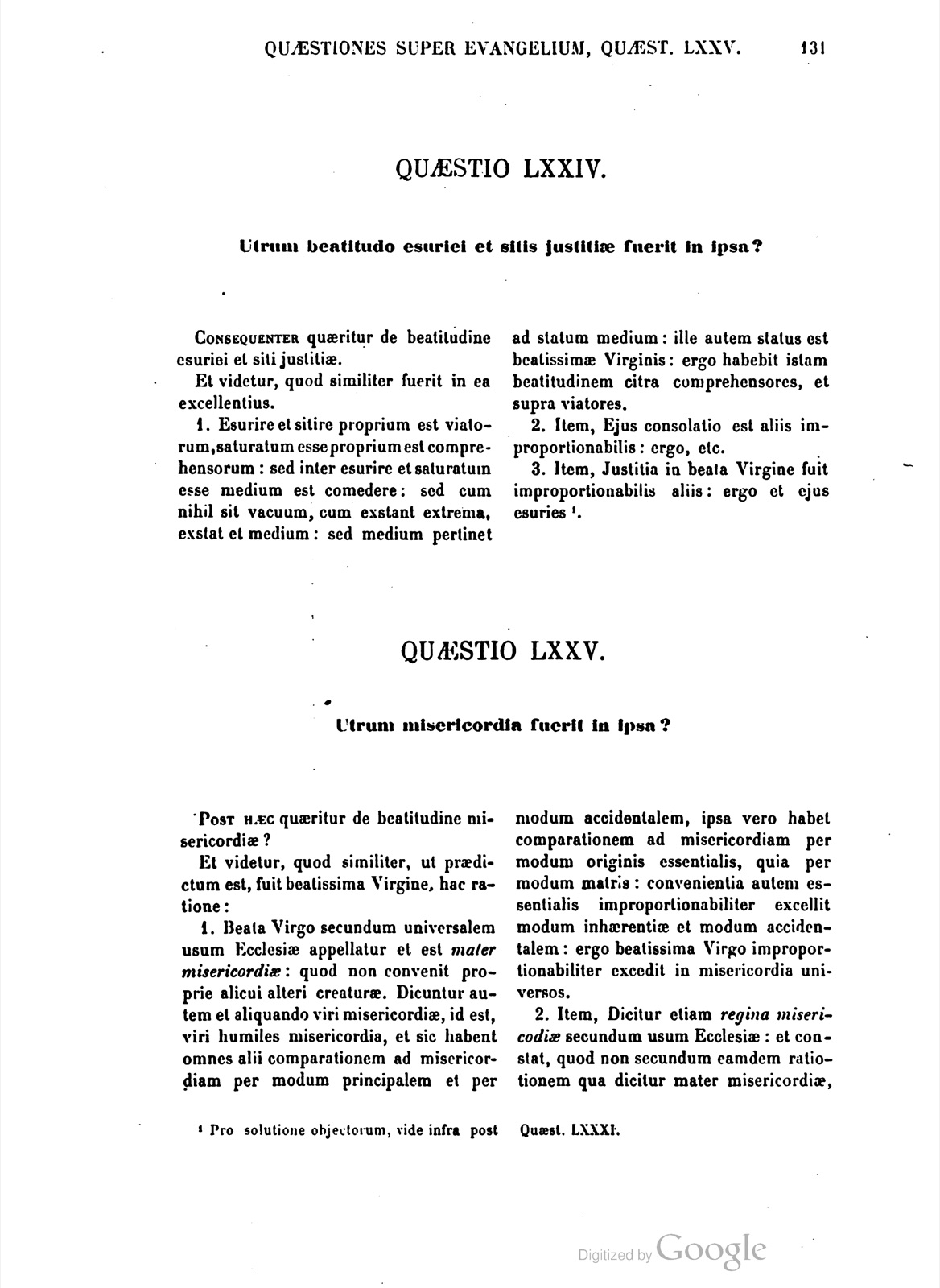
QUAESTIO LXXV.
Utrum misericordia fuerit in ipsa?
Post haec quaeritur de beatitudine misericordiae?
Et videtur, quod similiter, ut praedictum est, fuit beatissima Virgine, hac ratione:
1. Beata Virgo secundum universalem usum Ecclesiae appellatur et est mater misericordiae: quod non convenit proprie alicui alteri creaturae. Dicuntur autem et aliquando viri misericordiae, id est, viri humiles misericordia, et sic habent omnes alii comparationem ad misericordiam per modum principalem et per modum accidentalem, ipsa vero habet comparationem ad misericordiam per modum originis essentialis, quia per modum matris: convenientia autem essentialis improportionabiliter excellit modum inhaerentiae et modum accidentalem: ergo beatissima Virgo improportionabiliter excedit in misericordia universos.
2. Item, Dicitur etiam regina misericordiae secundum usum Ecclesiae: et constat, quod non secundum eamdem rationem qua dicitur mater misericordiae, alia est enim ratio matris et alia reginae: ergo propter aliam rationem dicetur regina misericordiae quam illam qua dicitur mater misericordiae. Et videtur, quod regina misericordiae dicatur ideo, quia ab ipsa fuit regni misericordiae origo, et ab ipsa potestas est prima misericordiae et gratiae. Cum enim sit regnum gloriae quod est regnum justitiae, in quo unusquisque recipit prout hic gessit in corpore, cujus prima potestas est a rege gloriae et a rege justitiae, id est, a sancta Trinitate: et est regnum gloriae sive misericordiae, ubi nondum recipitur secundum merita, sed adhuc regnat misericordia peccata dimittendo, poenas diluendo, bona multiplicando, mala differendo: hujus autem regni et origo et potestas prima est a beata Virgine, per quam suscepimus misericordiam tuam, Deus, in medio templi tui, Jesum Christum, per quem misericordia et veritas facta est, qui proprie modo regnat super eos quos proprio sanguine redemit, et passione et morte regeneravit, et sibi configuravit, donec in fine omnibus completis tradiderit regnum Deo Patri. Patet igitur, quod omnes alii servi misericordiae sunt, beatissima Virgo regina misericordiae. Sed improportionabiliter majus est esse reginam misericordiae, quam servum misericordiae: ergo beatissima Virgo improportionabiliter excellentius se habet ad misericordiam, quam alii.
QUESTION 75.
Whether mercy was in her.
After these things inquiry is made concerning the beatitude of mercy.
And it seems that likewise, as was said before, it was in the most blessed Virgin, by this reason:
1. The blessed Virgin, according to the universal use of the Church, is called and is the mother of mercy, which does not properly fit any other creature. But men of mercy are also sometimes spoken of, that is, men humble by mercy; and thus all others have a comparison to mercy through a principal mode and through an accidental mode, but she has a comparison to mercy through the mode of essential origin, because through the mode of a mother. But essential agreement disproportionately surpasses the mode of inherence and the accidental mode; therefore the most blessed Virgin disproportionately exceeds all in mercy.
2. Likewise, she is also called queen of mercy according to the use of the Church. And it is established that this is not according to the same account by which she is called mother of mercy, for the account of mother is one thing and that of queen another. Therefore she will be called queen of mercy for another account than that by which she is called mother of mercy. And it seems that she is called queen of mercy for this reason, because from her was the origin of the kingdom of mercy, and from her is the first power of mercy and grace. For since there is the kingdom of glory, which is the kingdom of justice, in which each one receives according as he has conducted himself here in the body, whose first power is from the king of glory and from the king of justice, that is, from the holy Trinity; and there is the kingdom of glory or of mercy, where what is received is not yet according to merits, but mercy still reigns by forgiving sins, washing away punishments, multiplying goods, and deferring evils: of this kingdom both the origin and the first power is from the blessed Virgin, through whom we have received your mercy, O God, in the midst of your temple, Jesus Christ, through whom mercy and truth were made, who properly now reigns over those whom he redeemed by his own blood, and regenerated by passion and death, and configured to himself, until at the end, when all things have been completed, he shall have handed over the kingdom to God the Father. Therefore it is clear that all others are servants of mercy, while the most blessed Virgin is queen of mercy. But to be queen of mercy is disproportionately greater than to be a servant of mercy; therefore the most blessed Virgin is related to mercy disproportionately more excellently than others.
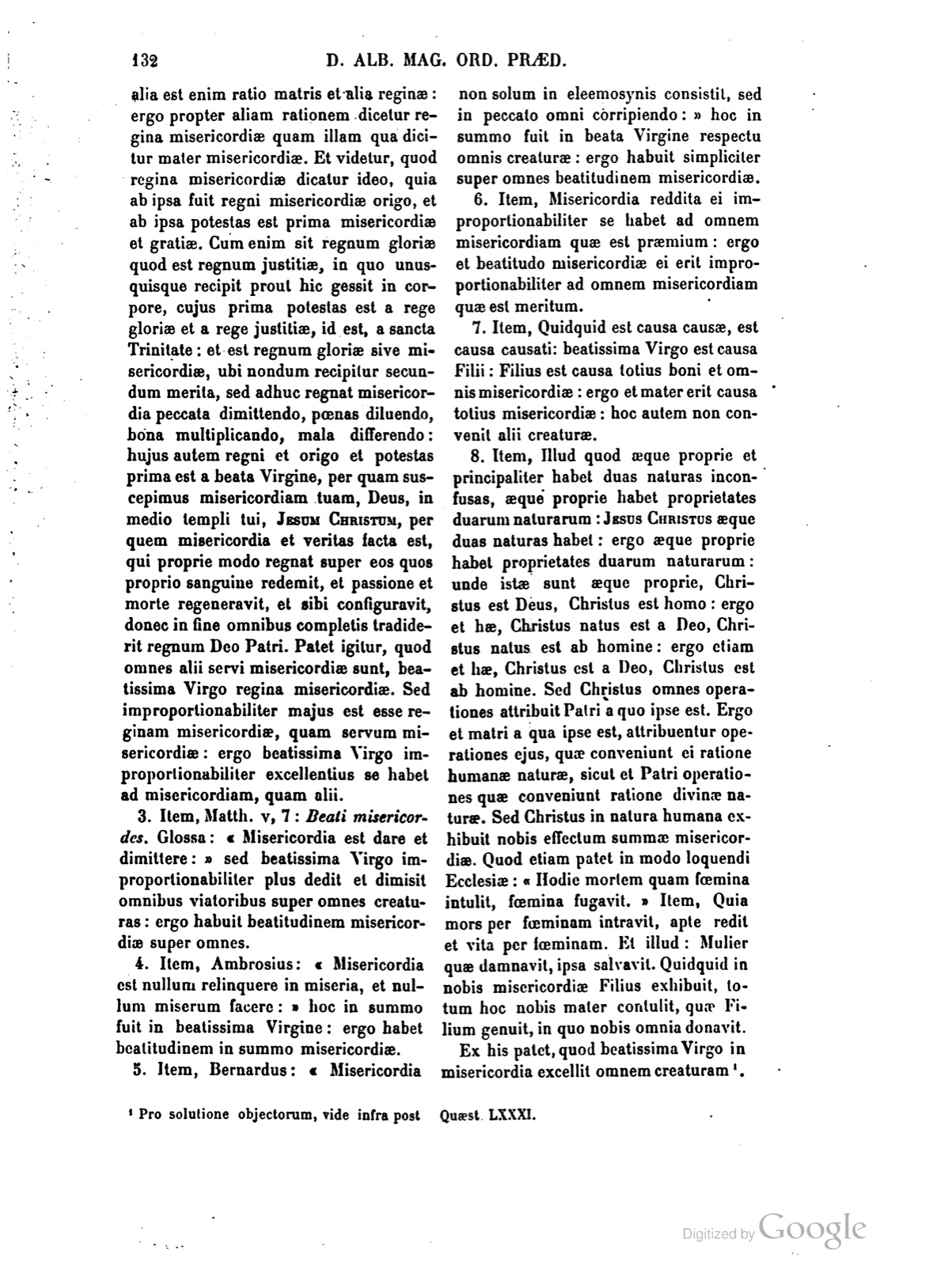
3. Item, Matth. V, 7: Beati misericordes. Glossa: "Misericordia est dare et dimittere:" sed beatissima Virgo improportionabiliter plus dedit et dimisit omnibus viatoribus super omnes creaturas: ergo habuit beatitudinem misericordiae super omnes.
4. Item, Ambrosius: "Misericordia est nullum relinquere in miseria, et nullum miserum facere:" hoc in summo fuit in beatissima Virgine: ergo habet beatitudinem in summo misericordiae.
5. Item, Bernardus: "Misericordia non solum in eleemosynis consistit, sed in peccato omni corripiendo:" hoc in summo fuit in beata Virgine respectu omnis creaturae: ergo habuit simpliciter super omnes beatitudinem misericordiae.
6. Item, Misericordia reddita ei improportionabiliter se habet ad omnem misericordiam quae est praemium: ergo et beatitudo misericordiae ei erit improportionabiliter ad omnem misericordiam quae est meritum.
7. Item, Quidquid est causa causae, est causa causati: beatissima Virgo est causa Filii: Filius est causa totius boni et omnis misericordiae: ergo et mater erit causa totius misericordiae: hoc autem non convenit alii creaturae.
8. Item, Illud quod aeque proprie et principaliter habet duas naturas inconfusas, aeque proprie habet proprietates duarum naturarum: Jesus Christus aeque duas naturas habet: ergo aeque proprie habet proprietates duarum naturarum: unde istae sunt aeque proprie, Christus est Deus, Christus est homo: ergo et hae, Christus natus est a Deo, Christus natus est ab homine: ergo etiam et hae, Christus est a Deo, Christus est ab homine. Sed Christus omnes operationes attribuit Patri a quo ipse est. Ergo et matri a qua ipse est, attribuentur operationes ejus, quae conveniunt ei ratione humanae naturae, sicut et Patri operationes quae conveniunt ratione divinae naturae. Sed Christus in natura humana exhibuit nobis effectum summae misericordiae. Quod etiam patet in modo loquendi Ecclesiae: "Hodie mortem quam femina intulit, femina fugavit." Item, Quia mors per feminam intravit, apte redit et vita per feminam. Et illud: Mulier quae damnavit, ipsa salvavit. Quidquid in nobis misericordiae Filius exhibuit, totum hoc nobis mater contulit, quae Filium genuit, in quo nobis omnia donavit.
Ex his patet, quod beatissima Virgo in misericordia excellit omnem creaturam 1.
3. Likewise, Matthew 5:7: Blessed are the merciful. The Gloss says: "Mercy is to give and to forgive." But the most blessed Virgin disproportionately gave and forgave more than all wayfarers, above all creatures; therefore she had the beatitude of mercy above all.
4. Likewise, Ambrose says: "Mercy is to leave no one in misery and to make no one miserable." This was in the highest degree in the most blessed Virgin; therefore she has beatitude in the highest degree of mercy.
5. Likewise, Bernard says: "Mercy does not consist only in alms, but in correcting in every sin." This was in the highest degree in the blessed Virgin with respect to every creature; therefore she had simply above all the beatitude of mercy.
6. Likewise, the mercy rendered to her is related disproportionately to every mercy that is a reward; therefore also the beatitude of mercy will be disproportionate to her in relation to every mercy that is merit.
7. Likewise, whatever is the cause of a cause is the cause of the thing caused. The most blessed Virgin is the cause of the Son; the Son is the cause of all good and of all mercy. Therefore the mother also will be the cause of all mercy; but this does not fit another creature.
8. Likewise, that which equally properly and principally has two unconfused natures equally properly has the properties of the two natures. Jesus Christ equally has two natures; therefore he equally properly has the properties of the two natures. Hence these statements are equally proper: Christ is God; Christ is man. Therefore also these: Christ is born from God; Christ is born from man. Therefore also these: Christ is from God; Christ is from man. But Christ attributes all operations to the Father from whom he himself is. Therefore also to the mother from whom he himself is will be attributed those operations of his that belong to him by reason of the human nature, just as to the Father are attributed the operations that belong by reason of the divine nature. But Christ in human nature showed us the effect of the highest mercy. This is also clear in the Church's manner of speaking: "Today the death that a woman brought in, a woman drove away." Likewise: Because death entered through a woman, life also aptly returns through a woman. And that saying: The woman who condemned, herself saved. Whatever of mercy the Son showed in us, all this the mother conferred on us, she who bore the Son, in whom he gave us all things.
From these things it is clear that the most blessed Virgin in mercy surpasses every creature 1.
Notes
- For the solution of the objections, see below after Question 81. (Pro solutione objectorum, vide infra post Quaest. LXXXI.) ↩
If a page does not appear, its photograph has not been uploaded yet.