Works › The Mariale: Questions on “Missus est”
Volume 37 · pp. 123–124
Question 67. In what way the gift of knowledge was in the blessed Virgin
A marker with ≈ is an approximate page boundary, placed by measure of the text; the page photographs remain the authority. In the paired views, clicking a page marker brings that page into view.
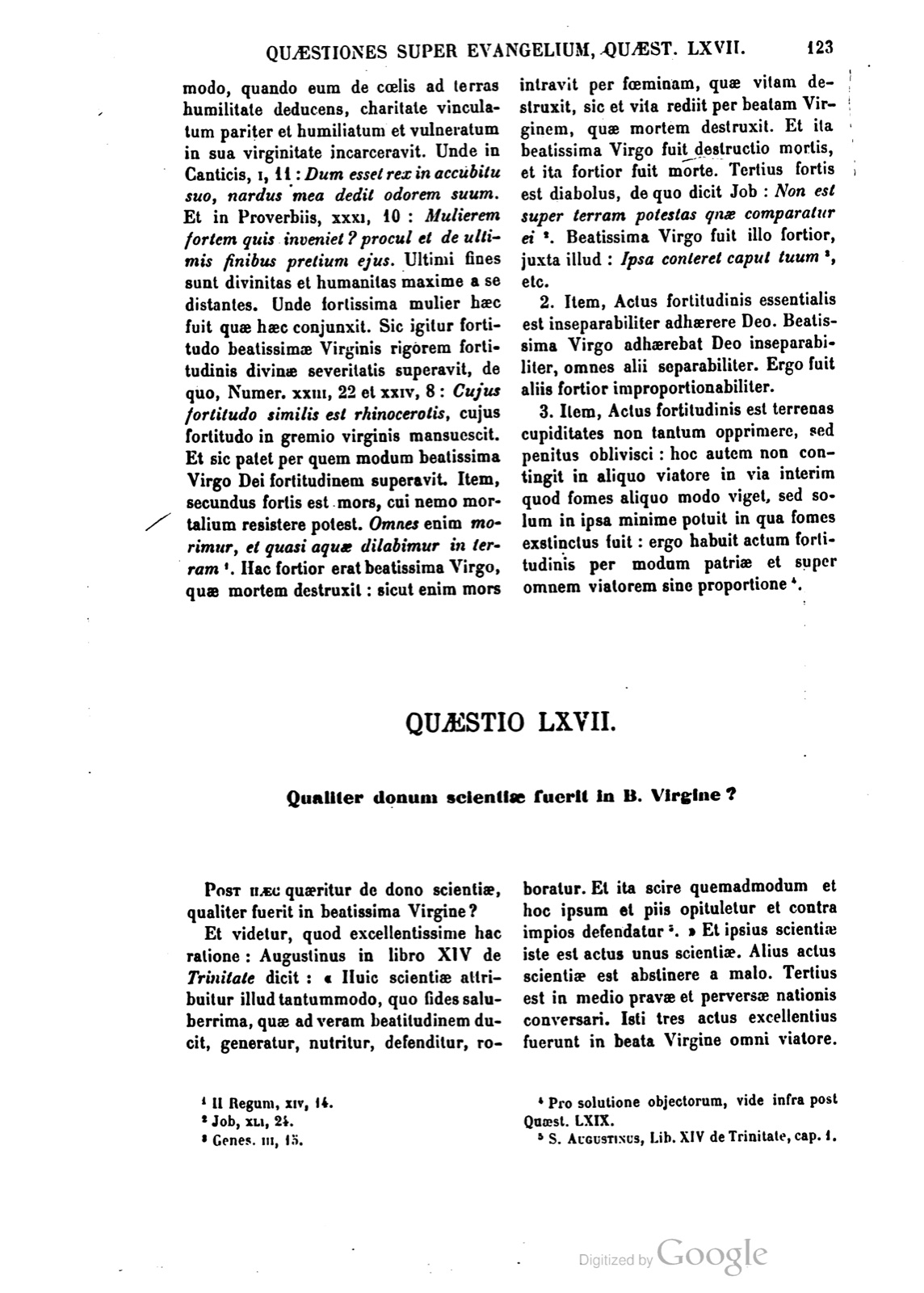
QUAESTIO LXVII.
Qualiter donum scientiae fuerit in B. Virgine?
Post haec quaeritur de dono scientiae, qualiter fuerit in beatissima Virgine?
Et videtur, quod excellentissime hac ratione: Augustinus in libro XIV de Trinitate dicit: "Huic scientiae attribuitur illud tantummodo, quo fides saluberrima, quae ad veram beatitudinem ducit, generatur, nutritur, defenditur, roboratur. Et ita scire quemadmodum et hoc ipsum et piis opituletur et contra impios defendatur 1." Et ipsius scientiae iste est actus unus scientiae. Alius actus scientiae est abstinere a malo. Tertius est in medio pravae et perversae nationis conversari. Isti tres actus excellentius fuerunt in beata Virgine omni viatore.
Quod primum habuit excellentius, scilicet fidei defensionem, patet per testimonium ipsius dicentis Ecclesiae, imo cantantis: "Cunctas haereses sola interemisti." Quod secundum actum abstinendi a malo excellentius habet, patet: quia ad minus pulvis venialis peccati omnium aliorum adhaesit pedibus: ipsa autem sola a peccatis immunis fuit, juxta illud: Tota pulchra es 2, etc. Similiter praesumitur de actu tertio: sola enim super omnes in medio pravae et perversae nationis conversari scivit, quae nihil faciendorum aut fiendorum omisit, et nihil omittendorum fecit, nulli in malo suo communicavit, nulli bonum suum non communicavit.
QUESTION 67.
In what way the gift of knowledge was in the blessed Virgin.
After these things inquiry is made concerning the gift of knowledge, in what way it was in the most blessed Virgin.
And it seems that it was most excellently, by this reason: Augustine in book XIV On the Trinity says: "To this knowledge is attributed only that by which the most healthful faith, which leads to true beatitude, is generated, nourished, defended, and strengthened. And so it is to know how both this very thing may assist the pious and be defended against the impious 1." And of this knowledge this is one act of knowledge. Another act of knowledge is to abstain from evil. A third is to live in the midst of a depraved and perverse nation. These three acts were in the blessed Virgin more excellently than in every wayfarer.
That she had the first more excellently, namely the defense of faith, is clear through the testimony of the Church herself speaking, indeed singing: "You alone have destroyed all heresies." That she has more excellently the second act, that of abstaining from evil, is clear, because at least the dust of venial sin clung to the feet of all others; but she alone was immune from sins, according to that saying: You are wholly beautiful 2, and so forth. Similarly it is presumed concerning the third act: for she alone above all knew how to live in the midst of a depraved and perverse nation, she who omitted none of the things to be done or brought about, and did none of the things to be omitted, communicated with no one in his evil, and did not fail to communicate her good to anyone.
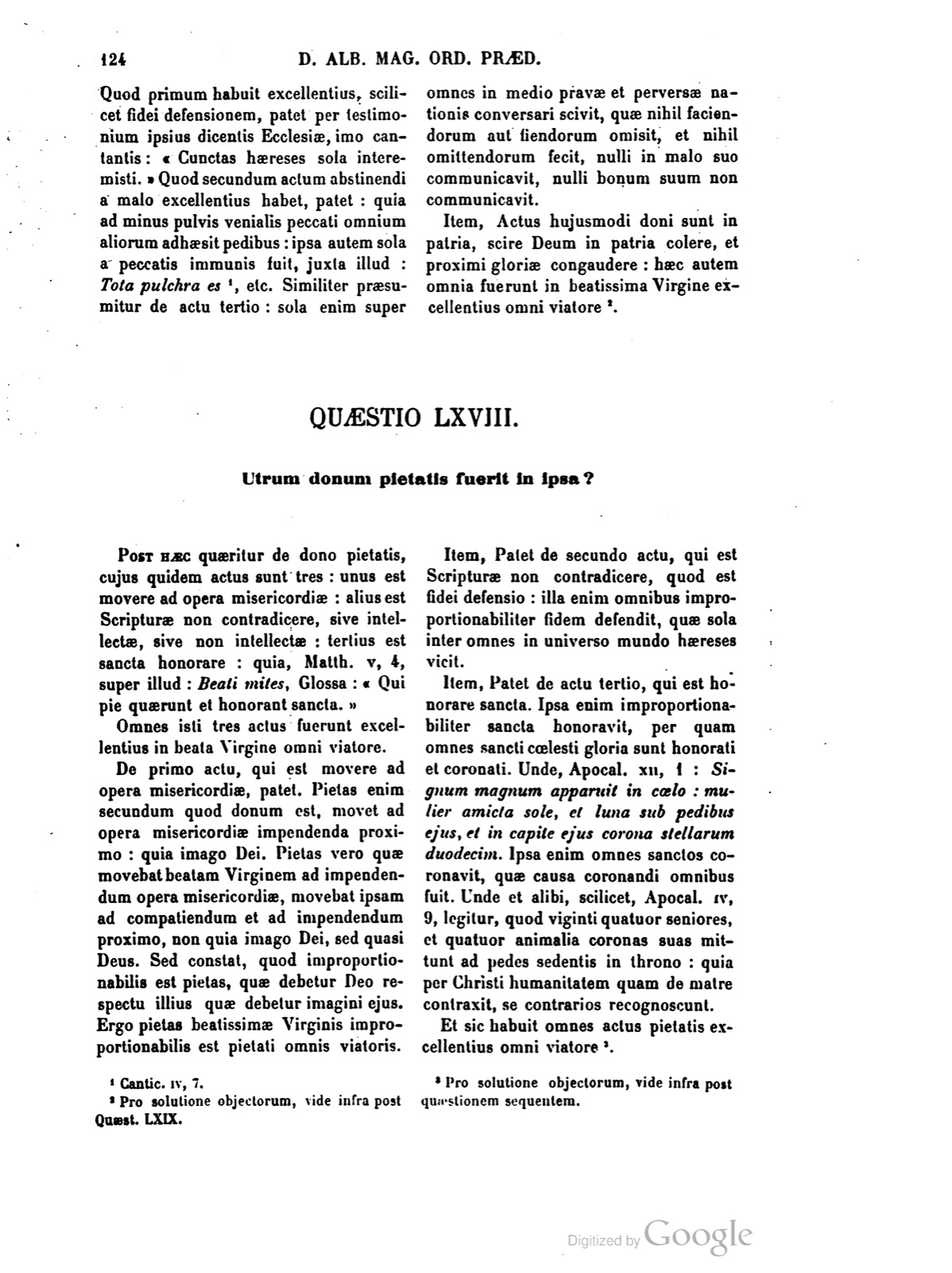
Item, Actus hujusmodi doni sunt in patria, scire Deum in patria colere, et proximi gloriae congaudere: haec autem omnia fuerunt in beatissima Virgine excellentius omni viatore 3.
Likewise, the acts of a gift of this kind in the homeland are to know how to worship God in the homeland and to rejoice together in the glory of one's neighbor. But all these things were in the most blessed Virgin more excellently than in every wayfarer 3.
Notes
- St. Augustine, book XIV On the Trinity, chapter 1. (S. Augustinus, Lib. XIV de Trinitate, cap. 1.) ↩
- Song of Songs 4:7. (Cantic. IV, 7.) ↩
- For the solution of the objections, see below after Question 69. (Pro solutione objectorum, vide infra post Quaest. LXIX.) ↩
If a page does not appear, its photograph has not been uploaded yet.