Works › The Mariale: Questions on “Missus est”
Volume 37 · pp. 125–126
Question 69 and the response to Questions 62, 63, etc., concerning the gifts
A marker with ≈ is an approximate page boundary, placed by measure of the text; the page photographs remain the authority. In the paired views, clicking a page marker brings that page into view.
QUAESTIO LXIX.
Utrum timor servilis fuerit in B. Virgine?
Ultimo quaeritur de timore. Et primo de timore servili, utrum ille fuit in beatissima Virgine?
Et videtur, quod sic:
Nullum enim bonum defuit ei quae gratia plena fuit: dicit autem Augustinus, quod timor servilis bonus est et utilis. Item, Glossa: Timores duos legimus, scilicet servilem et castum: et uterque est initium sapientiae: ergo videtur, quod timor servilis fuerit in beatissima Virgine.
Sed contra:
Timor servilis est cum peccato, de quo in beatissima Virgine nullam licet fieri quaestionem.
Post hoc quaeritur de timore initiali, utrum fuit in beatissima Virgine?
Et videtur, quod sic: quia ille simpliciter bonus est et donum Spiritus sancti: ergo ille fuit in beatissima Virgine.
Sed contra:
Perfecta charitas foras mittit timorem 1. Hoc intelligitur de timore initiali: quia etiam minima charitas foras mittit timorem servilem: sed beatissima Virgo perfectissimam habuit charitatem: ergo nec habuit timorem servilem, similiter nec initialem.
Post haec quaeritur de timore casto, utrum fuit in beatissima Virgine?
Et videtur, quod sic: quia
1. Ille est timor sanctus permanens in saeculum saeculi, qui etiam fuit in Domino Jesu Christo.
2. Item, Ille timor crescit charitate crescente: ergo debet in summo esse cum summa charitate.
3. Item, Timor nascitur ex amore: ergo si amor est improportionabilis, etiam et timor: sed amor beatissimae Virginis fuit improportionabilis omni viatore: ergo et timor.
Contra:
Timor castus timet separari: sed beatissima Virgo non timet separari: ergo non habuit timorem castum 2.
Responsio ad Quaestiones LXII, LXIII, etc., de donis.
Concedimus, sicut de virtutibus dictum est supra, quod beatissima Virgo habuit actus illorum donorum, quorum actus consistunt in cognitione et affectione, ut sapientiae, intellectus, consilii, et scientiae, excellentius omni viatore, et medio modo inter statum viae et statum patriae, ita quod circa statum patriae quantum ad actum patriae sive ad actuum perfectionem, et super statum patriae quantum ad effectum actuum sive merendi conditionem, super statum viae quantum ad habituum et actuum perfectionem et meriti supergressionem. Dona vero in actione consistentia habuit per modum patriae quantum ad actuum perfectionem, sed secundum statum viae quantum ad merendi conditionem, et ita quantum ad actum super statum viae, et super statum patriae quantum ad effectum.
QUESTION 69.
Whether servile fear was in the blessed Virgin.
Lastly inquiry is made concerning fear; and first concerning servile fear, whether that fear was in the most blessed Virgin.
And it seems that it was:
For no good thing was lacking to her who was full of grace; but Augustine says that servile fear is good and useful. Likewise, the Gloss says: We read of two fears, namely servile and chaste, and each is the beginning of wisdom. Therefore it seems that servile fear was in the most blessed Virgin.
But on the contrary:
Servile fear is with sin, concerning which no question at all may be made in the most blessed Virgin.
After this inquiry is made concerning initial fear, whether it was in the most blessed Virgin.
And it seems that it was, because that fear is simply good and a gift of the Holy Spirit; therefore it was in the most blessed Virgin.
But on the contrary:
Perfect charity casts fear outside 1. This is understood of initial fear, because even the smallest charity casts servile fear outside. But the most blessed Virgin had most perfect charity; therefore she had neither servile fear, and likewise neither initial fear.
After these things inquiry is made concerning chaste fear, whether it was in the most blessed Virgin.
And it seems that it was, because:
1. That fear is holy, remaining unto age of age, and it was also in the Lord Jesus Christ.
2. Likewise, that fear increases as charity increases; therefore it ought to exist in the highest degree with the highest charity.
3. Likewise, fear is born from love; therefore if love is disproportionate, so too is fear. But the love of the most blessed Virgin was disproportionate to every wayfarer; therefore so too was fear.
On the contrary:
Chaste fear fears to be separated; but the most blessed Virgin does not fear to be separated; therefore she did not have chaste fear 2.
Response to Questions 62, 63, etc., concerning the gifts.
We grant, as was said above concerning the virtues, that the most blessed Virgin had the acts of those gifts whose acts consist in knowledge and affection, as of wisdom, understanding, counsel, and knowledge, more excellently than every wayfarer, and in a middle mode between the state of the way and the state of the homeland, so that she was around the state of the homeland as to the act of the homeland, or as to the perfection of acts, and above the state of the homeland as to the effect of acts, or the condition of meriting, above the state of the way as to the perfection of habits and acts and the surpassing of merit. But the gifts that consist in action she had through the mode of the homeland as to the perfection of acts, but according to the state of the way as to the condition of meriting; and thus, as to act, above the state of the way, and, as to effect, above the state of the homeland.
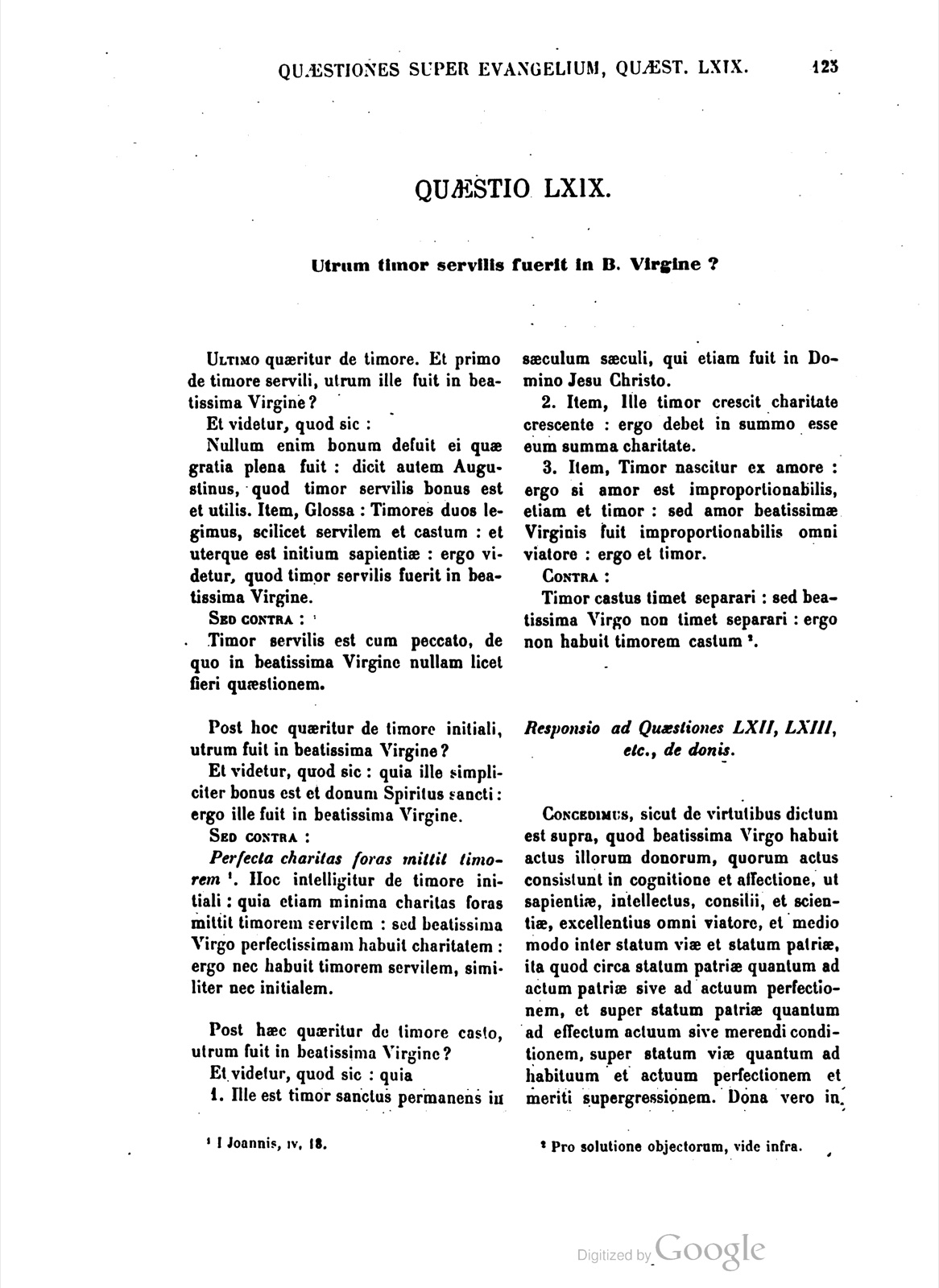
De timore servili respondendo dicimus, quod in timore servili duo sunt, scilicet timor, et servilitas. Timor in beatissima Virgine fuit: servilitas autem non fuit. Similiter de timore initiali secundum quod dicitur respectu augmenti, in beata Virgine non fuit: nec tamen propter hoc aliquod ei bonum defuit, sed perfecte ei affuit, et imperfectionem exclusit. Timor castus habet actus duos. Unum secundum statum viae, qui est timere separari: et iste non fuit in beatissima Virgine. Alium actum secundum statum patriae, qui est revereri: et ille fuit in beatissima Virgine. Est autem reverentia mixta cum dilectione subjectio. Habuit autem actum istius timoris excellentius omni viatore: unde si alicui viatori revelaretur quod deberet salvari, et sic non timeret separari, sicut videtur de beato Paulo, qui dicit: Certus sum quia neque mors, neque vita 3, etc.: non tamen in hac certitudine coaequaretur beatae Virgini: illa enim certitudo esset per scientiam et per effectum et per posterius: certitudo autem beatissimae Virginis qua se scivit non separari, fuit per modum causae: scivit enim se in utero sanctificatam, et scivit se matrem Dei esse effectam, et scivit se non peccasse, et de caetero non posse peccare, et sic scivit se separari non posse per modum causae.
Sic igitur manifestum est, qualiter beatissima Virgo septiformem gratiam Spiritus sancti in septem donis divisam, habuit excellentius omni viatore, et quodammodo omni creatura.
In responding concerning servile fear, we say that in servile fear there are two things, namely fear and servility. Fear was in the most blessed Virgin; but servility was not. Similarly, concerning initial fear insofar as it is spoken of with respect to increase, it was not in the blessed Virgin; nor nevertheless because of this was any good lacking to her, but it was present to her perfectly, and excluded imperfection. Chaste fear has two acts. One is according to the state of the way, which is to fear to be separated; and this was not in the most blessed Virgin. The other act is according to the state of the homeland, which is to revere; and that was in the most blessed Virgin. But reverence is subjection mixed with love. She had the act of this fear more excellently than every wayfarer; hence if it were revealed to some wayfarer that he ought to be saved, and thus he would not fear to be separated, as seems to have been the case with blessed Paul, who says: I am certain that neither death nor life 3, and so forth; nevertheless in this certainty he would not be equal to the blessed Virgin. For that certainty would be through knowledge and through effect and through what is later; but the certainty of the most blessed Virgin by which she knew herself not to be separated was through the mode of cause. For she knew herself sanctified in the womb, and she knew herself to have been made the mother of God, and she knew herself not to have sinned, and that thereafter she could not sin, and thus she knew herself unable to be separated through the mode of cause.
Thus, therefore, it is manifest in what way the most blessed Virgin had the sevenfold grace of the Holy Spirit, divided into seven gifts, more excellently than every wayfarer and in a certain way than every creature.
If a page does not appear, its photograph has not been uploaded yet.