Works › The Mariale: Questions on “Missus est”
Volume 37 · p. 97
Question LI, remainder
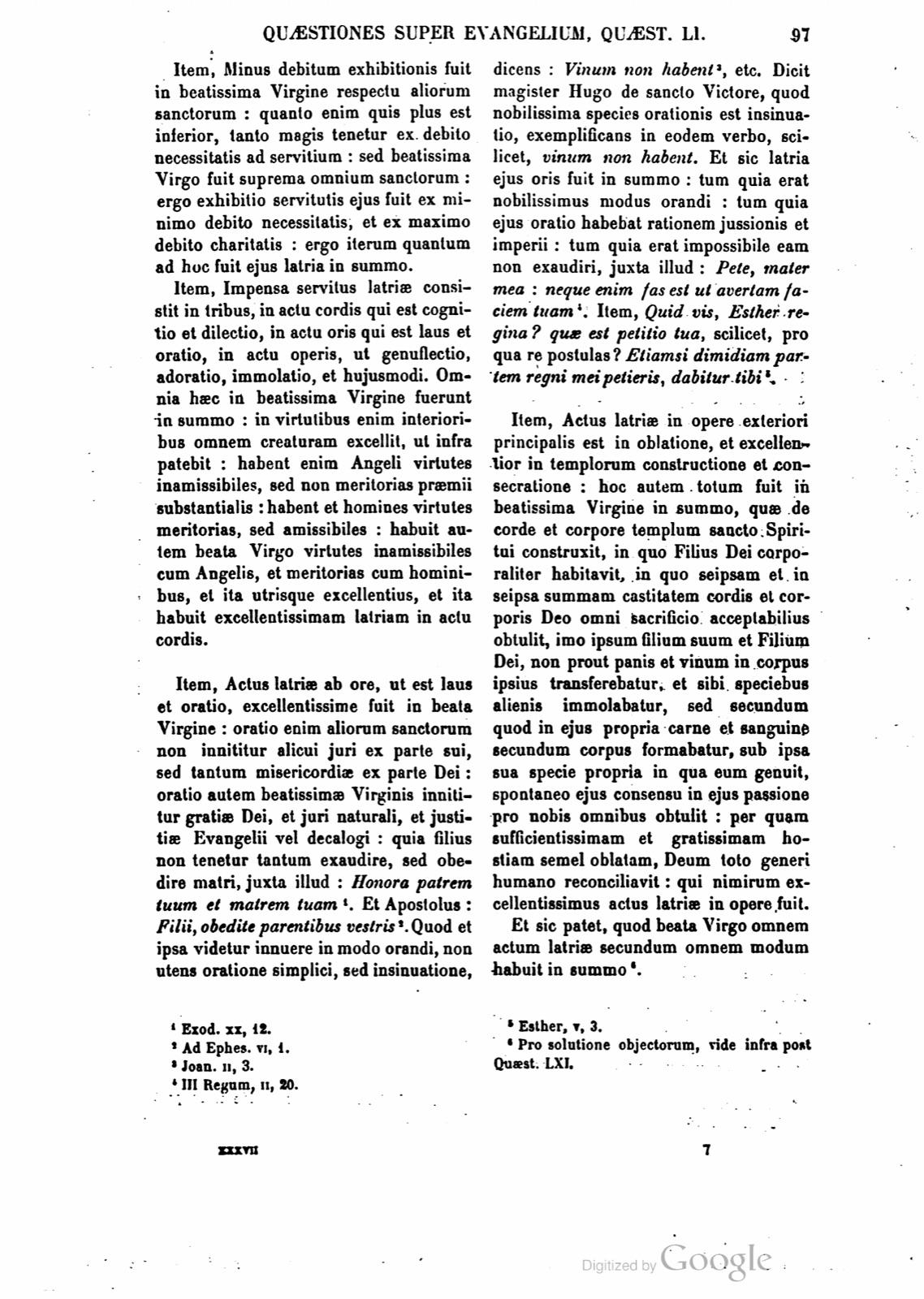
Item, Minus debitum exhibitionis fuit in beatissima Virgine respectu aliorum sanctorum: quanto enim quis plus est inferior, tanto magis tenetur ex debito necessitatis ad servitium: sed beatissima Virgo fuit suprema omnium sanctorum: ergo exhibitio servitutis ejus fuit ex minimo debito necessitatis, et ex maximo debito charitatis: ergo iterum quantum ad hoc fuit ejus latria in summo.
Item, Impensa servitus latriae consistit in tribus, in actu cordis qui est cognitio et dilectio, in actu oris qui est laus et oratio, in actu operis, ut genuflectio, adoratio, immolatio, et hujusmodi. Omnia haec in beatissima Virgine fuerunt in summo: in virtutibus enim interioribus omnem creaturam excellit, ut infra patebit: habent enim Angeli virtutes inamissibiles, sed non meritorias praemii substantialis: habent et homines virtutes meritorias, sed amissibiles: habuit autem beata Virgo virtutes inamissibiles cum Angelis, et meritorias cum hominibus, et ita utrisque excellentius, et ita habuit excellentissimam latriam in actu cordis.
Item, Actus latriae ab ore, ut est laus et oratio, excellentissime fuit in beata Virgine: oratio enim aliorum sanctorum non innititur alicui juri ex parte sui, sed tantum misericordiae ex parte Dei: oratio autem beatissimae Virginis innititur gratiae Dei, et juri naturali, et justitiae Evangelii vel decalogi: quia filius non tenetur tantum exaudire, sed obedire matri, juxta illud: Honora patrem tuum et matrem tuam 1. Et Apostolus: Filii, obedite parentibus vestris 2. Quod et ipsa videtur innuere in modo orandi, non utens oratione simplici, sed insinuatione, dicens: Vinum non habent 3, etc. Dicit magister Hugo de sancto Victore, quod nobilissima species orationis est insinuatio, exemplificans in eodem verbo, scilicet, vinum non habent. Et sic latria ejus oris fuit in summo: tum quia erat nobilissimus modus orandi: tum quia ejus oratio habebat rationem jussionis et imperii: tum quia erat impossibile eam non exaudiri, juxta illud: Pete, mater mea: neque enim fas est ut avertam faciem tuam 4. Item, Quid vis, Esther regina? quae est petitio tua, scilicet, pro qua re postulas? Etiamsi dimidiam partem regni mei petieris, dabitur tibi 5.
Item, Actus latriae in opere exteriori principalis est in oblatione, et excellentior in templorum constructione et consecratione: hoc autem totum fuit in beatissima Virgine in summo, quae de corde et corpore templum sancto Spiritui construxit, in quo Filius Dei corporaliter habitavit, in quo seipsam et in seipsa summam castitatem cordis et corporis Deo omni sacrificio acceptabilius obtulit, imo ipsum filium suum et Filium Dei, non prout panis et vinum in corpus ipsius transferebatur, et sibi speciebus alienis immolabatur, sed secundum quod in ejus propria carne et sanguine secundum corpus formabatur, sub ipsa sua specie propria in qua eum genuit, spontaneo ejus consensu in ejus passione pro nobis omnibus obtulit: per quam sufficientissimam et gratissimam hostiam semel oblatam, Deum toto generi humano reconciliavit: qui nimirum excellentissimus actus latriae in opere fuit. Et sic patet, quod beata Virgo omnem actum latriae secundum omnem modum habuit in summo 6.
Likewise, there was less debt of showing service in the most blessed Virgin with respect to the other saints: for the more inferior someone is, the more he is bound from the debt of necessity to service. But the most blessed Virgin was the highest of all saints. Therefore the showing of her service was from the least debt of necessity and from the greatest debt of charity. Therefore again, as to this, her latria was in the highest degree.
Likewise, the expended service of latria consists in three things: in the act of the heart, which is knowledge and love; in the act of the mouth, which is praise and prayer; and in the act of work, such as genuflection, adoration, immolation, and things of this kind. All these were in the most blessed Virgin in the highest degree. For in the interior virtues she excels every creature, as will be clear below: for the Angels have virtues that cannot be lost, but not virtues meritorious of substantial reward; and men have meritorious virtues, but ones that can be lost. But the blessed Virgin had virtues that cannot be lost with the Angels, and meritorious virtues with men, and thus more excellently than both; and so she had the most excellent latria in the act of the heart.
Likewise, the act of latria from the mouth, as praise and prayer, was most excellent in the blessed Virgin. For the prayer of the other saints does not rest on any right on its own part, but only on mercy on God's part. But the prayer of the most blessed Virgin rests on the grace of God, and on natural right, and on the justice of the Gospel or of the decalogue, because a son is bound not only to hear but to obey his mother, according to that saying: Honor your father and your mother 1. And the Apostle says: Children, obey your parents 2. She herself also seems to imply this in the manner of praying, not using simple prayer but insinuation, saying: They have no wine 3, and so forth. Master Hugh of Saint Victor says that the noblest species of prayer is insinuation, giving an example in this same word, namely, they have no wine. And thus the latria of her mouth was in the highest degree: both because it was the noblest manner of praying, and because her prayer had the character of command and rule, and because it was impossible for her not to be heard, according to that saying: Ask, my mother; for it is not right that I turn away your face 4. Likewise: What do you wish, Queen Esther? What is your petition, that is, for what thing do you ask? Even if you ask half of my kingdom, it will be given to you 5.
Likewise, the principal act of latria in exterior work is in offering, and a more excellent act is in the construction and consecration of temples. But this whole thing was in the most blessed Virgin in the highest degree: from heart and body she constructed a temple for the Holy Spirit, in which the Son of God dwelt bodily; in which she offered herself and in herself the highest chastity of heart and body to God, more acceptably than every sacrifice; indeed she offered her own son and the Son of God, not as bread and wine was being changed into his body and was being sacrificed to him under alien species, but according as he was being formed bodily in her own flesh and blood, under that very proper species of hers in which she begot him, by her voluntary consent in his passion for all of us. Through this most sufficient and most pleasing victim, once offered, she reconciled God to the whole human race. This undoubtedly was the most excellent act of latria in work. And thus it is clear that the blessed Virgin had every act of latria in the highest degree according to every mode 6.
Notes
- Exodus 20:12. (Exod. XX, 12.) ↩
- To the Ephesians 6:1. (Ad Ephes. VI, 1.) ↩
- John 2:3. (Joan. II, 3.) ↩
- 3 Kings 2:20. (III Regum, II, 20.) ↩
- Esther 5:3. (Esther, V, 3.) ↩
- For the solution of the objections, see below after Question LXI. (Pro solutione objectorum, vide infra post Quaest. LXI.) ↩
If a page does not appear, its photograph has not been uploaded yet.