Works › The Mariale: Questions on “Missus est”
Volume 37 · pp. 95–96
Question L. In what state the blessed Virgin had justice with respect to wayfarers?
A marker with ≈ is an approximate page boundary, placed by measure of the text; the page photographs remain the authority. In the paired views, clicking a page marker brings that page into view.
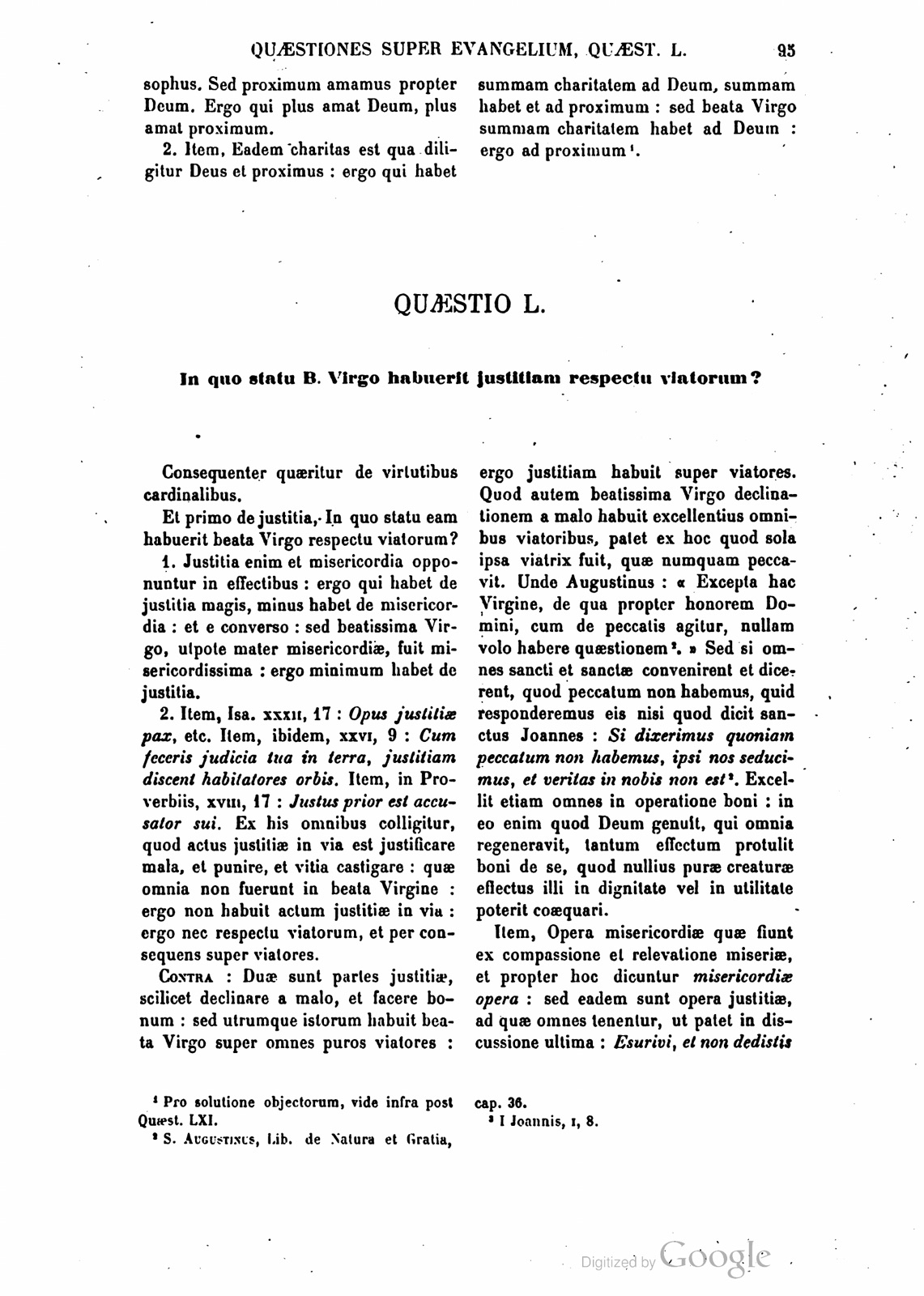
QUAESTIO L. In quo statu B. Virgo habuerit justitiam respectu viatorum?
Consequenter quaeritur de virtutibus cardinalibus.
Et primo de justitia, In quo statu eam habuerit beata Virgo respectu viatorum?
1. Justitia enim et misericordia opponuntur in effectibus: ergo qui habet de justitia magis, minus habet de misericordia: et e converso: sed beatissima Virgo, utpote mater misericordiae, fuit misericordissima: ergo minimum habet de justitia.
2. Item, Isa. XXXII, 17: Opus justitiae pax, etc. Item, ibidem, XXVI, 9: Cum feceris judicia tua in terra, justitiam discent habitatores orbis. Item, in Proverbiis, XVIII, 17: Justus prior est accusator sui. Ex his omnibus colligitur, quod actus justitiae in via est justificare mala, et punire, et vitia castigare: quae omnia non fuerunt in beata Virgine: ergo non habuit actum justitiae in via: ergo nec respectu viatorum, et per consequens super viatores.
Contra: Duae sunt partes justitiae, scilicet declinare a malo, et facere bonum: sed utrumque istorum habuit beata Virgo super omnes puros viatores: ergo justitiam habuit super viatores. Quod autem beatissima Virgo declinationem a malo habuit excellentius omnibus viatoribus, patet ex hoc quod sola ipsa viatrix fuit, quae numquam peccavit. Unde Augustinus: « Excepta hac Virgine, de qua propter honorem Domini, cum de peccatis agitur, nullam volo habere quaestionem 1. » Sed si omnes sancti et sanctae convenirent et dicerent, quod peccatum non habemus, quid responderemus eis nisi quod dicit sanctus Joannes: Si dixerimus quoniam peccatum non habemus, ipsi nos seducimus, et veritas in nobis non est 2. Excellit etiam omnes in operatione boni: in eo enim quod Deum genuit, qui omnia regeneravit, tantum effectum protulit boni de se, quod nullius purae creaturae effectus illi in dignitate vel in utilitate poterit coaequari.
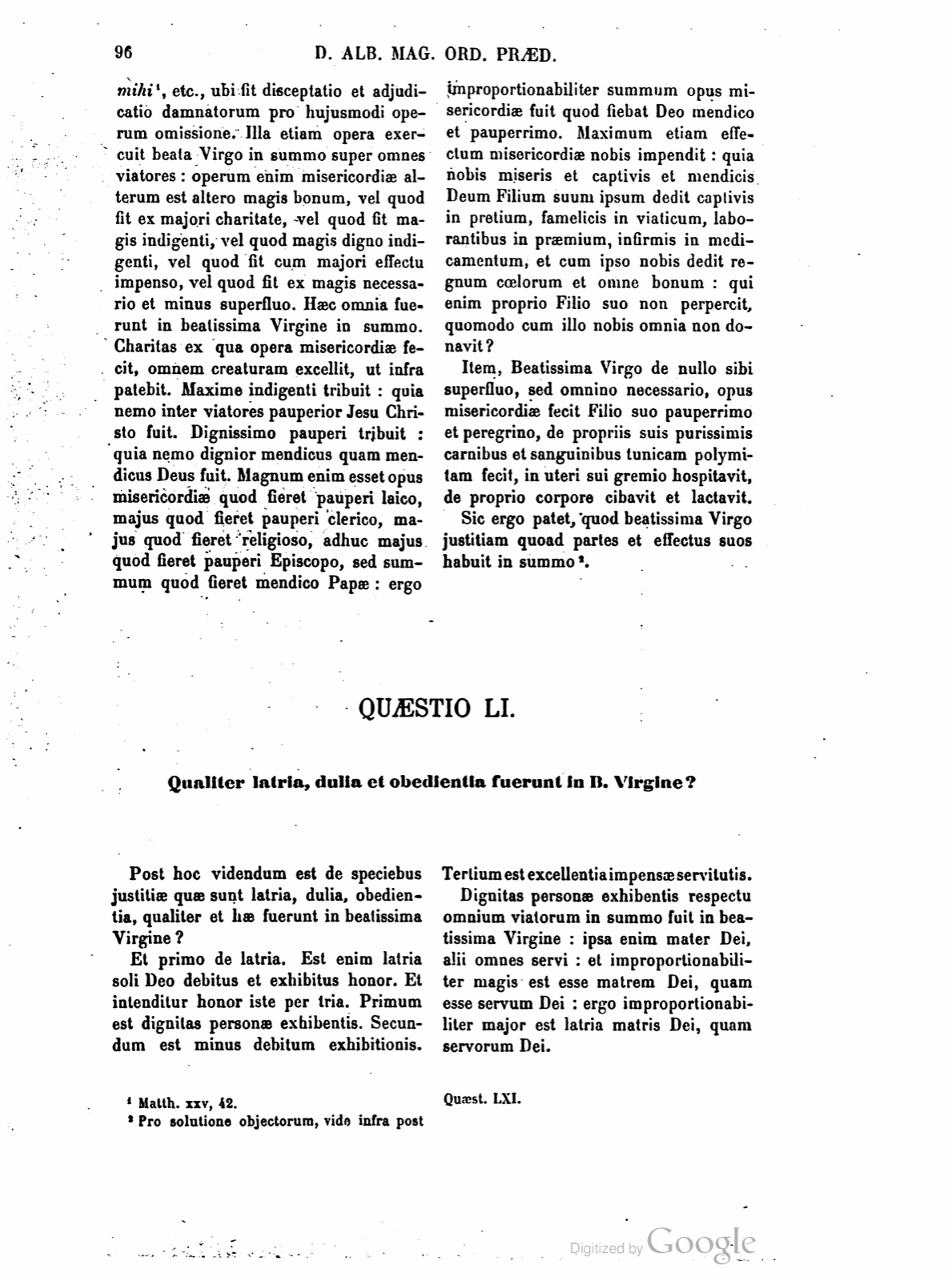
Item, Opera misericordiae quae fiunt ex compassione et relevatione miseriae, et propter hoc dicuntur misericordiae opera: sed eadem sunt opera justitiae, ad quae omnes tenentur, ut patet in discussione ultima: Esurivi, et non dedistis mihi 3, etc., ubi fit disceptatio et adjudicatio damnatorum pro hujusmodi operum omissione. Illa etiam opera exercuit beata Virgo in summo super omnes viatores: operum enim misericordiae alterum est altero magis bonum, vel quod fit ex majori charitate, vel quod fit magis indigenti, vel quod magis digno indigenti, vel quod fit cum majori effectu impenso, vel quod fit ex magis necessario et minus superfluo. Haec omnia fuerunt in beatissima Virgine in summo. Charitas ex qua opera misericordiae fecit, omnem creaturam excellit, ut infra patebit. Maxime indigenti tribuit: quia nemo inter viatores pauperior Jesu Christo fuit. Dignissimo pauperi tribuit: quia nemo dignior mendicus quam mendicus Deus fuit. Magnum enim esset opus misericordiae quod fieret pauperi laico, majus quod fieret pauperi clerico, majus quod fieret religioso, adhuc majus quod fieret pauperi Episcopo, sed summum quod fieret mendico Papae: ergo improportionabiliter summum opus misericordiae fuit quod fiebat Deo mendico et pauperrimo. Maximum etiam effectum misericordiae nobis impendit: quia nobis miseris et captivis et mendicis, Deum Filium suum ipsum dedit captivis in pretium, famelicis in viaticum, laborantibus in praemium, infirmis in medicamentum, et cum ipso nobis dedit regnum coelorum et omne bonum: qui enim proprio Filio suo non pepercit, quomodo cum illo nobis omnia non donavit?
QUESTION L. In what state the blessed Virgin had justice with respect to wayfarers?
Consequently it is asked concerning the cardinal virtues.
And first concerning justice, in what state the blessed Virgin had it with respect to wayfarers.
1. For justice and mercy are opposed in effects. Therefore one who has more of justice has less of mercy, and conversely. But the most blessed Virgin, as mother of mercy, was most merciful. Therefore she has the least of justice.
2. Likewise, Isaiah 32:17 says: The work of justice is peace, and so forth. Likewise, in the same place, 26:9: When you shall have made your judgments on earth, the inhabitants of the world will learn justice. Likewise, in Proverbs 18:17: The just one is first accuser of himself. From all these it is gathered that the act of justice on the way is to justify evils, and to punish, and to chastise vices. All these things were not in the blessed Virgin. Therefore she did not have the act of justice on the way; therefore neither with respect to wayfarers, and consequently above wayfarers.
To the contrary: there are two parts of justice, namely to decline from evil and to do good. But the blessed Virgin had each of these above all pure wayfarers. Therefore she had justice above wayfarers. But that the most blessed Virgin had decline from evil more excellently than all wayfarers is clear from this, that she alone was a wayfarer who never sinned. Hence Augustine says: "Except this Virgin, concerning whom, because of the honor of the Lord, when sins are being treated, I wish to have no question 1." But if all holy men and holy women were to assemble and say that we do not have sin, what would we answer them except what Saint John says: If we say that we do not have sin, we seduce ourselves, and the truth is not in us 2. She also excels all in the operation of good: for in this, that she bore God, who regenerated all things, she brought forth from herself so great an effect of good that the effect of no pure creature will be able to be equated to it in dignity or in utility.
Likewise, works of mercy are those that are done from compassion and the relieving of misery, and for this reason they are called works of mercy. But the same are works of justice, to which all are bound, as is clear in the final judgment: I was hungry, and you did not give to me 3, and so forth, where there is dispute and adjudication of the damned for the omission of works of this sort. The blessed Virgin also exercised those works in the highest degree above all wayfarers: for one work of mercy is better than another, either because it is done from greater charity, or because it is done to one more needy, or because it is done to one more worthy and needy, or because it is done with a greater effect bestowed, or because it is done from what is more necessary and less superfluous. All these things were in the most blessed Virgin in the highest degree. The charity from which she did works of mercy excels every creature, as will be clear below. She bestowed on the most needy, because no one among wayfarers was poorer than Jesus Christ. She bestowed on the most worthy poor man, because no beggar was more worthy than the beggar God. For it would be a great work of mercy if it were done for a poor layman, greater if it were done for a poor cleric, greater if it were done for a religious, still greater if it were done for a poor Bishop, but highest if it were done for a beggar Pope. Therefore the work of mercy that was done for God begging and most poor was disproportionately highest. She also bestowed on us the greatest effect of mercy, because for us miserable and captive and beggars she gave God himself, her Son, as a price for captives, as provision for the hungry, as reward for those laboring, as medicine for the sick; and with him she gave us the kingdom of heaven and every good thing. For he who did not spare his own Son, how did he not give us all things with him?
Item, Beatissima Virgo de nullo sibi superfluo, sed omnino necessario, opus misericordiae fecit Filio suo pauperrimo et peregrino, de propriis suis purissimis carnibus et sanguinibus tunicam polymitam fecit, in uteri sui gremio hospitavit, de proprio corpore cibavit et lactavit.
Sic ergo patet, quod beatissima Virgo justitiam quoad partes et effectus suos habuit in summo 4.
Likewise, the most blessed Virgin did a work of mercy for her most poor and pilgrim Son not from anything superfluous to herself, but from what was altogether necessary: from her own most pure flesh and blood she made him a many-colored tunic, she lodged him in the bosom of her womb, from her own body she fed and nursed him.
Therefore in this way it is clear that the most blessed Virgin had justice in the highest degree as to its parts and effects 4.
Notes
- St. Augustine, Book On Nature and Grace, chapter 36. (S. Augustinus, Lib. de Natura et Gratia, cap. 36.) ↩
- 1 John 1:8. (I Joannis, I, 8.) ↩
- Matthew 25:42. (Matth. XXV, 42.) ↩
- For the solution of the objections, see below after Question LXI. (Pro solutione objectorum, vide infra post Quaest. LXI.) ↩
If a page does not appear, its photograph has not been uploaded yet.