Volume 37 · pp. 435–436
The Gospel according to Luke and the Gospel according to John, pages 435-436
A marker with ≈ is an approximate page boundary, placed by measure of the text; the page photographs remain the authority. In the paired views, clicking a page marker brings that page into view.
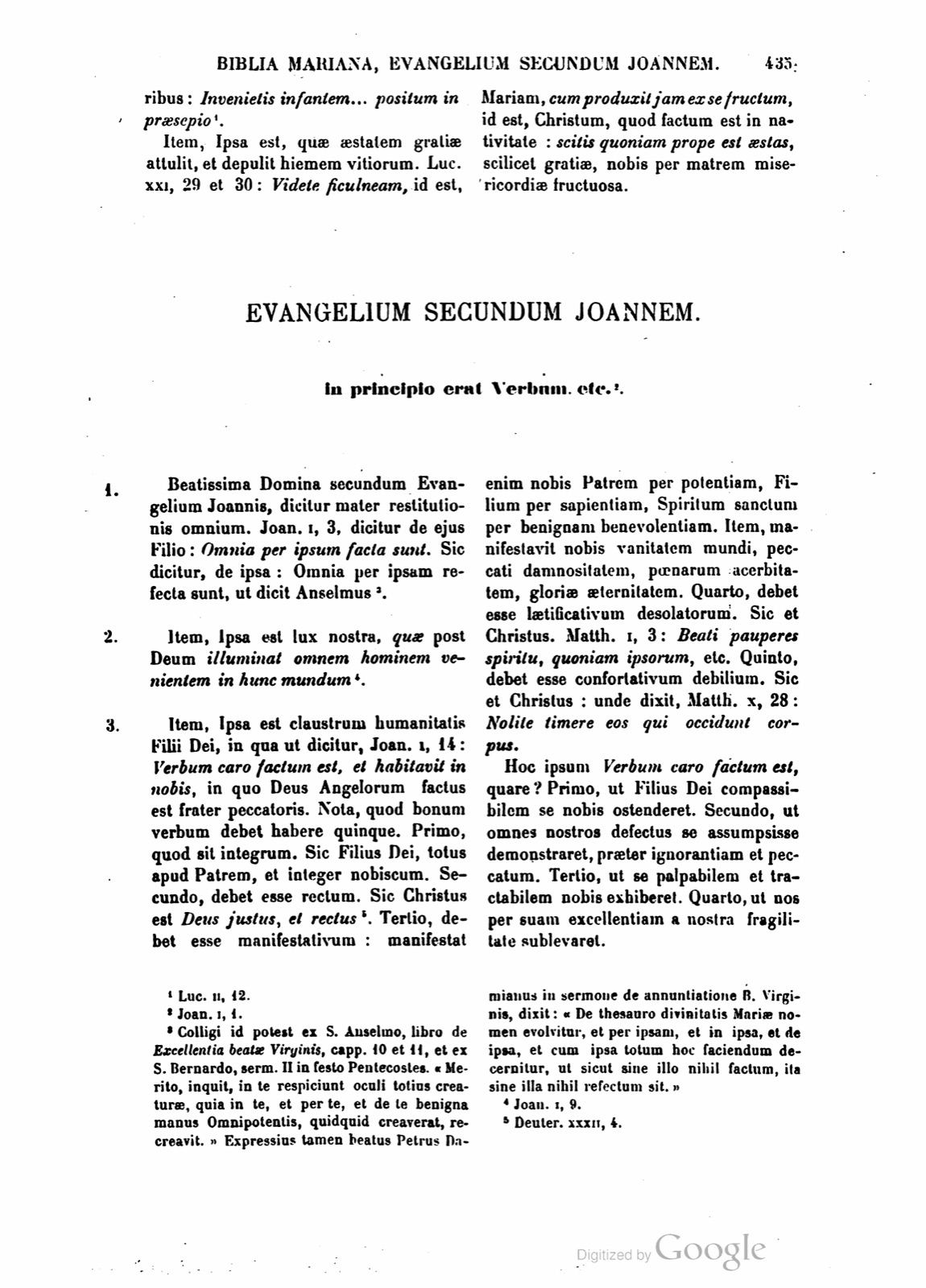
ribus: Invenietis infantem... positum in praesepio 1.
Item, Ipsa est, quae aestatem gratiae attulit, et depulit hiemem vitiorum. Luc. XXI, 29 et 30: Videte ficulneam, id est, Mariam, cum produxit jam ex se fructum, id est, Christum, quod factum est in nativitate: scitis quoniam prope est aestas, scilicet gratiae, nobis per matrem misericordiae fructuosa.
EVANGELIUM SECUNDUM JOANNEM.
In principio erat Verbum, etc. 2.
1. Beatissima Domina secundum Evangelium Joannis, dicitur mater restitutionis omnium. Joan. I, 3, dicitur de ejus Filio: Omnia per ipsum facta sunt. Sic dicitur, de ipsa: Omnia per ipsam refecta sunt, ut dicit Anselmus 3.
2. Item, Ipsa est lux nostra, quae post Deum illuminat omnem hominem venientem in hunc mundum 4.
3. Item, Ipsa est claustrum humanitatis Filii Dei, in qua ut dicitur, Joan. I, 14: Verbum caro factum est, et habitavit in nobis, in quo Deus Angelorum factus est frater peccatoris. Nota, quod bonum verbum debet habere quinque. Primo, quod sit integrum. Sic Filius Dei, totus apud Patrem, et integer nobiscum. Secundo, debet esse rectum. Sic Christus est Deus justus, et rectus 5. Tertio, debet esse manifestativum: manifestat enim nobis Patrem per potentiam, Filium per sapientiam, Spiritum sanctum per benignam benevolentiam. Item, manifestavit nobis vanitatem mundi, peccati damnositatem, poenarum acerbitatem, gloriae aeternitatem. Quarto, debet esse laetificativum desolatorum. Sic et Christus. Matth. I, 3: Beati pauperes spiritu, quoniam ipsorum, etc. Quinto, debet esse confortativum debilium. Sic et Christus: unde dixit, Matth. X, 28: Nolite timere eos qui occidunt corpus. Hoc ipsum Verbum caro factum est, quare? Primo, ut Filius Dei compassibilem se nobis ostenderet. Secundo, ut omnes nostros defectus se assumpsisse demonstraret, praeter ignorantiam et peccatum. Tertio, ut se palpabilem et tractabilem nobis exhiberet. Quarto, ut nos per suam excellentiam a nostra fragilitate sublevaret.
4. Item, Ipsa est promptuarium plenitudinis, unde omnes stipendiantur. Joan. I, 16: De plenitudine ejus nos omnes accepimus, scilicet post Deum, et gratiam pro gratia.
5. Item, Ipsa est generale baptisma peccatorum. Joan. I, 28: Erat Joannes baptizans, in remissionem peccatorum. Hujus baptismi formam spiritualiter ipsa in nobis baptizando conservat. Baptizat enim, id est, mundat peccatores, "in nomine Patris," per potentiam: "in nomine Filii," per sapientiam: "in nomine Spiritus sancti," per bonitatem, et clementiam. Unde si Joannes propter Baptismi officium interrogatus fuit: Tu quis es? etc. Sic et nos, si interrogaverimus eam, Tu quae es? Respondebit nobis, quod non sum Christus: sed Christi mater, et baptisma peccatorum.
to the shepherds: You will find the infant ... placed in a manger 1.
Likewise, she herself is she who brought the summer of grace and drove away the winter of vices. Luke 21:29 and 30: See the fig tree, that is, Mary, when it has already produced from itself the fruit, that is, Christ, which was done in the nativity; you know that summer is near, namely the summer of grace, fruitful for us through the mother of mercy.
THE GOSPEL ACCORDING TO JOHN.
In the beginning was the Word, and so forth 2.
1. The most blessed Lady according to the Gospel of John is called the mother of the restoration of all things. John 1:3 says concerning her Son: All things were made through him. Thus it is said concerning her: All things were remade through her, as Anselm says 3.
2. Likewise, she herself is our light, which after God enlightens every human being coming into this world 4.
3. Likewise, she herself is the enclosure of the humanity of the Son of God, in which, as is said, John 1:14: The Word was made flesh and dwelt among us; in this God of Angels was made the brother of the sinner. Note that a good word ought to have five things. First, that it be whole. Thus the Son of God is wholly with the Father and whole with us. Second, it ought to be right. Thus Christ is the just and right God 5. Third, it ought to be manifestative: for it manifests to us the Father through power, the Son through wisdom, the Holy Spirit through kindly benevolence. Likewise, it manifested to us the vanity of the world, the harmfulness of sin, the bitterness of punishments, and the eternity of glory. Fourth, it ought to be gladdening for the desolate. So also Christ. Matthew 1:3: Blessed are the poor in spirit, for theirs, and so forth. Fifth, it ought to be strengthening for the weak. So also Christ; whence he said, Matthew 10:28: Do not fear those who kill the body. Why was this very Word made flesh? First, so that the Son of God might show himself compassible with us. Second, so that he might demonstrate that he had taken on all our defects, except ignorance and sin. Third, so that he might present himself to us as palpable and touchable. Fourth, so that by his excellence he might lift us up from our fragility.
4. Likewise, she herself is the storehouse of fullness, whence all receive stipends. John 1:16: From his fullness we all have received, namely after God, and grace for grace.
5. Likewise, she herself is the general baptism of sinners. John 1:28: John was baptizing, unto remission of sins. She spiritually preserves the form of this baptism by baptizing in us. For she baptizes, that is, cleanses sinners, "in the name of the Father," through power; "in the name of the Son," through wisdom; "in the name of the Holy Spirit," through goodness and clemency. Hence if John was questioned because of the office of Baptism: Who are you? and so forth, so also we, if we question her, Who are you? she will answer us that I am not the Christ, but the mother of Christ and the baptism of sinners.
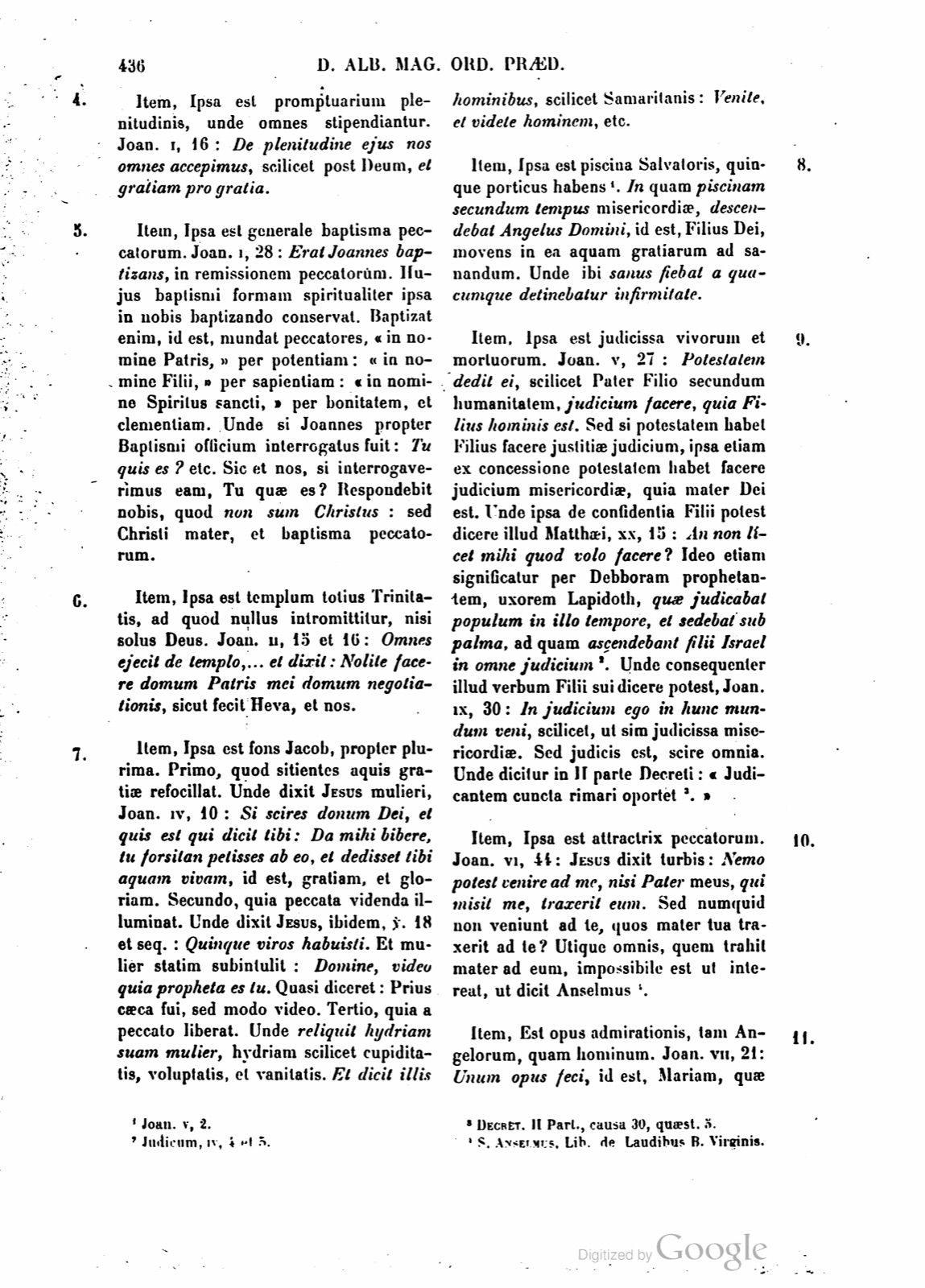
6. Item, Ipsa est templum totius Trinitatis, ad quod nullus intromittitur, nisi solus Deus. Joan. II, 15 et 16: Omnes ejecit de templo,... et dixit: Nolite facere domum Patris mei domum negotiationis, sicut fecit Heva, et nos.
7. Item, Ipsa est fons Jacob, propter plurima. Primo, quod sitientes aquis gratiae refocillat. Unde dixit Jesus mulieri, Joan. IV, 10: Si scires donum Dei, et quis est qui dicit tibi: Da mihi bibere, tu forsitan petisses ab eo, et dedisset tibi aquam vivam, id est, gratiam, et gloriam. Secundo, quia peccata videnda illuminat. Unde dixit Jesus, ibidem, v. 18 et seq.: Quinque viros habuisti. Et mulier statim subintulit: Domine, video quia propheta es tu. Quasi diceret: Prius caeca fui, sed modo video. Tertio, quia a peccato liberat. Unde reliquit hydriam suam mulier, hydriam scilicet cupiditatis, voluptatis, et vanitatis. Et dicit illis hominibus, scilicet Samaritanis: Venite, et videte hominem, etc.
8. Item, Ipsa est piscina Salvatoris, quinque porticus habens 6. In quam piscinam secundum tempus misericordiae, descendebat Angelus Domini, id est, Filius Dei, movens in ea aquam gratiarum ad sanandum. Unde ibi sanus fiebat a quacumque detinebatur infirmitate.
9. Item, Ipsa est judicissa vivorum et mortuorum. Joan. V, 27: Potestatem dedit ei, scilicet Pater Filio secundum humanitatem, judicium facere, quia Filius hominis est. Sed si potestatem habet Filius facere justitiae judicium, ipsa etiam ex concessione potestatem habet facere judicium misericordiae, quia mater Dei est. Unde ipsa de confidentia Filii potest dicere illud Matthaei, XX, 15: An non licet mihi quod volo facere? Ideo etiam significatur per Debboram prophetantem, uxorem Lapidoth, quae judicabat populum in illo tempore, et sedebat sub palma, ad quam ascendebant filii Israel in omne judicium 7. Unde consequenter illud verbum Filii sui dicere potest, Joan. IX, 30: In judicium ego in hunc mundum veni, scilicet, ut sim judicissa misericordiae. Sed judicis est, scire omnia. Unde dicitur in II parte Decreti: "Judicantem cuncta rimari oportet 8."
10. Item, Ipsa est attractrix peccatorum. Joan. VI, 44: Jesus dixit turbis: Nemo potest venire ad me, nisi Pater meus, qui misit me, traxerit eum. Sed numquid non veniunt ad te, quos mater tua traxerit ad te? Utique omnis, quem trahit mater ad eum, impossibile est ut intereat, ut dicit Anselmus 9.
11. Item, Est opus admirationis, tam Angelorum, quam hominum. Joan. VII, 21: Unum opus feci, id est, Mariam, quae
6. Likewise, she herself is the temple of the whole Trinity, into which no one is admitted except God alone. John 2:15 and 16: He cast all out of the temple, ... and said: Do not make the house of my Father a house of trade, as Eve and we did.
7. Likewise, she herself is the spring of Jacob, for many reasons. First, because she refreshes the thirsty with the waters of grace. Whence Jesus said to the woman, John 4:10: If you knew the gift of God and who it is who says to you, Give me to drink, perhaps you would have asked him, and he would have given you living water, that is, grace and glory. Second, because she illuminates sins that are to be seen. Whence Jesus said, in the same place, verse 18 and following: You have had five husbands. And the woman immediately added: Lord, I see that you are a prophet. As if she were saying: Before I was blind, but now I see. Third, because she frees from sin. Whence the woman left her water jar, namely the water jar of cupidity, pleasure, and vanity. And she says to those men, namely the Samaritans: Come and see the man, and so forth.
8. Likewise, she herself is the pool of the Savior, having five porches 6. Into this pool, according to the time of mercy, the Angel of the Lord, that is, the Son of God, descended, moving in it the water of graces for healing. Whence there one was made healthy from whatever infirmity he was held by.
9. Likewise, she herself is the female judge of the living and the dead. John 5:27: He gave him power, namely the Father to the Son according to humanity, to make judgment, because he is the Son of man. But if the Son has power to make the judgment of justice, she herself also by concession has power to make the judgment of mercy, because she is the mother of God. Whence she, from confidence in the Son, can say that saying of Matthew 20:15: Is it not permitted to me to do what I will? Therefore she is also signified by Deborah the prophetess, wife of Lapidoth, who judged the people at that time and sat under a palm tree, to which the children of Israel ascended for every judgment 7. Whence consequently she can say that word of her Son, John 9:30: For judgment I came into this world, namely that I may be the female judge of mercy. But it belongs to a judge to know all things. Whence it is said in the second part of the Decretum: "One judging ought to investigate all things 8."
10. Likewise, she herself is the drawer of sinners. John 6:44: Jesus said to the crowds: No one can come to me unless my Father, who sent me, draws him. But do those whom your mother draws to you not come to you? Certainly every one whom the mother draws to him, it is impossible that he perish, as Anselm says 9.
11. Likewise, she is a work of admiration, both of Angels and of human beings. John 7:21: I have done one work, that is, Mary, who
Notes
- Luke 2:12. (Luc. II, 12.) ↩
- John 1:1. (Joan. I, 1.) ↩
- This can be gathered from Saint Anselm, in the book On the Excellence of the Blessed Virgin, chapters 10 and 11, and from Saint Bernard, Sermon II on the feast of Pentecost. "Deservedly," he says, "the eyes of the whole creature look upon you, because in you, and through you, and from you the kindly hand of the Almighty recreated whatever he had created." Yet more expressly blessed Peter Damian, in a sermon on the Annunciation of the Blessed Virgin, said: "From the treasury of deity the name of Mary is unfolded, and through her, and in her, and from her, and with her this whole thing is decreed to be done, so that just as without him nothing was made, so without her nothing was remade." (Colligi id potest ex S. Anselmo, libro de Excellentia beatae Virginis, capp. 10 et 11, et ex S. Bernardo, serm. II in festo Pentecostes. "Merito, inquit, in te respiciunt oculi totius creaturae, quia in te, et per te, et de te benigna manus Omnipotentis, quidquid creaverat, recreavit." Expressius tamen beatus Petrus Damianus in sermone de annuntiatione B. Virginis, dixit: "De thesauro divinitatis Mariae nomen evolvitur, et per ipsam, et in ipsa, et de ipsa, et cum ipsa totum hoc faciendum decernitur, ut sicut sine illo nihil factum, ita sine illa nihil refectum sit.") ↩
- John 1:9. (Joan. I, 9.) ↩
- Deuteronomy 32:4. (Deuter. XXXII, 4.) ↩
- John 5:2. (Joan. V, 2.) ↩
- Judges 4:4 and 5. (Judicum, IV, 4 et 5.) ↩
- Decretum, Part II, case 30, question 5. (Decret. II Part., causa 30, quaest. 5.) ↩
- Saint Anselm, Book On the Praises of the Blessed Virgin. (S. Anselmus, Lib. de Laudibus B. Virginis.) ↩
If a page does not appear, its photograph has not been uploaded yet.