Volume 37 · pp. 437–438
The Gospel according to John, pages 437-438
A marker with ≈ is an approximate page boundary, placed by measure of the text; the page photographs remain the authority. In the paired views, clicking a page marker brings that page into view.
una et singularis est, et omnes admiramini ejus naturam, ejus gratiam, ejus gloriam, ejus humilitatem, ejus misericordiam.
12. Item, Ipsa est sedes misericordiae. Unde Filius Dei filiis Adae protulit sententiam absolutionis. Joan. VIII, 8 et 9: Jesus autem inclinans se deorsum. Glossa: de sede Patris in mundum, digito scribebat in terra... Qui sine peccato est vestrum, primus in illam lapidem mittat, etc. Et statim subintulit, vv. 10 et 11: Nemo te condemnavit, mulier? Quae dixit: Nemo, etc.
13. Item, Ipsa est ostium caeli. Unde illud Joannis, X, 9, dicere potest: Per me si quis introierit, salvabitur.
14. Item, Ipsa est vitis. Joan. XV, 1: Ego sum vitis vera, et Pater meus, etc. Nota proprietates vitis bonae, et adapta Virgini Mariae.
15. Item, Ipsa est mater fidelis stationis. Joan. XIX, 25: Stabant juxta crucem Jesu mater ejus, etc. Libet exclamare de ista statione. Clamo igitur et dico, quia ista statio est fidelissima. Fidelis enim advocatus libenter stat ad tribunal judicis, ubi pro suo clientulo datur sententia absolutionis, et pro adversario sententia damnationis. Sic Maria advocata nostra apud crucem stetit, in qua Filius Dei pendens judex omnium, dedit sententiam de diaboli damnatione, et de peccatorum absolutione. Ut ibi, Luc. XXIII, 34: Pater, dimitte illis, etc. Vel sententiam de regni apertione, ut ibidem v. 43: Hodie mecum eris, etc.
Clamo secundo, et dico, quia ista statio est sapientissima. Docet enim beata Virgo sub arbore crucis semper stare propter tuitionem a milvo inferni, propter refrigerationem ab aestu mundi et peccati, et propter pausationem a labore delicti. Genes. XVIII, 4 et 5, dixit Abraham: Requiescite sub arbore,... et postea transibitis.
Clamo tertio, quia statio ista est utilissima. Docet enim nos Magister Christus in cathedra crucis sedens, in omni tribulatione ad Dominum clamare, ut ibi, Marc. XV, 34: Eloi, Eloi, etc. Glossa: ut homo loquitur, ut homo flet, ut homo crucifigitur, ut homo turbatur. Secundo, docet pro persecutoribus exorare, ut ibi, Luc. XXIII, 34: Pater, dimitte illis, etc. Tertio, docet afflictis misereri, ut ibi, Amen dico tibi: hodie mecum eris in paradiso. Glossa: Semper Dominus plus tribuit quam rogetur, sicut patet in latrone, qui dicebat: Memento mei. Et ille: Hodie mecum eris in paradiso. Cito ignoscit Dominus, quia cito convertitur ille. Quarto, docet parentum diligentiam habere et curam, ibi, Joan. XIX, 26: Mulier, ecce filius tuus. Quinto, salutem desiderare, ibi, v. 28: Sitio. Sexto, in articulo mortis Deum invocare, ibi, Luc. XXIII, 46: Pater, in manus tuas, etc.
one and singular, and all of you admire her nature, her grace, her glory, her humility, her mercy.
12. Likewise, she herself is the seat of mercy. Hence the Son of God brought forth for the children of Adam a sentence of absolution. John 8:8 and 9: But Jesus, bending himself downward. Gloss: from the seat of the Father into the world, was writing with his finger on the earth ... Let the one of you who is without sin first cast a stone at her, etc. And immediately he added, verses 10 and 11: Has no one condemned you, woman? She said: No one, etc.
13. Likewise, she herself is the door of heaven. Hence she can speak that saying of John 10:9: If anyone enters through me, he will be saved.
14. Likewise, she herself is the vine. John 15:1: I am the true vine, and my Father, etc. Note the properties of a good vine, and adapt them to the Virgin Mary.
15. Likewise, she herself is the mother of faithful standing. John 19:25: There stood beside the cross of Jesus his mother, and so forth. It is pleasing to exclaim concerning that standing. Therefore I cry and say that that standing is most faithful. For a faithful advocate willingly stands at the tribunal of the judge, where for his little client a sentence of absolution is given, and for the adversary a sentence of damnation. Thus Mary our advocate stood beside the cross, on which the Son of God, hanging as judge of all, gave sentence concerning the damnation of the devil and concerning the absolution of sinners. As there, Luke 23:34: Father, forgive them, and so forth. Or the sentence concerning the opening of the kingdom, as in the same place, verse 43: Today you will be with me, and so forth.
I cry secondly and say that that standing is most wise. For the blessed Virgin teaches us always to stand under the tree of the cross for protection from the kite of hell, for cooling from the heat of the world and of sin, and for resting from the labor of guilt. Genesis 18:4 and 5, Abraham said: Rest under the tree, ... and afterward you will pass on.
I cry thirdly, because that standing is most useful. For the Master Christ, sitting in the chair of the cross, teaches us in every tribulation to cry to the Lord, as there, Mark 15:34: Eloi, Eloi, and so forth. Gloss: as man he speaks, as man he weeps, as man he is crucified, as man he is troubled. Secondly, he teaches us to pray for persecutors, as there, Luke 23:34: Father, forgive them, and so forth. Thirdly, he teaches us to have mercy on the afflicted, as there: Amen I say to you: today you will be with me in paradise. Gloss: The Lord always gives more than is asked, as is clear in the thief, who was saying: Remember me. And he: Today you will be with me in paradise. The Lord quickly forgives, because that man is quickly converted. Fourthly, he teaches us to have diligence and care for parents, there, John 19:26: Woman, behold your son. Fifthly, to desire salvation, there, verse 28: I thirst. Sixthly, in the moment of death to call upon God, there, Luke 23:46: Father, into your hands, and so forth.
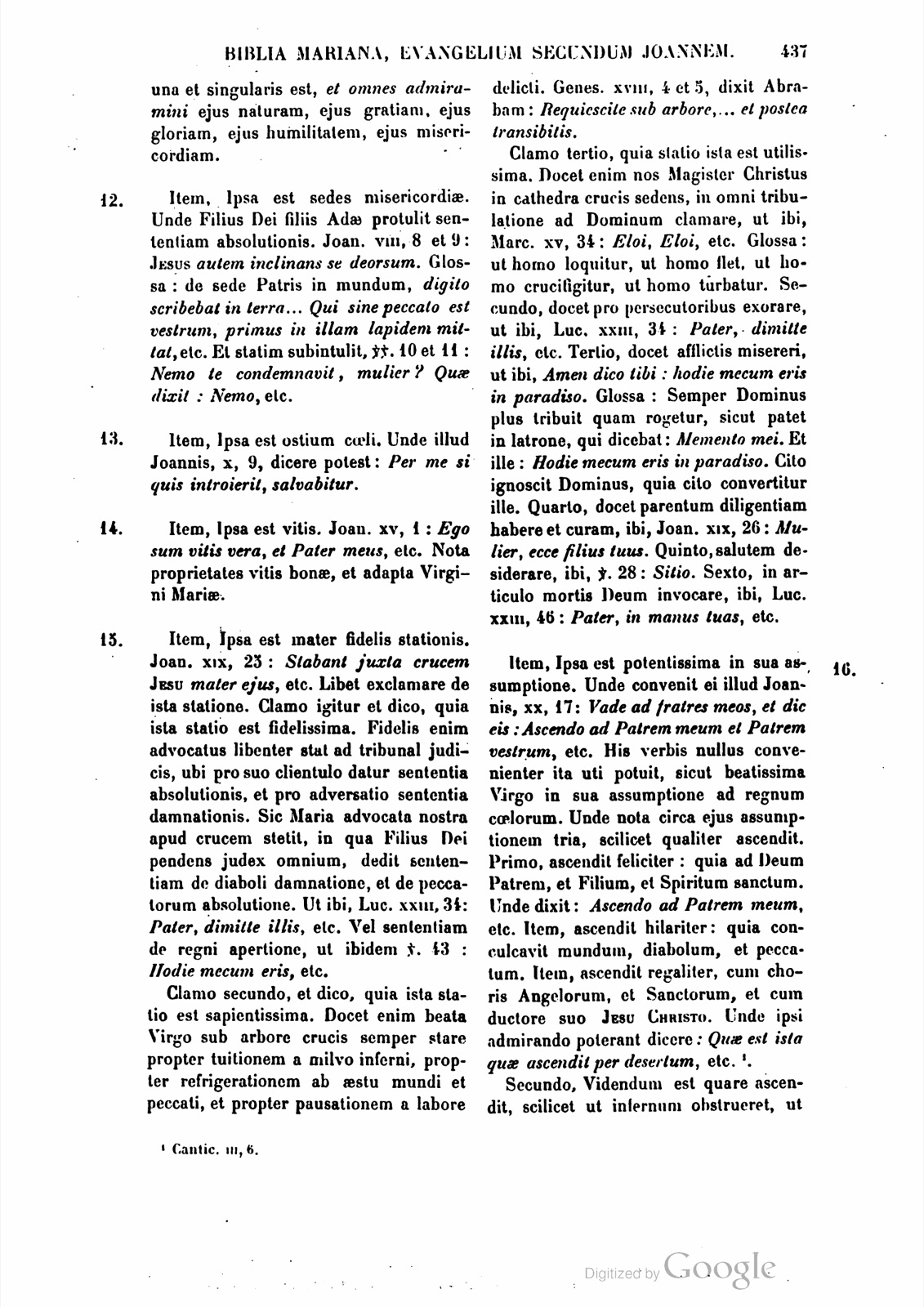
16. Item, Ipsa est potentissima in sua assumptione. Unde convenit ei illud Joannis, XX, 17: Vade ad fratres meos, et dic eis: Ascendo ad Patrem meum et Patrem vestrum, etc. His verbis nullus convenienter ita uti potuit, sicut beatissima Virgo in sua assumptione ad regnum caelorum. Unde nota circa ejus assumptionem tria, scilicet qualiter ascendit. Primo, ascendit feliciter: quia ad Deum Patrem, et Filium, et Spiritum sanctum. Unde dixit: Ascendo ad Patrem meum, etc. Item, ascendit hilariter: quia conculcavit mundum, diabolum, et peccatum. Item, ascendit regaliter, cum choris Angelorum, et Sanctorum, et cum ductore suo Jesu Christo. Unde ipsi admirando poterant dicere: Quae est ista quae ascendit per desertum, etc. 1.
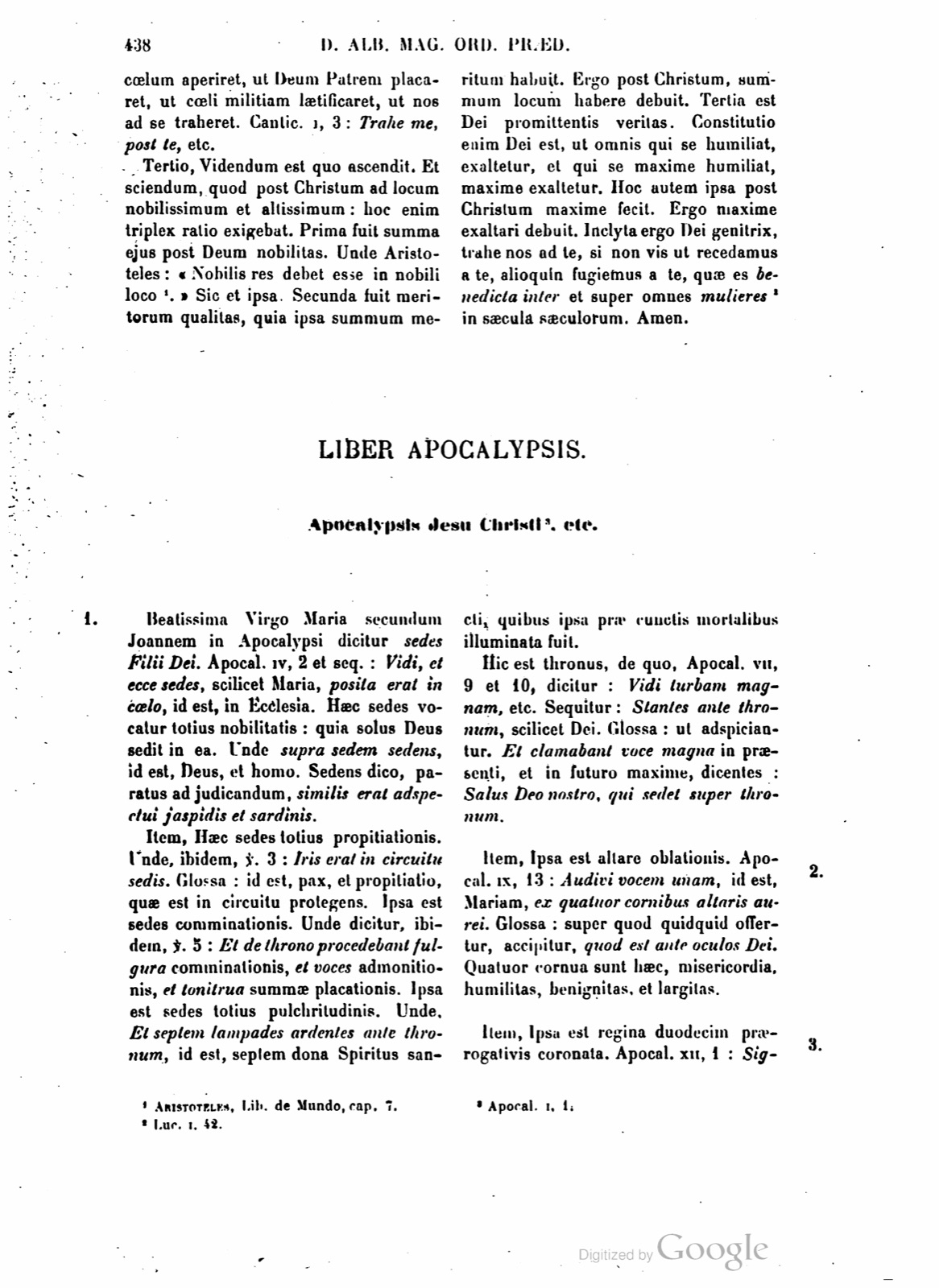
Secundo, Videndum est quare ascendit, scilicet ut infernum obstrueret, ut caelum aperiret, ut Deum Patrem placaret, ut caeli militiam laetificaret, ut nos ad se traheret. Cantic. I, 3: Trahe me, post te, etc.
Tertio, Videndum est quo ascendit. Et sciendum, quod post Christum ad locum nobilissimum et altissimum: hoc enim triplex ratio exigebat. Prima fuit summa ejus post Deum nobilitas. Unde Aristoteles: "Nobilis res debet esse in nobili loco 2." Sic et ipsa. Secunda fuit meritorum qualitas, quia ipsa summum meritum habuit. Ergo post Christum, summum locum habere debuit. Tertia est Dei promittentis veritas. Constitutio enim Dei est, ut omnis qui se humiliat, exaltetur, et qui se maxime humiliat, maxime exaltetur. Hoc autem ipsa post Christum maxime fecit. Ergo maxime exaltari debuit. Inclyta ergo Dei genitrix, trahe nos ad te, si non vis ut recedamus a te, alioquin fugiemus a te, quae es benedicta inter et super omnes mulieres 3 in saecula saeculorum. Amen.
16. Likewise, she herself is most powerful in her assumption. Hence that saying of John 20:17 befits her: Go to my brothers and say to them: I ascend to my Father and your Father, and so forth. No one could so fittingly use these words as the most blessed Virgin in her assumption to the kingdom of heaven. Hence note three things concerning her assumption, namely how she ascended. First, she ascended happily, because to God the Father, and the Son, and the Holy Spirit. Hence she said: I ascend to my Father, and so forth. Likewise, she ascended cheerfully, because she trampled upon the world, the devil, and sin. Likewise, she ascended royally, with the choirs of Angels and Saints, and with her leader Jesus Christ. Hence they themselves, marveling, could say: Who is this who ascends through the desert, and so forth 1.
Secondly, it must be seen why she ascended, namely that she might block up hell, that she might open heaven, that she might placate God the Father, that she might gladden the army of heaven, that she might draw us to herself. Song of Songs 1:3: Draw me after you, and so forth.
Thirdly, it must be seen whither she ascended. And it must be known that after Christ she ascended to the most noble and highest place; for a threefold reason required this. The first was her highest nobility after God. Whence Aristotle says: "A noble thing ought to be in a noble place 2." So also she herself. The second was the quality of merits, because she herself had the highest merit. Therefore after Christ she ought to have the highest place. The third is the truth of God promising. For the ordinance of God is that everyone who humbles himself is exalted, and the one who humbles himself most greatly is exalted most greatly. But she herself did this most greatly after Christ. Therefore she ought to be exalted most greatly. Therefore, renowned Mother of God, draw us to yourself, if you do not wish us to withdraw from you; otherwise we shall flee from you, you who are blessed among and above all women 3 forever and ever. Amen.
If a page does not appear, its photograph has not been uploaded yet.