Volume 37 · pp. 427–434
The Gospel according to Luke, pages 427-428
A marker with ≈ is an approximate page boundary, placed by measure of the text; the page photographs remain the authority. In the paired views, clicking a page marker brings that page into view.
EVANGELIUM SECUNDUM LUCAM.
Fuit in diebus Herodis, regis Judaeae, sacerdos, etc. 1.
1. Imperatrix Evangelistarum, Virgo Maria commendatur a maxima dignitate. Luc. I, 26 et 27: Missus est Angelus Gabriel, et caetera usque id, nomen Virginis Maria. Quamvis Deus esset per essentiam, potentiam, praesentiam, cum beata Virgine sicut est in creaturis generaliter: et licet esset in ea per inhabitantem gratiam, sicut est in sanctis specialiter, tamen quia adhuc distabat per corporalem praesentiam, ut in ea Deus homo fieret, similis nobis passibilis, voluit Angelum mittere ad Virginem, ad Virginis partum annuntiandum.
Cujus missio necessaria fuit propter quatuor: propter Dei honorationem, propter Angelicae dignitatis ostensionem, propter beatissimae Virginis commendationem, et propter nostram utilitatem. Deus honoratur in ista annuntiatione tripliciter. Quantum ad potentiam, in eo quod Angelos ministros habet. Secundo, quantum ad sapientiam, in eo quod modo praedonis obviavit: quia Virginem Angelus Dei docuit, sicut virginem angelus malus decepit. Tertio, quantum ad bonitatem, in eo quod nihil de contingentibus omisit, in omni eo quod matris suae honori et nostrae utilitati necessarium fuit. Secundo, necessaria fuit ad Angelicae dignitatis ostensionem, quae in tribus ostenditur. Primo, quia Angelus hic officium suum, scilicet nuntiandi, in summo exercuit. Secundo, quia summi consilii conscius fuit. Tertio, quia summam beatitudinem hominum nuntiavit. Tertio etiam fuit necessaria ad Virginis commendationem, quae in tribus ostenditur. Primo, in hoc quod non alius nuntius quam Angelus Gabriel mittitur. Secundo, in hoc quod cum ea tam multa mysteria loquitur. Tertio, in hoc quod Deus non nisi consensu Mariae, nostrae salutis opus operatur: quem consensum Angelus praeparavit. Quarto etiam fuit necessaria ad nostram utilitatem, scilicet ad fidei confirmationem, ad amicitiae Angelorum ostensionem et ad salutis nostrae procurationem.
2. Sequitur: Angelus Gabriel. Iste Angelus non fuit de majoribus, sed fuit Archangelus, et hoc in Virginis honorem, quia si quis de superioribus mitteretur, ab ipso illuminari crederetur. De minoribus ergo mittitur, ut ostendatur quod Angelus tantum est negotii ministeriique exterior delator, Deus autem per seipsum est negotii operator, salutaris decretator, intelligentiae inspirator, et mentis ad consensum inclinator, modi excusationis expositor. Unde Angelus requisitus de modo, transmisit ad Spiritum sanctum, Luc. I, 35: Spiritus sanctus superveniet in te. Apparuit autem ei Gabriel Archangelus in clara veste, ut dicunt quidam, ad honorem illius qui processit velut lux de luce. Et hoc, ut creditur, in ortu diei, ut cum sole oriente matutinali, orietur simul sol justitiae, Christus Deus noster, ut dicitur, Malach. IV, 2, et Ecclesia.
3. Sequitur: In civitatem. Si objiciatur, quod ista annuntiatio non debuit fieri in civitate, sed in dignissimo loco, scilicet in templo, propter dignissimum opus. Respondeo, quod Dominus in omnibus factis principalioribus, quae in mundo gessit, semper in communi fuit, per hoc ostendens, quare in mundum venisset: inter peccatores natus, ante bovem et asinum in praesepio locatus, inter peccatores conversatus, inter latrones crucifixus, resurgens peccatrici primus apparuit. Sic et in civitate, quae est locus communis, concipi voluit, "qui propter nostram salutem descendit de caelis," ut Ecclesia in Symbolo cantat: descendit, ut ostenderet, quia pro omnibus venit. In via natus fuit, quia sua vita debuit nobis esse via ad regnum caelorum. Extra portam passus est 2, quia per ipsius passionem non liberatur quis, nisi per conversionem ad eum.
THE GOSPEL ACCORDING TO LUKE.
There was in the days of Herod, king of Judea, a priest, and so forth 1.
1. The Empress of the Evangelists, the Virgin Mary, is commended from the greatest dignity. Luke 1:26 and 27: The Angel Gabriel was sent, and the rest down to this, the name of the Virgin was Mary. Although God was with the blessed Virgin by essence, power, and presence, as he is generally in creatures, and although he was in her through indwelling grace, as he is specially in the saints, nevertheless, because he was still distant by bodily presence, so that in her God might become man, passible like us, he wished to send an Angel to the Virgin, to announce the Virgin's childbirth.
This sending was necessary for four things: for the honoring of God, for the showing of angelic dignity, for the commendation of the most blessed Virgin, and for our usefulness. God is honored in this annunciation in three ways. As to power, in that he has Angels as ministers. Second, as to wisdom, in that he met the manner of the robber; because the Angel of God taught a virgin, just as an evil angel deceived a virgin. Third, as to goodness, in that he omitted nothing among the contingent things, in everything that was necessary for the honor of his mother and our usefulness. Second, it was necessary for the showing of angelic dignity, which is shown in three things. First, because here the Angel exercised his office, namely of announcing, in the highest way. Second, because he was conscious of the highest counsel. Third, because he announced the highest blessedness of human beings. Third, it was also necessary for the commendation of the Virgin, which is shown in three things. First, in this, that no messenger other than the Angel Gabriel is sent. Second, in this, that he speaks so many mysteries with her. Third, in this, that God works the work of our salvation only with Mary's consent, which consent the Angel prepared. Fourth, it was also necessary for our usefulness, namely for the confirmation of faith, for the showing of the friendship of Angels, and for the procuring of our salvation.
2. There follows: The Angel Gabriel. This Angel was not from the greater ones, but was an Archangel, and this for the honor of the Virgin, because if one from the higher orders were sent, it would be believed that he was illuminated by him. Therefore he is sent from the lesser ones, so that it may be shown that the Angel is only the outward bearer of the business and ministry, but God by himself is the worker of the business, the decreer of salvation, the inspirer of understanding, the incliner of the mind to consent, and the expositor of the manner of excuse. Whence the Angel, asked about the manner, referred it to the Holy Spirit, Luke 1:35: The Holy Spirit will come upon you. But Gabriel the Archangel appeared to her in bright clothing, as certain people say, for the honor of him who proceeded as light from light. And this, as is believed, was at daybreak, so that with the morning sun rising, the sun of justice, Christ our God, and the Church would rise at the same time, as is said, Malachi 4:2.
3. There follows: Into a city. If it is objected that this annunciation ought not to have happened in a city, but in the most worthy place, namely in the temple, because of the most worthy work, I answer that the Lord, in all the more principal deeds which he performed in the world, was always in a common place, showing by this why he had come into the world: born among sinners, placed in a manger before an ox and an ass, conversing among sinners, crucified between thieves, rising again and first appearing to a sinful woman. Thus also he wished to be conceived in a city, which is a common place, he "who for our salvation came down from heaven," as the Church sings in the Creed. He descended to show that he came for all. He was born on the way, because his life ought to be for us a way to the kingdom of heaven. He suffered outside the gate 2, because through his passion no one is freed except through conversion to him.
4. Sequitur: Galilaeae, quae est regio, quae a Gentibus et Judaeis inhabitabatur. Et sic in regione communi concipi voluit, qui pro omnibus nasci voluit: non enim Judaeorum Deus tantum, imo et Gentium 3. Regio illa nomine suo, proprietatem incarnationis optime expressit. Galilaea enim interpretatur revelatio, sive transmigratio: quia in hac annuntiatione erat summorum secretorum revelatio, quando Verbum, quod lucem inhabitabat inaccessibilem 4, caro factum est 5. Simili modo transmigratio maxima, scilicet de ignorantia in scientiam, de culpa in gratiam, de umbra in veritatem, de divinitate in humanitatem, quae maxima fuit.
5. Sequitur: Cui nomen Nazareth. Nazareth interpretatur flos. Bene ergo Dominus in Nazareth conceptus fuit: quia sicut odor de flore sine corruptione, sic ipse salvo virginitatis decore, et matris integritate processit.
6. Sequitur: Ad virginem. Sed quare non ad mulierem? Respondeo: A muliere initium factum est peccati 6: a muliere sub ratione mulieris, et non sub ratione virginis. Heva enim in quantum virgo nos non perdidit, sed in quantum conjuncta viro, cum nos carnaliter generavit. Unde Augustinus in Enchiridio 7, et aliis in locis: "Peccatum originale nascitur ex vulnere concupiscentiae, quae annexa est commixtioni seminum: cui vulneri subjacere non debuit, qui vulnus curare venit." Item, Ad virginem: quia generatio temporalis est imago aeternae generationis. Unde sicut aeterna generatio est de uno ente incorrupto et indiviso: ita generatio temporalis esse debuit de una incorrupta, hoc est de virgine. Creditur etiam quod beatissima Virgo in actu contemplationis fuerit, quando ei annuntiatio Dominica venit. Elevabatur autem in summam potestatem, in eo quod supra naturam Deum genuit. Et ad hanc elevabatur per fidem, juxta illud Marci, IX, 22: Omnia possibilia sunt credenti. Elevabatur etiam in summam dignitatem, per hoc quod totius creaturae per recreationem mater effecta est. Et ad hanc elevabatur humilitate, juxta illud Matthaei, XXIII, 12: Qui se humiliaverit, exaltabitur. Elevabatur etiam in summam charitatem, per hoc quod Deo summa et propinquissima fuit, utpote quae ipsius filia, mater, soror, et sponsa fuit. Et ad hanc elevabatur charitate, juxta illud Proverbiorum, VIII, 17: Ego diligentes me diligo. Elevabatur etiam in summam familiaritatem: et illam faciebat castitas, juxta illud Sapientiae, VI, 20:
4. There follows: Of Galilee, which is the region inhabited by Gentiles and Jews. And thus he wished to be conceived in a common region, who wished to be born for all; for he is not only God of the Jews, but also of the Gentiles 3. That region by its name expressed most well the property of the incarnation. For Galilee is interpreted revelation or transmigration: because in this annunciation there was a revelation of the highest secrets, when the Word, which inhabited inaccessible light 4, was made flesh 5. In like manner there was the greatest transmigration, namely from ignorance into knowledge, from fault into grace, from shadow into truth, from deity into humanity, which was the greatest.
5. There follows: Whose name was Nazareth. Nazareth is interpreted flower. Therefore the Lord was fittingly conceived in Nazareth, because as fragrance proceeds from a flower without corruption, so he proceeded with the beauty of virginity and the integrity of the mother preserved.
6. There follows: To a virgin. But why not to a woman? I answer: From a woman the beginning of sin was made 6, from a woman under the aspect of woman and not under the aspect of virgin. For Eve, insofar as she was a virgin, did not destroy us, but insofar as she was joined to a man, when she carnally generated us. Whence Augustine in the Enchiridion 7 and in other places: "Original sin is born from the wound of concupiscence, which is attached to the mingling of seeds; to this wound he who came to heal the wound ought not to have been subject." Likewise, To a virgin: because temporal generation is the image of eternal generation. Hence, just as eternal generation is from one incorrupt and undivided being, so temporal generation ought to be from one incorrupt woman, that is, from a virgin. It is also believed that the most blessed Virgin was in the act of contemplation when the Lord's annunciation came to her. But she was being raised to the highest power, in that she bore God above nature. And she was raised to this through faith, according to that saying of Mark 9:22: All things are possible to one who believes. She was also raised to the highest dignity, through this, that she was made the mother of the whole creature by recreation. And she was raised to this through humility, according to that saying of Matthew 23:12: Whoever humbles himself shall be exalted. She was also raised to the highest charity, through this, that she was highest and nearest to God, as one who was his daughter, mother, sister, and spouse. And she was raised to this through charity, according to that saying of Proverbs 8:17: I love those who love me. She was also raised to the highest familiarity, and chastity made that, according to that saying of Wisdom 6:20:
Incorruptio facit proximum esse Deo. Elevabatur ergo tota, quae tota replebatur, et tota glorificabatur.
7. Sequitur: Desponsatam. Ista desponsatio utilis fuit ad multa, sicut habetur, Matth. I, 18: Cum esset desponsata, etc. Creditur, quod Deum conceperit tali aetate, quae perfecta fuit statura, et corporis quantitate.
8. Sequitur: Viro, cui nomen erat Joseph. Joseph vir erat per constantiam fidelitatis, quantum ad justitiam: vir per virtutem castitatis, quantum ad temperantiam: vir per excellentiam discretionis, quantum ad prudentiam: vir per strenuitatem operationis, quantum ad fortitudinem. Et sic notatur excellentia quatuor cardinalium virtutum. Bernardus: "Non est dubium, quin bonus et fidelis homo fuerit iste Joseph, cui mater desponsata est Salvatoris. Fidelis, etc. 8."
9. Sequitur: De domo David. Sed quaeritur, cum hic mundissima Dei conceptio scribatur, cur David, qui quandoque notorius peccator exstitit, ibi ponatur? Dicendum, quod non ideo hic ponitur, quod peccator fuerit, sed quod Joseph ab eo carnaliter descendit, et per imitationem in virtutibus similis fuit. Nec propter peccati maculam, quam per poenitentiam delevit, minus in genealogia Domini nominari debuit, sed audacter praedicari: cum hoc et peccatoribus confidentiam generet, et ejus misericordiam augmentet, qui dicit: In quacumque hora peccator ingemuerit, etc.
10. Sequitur: Et nomen Virginis Maria. Nota quod beata Virgo interpretationem sui nominis non de novo acquisivit, sed et in hoc nata fuit. Semper enim stella maris fuit, et tam praecedentes se, quam sequentes illuminat: quia nisi per fidem Verbi incarnati, vel incarnandi de Virgine, numquam alicui salus fuit. Unde et ipsa in fide hominum, et Dei electione, et confirmatione, Domina et Regina omnium creaturarum exstitit semper. Unde ipsa illud Proverbiorum, VIII, 22, convenienter dicere potest: Dominus possedit me, etc. Unde illud, ibidem, v. 24: Nondum erant abyssi, etc. Sciendum est etiam, quod nomen, Maria, Virgini nostrae convenientissime impositum est propter tria. Primo, propter personae dignitatem. Secundo, propter actionis suae utilitatem. Tertio, propter conceptionis divinae proprietatem. Dignitas personae exprimitur per naturam lucis, quae intelligitur in stella maris. Sicut enim nihil pulchrius, aut nobilius luce: ita post Deum nihil dignius Maria. Et nota, quod haec beata Virgo, non solum a luce divina, sicut luna a sole, illuminata fuit: sed etiam ipsam lucem, quae Deus est 9, de se produxit: sicut aurora solem, qui omnia illuminabilia illuminavit. Et sic in beata Virgine per naturam lucis exprimitur excellentia dignitatis. Utilitas actionis intelligitur in hoc quod omnes naufragos ducit, deducit, conducit, reducit, perducit ad portum salutis aeternae. Proprietas conceptionis divinae signatur per hoc quod sicut sidus radium profert sine diminutione, ita Virgo Filium sine corruptione.
11. Et ingressus Angelus ad eam, dixit. Hic commendatur Maria a pudicitia summa. Unde Bernardus: "Quo ingressus est ad eam? Puto in secretarium pudici cubiculi, ubi illa fortassis clauso super se ostio, orabat Deum Patrem in abscondito. Non enim apertum invenit Angelus ostiolum Virginis, cui nimirum in proposito erat hominum fugere frequentiam, vitare colloquia, ne vel orantis perturbaretur silentium 10." Ex his verbis divi Bernardi, credunt quidam, beatissimam Virginem in adventu Angeli, inclinatis genibus, et elevatis piis manibus, erectis in caelum oculis ad Patrem misericordiarum pro incarnatione Filii sui, devotissime preces cum lacrymis fudisse, et Angelo venienti reverenter assurrexisse, et percepta ejus annuntiatione, credentem in eam consensisse, et quantocius impleta salutatione, flexis rursum in terra genibus, et elevatis in caelum oculis ac manibus, ex intimo corde erumpentibus lacrymis prae gaudio, devotissime gratias egisse. Et iste modus est earum, qui de manu Angeli, id est, sacerdotis, suscipiunt corpus Dominicum de altari.
Incorruption makes one nearest to God. Therefore she was raised up wholly, she who was wholly filled and wholly glorified.
7. There follows: Betrothed. This betrothal was useful for many things, as is had at Matthew 1:18: When she had been betrothed, and so forth. It is believed that she conceived God at such an age as was perfect in stature and in bodily quantity.
8. There follows: To a man whose name was Joseph. Joseph was a man through constancy of faithfulness, as to justice; a man through the virtue of chastity, as to temperance; a man through excellence of discretion, as to prudence; a man through vigorousness of action, as to fortitude. And thus the excellence of the four cardinal virtues is noted. Bernard: "There is no doubt that this Joseph, to whom the mother of the Savior was betrothed, was a good and faithful man. Faithful, and so forth 8."
9. There follows: Of the house of David. But it is asked, since here the most pure conception of God is being written, why David, who at one time existed as a notorious sinner, is placed there. It must be said that he is placed here not because he was a sinner, but because Joseph descended carnally from him and was like him in virtues by imitation. Nor, on account of the stain of sin which he destroyed through repentance, ought he to have been named less in the genealogy of the Lord, but boldly proclaimed, since this both generates confidence for sinners and increases the mercy of him who says: In whatever hour the sinner shall groan, and so forth.
10. There follows: And the name of the Virgin was Mary. Note that the blessed Virgin did not newly acquire the interpretation of her name, but was born also in this. For she was always the star of the sea, and she illuminates both those preceding her and those following her, because salvation never came to anyone except through faith in the Word incarnate, or to be incarnate, from the Virgin. Hence she herself also, in the faith of human beings, and in God's election and confirmation, always existed as Lady and Queen of all creatures. Whence she herself can fittingly say that saying of Proverbs 8:22: The Lord possessed me, and so forth. Whence that saying in the same place, verse 24: The abysses were not yet, and so forth. It must also be known that the name Mary was most fittingly imposed upon our Virgin for three things. First, because of the dignity of the person. Second, because of the usefulness of her action. Third, because of the property of the divine conception. The dignity of the person is expressed through the nature of light, which is understood in the star of the sea. For just as nothing is more beautiful or nobler than light, so after God nothing is worthier than Mary. And note that this blessed Virgin was not only illuminated by divine light, like the moon by the sun, but she also produced from herself the very light which is God 9, like the dawn producing the sun, which illuminated all things capable of illumination. And thus in the blessed Virgin the excellence of dignity is expressed through the nature of light. The usefulness of action is understood in this, that she leads, leads away, conducts, leads back, and brings all shipwrecked persons through to the harbor of eternal salvation. The property of the divine conception is signified by this, that as a star brings forth a ray without diminution, so the Virgin brought forth the Son without corruption.
11. And the Angel entering to her, said. Here Mary is commended from highest modesty. Whence Bernard: "Where did he enter to her? I think into the secret room of a modest chamber, where perhaps, with the door closed upon herself, she prayed to God the Father in secret. For the Angel did not find open the little door of the Virgin, whose purpose surely was to flee the crowd of human beings and to avoid conversations, lest even the silence of one praying be disturbed 10." From these words of divine Bernard, certain people believe that the most blessed Virgin, at the coming of the Angel, with knees bent and pious hands lifted, eyes raised to heaven toward the Father of mercies for the incarnation of his Son, poured out most devoted prayers with tears, and reverently rose to meet the Angel coming, and, when his announcement had been perceived, consented as one believing in it; and, as soon as the salutation had been completed, with knees again bent to the earth and eyes and hands raised to heaven, with tears breaking forth from the depths of the heart because of joy, she gave thanks most devoutly. And this is the manner of those who receive the Lord's body from the hand of an Angel, that is, of a priest, from the altar.
12. Sequitur: Ave. Ave, quasi sine vae corporis, et animae. Per peccatum incurrit homo triplex vae in corpore. Primum est corporis distemperatio, et naturalium appetituum inordinatio. Secundum est ipsius corporis, et animae ad invicem repugnatio: quia caro concupiscit adversus spiritum 11. Tertium est ipsius corporis post mortem incineratio. Sine isto triplici vae fuit beata Virgo in corpore, quae corpus habet virginitate integrum, cum spiritu pacificatum, et numquam post mortem incineratum. Ex parte animae habet homo triplex vae, errorem in rationabili, dolorem in concupiscibili, pudorem in irascibili. Ab isto etiam triplici vae immunis fuit Virgo Maria, quae nec in discretione, nec in elatione, nec in exsecutione umquam erravit.
Item, Est aliud triplex vae, scilicet culpae, poenae, ignorantiae. Vae culpae est triplex, scilicet originalis, actualis mortalis, venialis. Vel ita: Vae avaritiae in opere, vae luxuriae in carne, vae superbiae in corde. De isto triplici vae dicitur in Apocalypsi, VIII, 13: Vae, vae, vae habitantibus in terra. Item, Vae poenae triplex, scilicet vae gehennae, vae purgatorii, vae poenitentiae. Item, Vae ignorantiae est triplex, scilicet ignorantia credendi, operandi, salvandi. Sine isto multiplici vae fuit beatissima Virgo Maria. Item, Triplex vae est in mulieribus specialiter, scilicet vae sterilitatis in virginibus, vae subjectionis in conjugatis, vae desolationis in viduis. Ab isto etiam triplici vae fuit beata Virgo immunis. Fuit enim Virgo sine sterilitate, conjugata sine subjectione, vidua sine desolatione. Item, In mulieribus est triplex vae: omnis enim mulier, praeter eam, in conceptu perdit virginitatem: post conceptum, venustatem corporis et sanitatem: in partu, hominum societatem. Ab hoc etiam immunis fuit. In conceptu virginitatem non amisit, sed puritatem acquisivit: post conceptum, pulchritudinem non perdidit, sed in tantum irradiavit, quod eam Joseph inspicere non potuit. Item, post partum, hominum societatem non perdidit, imo tunc mediatrix Dei et hominum constituta est. Unde in puerperio, a pastoribus et regibus visitatur.
Item, Ipsa est gratia plena per influentiam divinae bonitatis, ut ejus gratiae plenitudo in nobis suppleat defectum. Etiam, Ipsa est stella in firmamento gloriae fixa, ut nos naufragos de statu miseriae, reducat ad portum salutis aeternae. Hac de causa apponit Ecclesia in salutatione ista felix nomen, Maria.
13. Sequitur: Gratia plena. Quatuor modis fuit gratia plena. Primo, quia omnes gratias generales et speciales in summo habuit, a quibus omnis alia creatura vacua fuit. Secundo, quia sua gratia tanta fuit, quod pura creatura majoris gratiae capax non fuit. Tertio, quia omnem gratiam increatam in se totam continuit, et sic per omnem modum gratiae, gratia plena fuit. De hac plenitudine dicit Bernardus 12: "Legimus in Actibus Apostolorum et Stephanum plenum gratia et
12. There follows: Hail. Hail, as if without woe of body and soul. Through sin the human being incurs a threefold woe in the body. The first is the body's distemper and the disorder of natural appetites. The second is the mutual opposition of body and soul, because the flesh lusts against the spirit 11. The third is the body's reduction to ashes after death. The blessed Virgin was without this threefold woe in the body, since she has a body whole in virginity, pacified with the spirit, and never reduced to ashes after death. On the part of the soul the human being has a threefold woe: error in the rational power, sorrow in the concupiscible power, shame in the irascible power. The Virgin Mary was also immune from this threefold woe, for she never erred in discretion, nor in elevation, nor in execution.
Likewise, there is another threefold woe, namely of fault, punishment, and ignorance. The woe of fault is threefold: original, actual mortal, and venial. Or thus: woe of avarice in work, woe of luxury in flesh, woe of pride in the heart. Concerning this threefold woe it is said in Apocalypse 8:13: Woe, woe, woe to those dwelling on the earth. Likewise, the woe of punishment is threefold, namely woe of Gehenna, woe of purgatory, woe of penitence. Likewise, the woe of ignorance is threefold, namely ignorance of believing, acting, and being saved. The most blessed Virgin Mary was without this manifold woe. Likewise, there is a threefold woe in women specially, namely woe of sterility in virgins, woe of subjection in married women, woe of desolation in widows. The blessed Virgin was also immune from this threefold woe. For she was a Virgin without sterility, married without subjection, a widow without desolation. Likewise, in women there is a threefold woe: for every woman, except her, loses virginity in conception; after conception, bodily beauty and health; in childbirth, the society of human beings. She also was immune from this. In conception she did not lose virginity, but acquired purity; after conception, she did not lose beauty, but shone forth so much that Joseph could not look upon her. Likewise, after childbirth she did not lose the society of human beings; indeed then she was constituted mediator of God and human beings. Whence in childbirth she is visited by shepherds and kings.
Likewise, she herself is full of grace through the inflow of divine goodness, so that the fullness of her grace may supply the defect in us. Also, she herself is the star fixed in the firmament of glory, so that she may lead us shipwrecked ones back from the state of misery to the harbor of eternal salvation. For this reason the Church adds to that salutation the happy name Mary.
13. There follows: Full of grace. In four ways she was full of grace. First, because she had in the highest degree all general and special graces, of which every other creature was empty. Second, because her grace was so great that a pure creature was not capable of greater grace. Third, because she contained in herself the whole uncreated grace, and thus in every manner of grace she was full of grace. Concerning this fullness Bernard says 12: "We read in the Acts of the Apostles both Stephen full of grace and
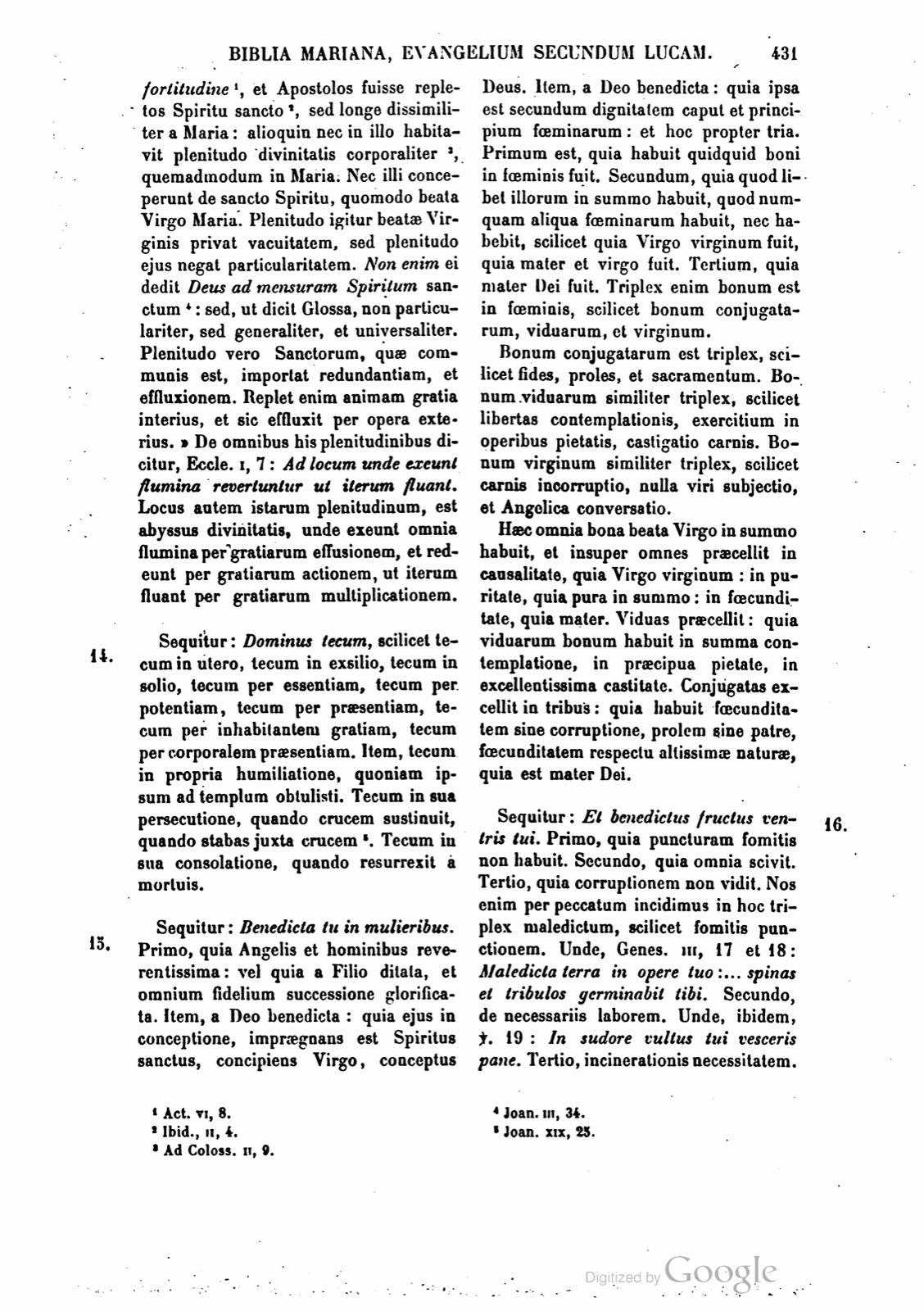
fortitudine 13, et Apostolos fuisse repletos Spiritu sancto 14, sed longe dissimiliter a Maria: alioquin nec in illo habitavit plenitudo divinitatis corporaliter 15, quemadmodum in Maria. Nec illi conceperunt de sancto Spiritu, quomodo beata Virgo Maria. Plenitudo igitur beatae Virginis privat vacuitatem, sed plenitudo ejus negat particularitatem. Non enim ei dedit Deus ad mensuram Spiritum sanctum 16: sed, ut dicit Glossa, non particulariter, sed generaliter, et universaliter. Plenitudo vero Sanctorum, quae communis est, importat redundantiam, et effluxionem. Replet enim animam gratia interius, et sic effluxit per opera exterius." De omnibus his plenitudinibus dicitur, Eccle. I, 7: Ad locum unde exeunt flumina revertuntur ut iterum fluant. Locus autem istarum plenitudinum, est abyssus divinitatis, unde exeunt omnia flumina per gratiarum effusionem, et redeunt per gratiarum actionem, ut iterum fluant per gratiarum multiplicationem.
14. Sequitur: Dominus tecum, scilicet tecum in utero, tecum in exsilio, tecum in solio, tecum per essentiam, tecum per potentiam, tecum per praesentiam, tecum per inhabitantem gratiam, tecum per corporalem praesentiam. Item, tecum in propria humiliatione, quoniam ipsum ad templum obtulisti. Tecum in sua persecutione, quando crucem sustinuit, quando stabas juxta crucem 17. Tecum in sua consolatione, quando resurrexit a mortuis.
15. Sequitur: Benedicta tu in mulieribus. Primo, quia Angelis et hominibus reverentissima: vel quia a Filio ditata, et omnium fidelium successione glorificata. Item, a Deo benedicta: quia ejus in conceptione, impraegnans est Spiritus sanctus, concipiens Virgo, conceptus Deus. Item, a Deo benedicta: quia ipsa est secundum dignitatem caput et principium foeminarum: et hoc propter tria. Primum est, quia habuit quidquid boni in foeminis fuit. Secundum, quia quodlibet illorum in summo habuit, quod numquam aliqua foeminarum habuit, nec habebit, scilicet quia Virgo virginum fuit, quia mater et virgo fuit. Tertium, quia mater Dei fuit. Triplex enim bonum est in foeminis, scilicet bonum conjugatarum, viduarum, et virginum. Bonum conjugatarum est triplex, scilicet fides, proles, et sacramentum. Bonum viduarum similiter triplex, scilicet libertas contemplationis, exercitium in operibus pietatis, castigatio carnis. Bonum virginum similiter triplex, scilicet carnis incorruptio, nulla viri subjectio, et Angelica conversatio. Haec omnia bona beata Virgo in summo habuit, et insuper omnes praecellit in causalitate, quia Virgo virginum: in puritate, quia pura in summo: in foecunditate, quia mater. Viduas praecellit: quia viduarum bonum habuit in summa contemplatione, in praecipua pietate, in excellentissima castitate. Conjugatas excellit in tribus: quia habuit foecunditatem sine corruptione, prolem sine patre, foecunditatem respectu altissimae naturae, quia est mater Dei.
16. Sequitur: Et benedictus fructus ventris tui. Primo, quia puncturam fomitis non habuit. Secundo, quia omnia scivit. Tertio, quia corruptionem non vidit. Nos enim per peccatum incidimus in hoc triplex maledictum, scilicet fomitis punctionem. Unde, Genes. III, 17 et 18: Maledicta terra in opere tuo: ... spinas et tribulos germinabit tibi. Secundo, de necessariis laborem. Unde, ibidem, v. 19: In sudore vultus tui vesceris pane. Tertio, incinerationis necessitatem. Unde, ibidem, Pulvis es, et in pulverem reverteris.
fortitude 13, and that the Apostles were filled with the Holy Spirit 14, but in a way far unlike Mary; otherwise the fullness of deity would not have dwelt bodily in him 15 in the same manner as in Mary. Nor did they conceive of the Holy Spirit in the way the blessed Virgin Mary did. Therefore the fullness of the blessed Virgin removes emptiness, but her fullness denies partiality. For God did not give the Holy Spirit to her by measure 16, but, as the Gloss says, not particularly, but generally and universally. But the fullness of the Saints, which is common, imports overflowing and outpouring. For grace fills the soul inwardly, and thus flows outwardly through works." Concerning all these fullnesses it is said, Ecclesiastes 1:7: To the place from which the rivers go forth, they return that they may flow again. But the place of these fullnesses is the abyss of deity, from which all rivers go forth through the outpouring of graces, and return through thanksgiving, so that they may flow again through the multiplication of graces.
14. There follows: The Lord is with you, namely with you in the womb, with you in exile, with you on the throne, with you through essence, with you through power, with you through presence, with you through indwelling grace, with you through bodily presence. Likewise, with you in his own humiliation, since you offered him in the temple. With you in his persecution, when he endured the cross, when you were standing beside the cross 17. With you in his consolation, when he rose again from the dead.
15. There follows: Blessed are you among women. First, because she is most reverend to Angels and human beings, or because she was enriched by the Son and glorified by the succession of all the faithful. Likewise, blessed by God, because in his conception the Holy Spirit is the impregnator, the Virgin is the conceiver, God is the one conceived. Likewise, blessed by God, because according to dignity she herself is the head and beginning of women, and this for three reasons. The first is because she had whatever good was in women. The second, because she had each of those goods in the highest degree, which no woman ever had nor will have, namely because she was Virgin of virgins, because she was mother and virgin. The third, because she was the mother of God. For there is a threefold good in women, namely the good of married women, of widows, and of virgins. The good of married women is threefold, namely fidelity, offspring, and sacrament. The good of widows is similarly threefold, namely liberty of contemplation, exercise in works of piety, chastisement of the flesh. The good of virgins is similarly threefold, namely incorruption of flesh, no subjection to a man, and angelic way of life. The blessed Virgin had all these goods in the highest degree, and furthermore she surpassed all in causality, because she was Virgin of virgins; in purity, because pure in the highest degree; in fruitfulness, because mother. She surpasses widows, because she had the good of widows in highest contemplation, in preeminent piety, in most excellent chastity. She excels married women in three things, because she had fruitfulness without corruption, offspring without a father, and fruitfulness with respect to the highest nature, because she is the mother of God.
16. There follows: And blessed is the fruit of your womb. First, because he did not have the prick of the tinder. Second, because he knew all things. Third, because he did not see corruption. For through sin we fell into this threefold curse, namely the prick of the tinder. Whence Genesis 3:17 and 18: Cursed is the earth in your work; ... it will bring forth thorns and thistles for you. Second, labor concerning necessary things. Whence, in the same place, verse 19: In the sweat of your face you shall eat bread. Third, the necessity of reduction to ashes. Whence, in the same place: You are dust, and into dust you shall return.
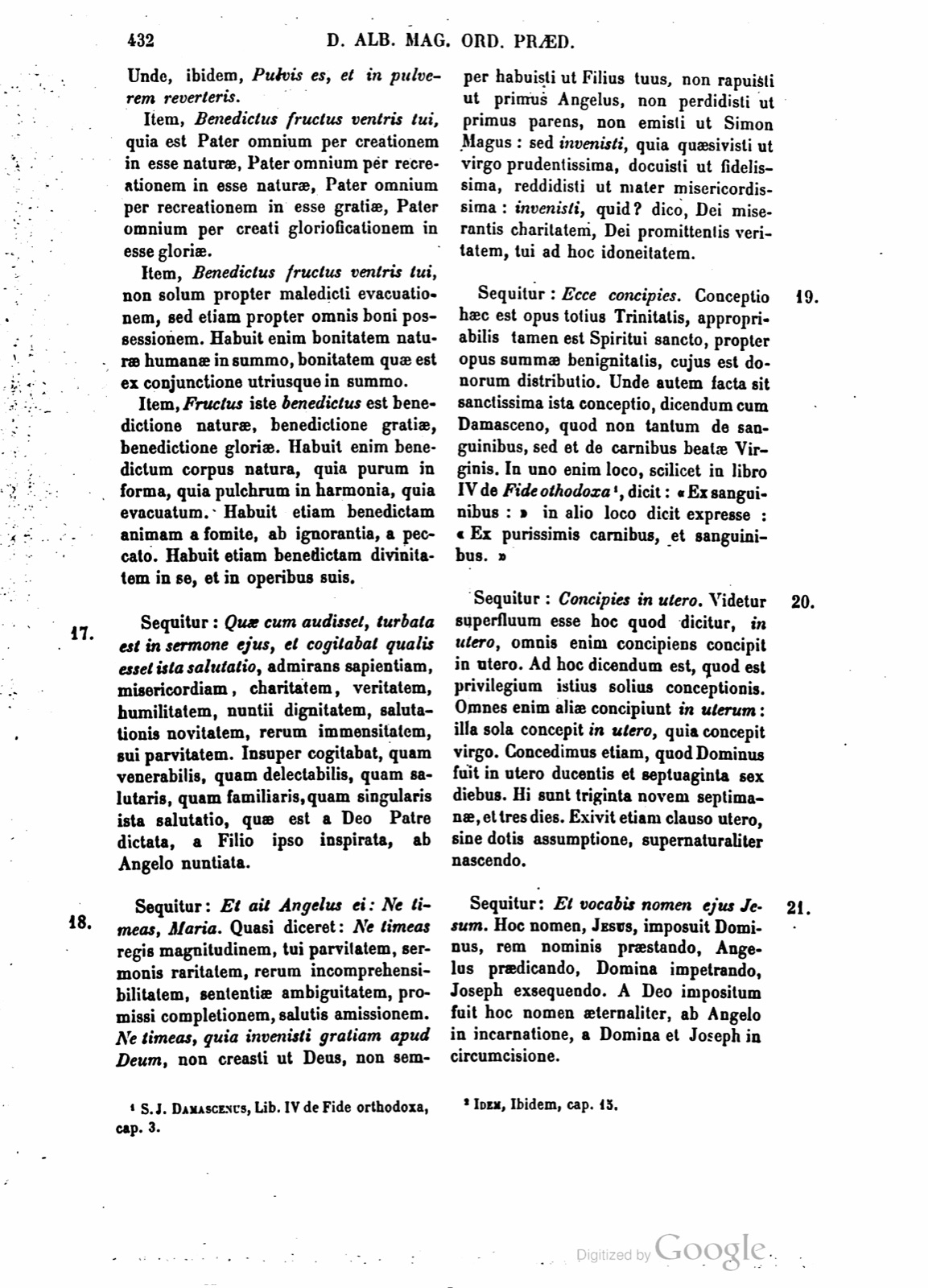
Item, Benedictus fructus ventris tui, quia est Pater omnium per creationem in esse naturae, Pater omnium per recreationem in esse naturae, Pater omnium per recreationem in esse gratiae, Pater omnium per creati glorificationem in esse gloriae. Item, Benedictus fructus ventris tui, non solum propter maledicti evacuationem, sed etiam propter omnis boni possessionem. Habuit enim bonitatem naturae humanae in summo, bonitatem quae est ex conjunctione utriusque in summo. Item, Fructus iste benedictus est benedictione naturae, benedictione gratiae, benedictione gloriae. Habuit enim benedictum corpus natura, quia purum in forma, quia pulchrum in harmonia, quia evacuatum. Habuit etiam benedictam animam a fomite, ab ignorantia, a peccato. Habuit etiam benedictam divinitatem in se, et in operibus suis.
17. Sequitur: Quae cum audisset, turbata est in sermone ejus, et cogitabat qualis esset ista salutatio, admirans sapientiam, misericordiam, charitatem, veritatem, humilitatem, nuntii dignitatem, salutationis novitatem, rerum immensitatem, sui parvitatem. Insuper cogitabat, quam venerabilis, quam delectabilis, quam salutaris, quam familiaris, quam singularis ista salutatio, quae est a Deo Patre dictata, a Filio ipso inspirata, ab Angelo nuntiata.
18. Sequitur: Et ait Angelus ei: Ne timeas, Maria. Quasi diceret: Ne timeas regis magnitudinem, tui parvitatem, sermonis raritatem, rerum incomprehensibilitatem, sententiae ambiguitatem, promissi completionem, salutis amissionem. Ne timeas, quia invenisti gratiam apud Deum, non creasti ut Deus, non semper habuisti ut Filius tuus, non rapuisti ut primus Angelus, non perdidisti ut primus parens, non emisti ut Simon Magus: sed invenisti, quia quaesivisti ut virgo prudentissima, docuisti ut fidelissima, reddidisti ut mater misericordissima: invenisti, quid? dico, Dei miserantis charitatem, Dei promittentis veritatem, tui ad hoc idoneitatem.
19. Sequitur: Ecce concipies. Conceptio haec est opus totius Trinitatis, appropriabilis tamen est Spiritui sancto, propter opus summae benignitatis, cujus est donorum distributio. Unde autem facta sit sanctissima ista conceptio, dicendum cum Damasceno, quod non tantum de sanguinibus, sed et de carnibus beatae Virginis. In uno enim loco, scilicet in libro IV de Fide orthodoxa 18, dicit: "Ex sanguinibus:" in alio loco dicit expresse: "Ex purissimis carnibus, et sanguinibus 19."
20. Sequitur: Concipies in utero. Videtur superfluum esse hoc quod dicitur, in utero, omnis enim concipiens concipit in utero. Ad hoc dicendum est, quod est privilegium istius solius conceptionis. Omnes enim aliae concipiunt in uterum: illa sola concepit in utero, quia concepit virgo. Concedimus etiam, quod Dominus fuit in utero ducentis et septuaginta sex diebus. Hi sunt triginta novem septimanae, et tres dies. Exivit etiam clauso utero, sine dotis assumptione, supernaturaliter nascendo.
21. Sequitur: Et vocabis nomen ejus Jesum. Hoc nomen, Jesus, imposuit Dominus, rem nominis praestando, Angelus praedicando, Domina impetrando, Joseph exsequendo. A Deo impositum fuit hoc nomen aeternaliter, ab Angelo in incarnatione, a Domina et Joseph in circumcisione.
Likewise, Blessed is the fruit of your womb, because he is the Father of all through creation in the being of nature, Father of all through recreation in the being of nature, Father of all through recreation in the being of grace, Father of all through the glorification of the creature in the being of glory. Likewise, Blessed is the fruit of your womb, not only because of the emptying of the curse, but also because of the possession of every good. For he had the goodness of human nature in the highest degree, and the goodness which is from the conjunction of both in the highest degree. Likewise, this fruit is blessed with the blessing of nature, the blessing of grace, and the blessing of glory. For he had a body blessed by nature, because pure in form, because beautiful in harmony, because emptied. He also had a soul blessed from the tinder, from ignorance, from sin. He also had blessed deity in himself and in his works.
17. There follows: When she had heard, she was troubled at his word, and she was considering what kind of salutation this was, wondering at the wisdom, mercy, charity, truth, humility, dignity of the messenger, newness of the salutation, immensity of the things, and her own smallness. In addition she was considering how venerable, how delightful, how saving, how familiar, how singular this salutation was, which was dictated by God the Father, inspired by the Son himself, announced by the Angel.
18. There follows: And the Angel said to her: Fear not, Mary. As if he were saying: Do not fear the greatness of the king, your own smallness, the rarity of the word, the incomprehensibility of the things, the ambiguity of the sentence, the completion of the promise, the loss of salvation. Do not fear, because you have found grace before God; you did not create it as God, did not always have it as your Son did, did not seize it as the first Angel did, did not lose it as the first parent did, did not buy it as Simon Magus did, but you found it, because you sought as the most prudent virgin, taught as the most faithful one, gave back as the most merciful mother. You found what? I say, the charity of God having mercy, the truth of God promising, and your suitability for this.
19. There follows: Behold, you shall conceive. This conception is the work of the whole Trinity; nevertheless it is appropriable to the Holy Spirit, because of the work of highest kindness, to whom belongs the distribution of gifts. But whence this most holy conception was made, one must say with Damascene that it was not only from the bloods, but also from the flesh of the blessed Virgin. For in one place, namely in Book IV On the Orthodox Faith 18, he says: "From the bloods"; in another place he expressly says: "From the most pure flesh and blood 19."
20. There follows: You shall conceive in the womb. What is said, in the womb, seems superfluous, for everyone conceiving conceives in the womb. To this it must be said that this is the privilege of this conception alone. For all other women conceive into the womb; she alone conceived in the womb, because she conceived as a virgin. We also concede that the Lord was in the womb for two hundred seventy-six days. These are thirty-nine weeks and three days. He also came forth while the womb was closed, without assuming the dowry, by being born supernaturally.
21. There follows: And you shall call his name Jesus. The Lord imposed this name Jesus by furnishing the reality of the name; the Angel by proclaiming it; the Lady by obtaining it; Joseph by carrying it out. This name was imposed by God eternally, by the Angel in the incarnation, by the Lady and Joseph in the circumcision.
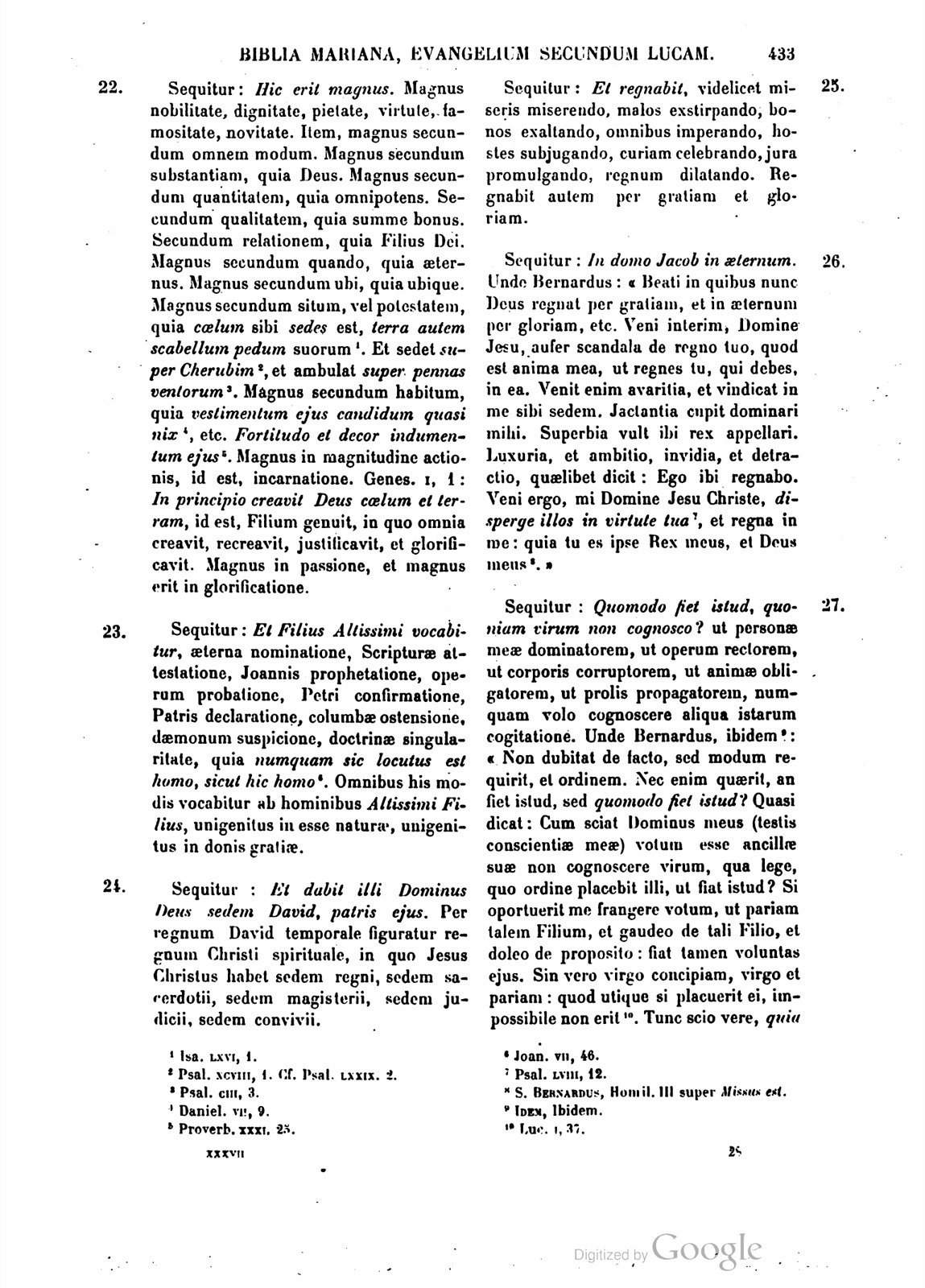
22. Sequitur: Hic erit magnus. Magnus nobilitate, dignitate, pietate, virtute, famositate, novitate. Item, magnus secundum omnem modum. Magnus secundum substantiam, quia Deus. Magnus secundum quantitatem, quia omnipotens. Secundum qualitatem, quia summe bonus. Secundum relationem, quia Filius Dei. Magnus secundum quando, quia aeternus. Magnus secundum ubi, quia ubique. Magnus secundum situm, vel potestatem, quia caelum sibi sedes est, terra autem scabellum pedum suorum 20. Et sedet super Cherubim 21, et ambulat super pennas ventorum 22. Magnus secundum habitum, quia vestimentum ejus candidum quasi nix 23, etc. Fortitudo et decor indumentum ejus 24. Magnus in magnitudine actionis, id est, incarnatione. Genes. I, 1: In principio creavit Deus caelum et terram, id est, Filium genuit, in quo omnia creavit, recreavit, justificavit, et glorificavit. Magnus in passione, et magnus erit in glorificatione.
23. Sequitur: Et Filius Altissimi vocabitur, aeterna nominatione, Scripturae attestatione, Joannis prophetatione, operum probatione, Petri confirmatione, Patris declaratione, columbae ostensione, daemonum suspicione, doctrinae singularitate, quia numquam sic locutus est homo, sicut hic homo 25. Omnibus his modis vocabitur ab hominibus Altissimi Filius, unigenitus in esse naturae, unigenitus in donis gratiae.
24. Sequitur: Et dabit illi Dominus Deus sedem David, patris ejus. Per regnum David temporale figuratur regnum Christi spirituale, in quo Jesus Christus habet sedem regni, sedem sacerdotii, sedem magisterii, sedem judicii, sedem convivii.
25. Sequitur: Et regnabit, videlicet miseris miserendo, malos exstirpando, bonos exaltando, omnibus imperando, hostes subjugando, curiam celebrando, jura promulgando, regnum dilatando. Regnabit autem per gratiam et gloriam.
26. Sequitur: In domo Jacob in aeternum. Unde Bernardus: "Beati in quibus nunc Deus regnat per gratiam, et in aeternum per gloriam, etc. Veni interim, Domine Jesu, aufer scandala de regno tuo, quod est anima mea, ut regnes tu, qui debes, in ea. Venit enim avaritia, et vindicat in me sibi sedem. Jactantia cupit dominari mihi. Superbia vult ibi rex appellari. Luxuria, et ambitio, invidia, et detractio, quaelibet dicit: Ego ibi regnabo. Veni ergo, mi Domine Jesu Christe, disperge illos in virtute tua 26, et regna in me: quia tu es ipse Rex meus, et Deus meus 27."
27. Sequitur: Quomodo fiet istud, quoniam virum non cognosco? ut personae meae dominatorem, ut operum rectorem, ut corporis corruptorem, ut animae obligatorem, ut prolis propagatorem, numquam volo cognoscere aliqua istarum cogitatione. Unde Bernardus, ibidem 28: "Non dubitat de facto, sed modum requirit, et ordinem. Nec enim quaerit, an fiet istud, sed quomodo fiet istud? Quasi dicat: Cum sciat Dominus meus, testis conscientiae meae, votum esse ancillae suae non cognoscere virum, qua lege, quo ordine placebit illi, ut fiat istud? Si oportuerit me frangere votum, ut pariam talem Filium, et gaudeo de tali Filio, et doleo de proposito: fiat tamen voluntas ejus. Sin vero virgo concipiam, virgo et pariam: quod utique si placuerit ei, impossibile non erit 29. Tunc scio vere, quia respexit humilitatem ancillae suae 30. Quomodo ergo fiet istud, quoniam virum non cognosco."
22. There follows: He shall be great. Great in nobility, dignity, piety, virtue, fame, newness. Likewise, great according to every mode. Great according to substance, because God. Great according to quantity, because omnipotent. According to quality, because supremely good. According to relation, because Son of God. Great according to when, because eternal. Great according to where, because everywhere. Great according to position or power, because heaven is his seat, but earth the footstool of his feet 20. And he sits upon the Cherubim 21, and walks upon the wings of the winds 22. Great according to habit, because his garment is white as snow 23, and so forth. Strength and beauty are his clothing 24. Great in the greatness of action, that is, in the incarnation. Genesis 1:1: In the beginning God created heaven and earth, that is, he begot the Son, in whom he created, recreated, justified, and glorified all things. Great in the passion, and great he will be in glorification.
23. There follows: And he shall be called Son of the Most High, by eternal naming, by the attestation of Scripture, by the prophecy of John, by the proof of works, by the confirmation of Peter, by the declaration of the Father, by the showing of the dove, by the suspicion of demons, by the singularity of doctrine, because never did a man speak thus as this man 25. In all these ways he will be called by human beings the Son of the Most High, only-begotten in the being of nature, only-begotten in the gifts of grace.
24. There follows: And the Lord God will give him the throne of David his father. Through the temporal kingdom of David is figured the spiritual kingdom of Christ, in which Jesus Christ has the throne of kingdom, the throne of priesthood, the throne of teaching, the throne of judgment, the throne of banquet.
25. There follows: And he shall reign, namely by having mercy on the wretched, rooting out the evil, exalting the good, commanding all, subjugating enemies, holding court, promulgating laws, enlarging the kingdom. But he will reign through grace and glory.
26. There follows: In the house of Jacob forever. Whence Bernard: "Blessed are those in whom God now reigns through grace and forever through glory, and so forth. Come meanwhile, Lord Jesus; remove scandals from your kingdom, which is my soul, so that you may reign in it, as you ought. For avarice comes and claims for itself a seat in me. Boasting desires to dominate me. Pride wishes to be called king there. Luxury, ambition, envy, and detraction, each says: I shall reign there. Come therefore, my Lord Jesus Christ, scatter them in your power 26, and reign in me, because you yourself are my King and my God 27."
27. There follows: How shall this happen, since I do not know a man? as dominator of my person, as ruler of my works, as corrupter of my body, as binder of my soul, as propagator of offspring, I never wish to know him by any thought of these things. Whence Bernard, in the same place 28: "She does not doubt concerning the fact, but asks the manner and order. For she does not ask whether this will happen, but how this will happen. As if she were saying: Since my Lord, witness of my conscience, knows that it is the vow of his handmaid not to know a man, by what law, by what order will it please him that this happen? If it will be necessary for me to break the vow so that I may bear such a Son, I both rejoice concerning such a Son and grieve concerning the purpose; nevertheless let his will be done. But if I shall conceive as a virgin and also bear as a virgin, which certainly, if it shall please him, will not be impossible 29, then I truly know that he has regarded the humility of his handmaid 30. How therefore shall this happen, since I do not know a man?"
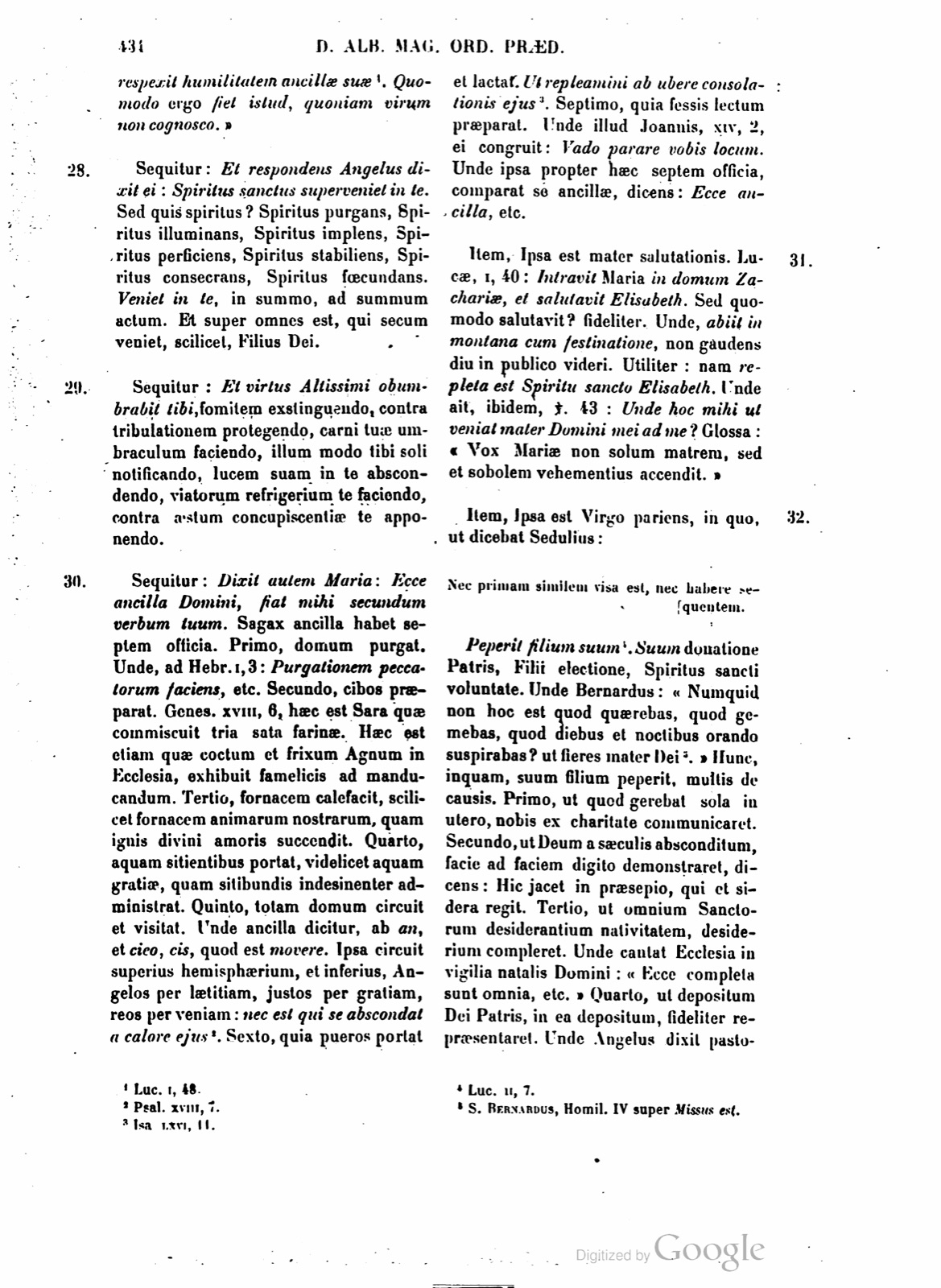
28. Sequitur: Et respondens Angelus dixit ei: Spiritus sanctus superveniet in te. Sed quis spiritus? Spiritus purgans, Spiritus illuminans, Spiritus implens, Spiritus perficiens, Spiritus stabiliens, Spiritus consecrans, Spiritus foecundans. Veniet in te, in summo, ad summum actum. Et super omnes est, qui secum veniet, scilicet, Filius Dei.
29. Sequitur: Et virtus Altissimi obumbrabit tibi, fomitem exstinguendo, contra tribulationem protegendo, carni tuae umbraculum faciendo, illum modo tibi soli notificando, lucem suam in te abscondendo, viatorum refrigerium te faciendo, contra aestum concupiscentiae te apponendo.
30. Sequitur: Dixit autem Maria: Ecce ancilla Domini, fiat mihi secundum verbum tuum. Sagax ancilla habet septem officia. Primo, domum purgat. Unde, ad Hebr. I, 3: Purgationem peccatorum faciens, etc. Secundo, cibos praeparat. Genes. XVIII, 6, haec est Sara quae commiscuit tria sata farinae. Haec est etiam quae coctum et frixum Agnum in Ecclesia, exhibuit famelicis ad manducandum. Tertio, fornacem calefacit, scilicet fornacem animarum nostrarum, quam ignis divini amoris succendit. Quarto, aquam sitientibus portat, videlicet aquam gratiae, quam sitibundis indesinenter administrat. Quinto, totam domum circuit et visitat. Unde ancilla dicitur, ab an, et cieo, cis, quod est movere. Ipsa circuit superius hemisphaerium, et inferius, Angelos per laetitiam, justos per gratiam, reos per veniam: nec est qui se abscondat a calore ejus 31. Sexto, quia pueros portat et lactat. Ut repleamini ab ubere consolationis ejus 32. Septimo, quia fessis lectum praeparat. Unde illud Joannis, XIV, 2, ei congruit: Vado parare vobis locum. Unde ipsa propter haec septem officia, comparat se ancillae, dicens: Ecce ancilla, etc.
31. Item, Ipsa est mater salutationis. Lucae, I, 40: Intravit Maria in domum Zachariae, et salutavit Elisabeth. Sed quomodo salutavit? fideliter. Unde, abiit in montana cum festinatione, non gaudens diu in publico videri. Utiliter: nam repleta est Spiritu sancto Elisabeth. Unde ait, ibidem, v. 43: Unde hoc mihi ut veniat mater Domini mei ad me? Glossa: "Vox Mariae non solum matrem, sed et sobolem vehementius accendit."
32. Item, Ipsa est Virgo pariens, in quo, ut dicebat Sedulius: Nec primam similem visa est, nec habere sequentem. Peperit filium suum 33. Suum donatione Patris, Filii electione, Spiritus sancti voluntate. Unde Bernardus: "Numquid non hoc est quod quaerebas, quod gemebas, quod diebus et noctibus orando suspirabas? ut fieres mater Dei 34." Hunc, inquam, suum filium peperit, multis de causis. Primo, ut quod gerebat sola in utero, nobis ex charitate communicaret. Secundo, ut Deum a saeculis absconditum, facie ad faciem digito demonstraret, dicens: Hic jacet in praesepio, qui et sidera regit. Tertio, ut omnium Sanctorum desiderantium nativitatem, desiderium compleret. Unde cantat Ecclesia in vigilia natalis Domini: "Ecce completa sunt omnia, etc." Quarto, ut depositum Dei Patris, in ea depositum, fideliter repraesentaret. Unde Angelus dixit pastoribus:
28. There follows: And the Angel answering said to her: The Holy Spirit will come upon you. But what spirit? The Spirit purging, the Spirit illuminating, the Spirit filling, the Spirit perfecting, the Spirit establishing, the Spirit consecrating, the Spirit making fruitful. He will come upon you in the highest degree, for the highest act. And he who will come with him is above all, namely the Son of God.
29. There follows: And the power of the Most High will overshadow you, by extinguishing the tinder, by protecting against tribulation, by making a shade for your flesh, by making known that manner to you alone, by hiding his light in you, by making you the refreshment of wayfarers, by setting you against the heat of concupiscence.
30. There follows: But Mary said: Behold the handmaid of the Lord, let it be done to me according to your word. A shrewd handmaid has seven offices. First, she cleans the house. Whence Hebrews 1:3: Making purification of sins, and so forth. Second, she prepares foods. Genesis 18:6, this is Sarah who mixed three measures of flour. She is also the one who presented the roasted and fried Lamb in the Church to the hungry to be eaten. Third, she heats the furnace, namely the furnace of our souls, which the fire of divine love kindles. Fourth, she carries water to the thirsty, namely the water of grace, which she unceasingly administers to the thirsty. Fifth, she goes around and visits the whole house. Whence handmaid, ancilla, is said from an and cieo, cies, which means to move. She goes around the upper and lower hemisphere, Angels through joy, the just through grace, the guilty through pardon; nor is there one who hides himself from her heat 31. Sixth, because she carries and nurses children. That you may be filled from the breast of her consolation 32. Seventh, because she prepares a bed for the weary. Whence that saying of John 14:2 suits her: I go to prepare a place for you. Hence she, because of these seven offices, compares herself to a handmaid, saying: Behold the handmaid, and so forth.
31. Likewise, she herself is the mother of salutation. Luke 1:40: Mary entered the house of Zachariah and greeted Elizabeth. But how did she greet? Faithfully. Whence she went into the hill country with haste, not rejoicing to be seen long in public. Usefully, for Elizabeth was filled with the Holy Spirit. Whence she says in the same place, verse 43: Whence is this to me, that the mother of my Lord should come to me? Gloss: "The voice of Mary kindled not only the mother, but also the offspring more vehemently."
32. Likewise, she herself is the Virgin giving birth, in which, as Sedulius said: She was seen to have neither a first like herself nor a following one. She bore her Son 33. Her own by the donation of the Father, by the election of the Son, by the will of the Holy Spirit. Whence Bernard: "Is this not what you sought, what you groaned for, what you sighed for day and night in prayer, that you might become the mother of God 34?" This Son, I say, her own, she bore for many reasons. First, so that what she alone bore in the womb she might communicate to us from charity. Second, so that she might show with her finger, face to face, God hidden from the ages, saying: Here lies in the manger the one who also rules the stars. Third, so that she might fulfill the desire of all Saints desiring the nativity. Whence the Church sings on the vigil of the Lord's nativity: "Behold, all things are fulfilled, and so forth." Fourth, so that the deposit of God the Father, deposited in her, she might faithfully present again. Whence the Angel said to the shepherds:
Notes
- Luke 1:5. (Luc. I, 5.) ↩
- Hebrews 13:12. (Ad Hebr. XIII, 12.) ↩
- Romans 3:29. (Ad Roman. III, 29.) ↩
- 1 Timothy 6:16. (I ad Timoth. VI, 16.) ↩
- John 1:14. (Joan. I, 14.) ↩
- Ecclesiasticus 25:33. (Eccli. XXV, 33.) ↩
- Saint Augustine, in the Enchiridion, chapter 34. (S. Augustinus, In Enchiridio, cap. 34.) ↩
- Saint Bernard, Homily II on Missus est. (S. Bernardus, Homil. II super Missus est.) ↩
- 1 John 1:5. (I Joannis, I, 5.) ↩
- Saint Bernard, Homily III on Missus est. (S. Bernardus, Homil. III super Missus est.) ↩
- Galatians 5:17. (Ad Galat. V, 17.) ↩
- Saint Bernard, Homily III on Missus est. (S. Bernardus, Homil. III super Missus est.) ↩
- Acts 6:8. (Act. VI, 8.) ↩
- The same, 2:4. (Ibid., II, 4.) ↩
- Colossians 2:9. (Ad Coloss. II, 9.) ↩
- John 3:34. (Joan. III, 34.) ↩
- John 19:25. (Joan. XIX, 25.) ↩
- Saint John Damascene, Book IV On the Orthodox Faith, chapter 3. (S. J. Damascenus, Lib. IV de Fide orthodoxa, cap. 3.) ↩
- The same, in the same place, chapter 15. (Idem, ibidem, cap. 15.) ↩
- Isaiah 66:1. (Isa. LXVI, 1.) ↩
- Psalm 98:1. Compare Psalm 79:2. (Psal. XCVIII, 1. Cf. Psal. LXXIX, 2.) ↩
- Psalm 103:3. (Psal. CIII, 3.) ↩
- Daniel 7:9. (Daniel. VII, 9.) ↩
- Proverbs 31:25. (Proverb. XXXI, 25.) ↩
- John 7:46. (Joan. VII, 46.) ↩
- Psalm 58:12. (Psal. LVIII, 12.) ↩
- Saint Bernard, Homily III on Missus est. (S. Bernardus, Homil. III super Missus est.) ↩
- The same, in the same place. (Idem, ibidem.) ↩
- Luke 1:37. (Luc. I, 37.) ↩
- Luke 1:48. (Luc. I, 48.) ↩
- Psalm 18:7. (Psal. XVIII, 7.) ↩
- Isaiah 66:11. (Isa. LXVI, 11.) ↩
- Luke 2:7. (Luc. II, 7.) ↩
- Saint Bernard, Homily IV on Missus est. (S. Bernardus, Homil. IV super Missus est.) ↩
If a page does not appear, its photograph has not been uploaded yet.