Volume 37 · pp. 397–401
Song of Songs, page 397
CANTICUM CANTICORUM.
Osculetur me osculo oris sui 1.
1. Hic commendatur Domina Angelorum a Salomone, a reconciliatione Dei, et peccatorum. Unde merito templum pacis dicitur, in quo osculata est divinitas humanitatem. In quo templo misericordia et veritas obviaverunt sibi, justitia et pax osculatae sunt 2. Cantic. I, 1: Osculetur me osculo oris sui. Glossa: Incarnatione Filii, quae est praelibatio communicationis nostrae, et Dei. Unde Bernardus: "Sit os osculans, Verbum assumens: osculatum, caro quae assumitur: osculum vero, quod pariter ab osculante et osculato conficitur, persona ipsa ex utroque compacta, mediator Dei et hominum, homo Christus Jesus 3. Minime igitur mihi suspectus erit. Frater enim et caro mea est 4. Puto enim, spernere non poterit Christus os de ossibus suis, et carnem de carne sua 5."
2. Item, Commendatur a pulchritudine, qua interius et exterius pollebat. Cantic. I, 14: Ecce tu pulchra es, amica mea, simplicitate cordis, et munditia operum. Oculi tui columbarum. Glossa: "Quibus Deum simpliciter intueris, et nihil aliud nisi ipsum quaeris." De pulchritudine Virginis nostrae sciendum, quod sicut Filius speciosissimus forma prae filiis hominum 6, ita ipsa pulcherrima inter filias, et filios hominum. Habuit enim pulchritudinem quae potuit esse in mortali corpore. Quod autem Evangelium nihil scribit de pulchritudine ejus, una potest esse causa, quod cum Domina nostra nobis posita sit in exemplum, et in speculum salvos faciendi, non vult eam a talibus laudari, quorum inordinatus appetitus, vel usus fuit multis, et est hodie causa pereundi. Alia causa est: sicut Angeli supremi a donis nobilioribus laudantur, et denominantur, et non ab inferioribus, quae tamen in ipsis esse non dubitantur: ita et beatissima Virgo donis spiritualibus plenissima, donis gratuitis nobilissima, ita occupat animos laudantium, quod bonorum corporalium obliviscuntur. Tamen pro infallibili regula debemus habere, qui eam diligimus, quod quidquid umquam bonitatis in aliquo sanctorum fuit, vel pulchritudinis, in ipsa hoc per excellentiam excreverit, et per ipsam in eos.
3. Item, Ipsa est lilium totius castitatis, et odoris. Cantic. II, 2: Sicut lilium inter spinas, etc. Glossa: "Quod pungitur spinis, candorem tamen retinens, et tunc majorem odorem effundens." Numquid non fuit lilium nostrum inter spinas detrahentium ei et Filio ejus?
THE SONG OF SONGS.
Let him kiss me with the kiss of his mouth 1.
1. Here the Lady of Angels is commended by Solomon from the reconciliation of God and sinners. Hence she is deservedly called the temple of peace, in which divinity kissed humanity. In that temple mercy and truth met each other, justice and peace kissed 2. Song of Songs I, 1: Let him kiss me with the kiss of his mouth. The Gloss: By the incarnation of the Son, which is the foretaste of the communication between us and God. Hence Bernard: "Let the kissing mouth be the Word assuming; the kissed mouth, the flesh that is assumed; but the kiss, which is produced equally by the one kissing and the one kissed, is the very person compacted from both, the mediator of God and men, the man Christ Jesus 3. Therefore he will be in no way suspect to me. For he is my brother and my flesh 4. For I think Christ will not be able to despise bone from his bones and flesh from his flesh 5."
2. Likewise, she is commended from the beauty by which she excelled inwardly and outwardly. Song of Songs I, 14: Behold, you are beautiful, my friend, by simplicity of heart and cleanness of works. Your eyes are of doves. The Gloss: "With these you look upon God simply, and seek nothing other than him." Concerning the beauty of our Virgin it must be known that just as the Son is most beautiful in form before the sons of men 6, so she is most beautiful among the daughters and sons of men. For she had the beauty that could exist in a mortal body. But that the Gospel writes nothing concerning her beauty can have one cause: since Our Lady has been set for us as an example and as a mirror of making people saved, it does not wish her to be praised by such things whose disordered appetite or use was for many, and today is, a cause of perishing. Another cause is this: just as the supreme Angels are praised and named from the nobler gifts and not from the lower ones, which nevertheless are not doubted to be in them, so also the most blessed Virgin, most full of spiritual gifts and most noble in gratuitous gifts, so occupies the minds of those praising her that they forget bodily goods. Nevertheless we who love her ought to hold as an infallible rule that whatever of goodness or beauty ever existed in any of the saints grew out in her by excellence and through her into them.
3. Likewise, she is the lily of all chastity and fragrance. Song of Songs II, 2: As a lily among thorns, etc. The Gloss: "Which is pierced by thorns, yet retains whiteness, and then pours out a greater fragrance." Was not our lily among the thorns of those speaking against her and her Son?
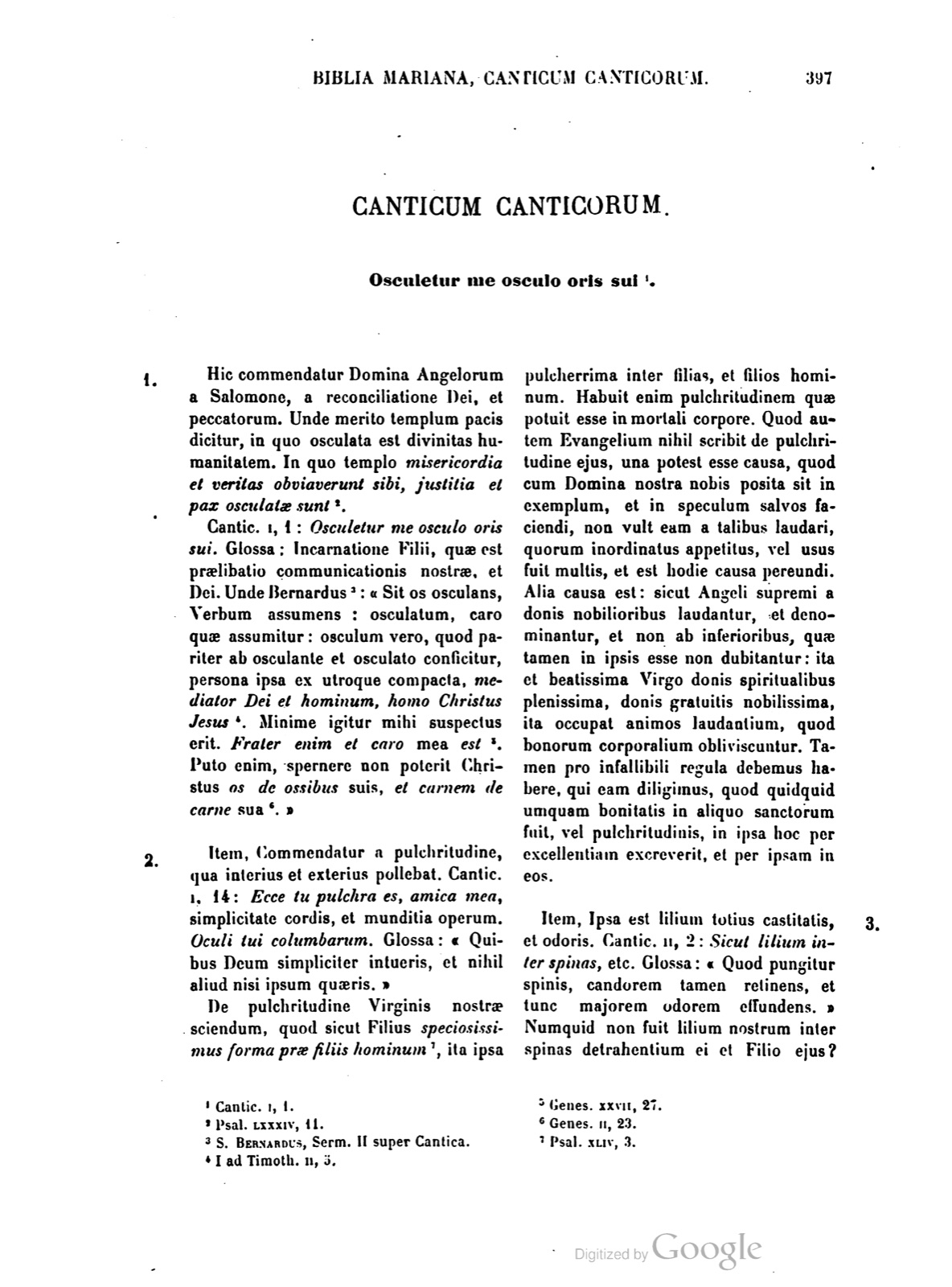
Nonne hic est faber filius Mariae 7? etc.: et maxime quando stetit inter crucifixores juxta crucem apud Filium 8.
4. Item, Ipsa est cellaria totius Trinitatis, quae de vino Spiritus sancti dat, et propinat, cui vult, et quantum vult. Unde et congratulando dicit, Cantic. II, 4: Introduxit me rex in cellam vinariam. Glossa: "Id est, in Ecclesiam, in cujus unitate Spiritus sanctus solet dari, et accipi." Vel, cella vinaria, est caelum empyreum, ubi omnes inebriabuntur ab ubertate domus Dei 9, in quam introducta fuit a Rege in die assumptionis.
5. Cantic. II, 4: Ordinavit in me charitatem: quam mihi excellentissime super omnes dedit. Quod sic probatur per Lucam, VII, 41 et seq., quaerenti Domino de duobus debitoribus, quorum unus debebat denarios quingentos, et alius quinquaginta. Non habentibus illis unde redderent, donavit utrisque. Quis ergo eum plus diligit? Respondens Simon, dixit: Aestimo quia is cui plus donavit. Sed beatissimae Virgini super omnes creaturas plus donatum est. Ergo super omnes creaturas plus diligit. Item, Deus dat omnibus affluenter 10, etc.: illuminans omnem hominem venientem in hunc mundum 11. Non tamen omnes recipiunt aequaliter. Cujus diversitatis duplex causa est. Una ex parte recipientis, quia alter altero capacior est, juxta illud Matthaei, XXV, 14 et 15: Tradidit illis bona sua, ... unicuique secundum propriam virtutem. Glossa: id est, capacitatem. Hanc autem capacitatem operatur humilitas vera, juxta illud Jacobi, IV, 6: Humilibus dat gratiam. Ergo ubi major humilitas est, ibi major capacitas est. Sed ipsa super omnes humillima fuit. Ergo maxime capax. Ergo maximam gratiam recipere potuit, scilicet quantum recipere potuit, tantum recepit. Item, Ex parte dantis est diversitas doni: quia cum dans det secundum rationem, et ratio respiciat finem, majus donum dat quod dat ad majorem finem, ut Imperator majus donum dat ad essendum senatorem, quam cui dat ad essendum simplicem servitorem. Sed dabatur Mariae gratia ad essendum matrem Dei, et omnibus aliis datur ad essendum servos et ancillas Dei. Sicut ergo improportionabiliter majus est esse matrem Dei, quam servum Dei, ita improportionabiliter erit majus donum ad essendum matrem Dei, quam ad essendum servum Dei: sed donum in quo omnia donantur, est charitas beatissimae Virginis: ergo improportionabiliter major erit charitate omnis creaturae. Habuit etiam beata Virgo summam charitatem ad proximum, quia animam Filii, et ipsum Filium pro proximo posuit, quem plus quam propriam animam dilexit, insuper obtulit. Et sic est quod dicitur: Et tuam ipsius animam pertransibit gladius 12.
6. Item, Ipsa est speculum totius pulchritudinis post Deum. Cantic. II, 14: Ostende mihi faciem tuam, scilicet faciem humilitatis, quam ostendisti in incarnatione, dicens: Ecce ancilla Domini 13. Faciem palloris, quam ostendisti in mea passione. Faciem summi decoris, quam ostendisti in tua assumptione.
7. Cantic. II, 14: Sonet vox tua in auribus meis. Vox pietatis, quando dixisti, Joan. II, 3: Vinum non habent. Vox fidelitatis, quando consuluisti, ibidem, v. 5: Quodcumque dixerit vobis, facite. Vox doloris quando dixisti, Luc. II, 48: Fili, quid fecisti nobis sic? Vox invitationis, ad famelicos peccatores invitandum.
Is this not the carpenter, the son of Mary 7? etc.; and especially when she stood among the crucifiers beside the cross near her Son 8.
4. Likewise, she is the wine-cellar of the whole Trinity, who gives and pours out from the wine of the Holy Spirit to whom she wishes and as much as she wishes. Hence, congratulating, she also says, Song of Songs II, 4: The king brought me into the wine-cellar. The Gloss: "That is, into the Church, in whose unity the Holy Spirit is accustomed to be given and received." Or the wine-cellar is the empyrean heaven, where all will be inebriated from the richness of the house of God 9, into which she was brought by the King on the day of the assumption.
5. Song of Songs II, 4: He ordered charity in me, which he gave to me most excellently above all. This is proved thus through Luke VII, 41 and following, where the Lord asks concerning two debtors, of whom one owed five hundred denarii and the other fifty. Since they did not have from which they might repay, he forgave both. Which therefore loves him more? Simon answered and said: I suppose the one to whom he forgave more. But more was given to the most blessed Virgin above all creatures. Therefore she loves more than all creatures. Likewise, God gives abundantly to all 10, etc., enlightening every man coming into this world 11. Nevertheless not all receive equally. Of this diversity there is a twofold cause. One is on the part of the receiver, because one is more capable than another, according to that word of Matthew XXV, 14 and 15: He handed over to them his goods, ... to each according to his proper power. The Gloss: that is, capacity. But true humility works this capacity, according to that word of James IV, 6: He gives grace to the humble. Therefore where greater humility is, there is greater capacity. But she was most humble above all. Therefore she was most capable. Therefore she was able to receive the greatest grace, namely as much as she could receive, so much she received. Likewise, on the part of the giver there is diversity of the gift, because when a giver gives according to reason, and reason looks to the end, he gives a greater gift when he gives for a greater end, as an Emperor gives a greater gift for being a senator than to one to whom he gives for being a simple servant. But grace was given to Mary for being the Mother of God, and to all others it is given for being servants and handmaids of God. Therefore just as it is immeasurably greater to be the Mother of God than a servant of God, so the gift for being Mother of God will be immeasurably greater than for being a servant of God. But the gift in which all things are given is the charity of the most blessed Virgin; therefore it will be immeasurably greater than the charity of every creature. The blessed Virgin also had the highest charity toward neighbor, because she set the soul of her Son and the Son himself for neighbor, whom she loved more than her own soul, and moreover offered him. And thus it is what is said: And a sword will pierce your own soul 12.
6. Likewise, she is the mirror of all beauty after God. Song of Songs II, 14: Show me your face, namely the face of humility, which you showed in the incarnation, saying: Behold the handmaid of the Lord 13; the face of pallor, which you showed in my passion; the face of the highest beauty, which you showed in your assumption.
7. Song of Songs II, 14: Let your voice sound in my ears: the voice of piety, when you said, John II, 3: They have no wine; the voice of fidelity, when you counseled, in the same place, verse 5: Whatever he shall say to you, do; the voice of sorrow when you said, Luke II, 48: Son, why have you done this to us?; the voice of invitation, for inviting hungry sinners,
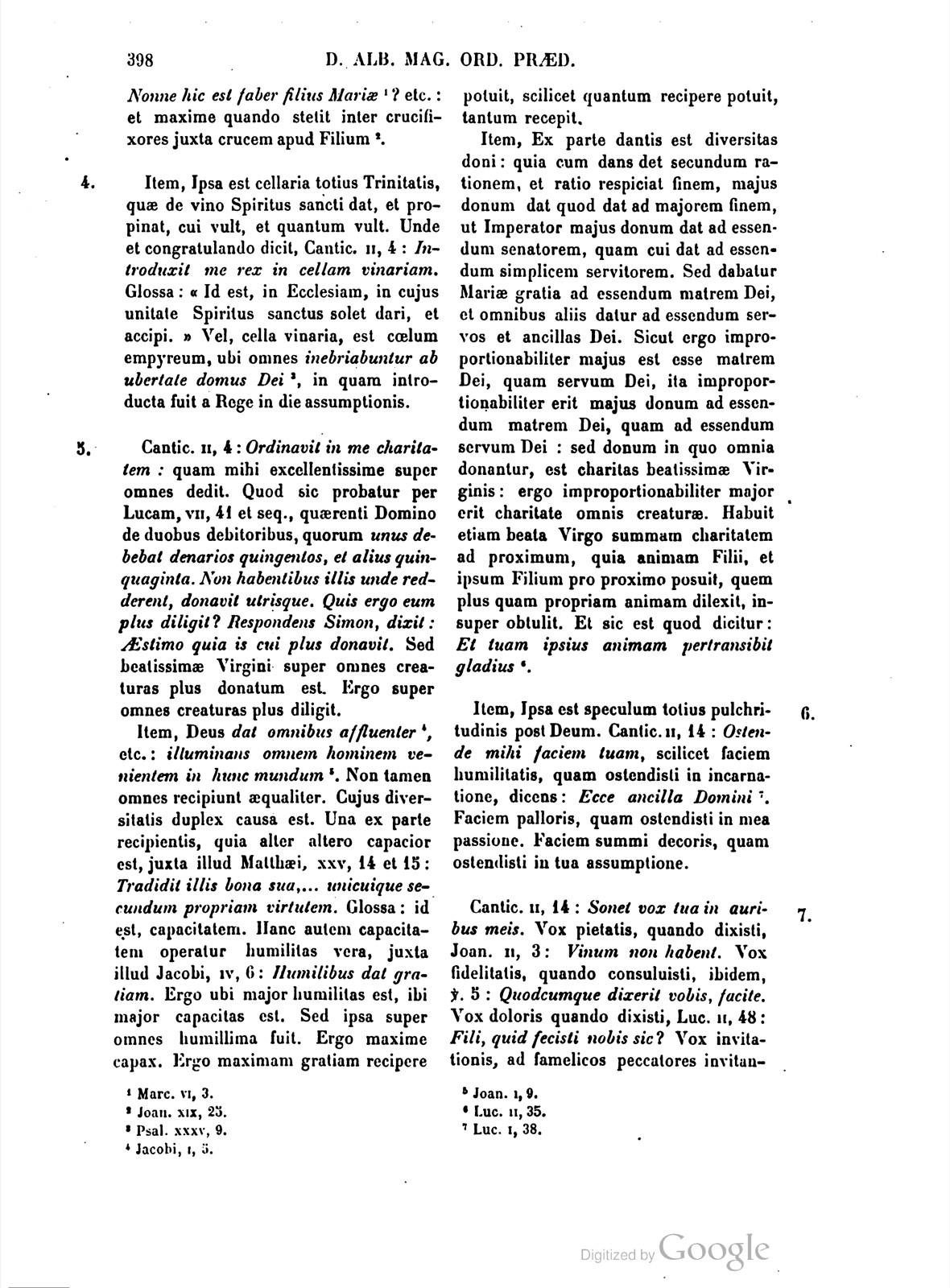
Proverb. IX, 5: Venite, comedite panem meum, etc. Eccli. XXIV, 26: Transite ad me, omnes qui concupiscitis me, etc. Hae voces dulciter sonant in auribus meis. Vox enim tua dulcis, et sermo tuus decorus 14.
8. Item, Ipsa est lectulus Salomonis 15, in quo requievit novem mensibus Filius Dei. Unde ipsa dicit, Eccli. XXIV, 12: Qui creavit me, requievit in tabernaculo meo.
9. Item, Ipsa est turris munitissima, in se, et in aliis. Cantic. IV, 4: Sicut turris David collum tuum, quae aedificata est cum propugnaculis: mille clypei pendent ex ea. Ibi quisque inveniet defensionem contra malum suum. Ibi pendet clypeus castitatis contra luxuriam, humilitatis contra superbiam, charitatis contra invidiam, largitatis contra avaritiam. Omnis armatura fortium in ipsa.
10. Item, Ipsa est quam tota Trinitas multiplici nomine ad se venire invitavit. Cantic. IV, 7 et 8: Tota pulchra es, amica mea. Glossa: Immunis etiam a veniali peccato: et ideo macula non est in te. Veni de Libano, sponsa mea, etc. Ter dicit: Veni, propter fidem Trinitatis. Nota, quod multum dilecta regis multiplici nomine solet a diligente appellari. Sic beatissima Virgo a Deo vocatur amica, columba, dilecta, speciosa, formosa, soror, immaculata, perfecta, electa, Sulamitis, filia. Diversitatem horum nominum nota, et gloriosae Virgini adapta.
11. Item, Ipsa est quam Salomon comparat aurorae in sua nativitate, lunae plenae in Filii Dei ineffabili conceptione, soli in sua assumptione, terribili castrorum aciei in daemonum effugatione. Cantic. VI, 9: Quae est ista quae progreditur quasi aurora, etc.
12. Item, Ipsa est ad quam omnis peregrinatio clamat. Cantic. VI, 12: Revertere, revertere, Sulamitis! revertere, etc. Petrus Damianus sic exponit: "Revertere primo per naturam. Numquid quia ita deificata, ideo nostrae humanitatis oblita es? Nequaquam, Domina. Scis in quo discrimine nos reliqueris, ubi jaceant, quantum delinquant servi tui. Non enim convenit tantae misericordiae tantam miseriam oblivisci: quia etsi subtrahit gloria, revocat natura. Non enim ita memoraris justitiae Dei solius, ut misericordiam non habeas: neque ita es impassibilis, ut sis incompassibilis. Naturam nostram habes, non aliam, et justum est ut de rore tantae pietatis diffusius infundamur. Revertere secundo per potentiam. Fecit in te magna qui potens est 16: et data est tibi omnis potestas in caelo, et in terra 17. Quid tibi negabitur, cui negatum non est Theophilum de ipsis perditionis faucibus revocare? Infelicem animulam totum illud, quod in te factum est, proprio charactere denegantem de luto faecis et miseriae sublevasti. Nil tibi impossibile, cui possibile est desperatos in spem beatitudinis relevare. Quomodo enim illa potestas tuae potentiae poterit obviare, quae de carne tua carnis suscepit originem? Accedis enim ante illud aureum humanae reconciliationis altare, non solum rogans sed imperans, Domina non ancilla, moveat te natura, potentia moveat: quia quanto potentior, tanto misericordior esse debebis. Revertere tertio per amorem. Scio, Domina, quia benignissima es, et amas nos amore invincibili, quos in te, et per
Proverbs IX, 5: Come, eat my bread, etc. Ecclesiasticus XXIV, 26: Come over to me, all you who desire me, etc. These voices sound sweetly in my ears. For your voice is sweet, and your speech is comely 14.
8. Likewise, she is Solomon's little bed 15, in which the Son of God rested for nine months. Hence she herself says, Ecclesiasticus XXIV, 12: He who created me rested in my tabernacle.
9. Likewise, she is the most fortified tower, in herself and in others. Song of Songs IV, 4: Your neck is like the tower of David, which was built with bulwarks; a thousand shields hang from it. There each one will find defense against his own evil. There hangs the shield of chastity against luxury, of humility against pride, of charity against envy, of generosity against avarice. All the armor of the strong is in her.
10. Likewise, she is the one whom the whole Trinity invited to come to itself under manifold names. Song of Songs IV, 7 and 8: You are wholly beautiful, my friend. The Gloss: Immune even from venial sin; and therefore there is no stain in you. Come from Lebanon, my spouse, etc. He says Come three times, because of faith in the Trinity. Note that one much loved by the king is accustomed to be called by the lover with many names. So the most blessed Virgin is called by God friend, dove, beloved, beautiful, fair, sister, immaculate, perfect, chosen, Shulamite, daughter. Note the diversity of these names, and adapt them to the glorious Virgin.
11. Likewise, she is the one whom Solomon compares to dawn in her nativity, to the full moon in the ineffable conception of the Son of God, to the sun in her assumption, to the terrible battle-line of camps in the putting to flight of demons. Song of Songs VI, 9: Who is she who goes forth like the dawn, etc.
12. Likewise, she is the one to whom every pilgrimage cries. Song of Songs VI, 12: Return, return, O Shulamite! return, etc. Peter Damian explains thus: "Return first by nature. Surely because you have been so deified, have you therefore forgotten our humanity? By no means, Lady. You know in what danger you left us, where your servants lie, how greatly they sin. For it does not befit such great mercy to forget such great misery, because even if glory draws you away, nature recalls you. For you do not remember only the justice of God in such a way that you do not have mercy, nor are you impassible in such a way that you are without compassion. You have our nature, not another, and it is just that we be more abundantly infused with the dew of such great piety. Return second by power. He who is mighty has done great things in you 16, and all power in heaven and on earth has been given to you 17. What will be denied to you, to whom it was not denied to call Theophilus back from the very jaws of perdition? You lifted up from the mud of filth and misery the unhappy little soul denying by his own signature all that was done in you. Nothing is impossible to you, to whom it is possible to raise the desperate into the hope of beatitude. For how will that power be able to oppose your power, which received the origin of flesh from your flesh? For you approach before that golden altar of human reconciliation, not only asking but commanding, Lady, not handmaid. Let nature move you; let power move you, because the more powerful you are, the more merciful you ought to be. Return third by love. I know, Lady, that you are most kind and love us with invincible love, whom in you and through
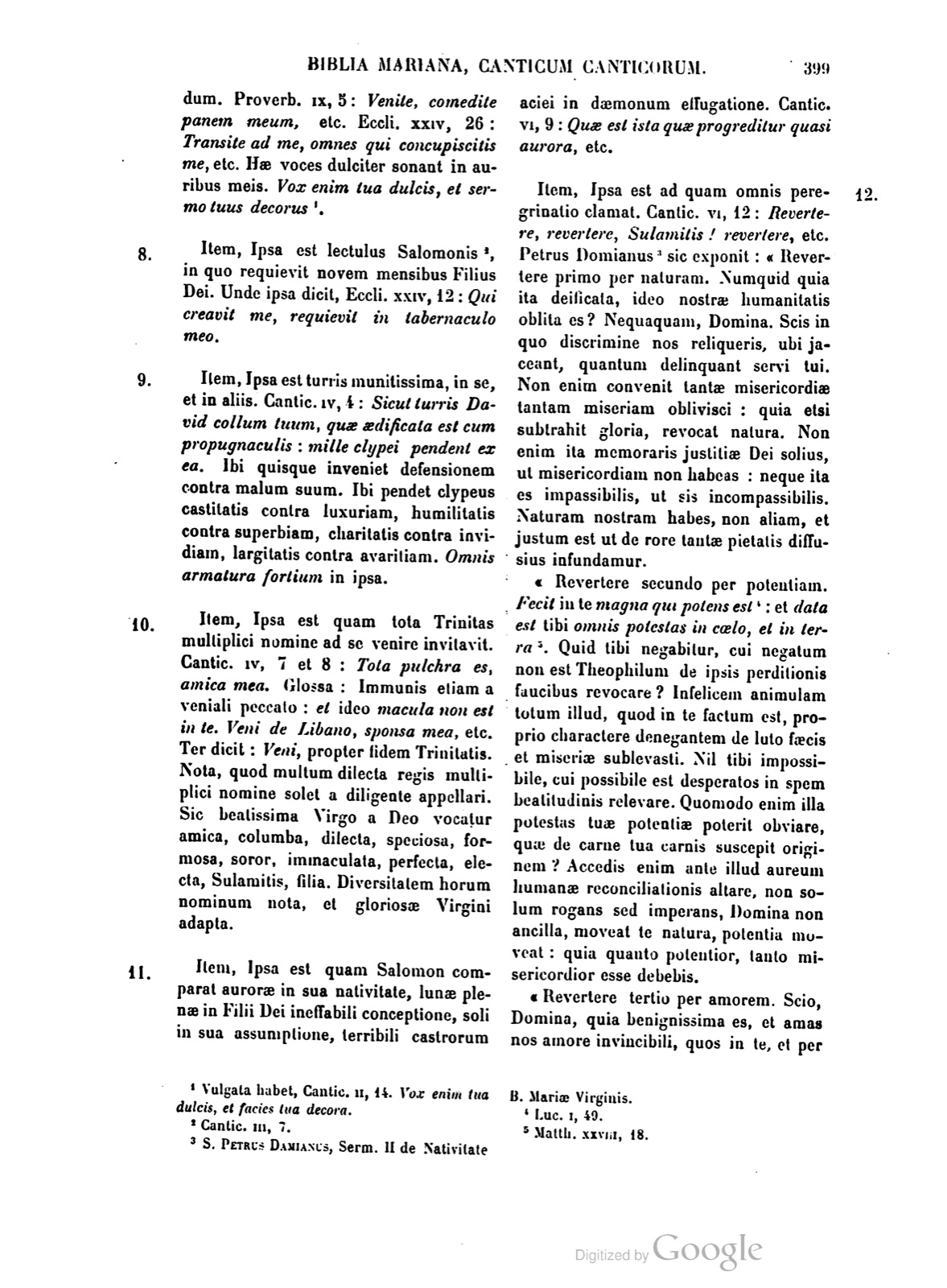
te, Filius tuus et Deus tuus summa dilectione dilexit. Quis scit quoties refrigas iram judicis, cum justitiae virtus a praesentia deitatis egreditur? Revertere quarto per largitatem. In manibus tuis sunt thesauri miserationum Domini, et sola electa es, cui gratia tanta conceditur. Absit ut cesset manus tua, cum occasionem quaeras salvandi miseros, et misericordiam effundendi: neque enim tua gloria minuitur, sed augetur, cum poenitentes ad veniam, justificati ad gloriam assumuntur. Revertere ergo, Sulamitis, id est, despecta, cujus animam pertransivit gladius: quae fabri uxor appellata fuisti. Ad quid? ut intueamur te. Summa gloria est, post Deum, te videre, adhaerere tibi, et tuae protectionis munimine demorari. Subveni igitur, Domina, ad te clamantibus jugiter fratribus. Hic triplex funiculus est, qui trahit matrem misericordiae ad nos visitandos, et consolandos, scilicet funiculus naturae, funiculus amoris, funiculus largitatis" 18.
13. Commendatur etiam Regina nostra a summa post Dominum nobilitate. Cantic. VII, 1: Quam pulchri sunt gressus tui in calceamentis, filia principis! a qua ipse Christus etiam vera generatione descendit 19. Porro ista nobilitas consideratur in substantia, si nobilem substantiam, et proprietatem in se possideat. Habuit autem in substantia, naturae perfectionem, et in anima gratiae plenitudinem. Item, consideratur in efficacia, si nobiles de se producat effectus, et ipsa ipsum Dominum, Dei Filium de se generavit. Unde beatissima Virgo in omnibus, in quibus nobilitas consideratur, in summo nobilis invenitur. Ipsa enim originem duxit a regibus, a sacerdotibus, et prophetis. Unde et est regina misericordiae, sacerdos justitiae, quae proprio Filio suo non pepercit 20, sed stabat juxta crucem, ut dicit Joannes, XIX, 25, ut non solum Filii Dei consideraret, sed ut salutem humani generis exspectaret. Prophetissa sapientiae, juxta illud Isaiae, VIII, 3: Accessi ad prophetissam, id est, Mariam. Et licet elevata per summam nobilitatem in sursum, tamen per humilitatem se ipsam depressit subtus omnes deorsum. Unde dicit Augustinus, quod nequaquam fuisset super omnes choros Angelorum exaltata, nisi fuisset infra omnes homines humiliata 21. Et sciendum quod ubi nobilitas carnis ornatur nobilitate meritis, utraque praestat alteri laudis incrementum: si autem separantur, tunc nobilitas carnis non tantum non laudatur, sed vituperatur: quia qualitas mali operis, contraria agit nobilitati carnis originis. Et tanto detestabilior est deformitas operationis, quanto magis est contra naturalem inclinationem originis, et nobilitatis. Nobilitas autem mentis, sine nobilitate carnis, tanto amplius laudatur, quanto etiam propriam vincens naturam laudabilius operatur.
14. Commendatur etiam a deliciarum copiositate. Cantic. VII, 6: Quam pulchra es, et quam decora, carissima, in deliciis, scilicet gratiae, et gloriae. Has delicias admiratur Salomon cum ait, Cantic. VIII, 5: Quae est ista quae ascendit de deserto, deliciis affluens, etc.? De ista gloriosa ascensione, sive assumptione Virginis matris sic loquitur Bernardus 22: "Tempus loquendi est omni carni, cum assumitur incarnati Verbi mater in caelum: nec cessare debet a laudibus humana mortalitas, cum homini sola natura supra immortales spiritus exaltatur in
you your Son and your God loved with the highest love. Who knows how often you cool the wrath of the judge, when the power of justice goes forth from the presence of deity? Return fourth by generosity. In your hands are the treasures of the Lord's mercies, and you alone have been chosen, to whom such great grace is granted. Far be it that your hand should cease, since you seek occasion of saving the miserable and pouring out mercy; for your glory is not diminished but increased, when penitents are assumed to pardon and the justified to glory. Return therefore, O Shulamite, that is, despised one, whose soul a sword pierced, who were called the wife of the craftsman. For what purpose? That we may look upon you. It is the highest glory, after God, to see you, to cling to you, and to abide in the fortification of your protection. Therefore help your brothers crying continually to you, Lady. This is the threefold cord that draws the mother of mercy to visit and console us, namely the cord of nature, the cord of love, the cord of generosity" 18.
13. Our Queen is also commended from the highest nobility after the Lord. Song of Songs VII, 1: How beautiful are your steps in shoes, daughter of the prince! from whom Christ himself also descended by true generation 19. Moreover, this nobility is considered in substance, if she possesses noble substance and property in herself. But in substance she had perfection of nature, and in soul fullness of grace. Likewise, it is considered in efficacy, if she produces noble effects from herself, and she generated from herself the Lord himself, the Son of God. Hence the most blessed Virgin is found to be noble in the highest degree in all things in which nobility is considered. For she drew her origin from kings, priests, and prophets. Hence she is also queen of mercy, priestess of justice, who did not spare her own Son 20, but stood beside the cross, as John says, XIX, 25, so that she might consider not only the Son of God, but also await the salvation of the human race. She is prophetess of wisdom, according to that word of Isaiah VIII, 3: I approached the prophetess, that is, Mary. And although she was lifted upward by the highest nobility, nevertheless through humility she depressed herself below all downward. Hence Augustine says that she would by no means have been exalted above all the choirs of Angels, unless she had been humbled below all men 21. And it must be known that where nobility of flesh is adorned by nobility of merits, each supplies to the other an increase of praise; but if they are separated, then nobility of flesh is not only not praised, but blamed, because the quality of an evil work acts contrary to the nobility of the origin of flesh. And the deformity of operation is so much more detestable as it is more against the natural inclination of origin and nobility. But nobility of mind without nobility of flesh is praised so much more as, even by conquering its own nature, it operates more laudably.
14. She is also commended from abundance of delights. Song of Songs VII, 6: How beautiful you are and how comely, dearest, in delights, namely of grace and glory. Solomon admires these delights when he says, Song of Songs VIII, 5: Who is she who ascends from the desert, flowing with delights, etc.? Concerning this glorious ascent, or assumption, of the Virgin Mother, Bernard speaks thus 22: "It is time for all flesh to speak, when the Mother of the incarnate Word is assumed into heaven; nor ought human mortality to cease from praises, when in human nature alone it is exalted above the immortal spirits in
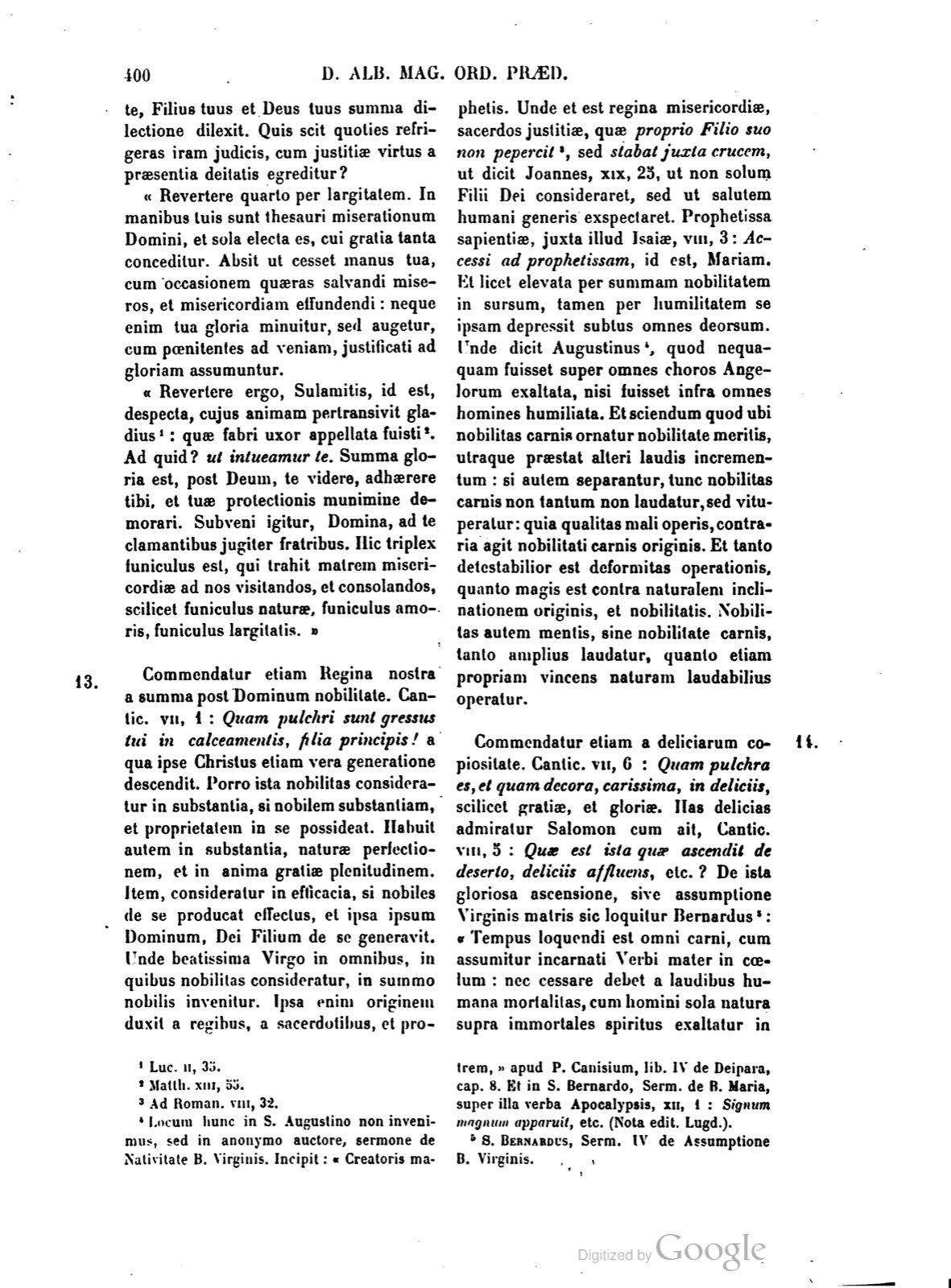
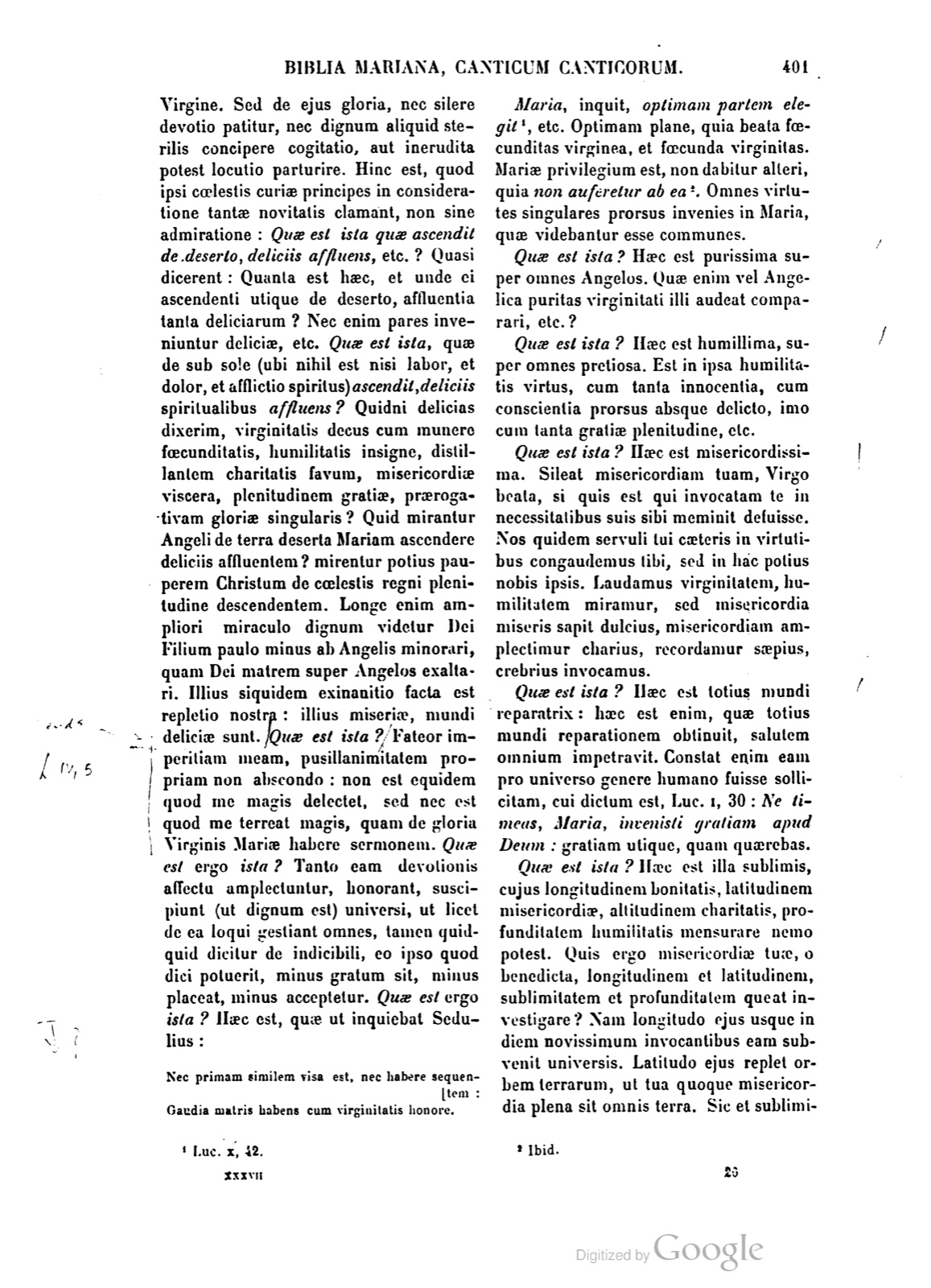
Virgine. Sed de ejus gloria, nec silere devotio patitur, nec dignum aliquid sterilis concipere cogitatio, aut inerudita potest locutio parturire. Hinc est, quod ipsi caelestis curiae principes in consideratione tantae novitatis clamant, non sine admiratione: Quae est ista quae ascendit de deserto, deliciis affluens, etc.? Quasi dicerent: Quanta est haec, et unde ei ascendenti utique de deserto, affluentia tanta deliciarum? Nec enim pares inveniuntur deliciae, etc. Quae est ista, quae de sub sole (ubi nihil est nisi labor, et dolor, et afflictio spiritus) ascendit, deliciis spiritualibus affluens? Quidni delicias dixerim, virginitatis decus cum munere foecunditatis, humilitatis insigne, stillantem charitatis favum, misericordiae viscera, plenitudinem gratiae, praerogativam gloriae singularis? Quid mirantur Angeli de terra deserta Mariam ascendere deliciis affluentem? mirentur potius pauperem Christum de caelestis regni plenitudine descendentem. Longe enim ampliori miraculo dignum videtur Dei Filium paulo minus ab Angelis minorari, quam Dei matrem super Angelos exaltari. Illius siquidem exinanitio facta est repletio nostra: illius miseriae, mundi deliciae sunt. Quae est ista? Fateor imperitiam meam, pusillanimitatem propriam non abscondo: non est equidem quod me magis delectet, sed nec est quod me terreat magis, quam de gloria Virginis Mariae habere sermonem. Quae est ergo ista? Tanto eam devotionis affectu amplectuntur, honorant, suscipiunt (ut dignum est) universi, ut licet de ea loqui gestiant omnes, tamen quidquid dicitur de indicibili, eo ipso quod dici potuerit, minus gratum sit, minus placeat, minus acceptetur. Quae est ergo ista? Haec est, quae ut inquiebat Sedulius:
Nec primam similem visa est, nec habere sequentem: Gaudia matris habens cum virginitatis honore.
Maria, inquit, optimam partem elegit 23, etc. Optimam plane, quia beata foecunditas virginea, et foecunda virginitas. Mariae privilegium est, non dabitur alteri, quia non auferetur ab ea 24. Omnes virtutes singulares prorsus invenies in Maria, quae videbantur esse communes.
Quae est ista? Haec est purissima super omnes Angelos. Quae enim vel Angelica puritas virginitati illi audeat comparari, etc.?
Quae est ista? Haec est humillima, super omnes pretiosa. Est in ipsa humilitatis virtus, cum tanta innocentia, cum conscientia prorsus absque delicto, imo cum tanta gratiae plenitudine, etc.
Quae est ista? Haec est misericordissima. Sileat misericordiam tuam, Virgo beata, si quis est qui invocatam te in necessitatibus suis sibi meminit defuisse. Nos quidem servuli tui caeteris in virtutibus congaudemus tibi, sed in hac potius nobis ipsis. Laudamus virginitatem, humilitatem miramur, sed misericordia miseris sapit dulcius, misericordiam amplectimur charius, recordamur saepius, crebrius invocamus.
Quae est ista? Haec est totius mundi reparatrix: haec est enim, quae totius mundi reparationem obtinuit, salutem omnium impetravit. Constat enim eam pro universo genere humano fuisse sollicitam, cui dictum est, Luc. I, 30: Ne timeas, Maria, invenisti gratiam apud Deum: gratiam utique, quam quaerebas.
Quae est ista? Haec est illa sublimis, cujus longitudinem bonitatis, latitudinem misericordiae, altitudinem charitatis, profunditatem humilitatis mensurare nemo potest. Quis ergo misericordiae tuae, o benedicta, longitudinem et latitudinem, sublimitatem et profunditatem queat investigare? Nam longitudo ejus usque in diem novissimum invocantibus eam subvenit universis. Latitudo ejus replet orbem terrarum, ut tua quoque misericordia plena sit omnis terra. Sic et sublimitas
the Virgin. But concerning her glory, devotion does not permit silence, nor can a barren thought conceive anything worthy, or an unlearned speech bring it forth. Hence it is that the princes themselves of the heavenly court, in consideration of so great a novelty, cry out, not without wonder: Who is this who ascends from the desert, flowing with delights, etc.? As if they were saying: How great is this one, and whence comes such an abundance of delights to her, surely ascending from the desert? For equal delights are not found, etc. Who is this, who from under the sun, where there is nothing except labor and sorrow and affliction of spirit, ascends, flowing with spiritual delights? Why should I not call delights the beauty of virginity with the gift of fruitfulness, the mark of humility, the dripping honeycomb of charity, the inward parts of mercy, the fullness of grace, the prerogative of singular glory? Why do the Angels marvel that Mary ascends from the desert earth flowing with delights? Let them marvel rather that poor Christ descends from the fullness of the heavenly kingdom. For it seems worthy of a much greater miracle that the Son of God should be made a little less than the Angels, than that the Mother of God should be exalted above the Angels. Indeed, his emptying was made our filling; his miseries are the delights of the world. Who is this? I confess my lack of skill; I do not hide my own smallness of soul. Indeed there is not anything that delights me more, but neither is there anything that terrifies me more, than to have discourse concerning the glory of the Virgin Mary. Who then is this? All embrace, honor, and receive her with so great an affection of devotion, as is worthy, that although all are eager to speak of her, nevertheless whatever is said concerning the unspeakable, by this very fact that it could be said, is less pleasing, pleases less, is accepted less. Who then is this? This is she of whom, as Sedulius used to say:
She was seen to have no first one like her, nor a following one: Having the joys of a mother with the honor of virginity.
Mary, he says, chose the best part 23, etc. Plainly the best, because blessed fruitfulness was virginal, and virginity was fruitful. It is Mary's privilege; it will not be given to another, because it will not be taken away from her 24. You will find in Mary absolutely all singular virtues, which seemed to be common.
Who is this? This is she most pure above all Angels. For what Angelic purity would dare to be compared to that virginity, etc.?
Who is this? This is she most humble, precious above all. In her there is the virtue of humility, with such great innocence, with a conscience altogether without fault, indeed with such fullness of grace, etc.
Who is this? This is she most merciful. Let your mercy be silent, blessed Virgin, if there is anyone who remembers that you, when invoked, failed him in his necessities. We, your little servants, rejoice with you in the other virtues, but in this virtue rather we rejoice for ourselves. We praise virginity, we marvel at humility, but mercy tastes sweeter to the miserable; we embrace mercy more dearly, we remember it more often, we invoke it more frequently.
Who is this? This is she, the repairer of the whole world; for this is she who obtained the reparation of the whole world and procured the salvation of all. For it is clear that she was solicitous for the whole human race, to whom it was said, Luke I, 30: Do not fear, Mary, you have found grace with God: grace indeed, which you were seeking.
Who is this? This is that sublime one, whose length of goodness, breadth of mercy, height of charity, and depth of humility no one can measure. Who then can investigate the length and breadth, the sublimity and depth of your mercy, O blessed one? For its length comes to the aid of all invoking her even to the last day. Its breadth fills the whole earth, so that your mercy also fills all the earth. Thus also its sublimity
Notes
- Song of Songs I, 1. (Cantic. I, 1.) ↩
- Psalm LXXXIV, 11. (Psal. LXXXIV, 11.) ↩
- St. Bernard, Sermon II on the Song of Songs. (S. Bernardus, Serm. II super Cantica.) ↩
- I Timothy II, 5. (I ad Timoth. II, 5.) ↩
- Genesis II, 23. (Genes. II, 23.) ↩
- Psalm XLIV, 3. (Psal. XLIV, 3.) ↩
- Mark VI, 3. (Marc. VI, 3.) ↩
- John XIX, 25. (Joan. XIX, 25.) ↩
- Psalm XXXV, 9. (Psal. XXXV, 9.) ↩
- James I, 5. (Jacobi I, 5.) ↩
- John I, 9. (Joan. I, 9.) ↩
- Luke II, 35. (Luc. II, 35.) ↩
- Luke I, 38. (Luc. I, 38.) ↩
- The Vulgate has, Song of Songs II, 14: For your voice is sweet, and your face is comely. (Vulgata habet, Cantic. II, 14: Vox enim tua dulcis, et facies tua decora.) ↩
- Song of Songs I, 7. (Cantic. I, 7.) ↩
- Luke I, 49. (Luc. I, 49.) ↩
- Matthew XXVII, 18. (Matth. XXVII, 18.) ↩
- St. Peter Damian, Sermon II on the Nativity of the Blessed Virgin Mary. (S. Petrus Damianus, Serm. II de Nativitate B. Mariae Virginis.) ↩
- Luke I, 33; Matthew XIII, 55. (Luc. I, 33; Matth. XIII, 55.) ↩
- Romans VIII, 32. (Ad Roman. VIII, 32.) ↩
- We have not found this passage in St. Augustine, but in an anonymous author, in the sermon on the Nativity of the Blessed Virgin. It begins, "The mother of the Creator," in P. Canisius, book IV On the Mother of God, chapter 8; and in St. Bernard, Sermon on Blessed Mary, on those words of Apocalypse XII, 1: A great sign appeared, etc. (note of the Lyon editor). (Locum hunc in S. Augustino non invenimus, sed in anonymo auctore, sermone de Nativitate B. Virginis. Incipit: "Creatoris matrem," apud P. Canisium, lib. IV de Deipara, cap. 8. Et in S. Bernardo, Serm. de B. Maria, super illa verba Apocalypsis, XII, 1: Signum magnum apparuit, etc. (Nota edit. Lugd.).) ↩
- St. Bernard, Sermon IV on the Assumption of the Blessed Virgin. (S. Bernardus, Serm. IV de Assumptione B. Virginis.) ↩
- Luke X, 42. (Luc. X, 42.) ↩
- Ibid. ↩
If a page does not appear, its photograph has not been uploaded yet.