Volume 37 · p. 396
Book of Ecclesiastes, page 396
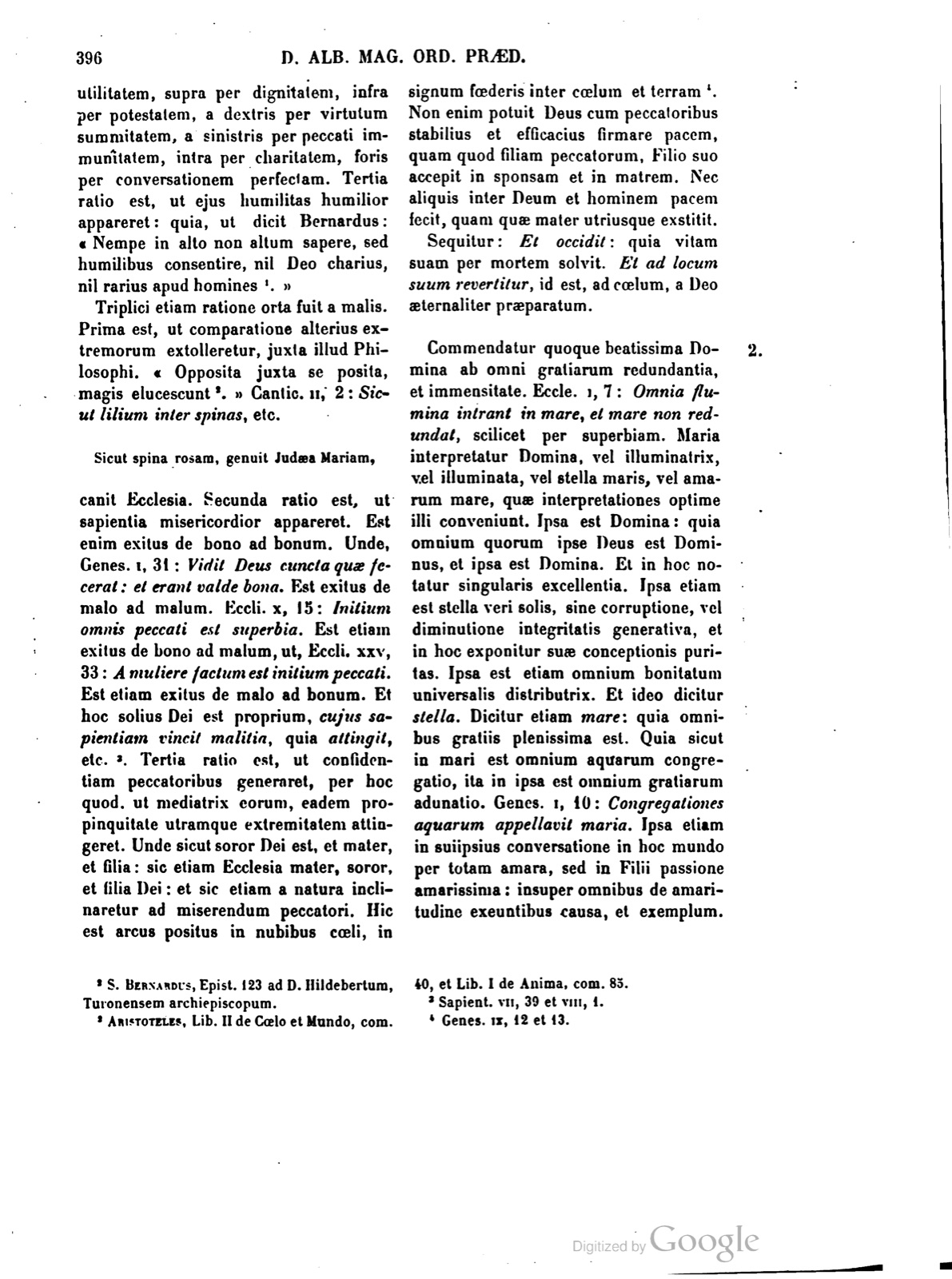
utilitatem, supra per dignitatem, infra per potestatem, a dextris per virtutum summitatem, a sinistris per peccati immunitatem, intra per charitatem, foris per conversationem perfectam. Tertia ratio est, ut ejus humilitas humilior appareret: quia, ut dicit Bernardus: "Nempe in alto non altum sapere, sed humilibus consentire, nil Deo charius, nil rarius apud homines 1." Triplici etiam ratione orta fuit a malis. Prima est, ut comparatione alterius extremorum extolleretur, juxta illud Philosophi: "Opposita juxta se posita, magis elucescunt 2." Cantic. II, 2: Sicut lilium inter spinas, etc. Sicut spina rosam, genuit Judaea Mariam, canit Ecclesia. Secunda ratio est, ut sapientia misericordior appareret. Est enim exitus de bono ad bonum. Unde, Genes. I, 31: Vidit Deus cuncta quae fecerat: et erant valde bona. Est exitus de malo ad malum. Eccli. X, 15: Initium omnis peccati est superbia. Est etiam exitus de bono ad malum, ut, Eccli. XXV, 33: A muliere factum est initium peccati. Est etiam exitus de malo ad bonum. Et hoc solius Dei est proprium, cujus sapientiam vincit malitia, quia attingit, etc. 3. Tertia ratio est, ut confidentiam peccatoribus generaret, per hoc quod, ut mediatrix eorum, eadem propinquitate utramque extremitatem attingeret. Unde sicut soror Dei est, et mater, et filia: sic etiam Ecclesia mater, soror, et filia Dei: et sic etiam a natura inclinaretur ad miserendum peccatori. Hic est arcus positus in nubibus caeli, in signum foederis inter caelum et terram 4. Non enim potuit Deus cum peccatoribus stabilius et efficacius firmare pacem, quam quod filiam peccatorum, Filio suo accepit in sponsam et in matrem. Nec aliquis inter Deum et hominem pacem fecit, quam quae mater utriusque exstitit. Sequitur: Et occidit: quia vitam suam per mortem solvit. Et ad locum suum revertitur, id est, ad caelum, a Deo aeternaliter praeparatum.
2. Commendatur quoque beatissima Domina ab omni gratiarum redundantia, et immensitate. Eccle. I, 7: Omnia flumina intrant in mare, et mare non redundat, scilicet per superbiam. Maria interpretatur Domina, vel illuminatrix, vel illuminata, vel stella maris, vel amarum mare, quae interpretationes optime illi conveniunt. Ipsa est Domina: quia omnium quorum ipse Deus est Dominus, et ipsa est Domina. Et in hoc notatur singularis excellentia. Ipsa etiam est stella veri solis, sine corruptione, vel diminutione integritatis generativa, et in hoc exponitur suae conceptionis puritas. Ipsa est etiam omnium bonitatum universalis distributrix. Et ideo dicitur stella. Dicitur etiam mare: quia omnibus gratiis plenissima est. Quia sicut in mari est omnium aquarum congregatio, ita in ipsa est omnium gratiarum adunatio. Genes. I, 10: Congregationes aquarum appellavit maria. Ipsa etiam in sui ipsius conversatione in hoc mundo per totam amara, sed in Filii passione amarissima: insuper omnibus de amaritudine exeuntibus causa, et exemplum.
usefulness, above by dignity, below by power, on the right by the height of virtues, on the left by immunity from sin, within by charity, without by perfect conduct. The third reason is that her humility might appear more humble, because, as Bernard says: "Indeed, to be in a high place and not to think high things, but to consent to the humble, nothing is dearer to God, nothing rarer among men 1." She was also born from the evil for three reasons. The first is that she might be exalted by comparison with the other of the extremes, according to that saying of the Philosopher: "Opposites placed next to each other shine forth more 2." Song of Songs II, 2: As a lily among thorns, etc. As a thorn generated a rose, Judea generated Mary, the Church sings. The second reason is that wisdom might appear more merciful. For there is a going out from good to good. Hence Genesis I, 31: God saw all the things that he had made, and they were very good. There is a going out from evil to evil. Ecclesiasticus X, 15: The beginning of every sin is pride. There is also a going out from good to evil, as Ecclesiasticus XXV, 33: From a woman the beginning of sin was made. There is also a going out from evil to good. And this is proper to God alone, whose wisdom malice conquers, because it reaches, etc. 3. The third reason is that she might generate confidence for sinners, by this, that as their mediatrix she would touch both extremes with the same nearness. Hence just as she is sister of God, and mother, and daughter, so also the Church is mother, sister, and daughter of God; and thus she would also be inclined by nature to pity the sinner. This is the bow placed in the clouds of heaven as a sign of the covenant between heaven and earth 4. For God could not have established peace with sinners more stably and effectively than by taking the daughter of sinners as spouse and mother for his Son. Nor did anyone make peace between God and man more than she who existed as mother of both. It follows: And it sets, because she paid her life through death. And it returns to its place, that is, to heaven, prepared eternally by God.
2. The most blessed Lady is also commended from every overflowing and immensity of graces. Ecclesiastes I, 7: All rivers enter into the sea, and the sea does not overflow, namely through pride. Mary is interpreted Lady, or illuminator, or illuminated one, or star of the sea, or bitter sea; these interpretations most fittingly suit her. She is Lady, because of all those of whom God himself is Lord, she also is Lady. And in this singular excellence is noted. She is also the star of the true sun, generative without corruption or diminution of integrity, and in this the purity of her conception is explained. She is also the universal distributor of all good things. And therefore she is called star. She is also called sea because she is most full of all graces. For just as in the sea there is the gathering of all waters, so in her there is the uniting of all graces. Genesis I, 10: He called the gatherings of waters seas. She also in her own conduct in this world was bitter through the whole of it, but in the passion of the Son most bitter; moreover, for all coming out of bitterness, she is cause and example.
Notes
- St. Bernard, Letter 123 to D. Hildebert, archbishop of Tours. (S. Bernardus, Epist. 123 ad D. Hildebertum, Turonensem archiepiscopum.) ↩
- Aristotle, Book II On Heaven and the World, commentary 40, and Book I On the Soul, commentary 85. (Aristoteles, Lib. II de Caelo et Mundo, com. 40, et Lib. I de Anima, com. 85.) ↩
- Wisdom VII, 39 and VIII, 1. (Sapient. VII, 39 et VIII, 1.) ↩
- Genesis IX, 12 and 13. (Genes. IX, 12 et 13.) ↩
If a page does not appear, its photograph has not been uploaded yet.