Volume 37 · p. 375
Book of Deuteronomy, page 375
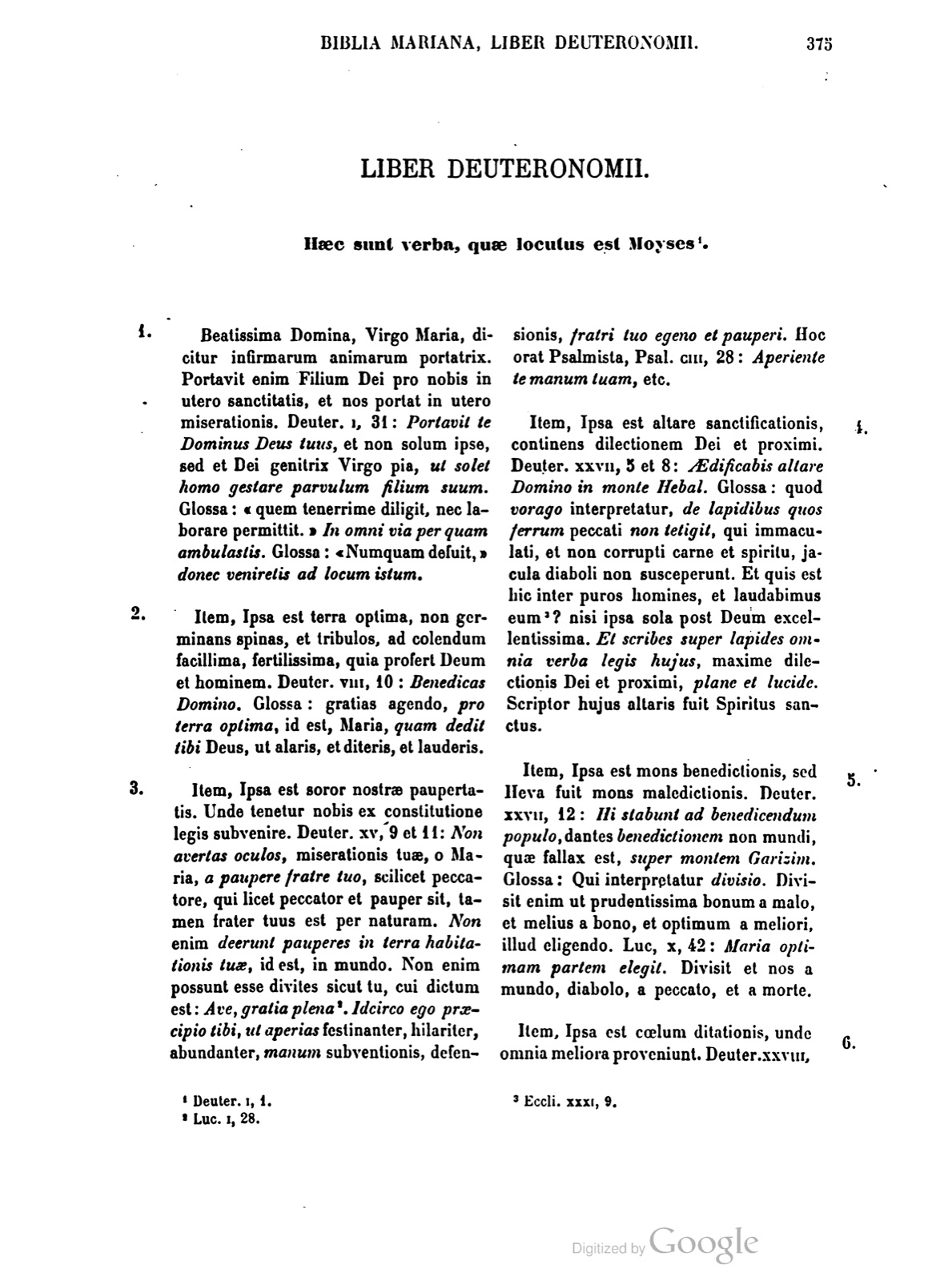
LIBER DEUTERONOMII.
Haec sunt verba, quae locutus est Moyses 1.
1. Beatissima Domina, Virgo Maria, dicitur infirmarum animarum portatrix. Portavit enim Filium Dei pro nobis in utero sanctitatis, et nos portat in utero miserationis. Deuter. I, 31: Portavit te Dominus Deus tuus, et non solum ipse, sed et Dei genitrix Virgo pia, ut solet homo gestare parvulum filium suum. Glossa: "quem tenerrime diligit, nec laborare permittit." In omni via per quam ambulastis. Glossa: "Numquam defuit," donec veniretis ad locum istum.
2. Item, Ipsa est terra optima, non germinans spinas, et tribulos, ad colendum facillima, fertilissima, quia profert Deum et hominem. Deuter. VIII, 10: Benedicas Domino. Glossa: gratias agendo, pro terra optima, id est, Maria, quam dedit tibi Deus, ut alaris, et diteris, et lauderis.
3. Item, Ipsa est soror nostrae paupertatis. Unde tenetur nobis ex constitutione legis subvenire. Deuter. XV, 9 et 11: Non avertas oculos, miserationis tuae, o Maria, a paupere fratre tuo, scilicet peccatore, qui licet peccator et pauper sit, tamen frater tuus est per naturam. Non enim deerunt pauperes in terra habitationis tuae, id est, in mundo. Non enim possunt esse divites sicut tu, cui dictum est: Ave, gratia plena 2. Idcirco ego praecipio tibi, ut aperias festinanter, hilariter, abundanter, manum subventionis, defensionis, fratri tuo egeno et pauperi. Hoc orat Psalmista, Psal. CIII, 28: Aperiente te manum tuam, etc.
4. Item, Ipsa est altare sanctificationis, continens dilectionem Dei et proximi. Deuter. XXVII, 5 et 8: Edificabis altare Domino in monte Hebal. Glossa: quod vorago interpretatur, de lapidibus quos ferrum peccati non tetigit, qui immaculati, et non corrupti carne et spiritu, jacula diaboli non susceperunt. Et quis est hic inter puros homines, et laudabimus eum? nisi ipsa sola post Deum excellentissima. Et scribes super lapides omnia verba legis hujus, maxime dilectionis Dei et proximi, plane et lucide. Scriptor hujus altaris fuit Spiritus sanctus.
5. Item, Ipsa est mons benedictionis, sed Heva fuit mons maledictionis. Deuter. XXVII, 12: Hi stabunt ad benedicendum populo, dantes benedictionem non mundi, quae fallax est, super montem Garizim. Glossa: Qui interpretatur divisio. Divisit enim ut prudentissima bonum a malo, et melius a bono, et optimum a meliori, illud eligendo. Luc. X, 42: Maria optimam partem elegit. Divisit et nos a mundo, diabolo, a peccato, et a morte.
6. Item, Ipsa est caelum ditationis, unde omnia meliora proveniunt. Deuter. XXVIII,
BOOK OF DEUTERONOMY.
These are the words that Moses spoke 1.
1. The most blessed Lady, the Virgin Mary, is called the bearer of weak souls. For she carried the Son of God for us in the womb of sanctity, and she carries us in the womb of compassion. Deuteronomy I, 31: The Lord your God carried you, and not only he, but also the pious Virgin Mother of God, as a man is accustomed to carry his little son. The Gloss: "whom he loves most tenderly, and does not permit to labor." In every way through which you walked. The Gloss: "He was never lacking," until you came to this place.
2. Likewise, she is the best land, not bringing forth thorns and thistles, easiest to cultivate, most fertile, because she brings forth God and man. Deuteronomy VIII, 10: Bless the Lord. The Gloss: by giving thanks, for the best land, that is, Mary, which God gave you, so that you may be fed, enriched, and praised.
3. Likewise, she is the sister of our poverty. Hence she is bound to come to our aid by the constitution of the law. Deuteronomy XV, 9 and 11: Do not turn away the eyes of your compassion, O Mary, from your poor brother, namely the sinner, who, although he is a sinner and poor, is nevertheless your brother by nature. For the poor will not be lacking in the land of your habitation, that is, in the world. For they cannot be rich as you are, to whom it was said: Hail, full of grace 2. Therefore I command you to open swiftly, cheerfully, abundantly, the hand of assistance and defense to your needy and poor brother. The Psalmist prays this, Psalm CIII, 28: When you open your hand, etc.
4. Likewise, she is the altar of sanctification, containing love of God and neighbor. Deuteronomy XXVII, 5 and 8: You shall build an altar to the Lord on Mount Ebal. The Gloss: which is interpreted abyss, from stones that the iron of sin has not touched, which, immaculate and not corrupted in flesh and spirit, have not received the darts of the devil. And who is this among pure humans, and we shall praise him? except she alone, most excellent after God. And you shall write upon the stones all the words of this law, especially of the love of God and neighbor, plainly and clearly. The writer of this altar was the Holy Spirit.
5. Likewise, she is the mountain of blessing, but Eve was the mountain of curse. Deuteronomy XXVII, 12: These shall stand to bless the people, giving not the blessing of the world, which is deceitful, upon Mount Garizim. The Gloss: Which is interpreted division. For she, as most prudent, divided good from evil, and the better from the good, and the best from the better, by choosing that. Luke X, 42: Mary chose the best part. She also divided us from the world, the devil, sin, and death.
6. Likewise, she is the heaven of enrichment, whence all better things come forth. Deuteronomy XXVIII,
If a page does not appear, its photograph has not been uploaded yet.