Works › Sermons for the Seasons of the Year
Volume 13 · pp. 277–278
Sermon LXXI, Conclusion
A marker with ≈ is an approximate page boundary, placed by measure of the text; the page photographs remain the authority. In the paired views, clicking a page marker brings that page into view.
Quintum, quod attenditur in hydropico, hoc est, quod sicut Glossa dicit, proprium hydropici est, quod quanto plus biberit, tanto amplius sitit. Et per hoc vocari potest avaritia, quae semper est sitibunda. Avaritia enim est una filiarum illius sanguisugae, id est, diaboli, qui semper dicit: Affer, affer, ut dicitur Proverb. XXX, 15. Ibi dicit Glossa: Crescit amor nummi, quantum ipsa pecunia crescit.
Dicit etiam Sallustius: "Avaritia pecuniae studium habet, quam nemo sapiens umquam concupivit, et quasi venenis imbuta corpus animumque virilem effaeminat, semper infinita, semper insatiabilis, neque copia neque inopia minuitur."
Sextum, quod attenditur in hydropico, hoc est, quod habet foetidum anhelitum. Et per hoc notatur luxuria, quae foetet coram Deo et Angelis, et hominibus: propter hoc dicit Anselmus: "O quam tolerabilius foetet canis putridus hominibus quam anima peccatrix Deo!"
Septimum est, quod attenditur in hydropico, quod videlicet gravis est, et piger. Et per hoc exprimitur acedia, quae hominem gravem et pigrum reddit in obsequio Jesu Christi. Contra pigros et acediosos dicitur Prover. XX, 4: Propter frigus piger arare noluit: mendicabit ergo aestate et non dabitur illi. Pigri propter frigus desidiae nolunt modo mittere manus operationis ad aratrum crucis, quod ipse Jesus, quasi quidam bos traxit: et propter hoc in aestate, cum sol sempiterni ardoris caput eorum exuret, mendicabunt divinam misericordiam, et non dabitur eis vel una gutta alleviationis et misericordiae.
III.
De tertio nota, quod ad hoc quod hydropicus a Domino curetur, tria requiruntur. Primum est, quod hydropicus ante appareat. Secundum est, quod eum Dominus apprehendat. Tertium est, quod sanet eum, ac dimittat.
1. Primum igitur est, quod hydropicus sit et appareat ante Jesum, quando videlicet Dominus peccatorem respicit oculis misericordiae suae. Sic Dominus Petrum qui eum ter negaverat, oculis misericordiae clementer respexit. Unde dicitur Luc. XXII, 61 et 62: Et conversus Dominus respexit Petrum..., et egressus foras Petrus flevit amare.
The fifth thing that is considered in the dropsical man is this, that, as the Gloss says, it is proper to the dropsical man that the more he drinks, the more he thirsts. And through this avarice can be called to mind, which is always thirsty. For avarice is one of the daughters of that bloodsucker, that is, of the devil, who always says: Bring, bring, as is said in Proverbs XXX, 15. There the Gloss says: The love of money grows as the money itself grows.
Sallust also says: "Avarice has zeal for money, which no wise person ever desired; and, as if imbued with poisons, it effeminates the body and manly spirit, always infinite, always insatiable, diminished neither by abundance nor by lack."
The sixth thing that is considered in the dropsical man is this, that he has stinking breath. And through this lust is noted, which stinks before God and Angels and human beings; because of this Anselm says: "O how much more tolerably a rotten dog stinks to human beings than a sinful soul to God!"
The seventh thing that is considered in the dropsical man is that, namely, he is heavy and lazy. And through this acedia is expressed, which makes a human being heavy and lazy in the service of Jesus Christ. Against the lazy and acedious Proverbs XX, 4 says: Because of cold the lazy man would not plow; therefore he will beg in summer and it will not be given to him. The lazy, because of the cold of sloth, are unwilling now to put the hands of work to the plow of the cross, which Jesus himself, like a certain ox, drew; and because of this in summer, when the sun of everlasting burning will scorch their head, they will beg divine mercy, and not one drop of relief and mercy will be given to them.
III.
Concerning the third, note that for the dropsical man to be cured by the Lord, three things are required. The first is that the dropsical man appear before him. The second is that the Lord take hold of him. The third is that he heal him and dismiss him.
1. Therefore the first is that the dropsical man be and appear before Jesus, when, namely, the Lord looks upon the sinner with the eyes of his mercy. Thus the Lord mercifully looked upon Peter with the eyes of mercy when he had denied him three times. Hence it is said in Luke XXII, 61 and 62: And the Lord turned and looked upon Peter..., and Peter, going outside, wept bitterly.
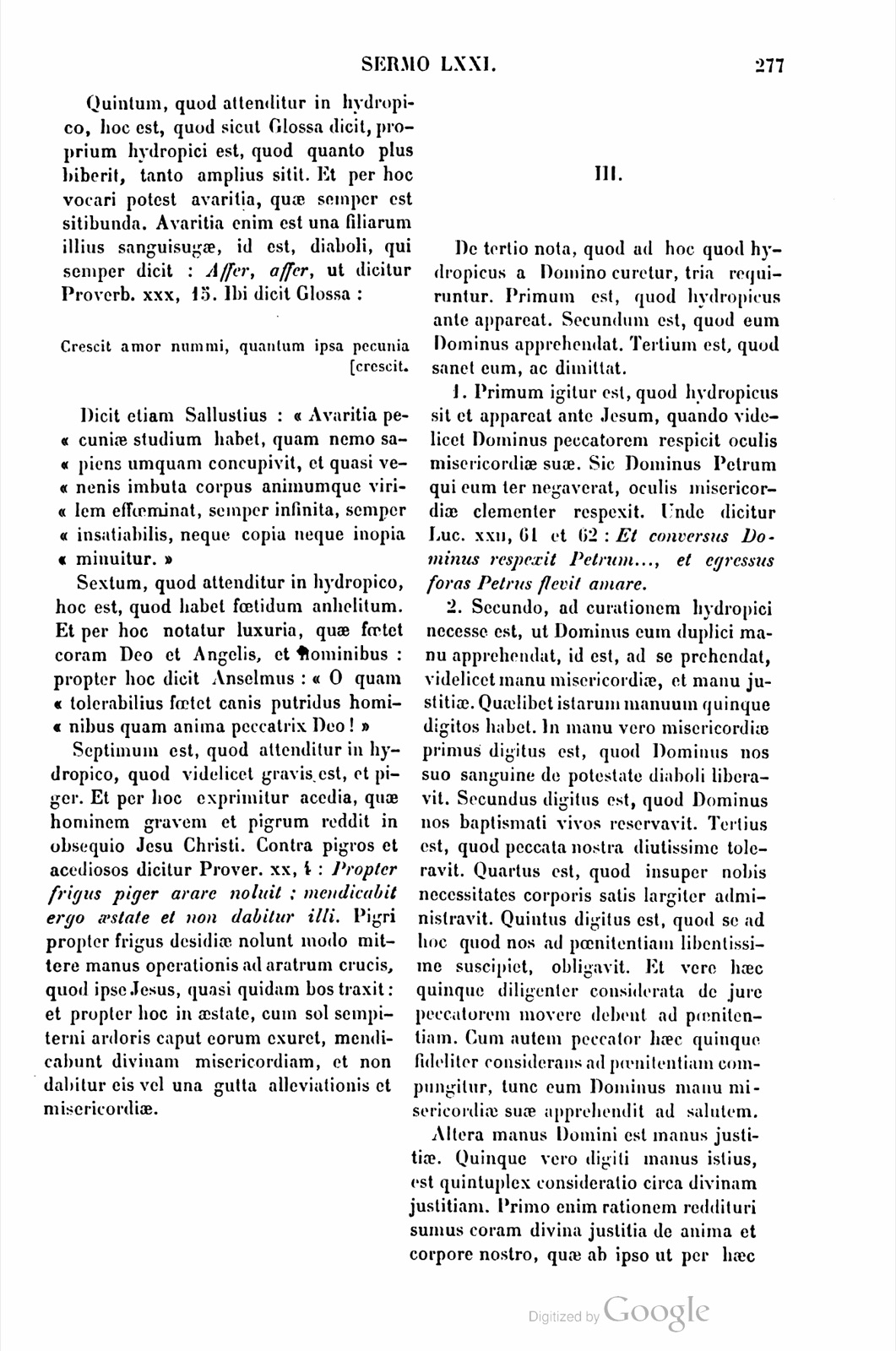
2. Secundo, ad curationem hydropici necesse est, ut Dominus eum duplici manu apprehendat, id est, ad se prehendat, videlicet manu misericordiae, et manu justitiae. Quaelibet istarum manuum quinque digitos habet. In manu vero misericordiae primus digitus est, quod Dominus nos suo sanguine de potestate diaboli liberavit. Secundus digitus est, quod Dominus nos baptismati vivos reservavit. Tertius est, quod peccata nostra diutissime toleravit. Quartus est, quod insuper nobis necessitates corporis satis largiter administravit. Quintus digitus est, quod se ad hoc quod nos ad poenitentiam libentissime suscipiet, obligavit. Et vere haec quinque diligenter considerata de jure peccatorem movere debent ad poenitentiam. Cum autem peccator haec quinque fideliter considerans ad poenitentiam compungitur, tunc eum Dominus manu misericordiae suae apprehendit ad salutem.
Altera manus Domini est manus justitiae. Quinque vero digiti manus istius, est quintuplex consideratio circa divinam justitiam. Primo enim rationem reddituri sumus coram divina justitia de anima et corpore nostro, quae ab ipso ut per haec ei serviremus, accepimus. Secundo, rationem reddemus de sanguine unigeniti Filii Dei, cui debitas vices servitutis non rependimus. Tertio, ratio a nobis requiretur de omni tempore, et de universis, quae cum tempore de manu Domini suscepimus. Quarto, rationem reddemus de omni peccato, quod vel cogitatione, vel locutione, vel operatione commisimus. Quinto, rationem reddemus de omni bono opere quod poteramus fecisse, et non fecimus. Quisquis haec quinque bene considerans, etiamsi saxeus vel ferreus fuerit, non trepidabit?
3. Quemcunque ergo Dominus hac duplici manu, per spem et metum vere apprehendet, sine dubio sanabit eum per veram poenitentiam, et sic sanatum dimittet in pace, ac requie sempiterna.
Rogate ergo Dominum, ut sic nos sanare dignetur, ut ad aeternam requiem pertingere mereamur. Quod, etc.
2. Second, for the curing of the dropsical man it is necessary that the Lord take hold of him with a twofold hand, that is, draw him to himself, namely with the hand of mercy and the hand of justice. Each of those hands has five fingers. But in the hand of mercy the first finger is that the Lord freed us by his blood from the power of the devil. The second finger is that the Lord preserved us alive for baptism. The third is that he endured our sins for a very long time. The fourth is that he furthermore provided the necessities of the body for us quite generously. The fifth finger is that he bound himself to this, that he will receive us to repentance most willingly. And truly these five things, carefully considered, ought by right to move the sinner to repentance. But when the sinner, faithfully considering these five things, is pierced toward repentance, then the Lord takes hold of him with the hand of his mercy unto salvation.
The other hand of the Lord is the hand of justice. But the five fingers of that hand are a fivefold consideration concerning divine justice. For first we will render an account before divine justice concerning our soul and body, which we received from him so that through them we might serve him. Second, we will render an account concerning the blood of the only-begotten Son of God, to whom we have not paid back the owed turns of service. Third, an account will be required from us concerning all time and all things which with time we have received from the hand of the Lord. Fourth, we will render an account concerning every sin that we have committed either by thought or speech or operation. Fifth, we will render an account concerning every good work that we could have done and did not do. Whoever considers these five things well, even if he were stony or iron, will he not tremble?
3. Therefore whomever the Lord truly takes hold of with this twofold hand, through hope and fear, without doubt he will heal him through true repentance, and thus, healed, he will dismiss him in peace and everlasting rest.
Therefore ask the Lord that he may deign so to heal us, that we may deserve to reach eternal rest. Which, etc.

If a page does not appear, its photograph has not been uploaded yet.