Works › Sermons for the Seasons of the Year
Volume 13 · pp. 279–281
Sermon LXXII. On the Eighteenth Sunday After Trinity
A marker with ≈ is an approximate page boundary, placed by measure of the text; the page photographs remain the authority. In the paired views, clicking a page marker brings that page into view.
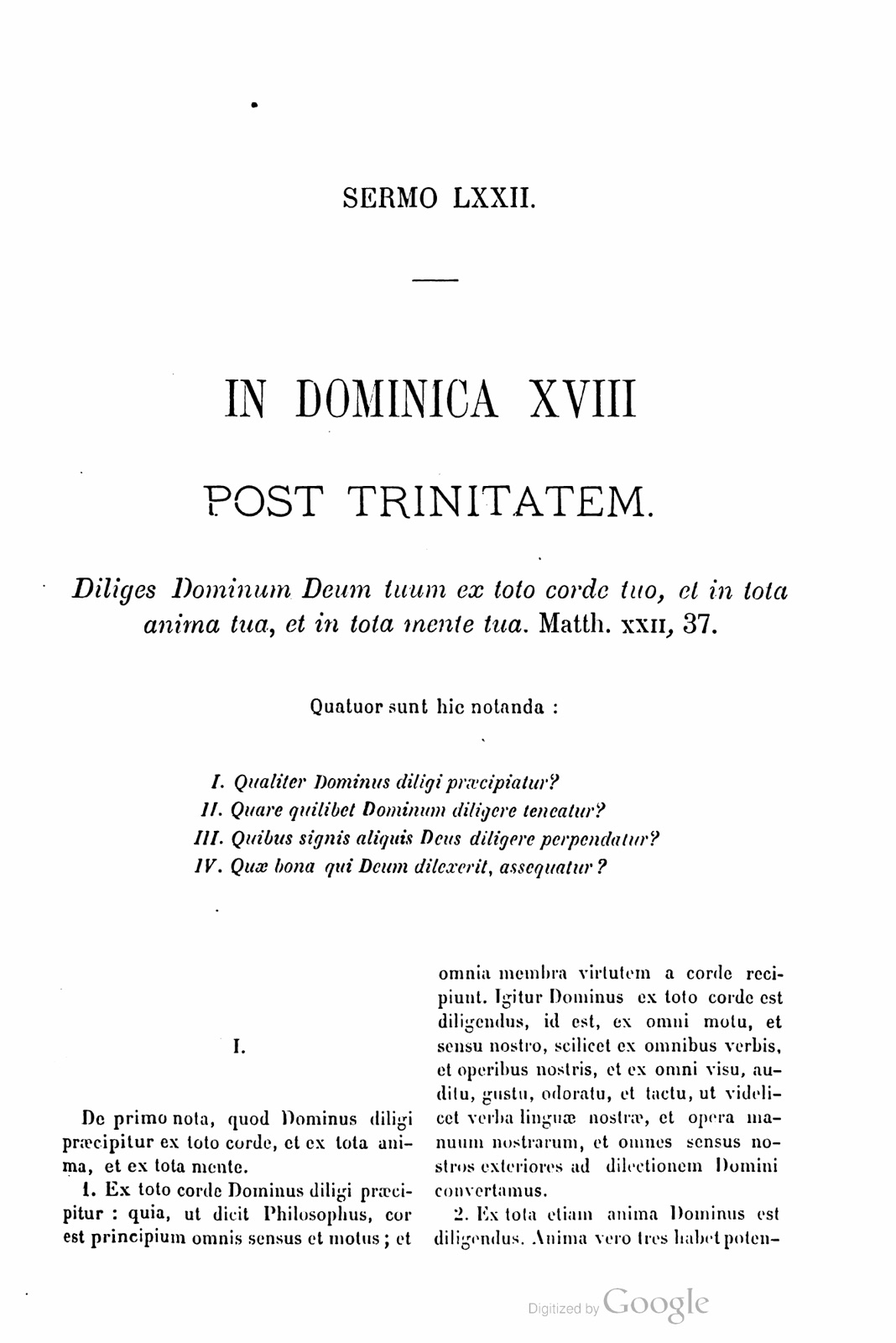
SERMO LXXII.
IN DOMINICA XVIII POST TRINITATEM.
Diliges Dominum Deum tuum ex toto corde tuo, et in tota anima tua, et in tota mente tua. Matth. XXII, 37.
Quatuor sunt hic notanda:
I. Qualiter Dominus diligi praecipiatur? II. Quare quilibet Dominum diligere teneatur? III. Quibus signis aliquis Deum diligere perpendatur? IV. Quae bona qui Deum dilexerit, assequatur?
I.
De primo nota, quod Dominus diligi praecipitur ex toto corde, et ex tota anima, et ex tota mente.
1. Ex toto corde Dominus diligi praecipitur: quia, ut dicit Philosophus, cor est principium omnis sensus et motus; et omnia membra virtutem a corde recipiunt. Igitur Dominus ex toto corde est diligendus, id est, ex omni motu, et sensu nostro, scilicet ex omnibus verbis, et operibus nostris, et ex omni visu, auditu, gustu, odoratu, et tactu, ut videlicet verba linguae nostrae, et opera manuum nostrarum, et omnes sensus nostros exteriores ad dilectionem Domini convertamus.
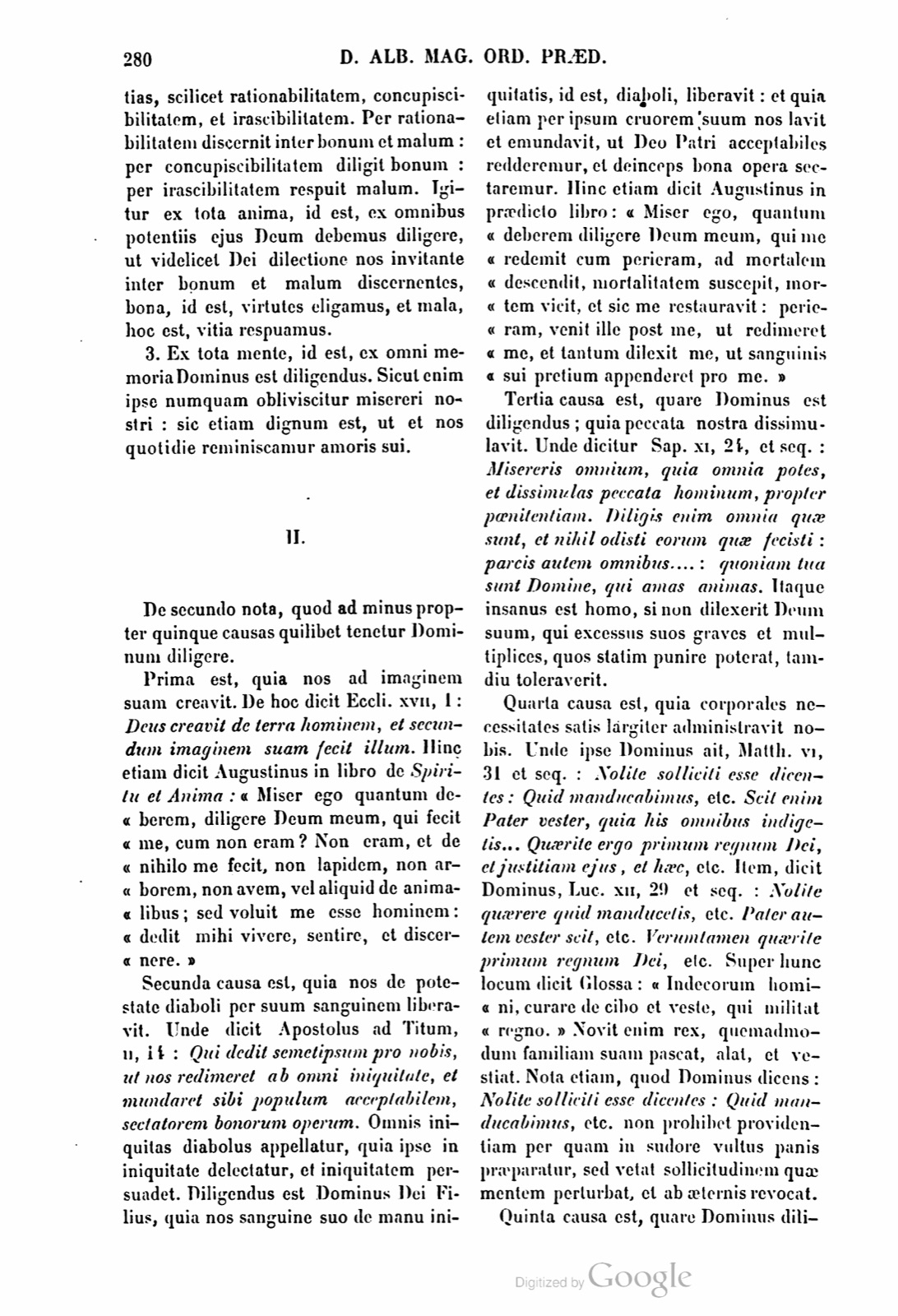
2. Ex tota etiam anima Dominus est diligendus. Anima vero tres habet potentias, scilicet rationabilitatem, concupiscibilitatem, et irascibilitatem. Per rationabilitatem discernit inter bonum et malum: per concupiscibilitatem diligit bonum: per irascibilitatem respuit malum. Igitur ex tota anima, id est, ex omnibus potentiis ejus Deum debemus diligere, ut videlicet Dei dilectione nos invitante inter bonum et malum discernentes, bona, id est, virtutes eligamus, et mala, hoc est, vitia respuamus.
3. Ex tota mente, id est, ex omni memoria Dominus est diligendus. Sicut enim ipse numquam obliviscitur misereri nostri: sic etiam dignum est, ut et nos quotidie reminiscamur amoris sui.
II.
De secundo nota, quod ad minus propter quinque causas quilibet tenetur Dominum diligere.
Prima est, quia nos ad imaginem suam creavit. De hoc dicit Eccli. XVII, 1: Deus creavit de terra hominem, et secundum imaginem suam fecit illum. Hinc etiam dicit Augustinus in libro de Spiritu et Anima: "Miser ego quantum deberem, diligere Deum meum, qui fecit me, cum non eram? Non eram, et de nihilo me fecit, non lapidem, non arborem, non avem, vel aliquid de animalibus; sed voluit me esse hominem: dedit mihi vivere, sentire, et discernere."
Secunda causa est, quia nos de potestate diaboli per suum sanguinem liberavit. Unde dicit Apostolus ad Titum, II, 14: Qui dedit semetipsum pro nobis, ut nos redimeret ab omni iniquitate, et mundaret sibi populum acceptabilem, sectatorem bonorum operum. Omnis iniquitas diabolus appellatur, quia ipse in iniquitate delectatur, et iniquitatem persuadet. Diligendus est Dominus Dei Filius, quia nos sanguine suo de manu iniquitatis, id est, diaboli, liberavit: et quia etiam per ipsum cruorem suum nos lavit et emundavit, ut Deo Patri acceptabiles redderemur, et deinceps bona opera sectaremur. Hinc etiam dicit Augustinus in praedicto libro: "Miser ego, quantum deberem diligere Deum meum, qui me redemit cum perieram, ad mortalem descendit, mortalitatem suscepit, mortem vicit, et sic me restauravit: perieram, venit ille post me, ut redimeret me, et tantum dilexit me, ut sanguinis sui pretium appenderet pro me."
SERMON LXXII.
ON THE EIGHTEENTH SUNDAY AFTER TRINITY.
You shall love the Lord your God from your whole heart, and in your whole soul, and in your whole mind. Matthew XXII, 37.
Four things are to be noted here:
I. How is the Lord commanded to be loved? II. Why is anyone bound to love the Lord? III. By what signs is someone weighed as loving God? IV. What goods will he who has loved God obtain?
I.
Concerning the first, note that the Lord is commanded to be loved from the whole heart, and from the whole soul, and from the whole mind.
1. The Lord is commanded to be loved from the whole heart, because, as the Philosopher says, the heart is the principle of every sense and motion, and all members receive power from the heart. Therefore the Lord is to be loved from the whole heart, that is, from every motion and sense of ours, namely from all our words and works, and from every sight, hearing, taste, smell, and touch, so that we may turn the words of our tongue, the works of our hands, and all our outward senses to the love of the Lord.
2. The Lord is also to be loved from the whole soul. But the soul has three powers, namely rationality, concupiscibility, and irascibility. Through rationality it discerns between good and evil; through concupiscibility it loves good; through irascibility it rejects evil. Therefore from the whole soul, that is, from all its powers, we ought to love God, so that, with the love of God inviting us, discerning between good and evil, we may choose good things, that is, virtues, and reject evils, that is, vices.
3. The Lord is to be loved from the whole mind, that is, from every memory. For just as he never forgets to have mercy on us, so also it is fitting that we daily remember his love.
II.
Concerning the second, note that for at least five causes anyone is bound to love the Lord.
The first is because he created us according to his image. Concerning this Ecclesiasticus XVII, 1 says: God created man from the earth and made him according to his image. Hence Augustine also says in the book On Spirit and Soul: "Miserable me, how much ought I to love my God, who made me when I was not? I was not, and from nothing he made me, not a stone, not a tree, not a bird, or any of the animals, but he wished me to be a human being: he gave me to live, to sense, and to discern."
The second cause is because he freed us from the power of the devil through his blood. Hence the Apostle says to Titus II, 14: Who gave himself for us, that he might redeem us from every iniquity and cleanse for himself an acceptable people, a follower of good works. Every iniquity is called the devil, because he delights in iniquity and persuades iniquity. The Lord Son of God is to be loved, because by his blood he freed us from the hand of iniquity, that is, of the devil; and because also through his blood itself he washed and cleansed us, so that we might be rendered acceptable to God the Father and henceforth follow good works. Hence Augustine also says in the aforesaid book: "Miserable me, how much ought I to love my God, who redeemed me when I had perished, descended to a mortal one, took on mortality, conquered death, and thus restored me: I had perished, he came after me to redeem me, and he loved me so much that he weighed out the price of his blood for me."
Tertia causa est, quare Dominus est diligendus; quia peccata nostra dissimulavit. Unde dicitur Sap. XI, 24, et seq.: Misereris omnium, quia omnia potes, et dissimulas peccata hominum, propter paenitentiam. Diligis enim omnia quae sunt, et nihil odisti eorum quae fecisti: parcis autem omnibus....: quoniam tua sunt Domine, qui amas animas. Itaque insanus est homo, si non dilexerit Deum suum, qui excessus suos graves et multiplices, quos statim punire poterat, tamdiu toleraverit.
Quarta causa est, quia corporales necessitates satis largiter administravit nobis. Unde ipse Dominus ait, Matth. VI, 31 et seq.: Nolite solliciti esse dicentes: Quid manducabimus, etc. Scit enim Pater vester, quia his omnibus indigetis.... Quaerite ergo primum regnum Dei, et justitiam ejus, et haec, etc. Item, dicit Dominus, Luc. XII, 29 et seq.: Nolite quaerere quid manducetis, etc. Pater autem vester scit, etc. Verumtamen quaerite primum regnum Dei, etc. Super hunc locum dicit Glossa: "Indecorum homini, curare de cibo et veste, qui militat regno." Novit enim rex, quemadmodum familiam suam pascat, alat, et vestiat. Nota etiam, quod Dominus dicens: Nolite solliciti esse dicentes: Quid manducabimus, etc. non prohibet providentiam per quam in sudore vultus panis praeparatur, sed vetat sollicitudinem quae mentem perturbat, et ab aeternis revocat.
Quinta causa est, quare Dominus diligendus est, hoc est, quia nobis regnum copiosissimum praeparavit. Unde dicit I Petr. I, 3 et 4, quod nobis per Jesum Christum haereditas incorruptibilis, incontaminata, immarcescibilis in caelis est conservata. Dicit etiam Matth. XXV, 34: Tunc dicet rex his, qui a dextris ejus erunt: Venite benedicti Patris mei, possidete paratum vobis regnum a constitutione mundi.
The third cause why the Lord is to be loved is because he overlooked our sins. Hence it is said in Wisdom XI, 24 and following: You have mercy on all, because you can do all things, and you overlook the sins of human beings because of repentance. For you love all things that are, and hate nothing of the things that you have made; but you spare all things... because they are yours, Lord, who loves souls. Therefore a human being is insane if he has not loved his God, who so long endured his grave and manifold excesses which he could have punished immediately.
The fourth cause is because he has administered bodily necessities to us quite generously. Hence the Lord himself says, Matthew VI, 31 and following: Do not be anxious, saying: What will we eat, etc. For your Father knows that you need all these things.... Therefore seek first the kingdom of God and his justice, and these things, etc. Likewise the Lord says, Luke XII, 29 and following: Do not seek what you will eat, etc. But your Father knows, etc. Nevertheless seek first the kingdom of God, etc. On this place the Gloss says: "It is unbecoming for a man to care about food and clothing when he serves the kingdom." For the king knows how he should feed, nourish, and clothe his household. Note also that the Lord, saying: Do not be anxious, saying: What will we eat, etc., does not prohibit the providence through which bread is prepared in the sweat of the face, but forbids the anxiety that disturbs the mind and calls it away from eternal things.
The fifth cause why the Lord is to be loved is this, because he has prepared for us a most abundant kingdom. Hence I Peter I, 3 and 4 says that for us through Jesus Christ an incorruptible, undefiled, unfading inheritance has been preserved in the heavens. Matthew XXV, 34 also says: Then the king will say to those who will be at his right hand: Come, blessed of my Father, possess the kingdom prepared for you from the foundation of the world.
III.
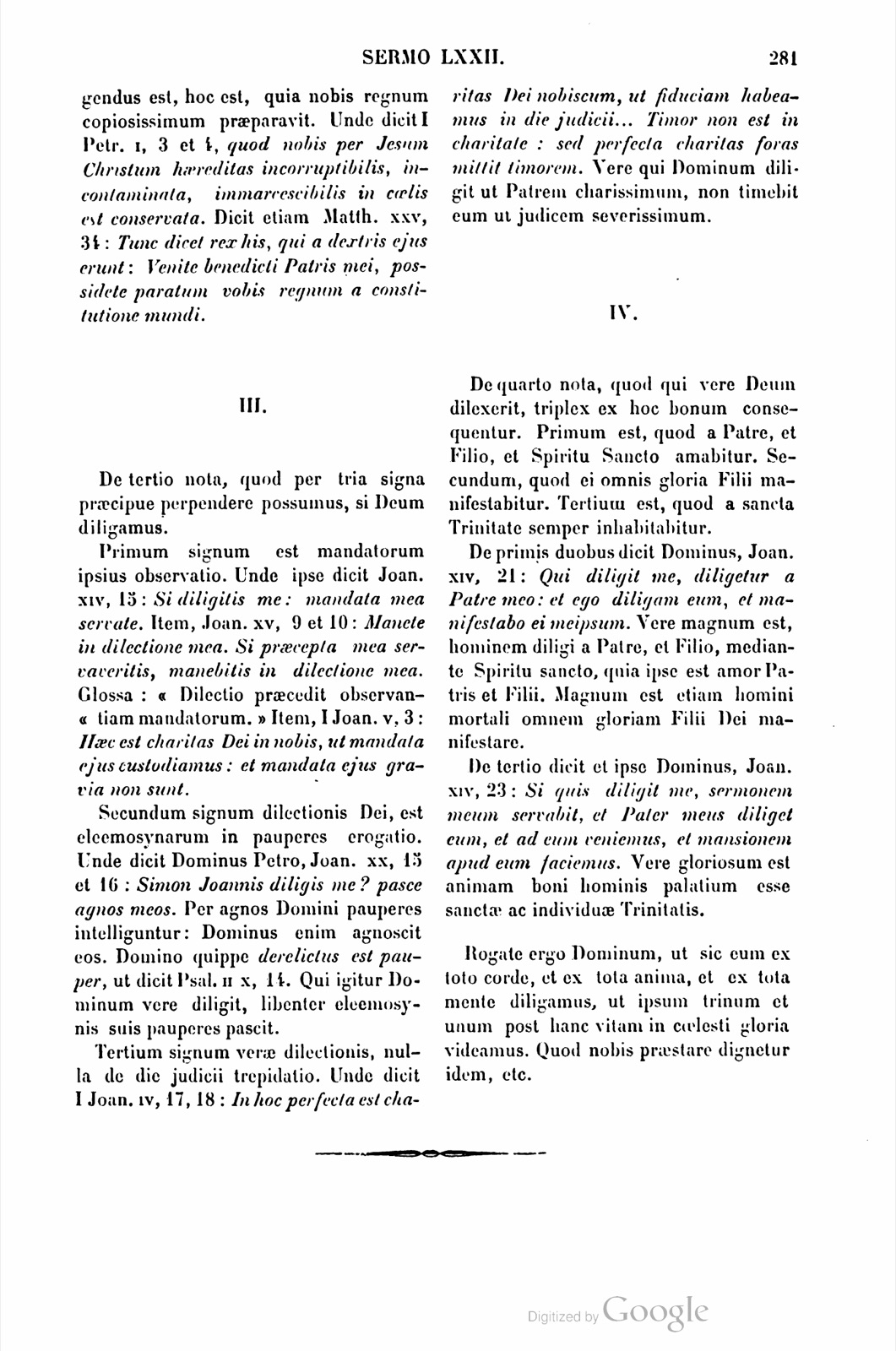
De tertio nota, quod per tria signa praecipue perpendere possumus, si Deum diligamus.
Primum signum est mandatorum ipsius observatio. Unde ipse dicit Joan. XIV, 15: Si diligitis me: mandata mea servate. Item, Joan. XV, 9 et 10: Manete in dilectione mea. Si praecepta mea servaveritis, manebitis in dilectione mea. Glossa: "Dilectio praecedit observantiam mandatorum." Item, I Joan. V, 3: Haec est charitas Dei in nobis, ut mandata ejus custodiamus: et mandata ejus gravia non sunt.
Secundum signum dilectionis Dei, est eleemosynarum in pauperes erogatio. Unde dicit Dominus Petro, Joan. XX, 15 et 16: Simon Joannis diligis me? pasce agnos meos. Per agnos Domini pauperes intelliguntur: Dominus enim agnoscit eos. Domino quippe derelictus est pauper, ut dicit Psal. IX, 14. Qui igitur Dominum vere diligit, libenter eleemosynis suis pauperes pascit.
Tertium signum verae dilectionis, nulla de die judicii trepidatio. Unde dicit I Joan. IV, 17, 18: In hoc perfecta est charitas Dei nobiscum, ut fiduciam habeamus in die judicii.... Timor non est in charitate: sed perfecta charitas foras mittit timorem. Vere qui Dominum diligit ut Patrem charissimum, non timebit eum ut judicem severissimum.
IV.
De quarto nota, quod qui vere Deum dilexerit, triplex ex hoc bonum consequentur. Primum est, quod a Patre, et Filio, et Spiritu Sancto amabitur. Secundum, quod ei omnis gloria Filii manifestabitur. Tertium est, quod a sancta Trinitate semper inhabitabitur.
De primis duobus dicit Dominus, Joan. XIV, 21: Qui diligit me, diligetur a Patre meo: et ego diligam eum, et manifestabo ei meipsum. Vere magnum est, hominem diligi a Patre, et Filio, mediante Spiritu sancto, quia ipse est amor Patris et Filii. Magnum est etiam homini mortali omnem gloriam Filii Dei manifestare.
De tertio dicit et ipse Dominus, Joan. XIV, 23: Si quis diligit me, sermonem meum servabit, et Pater meus diliget eum, et ad eum veniemus, et mansionem apud eum faciemus. Vere gloriosum est animam boni hominis palatium esse sanctae ac individuae Trinitatis.
Rogate ergo Dominum, ut sic eum ex toto corde, et ex tota anima, et ex tota mente diligamus, ut ipsum trinum et unum post hanc vitam in caelesti gloria videamus. Quod nobis praestare dignetur idem, etc.
III.
Concerning the third, note that through three signs especially we can weigh whether we love God.
The first sign is the observation of his commandments. Hence he himself says, John XIV, 15: If you love me, keep my commandments. Likewise, John XV, 9 and 10: Remain in my love. If you keep my precepts, you will remain in my love. The Gloss says: "Love precedes the observance of commandments." Likewise, I John V, 3: This is the charity of God in us, that we keep his commandments, and his commandments are not heavy.
The second sign of the love of God is the distribution of alms among the poor. Hence the Lord says to Peter, John XX, 15 and 16: Simon of John, do you love me? Feed my lambs. By the lambs of the Lord the poor are understood, for the Lord acknowledges them. For the poor man has been left to the Lord, as Psalm IX, 14 says. Therefore he who truly loves the Lord freely feeds the poor with his alms.
The third sign of true love is no trembling concerning the day of judgment. Hence I John IV, 17, 18 says: In this the charity of God is perfected with us, that we may have confidence on the day of judgment.... Fear is not in charity; but perfect charity casts fear outside. Truly he who loves the Lord as a most dear Father will not fear him as a most severe judge.
IV.
Concerning the fourth, note that he who has truly loved God will obtain a threefold good from this. The first is that he will be loved by Father and Son and Holy Spirit. The second, that all the glory of the Son will be manifested to him. The third is that he will always be inhabited by the holy Trinity.
Concerning the first two the Lord says, John XIV, 21: He who loves me will be loved by my Father, and I will love him and will manifest myself to him. Truly it is a great thing for a human being to be loved by the Father and the Son, with the Holy Spirit mediating, because he is the love of the Father and the Son. It is also a great thing for a mortal human being to have all the glory of the Son of God manifested.
Concerning the third the Lord himself also says, John XIV, 23: If anyone loves me, he will keep my word, and my Father will love him, and we will come to him and make a dwelling with him. Truly it is glorious for the soul of a good human being to be the palace of the holy and indivisible Trinity.
Therefore ask the Lord that we may so love him from the whole heart, and from the whole soul, and from the whole mind, that after this life we may see him, three and one, in heavenly glory. May the same one deign to grant this to us, etc.
If a page does not appear, its photograph has not been uploaded yet.