Works › Sermons for the Seasons of the Year
Volume 13 · pp. 275–276
Sermon LXXI. On the Seventeenth Sunday After Trinity, Opening
A marker with ≈ is an approximate page boundary, placed by measure of the text; the page photographs remain the authority. In the paired views, clicking a page marker brings that page into view.
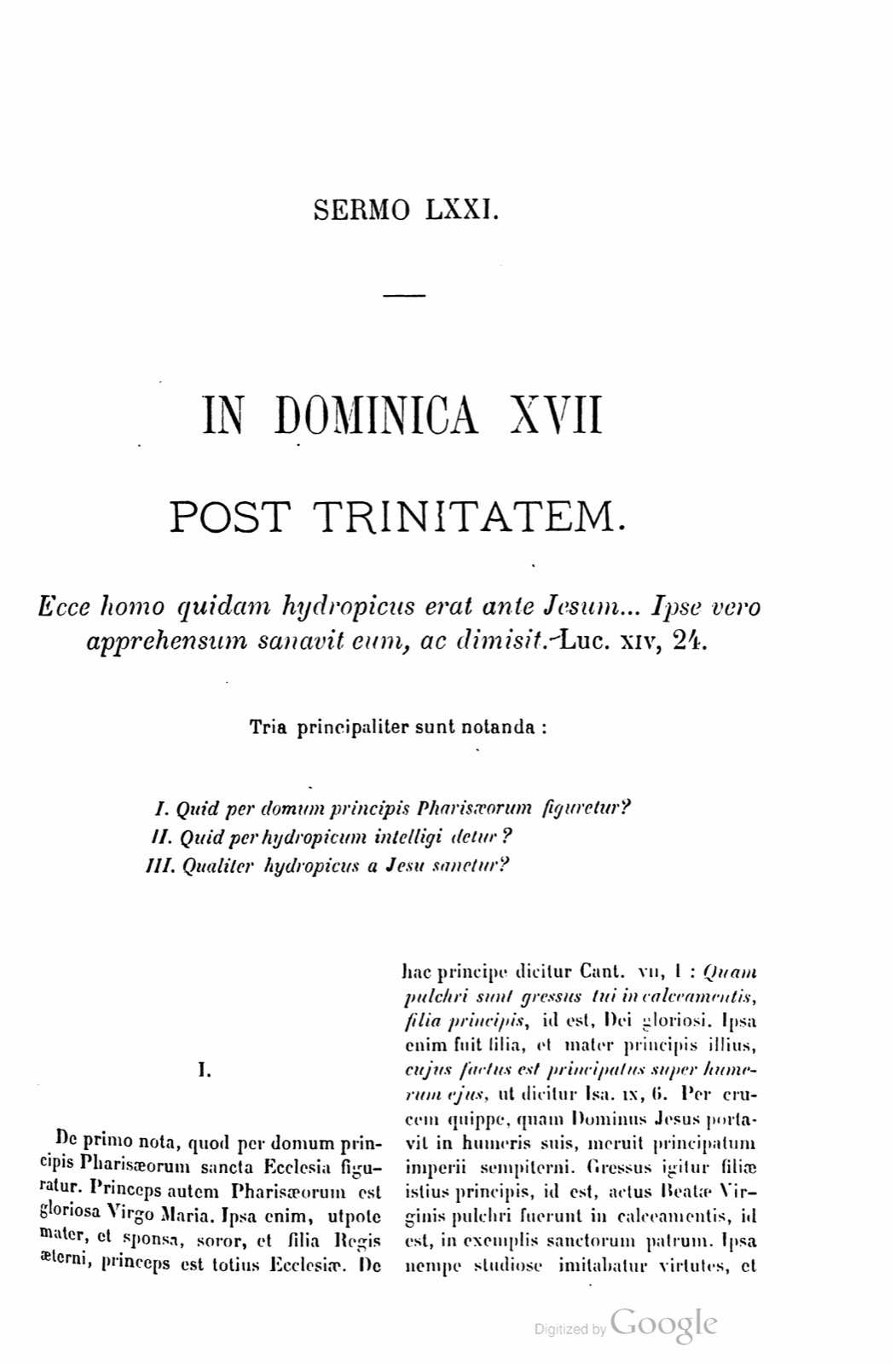
SERMO LXXI.
IN DOMINICA XVII POST TRINITATEM.
Ecce homo quidam hydropicus erat ante Jesum... Ipse vero apprehensum sanavit eum, ac dimisit. Luc. XIV, 24.
Tria principaliter sunt notanda:
I. Quid per domum principis Pharisaeorum figuretur? II. Quid per hydropicum intelligi detur? III. Qualiter hydropicus a Jesu sanetur?
I.
De primo nota, quod per domum principis Pharisaeorum sancta Ecclesia figuratur. Princeps autem Pharisaeorum est gloriosa Virgo Maria. Ipsa enim, utpote mater, et sponsa, soror, et filia Regis aeterni, princeps est totius Ecclesiae. De hac principe dicitur Cant. VII, 1: Quam pulchri sunt gressus tui in calceamentis, filia principis, id est, Dei gloriosi. Ipsa enim fuit filia, et mater principis illius, cujus factus est principatus super humerum ejus, ut dicitur Isa. IX, 6. Per crucem quippe, quam Dominus Jesus portavit in humeris suis, meruit principatum imperii sempiterni. Gressus igitur filiae istius principis, id est, actus Beatae Virginis pulchri fuerunt in calceamentis, id est, in exemplis sanctorum patrum. Ipsa nempe studiose imitabatur virtutes, et exempla praecedentium patrum, ac in omnibus strenue exsequebatur.
Et bene Beata Virgo princeps Pharisaeorum appellatur. Pharisaei quippe divisi interpretantur. Ipsa enim est Princeps et Domina fidelium, qui vita et moribus divisi sunt a populo diaboli. Populus quippe diaboli superbus est, iracundus, invidus et acediosus, avarus, luxuriosus et gulosus. Populus autem Beatae Virginis e diverso humilis est, mitis, benignus, et religiosus, sufficiens etiam in his quae a Deo habet, et castus, et sobrius.
Jesus autem hanc domum, id est, Ecclesiam intrat sabbato manducare panem. Desiderat enim, ut peccatores ipsi sabbatum faciant, id est, a peccatis desistant, et eum quiescere permittant, quem quotidie per peccata impugnant. Desiderat etiam, ut dent ei manducare panem, id est, ut de caetero per conversionem veram voluntatem suam perficiant. Unde legitur in Joan. IV, 31 et 32, quod cum Jesus mulierem Samaritanam convertisset, et illa in eum crederet: Venerunt Discipuli ejus apportantes cibum materialem, et dicebant: Rabbi manduca. Ille autem dicit eis: Ego cibum habeo manducare, quem vos nescitis. Quasi diceret: Bene refectus sum per conversionem et fidem hujus mulieris. Quicumque enim facit voluntatem Dei, optimo cibo cibat eum.
SERMON LXXI.
ON THE SEVENTEENTH SUNDAY AFTER TRINITY.
Behold, a certain dropsical man was before Jesus... But he, having taken him, healed him and dismissed him. Luke XIV, 24.
Three things principally are to be noted:
I. What is figured by the house of the ruler of the Pharisees? II. What is given to be understood by the dropsical man? III. How is the dropsical man healed by Jesus?
I.
Concerning the first, note that by the house of the ruler of the Pharisees holy Church is figured. But the ruler of the Pharisees is the glorious Virgin Mary. For she, as mother and bride, sister and daughter of the eternal King, is the ruler of the whole Church. Concerning this ruler it is said in Song VII, 1: How beautiful are your steps in shoes, daughter of the ruler, that is, of the glorious God. For she was the daughter and mother of that ruler whose government was made upon his shoulder, as is said in Isaiah IX, 6. For through the cross, which the Lord Jesus carried on his shoulders, he merited the government of eternal empire. Therefore the steps of the daughter of that ruler, that is, the acts of the Blessed Virgin, were beautiful in shoes, that is, in the examples of the holy fathers. For she zealously imitated the virtues and examples of the preceding fathers, and strenuously carried them out in all things.
And the Blessed Virgin is well called the ruler of the Pharisees. For Pharisees is interpreted separated. For she is the Ruler and Lady of the faithful, who in life and morals are separated from the people of the devil. For the people of the devil is proud, angry, envious and acedious, avaricious, lustful and gluttonous. But the people of the Blessed Virgin, on the contrary, is humble, meek, benign and religious, content also in the things that it has from God, and chaste and sober.
But Jesus enters this house, that is, the Church, on the sabbath to eat bread. For he desires that sinners themselves make sabbath, that is, cease from sins, and permit him to rest, whom daily they attack through sins. He also desires that they give him bread to eat, that is, that thereafter through true conversion they fulfill his will. Hence it is read in John IV, 31 and 32, that when Jesus had converted the Samaritan woman and she believed in him: His Disciples came bringing material food, and they were saying: Rabbi, eat. But he says to them: I have food to eat which you do not know. As if he were saying: I have been well refreshed through the conversion and faith of this woman. For whoever does the will of God feeds him with the best food.
II.
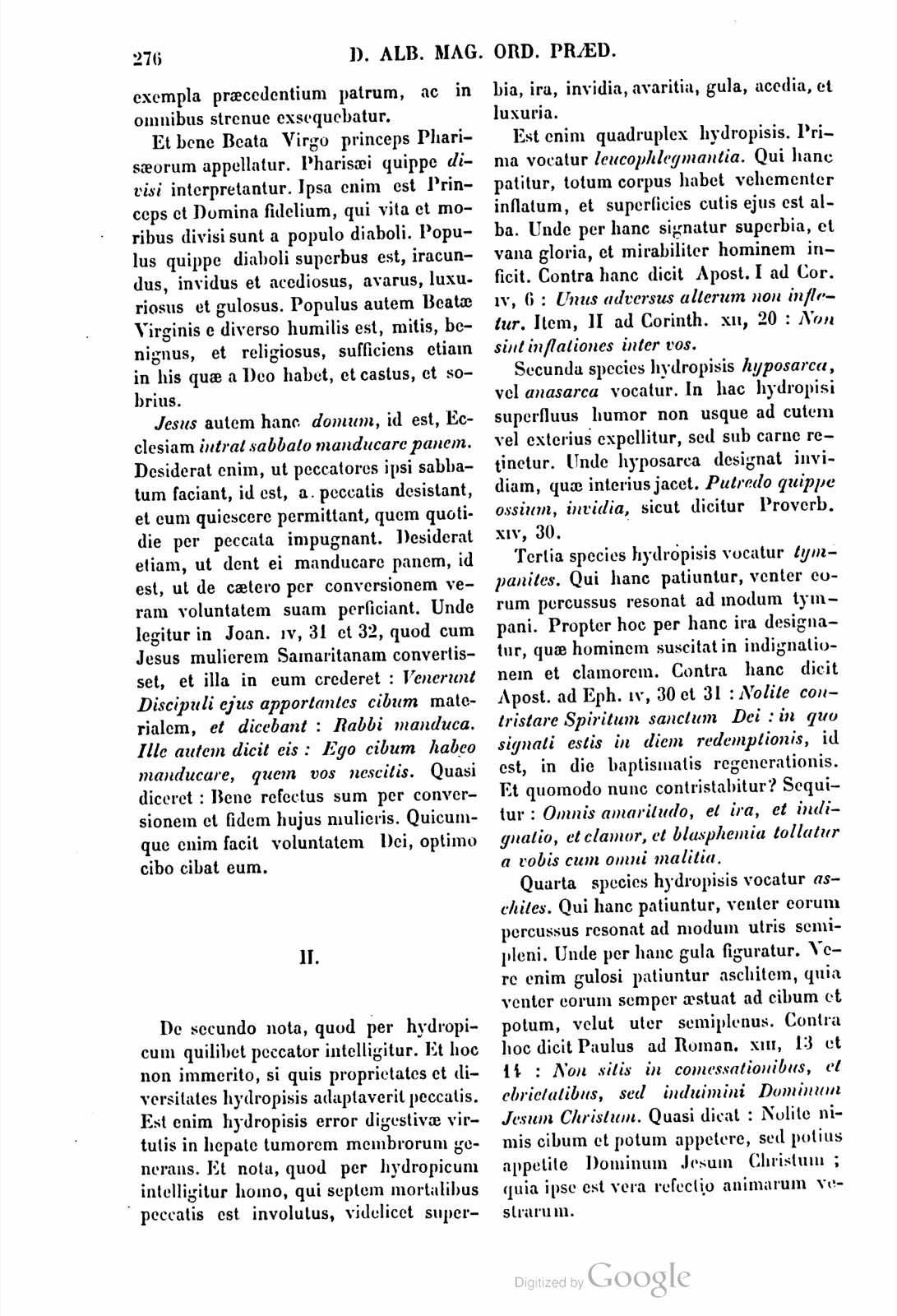
De secundo nota, quod per hydropicum quilibet peccator intelligitur. Et hoc non immerito, si quis proprietates et diversitates hydropisis adaptaverit peccatis. Est enim hydropisis error digestivae virtutis in hepate tumorem membrorum generans. Et nota, quod per hydropicum intelligitur homo, qui septem mortalibus peccatis est involutus, videlicet superbia, ira, invidia, avaritia, gula, acedia, et luxuria.
Est enim quadruplex hydropisis. Prima vocatur leucophlegmantia. Qui hanc patitur, totum corpus habet vehementer inflatum, et superficies cutis ejus est alba. Unde per hanc signatur superbia, et vana gloria, et mirabiliter hominem inficit. Contra hanc dicit Apost. I ad Cor. IV, 6: Unus adversus alterum non infletur. Item, II ad Corinth. XII, 20: Non sint inflationes inter vos.
Secunda species hydropisis hyposarca, vel anasarca vocatur. In hac hydropisi superfluus humor non usque ad cutem vel exterius expellitur, sed sub carne retinetur. Unde hyposarca designat invidiam, quae interius jacet. Putredo quippe ossium, invidia, sicut dicitur Proverb. XIV, 30.
Tertia species hydropisis vocatur tympanites. Qui hanc patiuntur, venter eorum percussus resonat ad modum tympani. Propter hoc per hanc ira designatur, quae hominem suscitat in indignationem et clamorem. Contra hanc dicit Apost. ad Eph. IV, 30 et 31: Nolite contristare Spiritum sanctum Dei: in quo signati estis in diem redemptionis, id est, in die baptismatis regenerationis. Et quomodo nunc contristabitur? Sequitur: Omnis amaritudo, et ira, et indignatio, et clamor, et blasphemia tollatur a vobis cum omni malitia.
Quarta species hydropisis vocatur aschites. Qui hanc patiuntur, venter eorum percussus resonat ad modum utris semipleni. Unde per hanc gula figuratur. Vere enim gulosi patiuntur aschitem, quia venter eorum semper aestuat ad cibum et potum, velut uter semiplenus. Contra hoc dicit Paulus ad Roman. XIII, 13 et 14: Non sitis in comessationibus, et ebrietatibus, sed induimini Dominum Jesum Christum. Quasi dicat: Nolite nimis cibum et potum appetere, sed potius appetite Dominum Jesum Christum; quia ipse est vera refectio animarum vestrarum.
II.
Concerning the second, note that by the dropsical man any sinner is understood. And this is not undeservedly so, if one adapts the properties and differences of dropsy to sins. For dropsy is an error of the digestive power in the liver, generating swelling of the members. And note that by the dropsical man is understood a human being who is entangled in the seven mortal sins, namely pride, anger, envy, avarice, gluttony, acedia, and lust.
For dropsy is fourfold. The first is called leukophlegmatia. He who suffers this has the whole body vehemently swollen, and the surface of his skin is white. Hence through this pride and vain glory are signified, and it wonderfully infects the human being. Against this the Apostle says, I Corinthians IV, 6: Let not one be puffed up against another. Likewise, II Corinthians XII, 20: Let there not be swellings among you.
The second species of dropsy is called hyposarca or anasarca. In this dropsy the superfluous humor is not driven all the way to the skin or outwardly, but is retained under the flesh. Hence hyposarca designates envy, which lies inwardly. For envy is rottenness of the bones, as is said in Proverbs XIV, 30.
The third species of dropsy is called tympanites. Those who suffer this, when their belly is struck, sound after the manner of a drum. Because of this, through this anger is designated, which stirs a human being into indignation and shouting. Against this the Apostle says at Ephesians IV, 30 and 31: Do not sadden the Holy Spirit of God, in whom you have been sealed unto the day of redemption, that is, on the day of baptismal regeneration. And how now will he be saddened? It follows: Let all bitterness and anger and indignation and shouting and blasphemy be taken away from you with all malice.
The fourth species of dropsy is called ascites. Those who suffer this, when their belly is struck, sound after the manner of a half-full wineskin. Hence by this gluttony is figured. For truly gluttonous persons suffer ascites, because their belly always burns for food and drink, like a half-full wineskin. Against this Paul says at Romans XIII, 13 and 14: Do not be in feastings and drunkennesses, but put on the Lord Jesus Christ. As if he were saying: Do not seek food and drink too much, but rather seek the Lord Jesus Christ, because he is the true refreshment of your souls.
If a page does not appear, its photograph has not been uploaded yet.