Works › Sermons for the Seasons of the Year
Volume 13 · pp. 253–255
Sermon LXV, Conclusion
A marker with ≈ is an approximate page boundary, placed by measure of the text; the page photographs remain the authority. In the paired views, clicking a page marker brings that page into view.
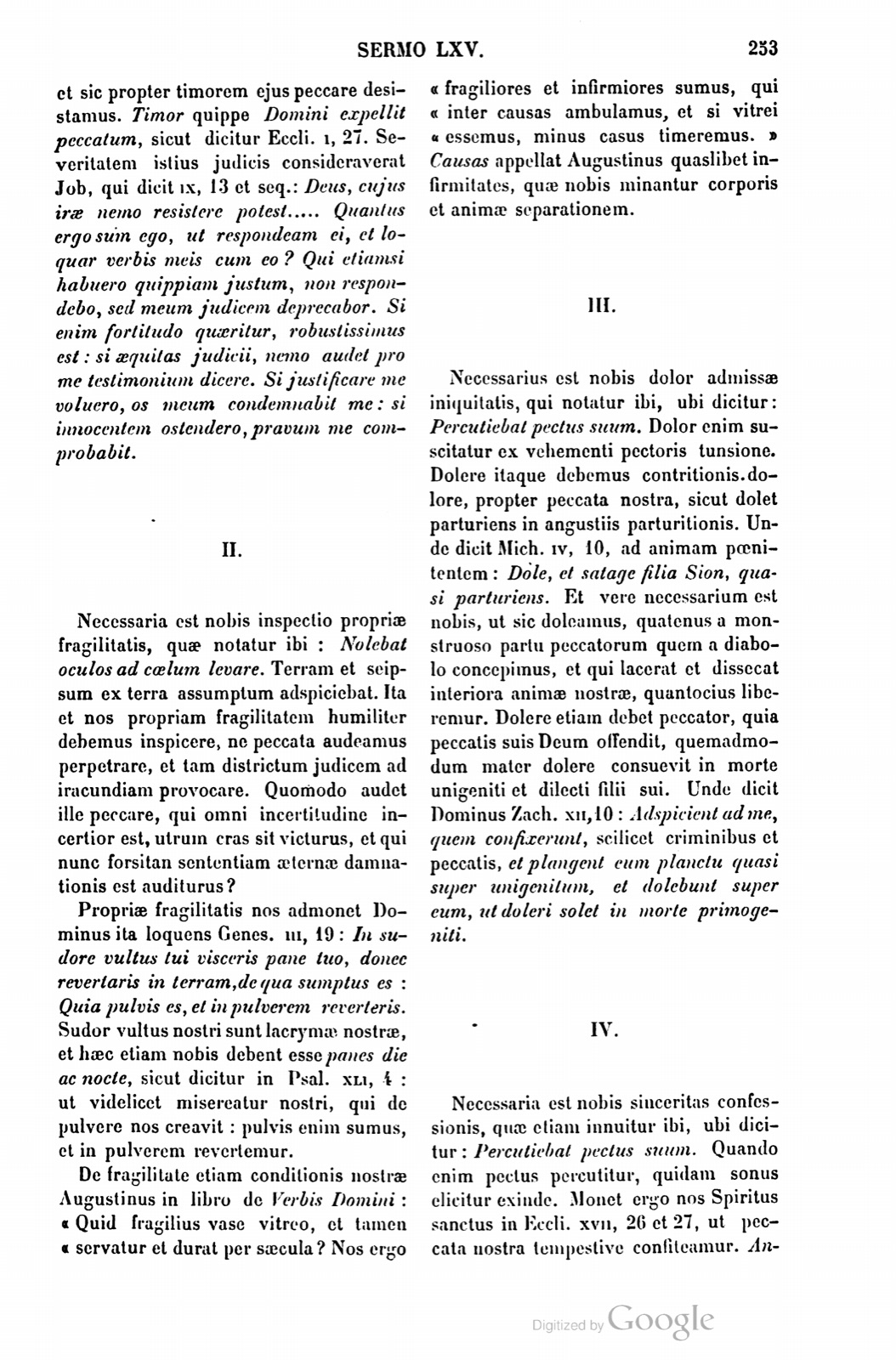
et sic propter timorem ejus peccare desistamus. Timor quippe Domini expellit peccatum, sicut dicitur Eccli. I, 27. Severitatem istius judicis consideraverat Job, qui dicit IX, 13 et seq.: Deus, cujus irae nemo resistere potest..... Quantus ergo sum ego, ut respondeam ei, et loquar verbis meis cum eo? Qui etiamsi habuero quippiam justum, non respondebo, sed meum judicem deprecabor. Si enim fortitudo quaeritur, robustissimus est: si aequitas judicii, nemo audet pro me testimonium dicere. Si justificare me voluero, os meum condemnabit me: si innocentem ostendero, pravum me comprobabit.
II.
Necessaria est nobis inspectio propriae fragilitatis, quae notatur ibi: Nolebat oculos ad caelum levare. Terram et seipsum ex terra assumptum adspiciebat. Ita et nos propriam fragilitatem humiliter debemus inspicere, ne peccata audeamus perpetrare, et tam districtum judicem ad iracundiam provocare. Quomodo audet ille peccare, qui omni incertitudine incertior est, utrum cras sit victurus, et qui nunc forsitan sententiam aeternae damnationis est auditurus?
Propriae fragilitatis nos admonet Dominus ita loquens Genes. III, 19: In sudore vultus tui vesceris pane tuo, donec revertaris in terram, de qua sumptus es: Quia pulvis es, et in pulverem reverteris. Sudor vultus nostri sunt lacrymae nostrae, et haec etiam nobis debent esse panes die ac nocte, sicut dicitur in Psal. XLI, 4: ut videlicet misereatur nostri, qui de pulvere nos creavit: pulvis enim sumus, et in pulverem revertemur.
De fragilitate etiam conditionis nostrae Augustinus in libro de Verbis Domini: "Quid fragilius vase vitreo, et tamen servatur et durat per saecula? Nos ergo fragiliores et infirmiores sumus, qui inter causas ambulamus, et si vitrei essemus, minus casus timeremus." Causas appellat Augustinus quaslibet infirmitates, quae nobis minantur corporis et animae separationem.
III.
Necessarius est nobis dolor admissae iniquitatis, qui notatur ibi, ubi dicitur: Percutiebat pectus suum. Dolor enim suscitatur ex vehementi pectoris tunsione. Dolere itaque debemus contritionis dolore, propter peccata nostra, sicut dolet parturiens in angustiis parturitionis. Unde dicit Mich. IV, 10, ad animam poenitentem: Dole, et satage filia Sion, quasi parturiens. Et vere necessarium est nobis, ut sic doleamus, quatenus a monstruoso partu peccatorum quem a diabolo concepimus, et qui lacerat et dissecat interiora animae nostrae, quantocius liberemur. Dolere etiam debet peccator, quia peccatis suis Deum offendit, quemadmodum mater dolere consuevit in morte unigeniti et dilecti filii sui. Unde dicit Dominus Zach. XII, 10: Adspicient ad me, quem confixerunt, scilicet criminibus et peccatis, et plangent cum planctu quasi super unigenitum, et dolebunt super eum, ut doleri solet in morte primogeniti.
and so because of fear of him let us cease to sin. For the fear of the Lord drives out sin, as is said in Ecclesiasticus I, 27. Job had considered the severity of that judge, who says, IX, 13 and following: God, whose wrath no one can resist.... How great then am I, that I should answer him, and speak with my words with him? And even if I shall have had something just, I will not answer, but will beseech my judge. For if strength is sought, he is most strong; if equity of judgment, no one dares to give testimony for me. If I shall wish to justify myself, my mouth will condemn me; if I shall show myself innocent, it will prove me depraved.
II.
Inspection of our own fragility is necessary for us, which is noted there: He did not wish to lift his eyes to heaven. He was looking at the earth and at himself, assumed from the earth. Thus we also ought humbly to inspect our own fragility, lest we dare to perpetrate sins and provoke so strict a judge to wrath. How does that one dare to sin, who is more uncertain than every uncertainty whether he will live tomorrow, and who perhaps now is about to hear the sentence of eternal damnation?
The Lord admonishes us concerning our own fragility, speaking thus in Genesis III, 19: In the sweat of your face you will eat your bread, until you return into the earth from which you were taken: because you are dust, and into dust you will return. The sweat of our face is our tears, and these also ought to be our breads by day and by night, as is said in Psalm XLI, 4, namely that he may have mercy on us, who created us from dust: for we are dust, and we will return into dust.
Concerning the fragility also of our condition Augustine says in the book On the Words of the Lord: "What is more fragile than a glass vessel, and nevertheless it is preserved and lasts for ages? We therefore are more fragile and weaker, who walk among causes, and if we were glass, we would fear falls less." Augustine calls causes any infirmities that threaten us with separation of body and soul.
III.
Sorrow for admitted iniquity is necessary for us, which is noted there, where it is said: He was striking his breast. For sorrow is stirred up from vehement beating of the breast. Therefore we ought to grieve with the sorrow of contrition because of our sins, as a woman giving birth grieves in the straits of childbirth. Hence Micah IV, 10 says to the penitent soul: Grieve, and labor, daughter of Sion, as one giving birth. And it is truly necessary for us to grieve thus, so that we may be freed as quickly as possible from the monstrous birth of sins which we have conceived from the devil and which tears and cuts apart the inner parts of our soul. The sinner also ought to grieve because by his sins he has offended God, just as a mother is accustomed to grieve at the death of her only-begotten and beloved son. Hence the Lord says, Zechariah XII, 10: They will look upon me whom they pierced, namely with crimes and sins, and they will lament with a lamentation as over an only-begotten one, and they will grieve over him, as one is accustomed to grieve at the death of a first-born.
IV.
Necessaria est nobis sinceritas confessionis, quae etiam innuitur ibi, ubi dicitur: Percutiebat pectus suum. Quando enim pectus percutitur, quidam sonus elicitur exinde. Monet ergo nos Spiritus sanctus in Eccli. XVII, 26 et 27, ut peccata nostra tempestive confiteamur. Ante mortem, inquit, confitere. A mortuo enim quasi nihil sit, perit confessio. Confiteberis vivens, vivus et sanus confiteberis.
Nota, quod monet nos, ut ante mortem confiteamur, et sani. Multi quippe per hoc decipiuntur, quod differunt poenitentiam suam ad horam mortis. Unde dicit Augustinus in quodam sermone de Poenitentia: "Agens poenitentiam et reconciliatus, dum sanus est, et postea vivens securus hinc exit: de sera poenitentia, quae raro vera, ego non sum securus: numquid dico, Damnabitur: non dico; sed non dico etiam, Liberabitur. Vis quod incertum est evadere: Age poenitentiam, dum sanus es: si sic agis securus es. Quare securus es? quia egisti poenitentiam eo tempore, quo potuisti peccare. Si autem tunc vis agere poenitentiam, quando jam nequis peccare, peccata te dimiserunt, non tu illa."
Nota etiam quod dicitur Eccli. supra, Confitere, confiteberis. Tria quippe genera sunt peccatorum confitenda, videlicet peccata cogitationum, locutionum, et operationum. Quod etiam peccata integraliter sint confitenda, per hoc ostenditur quod dicitur, Confitere. Quod etiam simul facere debes, ne videlicet honesta peccata confitearis, et inhonesta reticeas; ne etiam confessionem tuam in plures sacerdotes dividas, ut scilicet uni partem, et tertio, et quarto, et quinto, et sexto partem confitearis.
V.
Nobis necessaria est strenuitas satisfactionis, quae notatur ibi, ubi dicitur: Percutiebat pectus suum. Pectus enim percutere non poterat, nisi manum movisset. Manibus autem operamur. Unde per motum manus satisfactio designatur, quae maxime in duobus consistit, videlicet in corporis afflictione, et eleemosynarum largitione.
Corporis afflictio consistit in jejunio, fletu, et ciliciis, in disciplinis, in genuflexionibus, et peregrinationibus, et hujuscemodi corporalibus exercitiis. De ista afflictione dicit Dominus in Levit. XXIII, 27 et seq.: Affligetis animas vestras in die expiationis..., quia dies propitiationis est.... Omnis anima, quae afflicta non fuerit die hac, peribit de populis suis. Dies expiationis est tempus hujus vitae ad poenitentiam nobis concessum. Qui se in die isto non afflixerit per poenitentiam, peribit a numero electorum. Si quis enim impaenitens discesserit, non inveniet gratiam coram oculis Domini. Post hanc quippe vitam non est tempus miserendi, sed potius crimina puniendi.
IV.
Sincerity of confession is necessary for us, which also is intimated there, where it is said: He was striking his breast. For when the breast is struck, a certain sound is drawn out from it. Therefore the Holy Spirit admonishes us in Ecclesiasticus XVII, 26 and 27, that we confess our sins in good time. Before death, he says, confess. For from the dead, as if he were nothing, confession perishes. You will confess living; living and healthy you will confess.
Note that he admonishes us to confess before death and while healthy. For many are deceived by this, that they put off their repentance to the hour of death. Hence Augustine says in a certain sermon On Repentance: "Doing repentance and reconciled while he is healthy, and afterward living, he goes out from here secure; concerning late repentance, which is rarely true, I am not secure. Do I say, He will be damned? I do not say it; but I also do not say, He will be freed. Do you wish to escape what is uncertain? Do repentance while you are healthy; if you act thus, you are secure. Why are you secure? Because you did repentance at that time when you were able to sin. But if then you wish to do repentance, when already you are not able to sin, sins have dismissed you; you have not dismissed them."
Note also what is said above in Ecclesiasticus: Confess, you will confess. For three kinds of sins are to be confessed, namely sins of thoughts, of speeches, and of operations. That sins are also to be confessed integrally is shown through this, that it is said, Confess. You ought also to do this at the same time, lest namely you confess respectable sins and keep silent about shameful ones; lest also you divide your confession among many priests, so that, namely, to one you confess one part, and to a third, and a fourth, and a fifth, and a sixth, another part.
V.
Strenuousness of satisfaction is necessary for us, which is noted there, where it is said: He was striking his breast. For he could not strike his breast unless he had moved his hand. But with hands we work. Hence by the motion of the hand satisfaction is designated, which consists especially in two things, namely in affliction of the body and in the bestowal of alms.
Affliction of the body consists in fasting, weeping, and hair-shirts, in disciplines, in genuflections, and pilgrimages, and bodily exercises of this sort. Concerning that affliction the Lord says in Leviticus XXIII, 27 and following: You will afflict your souls on the day of expiation..., because it is the day of propitiation.... Every soul that will not have been afflicted on this day will perish from his peoples. The day of expiation is the time of this life granted to us for repentance. He who has not afflicted himself on this day through repentance will perish from the number of the elect. For if anyone has departed impenitent, he will not find grace before the eyes of the Lord. For after this life there is not a time of having mercy, but rather of punishing crimes.
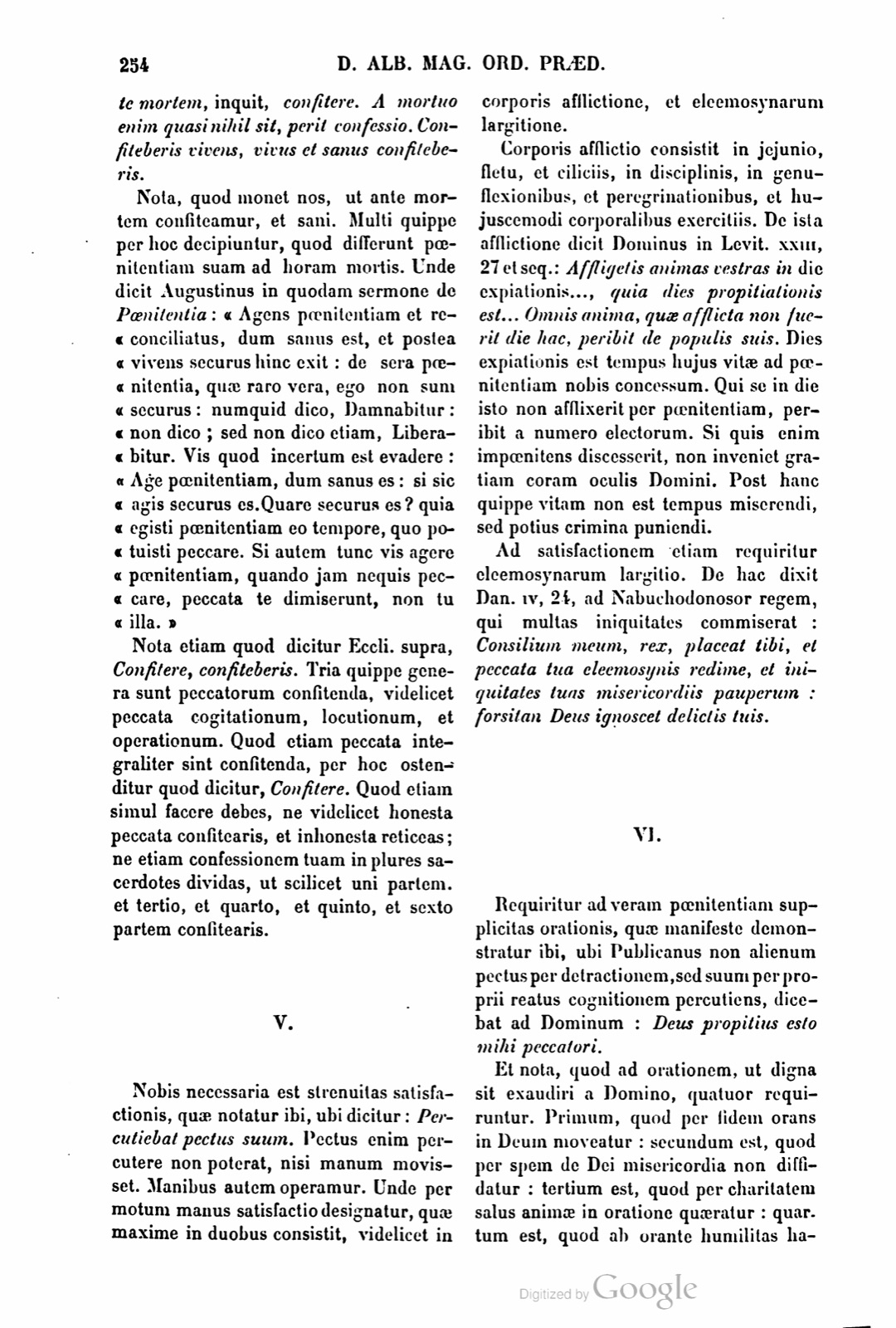
Ad satisfactionem etiam requiritur eleemosynarum largitio. De hac dixit Dan. IV, 24, ad Nabuchodonosor regem, qui multas iniquitates commiserat: Consilium meum, rex, placeat tibi, et peccata tua eleemosynis redime, et iniquitates tuas misericordiis pauperum: forsitan Deus ignoscet delictis tuis.
VI.
Requiritur ad veram poenitentiam supplicitas orationis, quae manifeste demonstratur ibi, ubi Publicanus non alienum pectus per detractionem, sed suum per proprii reatus cognitionem percutiens, dicebat ad Dominum: Deus propitius esto mihi peccatori.
Et nota, quod ad orationem, ut digna sit exaudiri a Domino, quatuor requiruntur. Primum, quod per fidem orans in Deum moveatur: secundum est, quod per spem de Dei misericordia non diffidatur: tertium est, quod per charitatem salus animae in oratione quaeratur: quartum est, quod ab orante humilitas habeatur. Superbia quippe nihil impetrare potest a Domino.
Et certe haec quatuor inveniuntur in oratione Publicani.
1. Per fidem namque movebatur in Deum. Unde dixit, Deus.
2. Spem quoque habuit ut exaudiretur. Si enim de misericordia Dei desperasset, propitiationem ejus non implorasset. Dixit autem: Deus propitius esto mihi peccatori.
3. Per charitatem etiam animae salutem quaesivit. Unde dixit: Deus propitius.
4. Quod nihilominus humilitatem habuerit, per hoc patet, quod se peccatorem appellat dicens: Deus propitius esto mihi peccatori. Haec autem et nos, charissimi, in orationibus nostris habere debemus, videlicet fidem, spem, charitatem, et humilitatem.
Rogate ergo Dominum, ut sic nunc per veram poenitentiam remissionem nostrorum criminum obtineamus, ut tandem exsultantes coram Christo in Angelorum consortiis appareamus. Quod nobis, etc.
For satisfaction there is also required the bestowal of alms. Concerning this Daniel IV, 24 said to King Nabuchodonosor, who had committed many iniquities: Let my counsel, O king, be pleasing to you, and redeem your sins with alms, and your iniquities with mercies toward the poor; perhaps God will forgive your offenses.
VI.
Supplication of prayer is required for true repentance, which is clearly shown there, where the publican, striking not another's breast through detraction, but his own through knowledge of his own guilt, was saying to the Lord: God, be propitious to me a sinner.
And note that for prayer, so that it may be worthy to be heard by the Lord, four things are required. The first, that the one praying be moved toward God through faith; the second is that through hope he not distrust concerning God's mercy; the third is that through charity the salvation of the soul be sought in prayer; the fourth is that humility be possessed by the one praying. For pride can obtain nothing from the Lord.
And certainly these four are found in the prayer of the publican.
1. For through faith he was moved toward God. Hence he said, God.
2. He also had hope that he would be heard. For if he had despaired of the mercy of God, he would not have implored his propitiation. But he said: God, be propitious to me a sinner.
3. Through charity also he sought the salvation of his soul. Hence he said: God, be propitious.
4. That nevertheless he had humility is clear through this, that he calls himself a sinner, saying: God, be propitious to me a sinner. But we also, dearest ones, ought to have these things in our prayers, namely faith, hope, charity, and humility.
Therefore ask the Lord that we may now so obtain remission of our crimes through true repentance, that at last, exulting before Christ, we may appear in the companies of Angels. May he grant this to us, etc.

If a page does not appear, its photograph has not been uploaded yet.