Works › Sermons for the Seasons of the Year
Volume 13 · pp. 256–258
Sermon LXVI. On the Twelfth Sunday After Trinity
A marker with ≈ is an approximate page boundary, placed by measure of the text; the page photographs remain the authority. In the paired views, clicking a page marker brings that page into view.
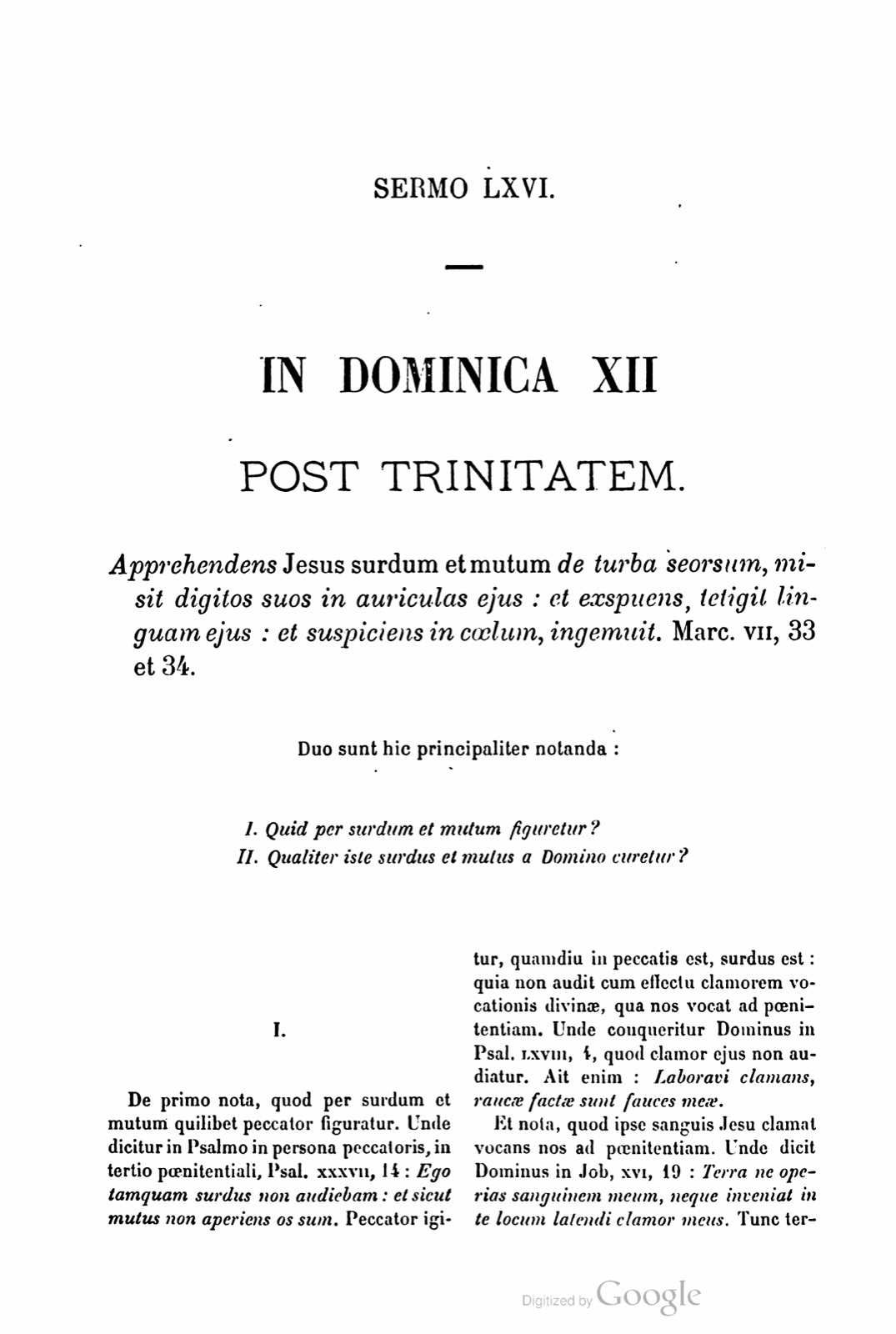
SERMO LXVI.
IN DOMINICA XII POST TRINITATEM.
Apprehendens Jesus surdum et mutum de turba seorsum, misit digitos suos in auriculas ejus: et exspuens, tetigit linguam ejus: et suspiciens in caelum, ingemuit. Marc. VII, 33 et 34.
Duo sunt hic principaliter notanda:
I. Quid per surdum et mutum figuretur? II. Qualiter iste surdus et mutus a Domino curetur?
I.
De primo nota, quod per surdum et mutum quilibet peccator figuratur. Unde dicitur in Psalmo in persona peccatoris, in tertio poenitentiali, Psal. XXXVII, 14: Ego tamquam surdus non audiebam: et sicut mutus non aperiens os sum. Peccator igitur, quamdiu in peccatis est, surdus est: quia non audit cum effectu clamorem vocationis divinae, qua nos vocat ad poenitentiam. Unde conqueritur Dominus in Psal. LXVIII, 4, quod clamor ejus non audiatur. Ait enim: Laboravi clamans, raucae factae sunt fauces meae.
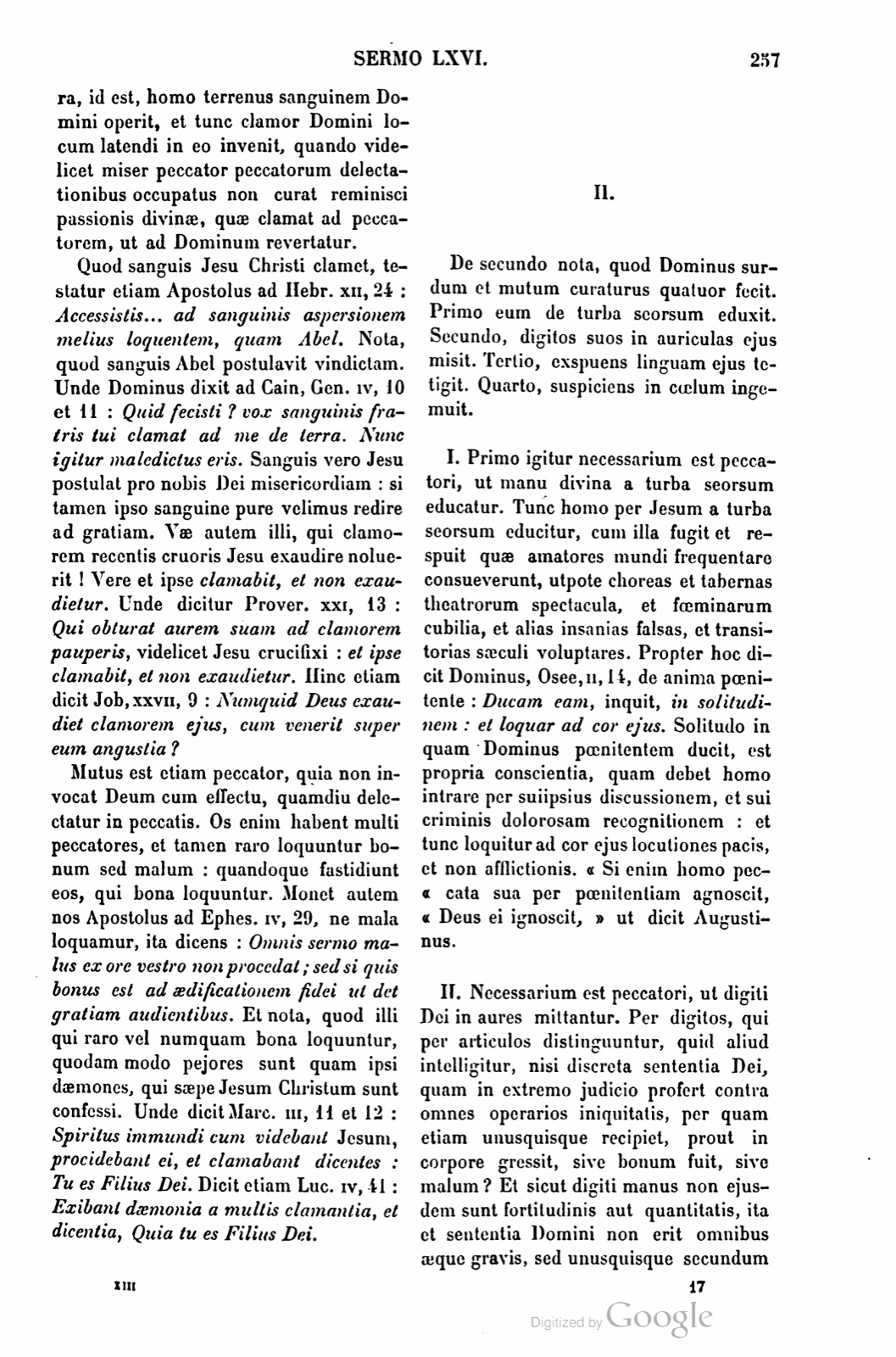
Et nota, quod ipse sanguis Jesu clamat vocans nos ad poenitentiam. Unde dicit Dominus in Job, XVI, 19: Terra ne operias sanguinem meum, neque inveniat in te locum latendi clamor meus. Tunc terra, id est, homo terrenus sanguinem Domini operit, et tunc clamor Domini locum latendi in eo invenit, quando videlicet miser peccator peccatorum delectationibus occupatus non curat reminisci passionis divinae, quae clamat ad peccatorem, ut ad Dominum revertatur.
Quod sanguis Jesu Christi clamet, testatur etiam Apostolus ad Hebr. XII, 24: Accessistis ... ad sanguinis aspersionem melius loquentem, quam Abel. Nota, quod sanguis Abel postulavit vindictam. Unde Dominus dixit ad Cain, Gen. IV, 10 et 11: Quid fecisti? vox sanguinis fratris tui clamat ad me de terra. Nunc igitur maledictus eris. Sanguis vero Jesu postulat pro nobis Dei misericordiam: si tamen ipso sanguine pure velimus redire ad gratiam. Vae autem illi, qui clamorem recentis cruoris Jesu exaudire noluerit! Vere et ipse clamabit, et non exaudietur. Unde dicitur Prover. XXI, 13: Qui obturat aurem suam ad clamorem pauperis, videlicet Jesu crucifixi: et ipse clamabit, et non exaudietur. Hinc etiam dicit Job, XXVII, 9: Numquid Deus exaudiet clamorem ejus, cum venerit super eum angustia?
Mutus est etiam peccator, quia non invocat Deum cum effectu, quamdiu delectatur in peccatis. Os enim habent multi peccatores, et tamen raro loquuntur bonum sed malum: quandoque fastidiunt eos, qui bona loquuntur. Monet autem nos Apostolus ad Ephes. IV, 29, ne mala loquamur, ita dicens: Omnis sermo malus ex ore vestro non procedat; sed si quis bonus est ad aedificationem fidei ut det gratiam audientibus. Et nota, quod illi qui raro vel numquam bona loquuntur, quodam modo pejores sunt quam ipsi daemones, qui saepe Jesum Christum sunt confessi. Unde dicit Marc. III, 11 et 12: Spiritus immundi cum videbant Jesum, procidebant ei, et clamabant dicentes: Tu es Filius Dei. Dicit etiam Luc. IV, 41: Exibant daemonia a multis clamantia, et dicentia, Quia tu es Filius Dei.
SERMON LXVI.
ON THE TWELFTH SUNDAY AFTER TRINITY.
Jesus, taking the deaf and mute man aside from the crowd, put his fingers into his ears; and spitting, he touched his tongue; and looking up into heaven, he groaned. Mark VII, 33 and 34.
Two things are principally to be noted here:
I. What is figured by the deaf and mute man? II. How is that deaf and mute man cured by the Lord?
I.
Concerning the first, note that by the deaf and mute man any sinner is figured. Hence it is said in the Psalm in the person of the sinner, in the third penitential psalm, Psalm XXXVII, 14: I, like one deaf, did not hear; and I was like a mute not opening his mouth. Therefore the sinner, as long as he is in sins, is deaf, because he does not hear with effect the cry of the divine calling, by which he calls us to repentance. Hence the Lord complains in Psalm LXVIII, 4, that his cry is not heard. For he says: I have labored crying; my jaws have become hoarse.
And note that the very blood of Jesus cries out, calling us to repentance. Hence the Lord says in Job XVI, 19: Earth, do not cover my blood, nor may my cry find in you a place of hiding. Then the earth, that is, an earthly human being, covers the blood of the Lord, and then the cry of the Lord finds in him a place of hiding, when, namely, the miserable sinner, occupied with the delights of sins, does not care to remember the divine passion, which cries to the sinner that he return to the Lord.
That the blood of Jesus Christ cries out, the Apostle also testifies at Hebrews XII, 24: You have come ... to the sprinkling of blood speaking better than Abel. Note that the blood of Abel demanded vengeance. Hence the Lord said to Cain, Genesis IV, 10 and 11: What have you done? The voice of your brother's blood cries to me from the earth. Now therefore you will be cursed. But the blood of Jesus demands for us the mercy of God, if nevertheless by that blood itself we wish to return purely to grace. But woe to him who has refused to hear the cry of the fresh blood of Jesus! Truly he too will cry, and he will not be heard. Hence it is said in Proverbs XXI, 13: He who stops his ear at the cry of the poor man, namely of Jesus crucified, he too will cry, and he will not be heard. Hence Job XXVII, 9 also says: Will God hear his cry when distress comes upon him?
The sinner is also mute, because he does not invoke God with effect as long as he delights in sins. For many sinners have a mouth, and nevertheless they rarely speak good but evil; sometimes they loathe those who speak good things. But the Apostle admonishes us at Ephesians IV, 29 not to speak evil things, saying thus: Let no evil speech proceed from your mouth, but if there is any good speech for the edification of faith, that it may give grace to those hearing. And note that those who rarely or never speak good things are in a certain way worse than the demons themselves, who often confessed Jesus Christ. Hence Mark III, 11 and 12 says: The unclean spirits, when they saw Jesus, fell down before him and cried out, saying: You are the Son of God. Luke IV, 41 also says: Demons went out from many crying out and saying, Because you are the Son of God.
II.
De secundo nota, quod Dominus surdum et mutum curaturus quatuor fecit. Primo eum de turba seorsum eduxit. Secundo, digitos suos in auriculas ejus misit. Tertio, exspuens linguam ejus tetigit. Quarto, suspiciens in caelum ingemuit.
I. Primo igitur necessarium est peccatori, ut manu divina a turba seorsum educatur. Tunc homo per Jesum a turba seorsum educitur, cum illa fugitet respuit quae amatores mundi frequentare consueverunt, utpote choreas et tabernas theatrorum spectacula, et feminarum cubilia, et alias insanias falsas, et transitorias saeculi voluptates. Propter hoc dicit Dominus, Osee, II, 14, de anima poenitente: Ducam eam, inquit, in solitudinem: et loquar ad cor ejus. Solitudo in quam Dominus poenitentem ducit, est propria conscientia, quam debet homo intrare per sui ipsius discussionem, et sui criminis dolorosam recognitionem: et tunc loquitur ad cor ejus locutiones pacis, et non afflictionis. "Si enim homo peccata sua per poenitentiam agnoscit, Deus ei ignoscit," ut dicit Augustinus.
II. Necessarium est peccatori, ut digiti Dei in aures mittantur. Per digitos, qui per articulos distinguuntur, quid aliud intelligitur, nisi discreta sententia Dei, quam in extremo judicio profert contra omnes operarios iniquitatis, per quam etiam unusquisque recipiet, prout in corpore gessit, sive bonum fuit, sive malum? Et sicut digiti manus non ejusdem sunt fortitudinis aut quantitatis, ita et sententia Domini non erit omnibus aeque gravis, sed unusquisque secundum merita peccatorum suorum crudeliorem sententiam audiet aut minorem. Necesse igitur habes, o peccator, ut Dominus hos digitos suos in aures tui cordis immittat, ut videlicet quasi jam suo tribunali assistas, contra te aeternae damnationis sententiam proferendam pertimescas, et sic quamdiu tempus est miserendi, pedibus suae misericordiae provolutus, peccata tua per veram contritionem tibi remitti deposcas.
De praedictis digitis Dominus, Cant. V, 5: Manus meae distillaverunt myrrham, et digiti mei pleni myrrha probatissima. Nota, quod Dominus habet duas manus, videlicet manum misericordiae, et manum justitiae. Per primam peccatores ad poenitentiam vocat, per secundam venire nolentes perpetuo castigat.
1. Manus itaque misericordiae distillat myrrham, quia ostendit nobis amaritudines passionis, quas pro nobis Dominus passus est in cruce.
II.
Concerning the second, note that the Lord, about to cure the deaf and mute man, did four things. First he led him aside from the crowd. Second, he put his fingers into his ears. Third, spitting, he touched his tongue. Fourth, looking up into heaven, he groaned.
I. Therefore first it is necessary for the sinner to be led aside from the crowd by the divine hand. Then a human being is led aside from the crowd through Jesus, when he flees and rejects those things which lovers of the world are accustomed to frequent, as for instance dances and taverns, spectacles of theaters, and beds of women, and other false insanities and transitory pleasures of the age. Because of this the Lord says in Hosea II, 14, concerning the penitent soul: I will lead her, he says, into solitude, and I will speak to her heart. The solitude into which the Lord leads the penitent is his own conscience, which a human being ought to enter through discussion of himself and sorrowful recognition of his crime; and then he speaks to his heart words of peace and not of affliction. "For if a human being acknowledges his sins through repentance, God forgives him," as Augustine says.
II. It is necessary for the sinner that the fingers of God be put into his ears. By the fingers, which are distinguished by joints, what else is understood except the discerning sentence of God, which in the final judgment he pronounces against all workers of iniquity, through which each one will also receive according as he has done in the body, whether it was good or whether evil? And just as the fingers of the hand are not of the same strength or size, so also the sentence of the Lord will not be equally grave for all, but each one according to the merits of his sins will hear a harsher or a lesser sentence. Therefore it is necessary for you, O sinner, that the Lord put these fingers of his into the ears of your heart, so that, namely, as if you already stood at his tribunal, you may greatly fear the sentence of eternal damnation to be pronounced against you, and so, while it is the time of having mercy, lying prostrate at the feet of his mercy, you may beg that your sins be remitted to you through true contrition.
Concerning the aforesaid fingers the Lord says, Song V, 5: My hands have dripped myrrh, and my fingers are full of the finest myrrh. Note that the Lord has two hands, namely the hand of mercy and the hand of justice. Through the first he calls sinners to repentance; through the second he perpetually chastises those unwilling to come.
1. Therefore the hand of mercy drips myrrh, because it shows us the bitternesses of the passion, which the Lord suffered for us on the cross.
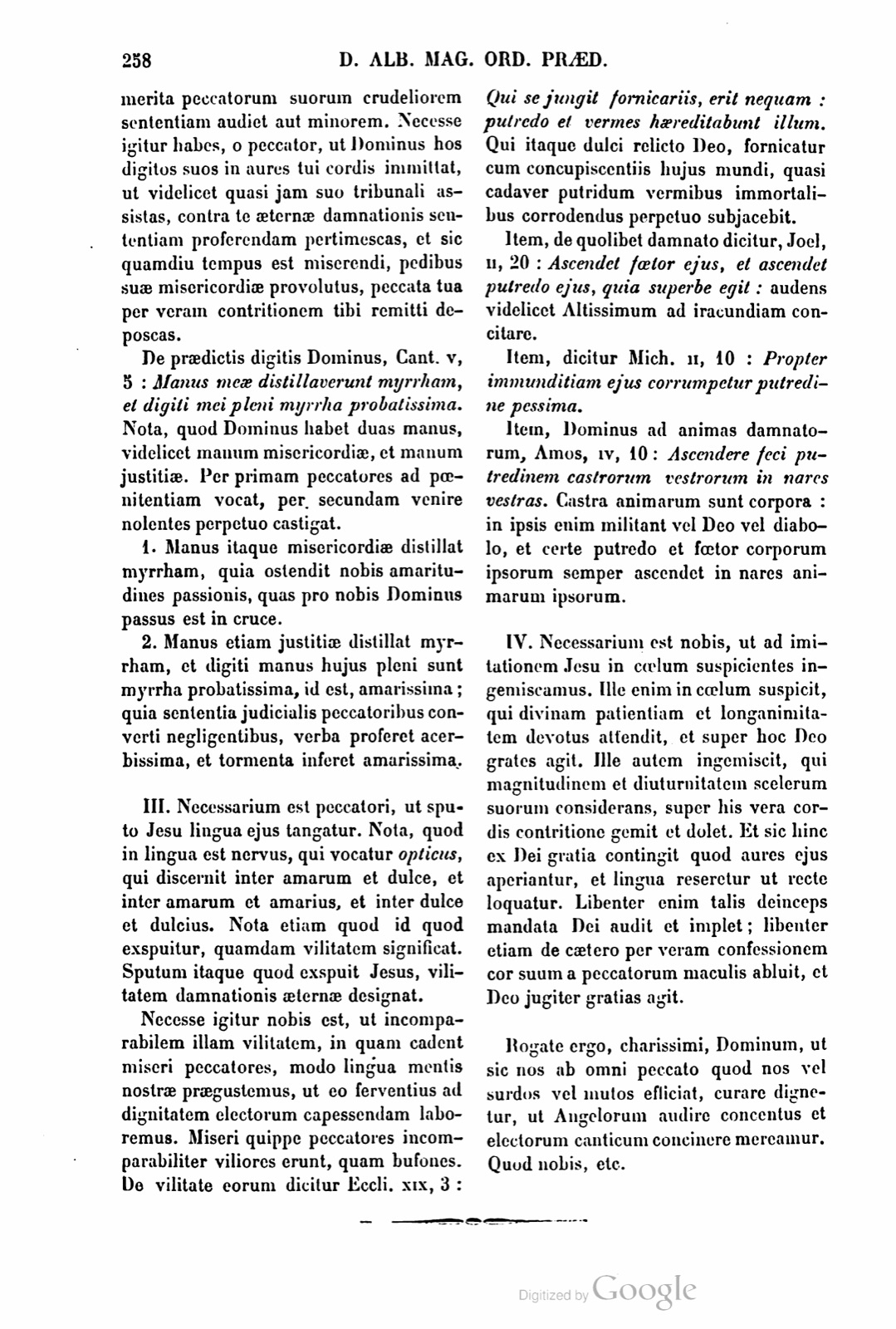
2. Manus etiam justitiae distillat myrrham, et digiti manus hujus pleni sunt myrrha probatissima, id est, amarissima; quia sententia judicialis peccatoribus converti negligentibus, verba proferet acerbissima, et tormenta inferet amarissima.
III. Necessarium est peccatori, ut sputo Jesu lingua ejus tangatur. Nota, quod in lingua est nervus, qui vocatur opticus, qui discernit inter amarum et dulce, et inter amarum et amarius, et inter dulce et dulcius. Nota etiam quod id quod exspuitur, quamdam vilitatem significat. Sputum itaque quod exspuit Jesus, vilitatem damnationis aeternae designat.
Necesse igitur nobis est, ut incomparabilem illam vilitatem, in quam cadent miseri peccatores, modo lingua mentis nostrae praegustemus, ut eo ferventius ad dignitatem electorum capessendam laboremus. Miseri quippe peccatores incomparabiliter viliores erunt, quam bufones. De vilitate eorum dicitur Eccli. XIX, 3: Qui se jungit fornicariis, erit nequam: putredo et vermes haereditabunt illum. Qui itaque dulci relicto Deo, fornicatur cum concupiscentiis hujus mundi, quasi cadaver putridum vermibus immortalibus corrodendus perpetuo subjacebit.
Item, de quolibet damnato dicitur, Joel, II, 20: Ascendet foetor ejus, et ascendet putredo ejus, quia superbe egit: audens videlicet Altissimum ad iracundiam concitare.
Item, dicitur Mich. II, 10: Propter immunditiam ejus corrumpetur putredine pessima.
Item, Dominus ad animas damnatorum, Amos, IV, 10: Ascendere feci putredinem castrorum vestrorum in nares vestras. Castra animarum sunt corpora: in ipsis enim militant vel Deo vel diabolo, et certe putredo et foetor corporum ipsorum semper ascendet in nares animarum ipsorum.
IV. Necessarium est nobis, ut ad imitationem Jesu in caelum suspicientes ingemiscamus. Ille enim in caelum suspicit, qui divinam patientiam et longanimitatem devotus attendit, et super hoc Deo grates agit. Ille autem ingemiscit, qui magnitudinem et diuturnitatem scelerum suorum considerans, super his vera cordis contritione gemit et dolet. Et sic hinc ex Dei gratia contingit quod aures ejus aperiantur, et lingua reseretur ut recte loquatur. Libenter enim talis deinceps mandata Dei audit et implet; libenter etiam de caetero per veram confessionem cor suum a peccatorum maculis abluit, et Deo jugiter gratias agit.
Rogate ergo, charissimi, Dominum, ut sic nos ab omni peccato quod nos vel surdos vel mutos efficiat, curare dignetur, ut Angelorum audire concentus et electorum canticum concinere mereamur. Quod nobis, etc.
2. The hand also of justice drips myrrh, and the fingers of this hand are full of the finest myrrh, that is, very bitter myrrh; because the judicial sentence will pronounce most harsh words to sinners neglecting to be converted, and will bring in most bitter torments.
III. It is necessary for the sinner that his tongue be touched by the spittle of Jesus. Note that in the tongue there is a nerve which is called optic, which discerns between bitter and sweet, and between bitter and more bitter, and between sweet and sweeter. Note also that what is spit out signifies a certain vileness. Therefore the spittle which Jesus spits out designates the vileness of eternal damnation.
Therefore it is necessary for us now to foretaste with the tongue of our mind that incomparable vileness into which miserable sinners will fall, so that we may labor with greater fervor to take possession of the dignity of the elect. For miserable sinners will be incomparably viler than toads. Concerning their vileness it is said in Ecclesiasticus XIX, 3: He who joins himself to fornicators will be wicked; rottenness and worms will inherit him. Therefore he who, having abandoned sweet God, fornicates with the concupiscences of this world, will be perpetually subject to being gnawed by immortal worms like a rotten corpse.
Likewise, concerning any damned person it is said, Joel II, 20: His stench will ascend, and his rottenness will ascend, because he acted proudly, namely daring to provoke the Most High to wrath.
Likewise, it is said in Micah II, 10: Because of his uncleanness he will be corrupted with the worst rottenness.
Likewise, the Lord says to the souls of the damned, Amos IV, 10: I made the rottenness of your camps ascend into your nostrils. The camps of souls are bodies; for in them they fight either for God or for the devil, and certainly the rottenness and stench of their bodies will always ascend into the nostrils of their souls.
IV. It is necessary for us, in imitation of Jesus, to groan while looking up into heaven. For he looks up into heaven who devoutly attends to divine patience and long-suffering, and over this gives thanks to God. But he groans who, considering the magnitude and duration of his crimes, groans and grieves over them with true contrition of heart. And thus hence by the grace of God it happens that his ears are opened and his tongue is unbound so that he may speak rightly. For such a person henceforth freely hears and fulfills the commandments of God; freely also thereafter through true confession he washes his heart from the stains of sins, and continually gives thanks to God.
Therefore ask the Lord, dearest ones, that he may deign so to cure us from every sin that makes us either deaf or mute, that we may deserve to hear the harmonies of Angels and to sing together the song of the elect. May he grant this to us, etc.
If a page does not appear, its photograph has not been uploaded yet.