Works › Sermons for the Seasons of the Year
Volume 13 · pp. 249–251
Sermon LXIV. On the Tenth Sunday After Trinity
A marker with ≈ is an approximate page boundary, placed by measure of the text; the page photographs remain the authority. In the paired views, clicking a page marker brings that page into view.
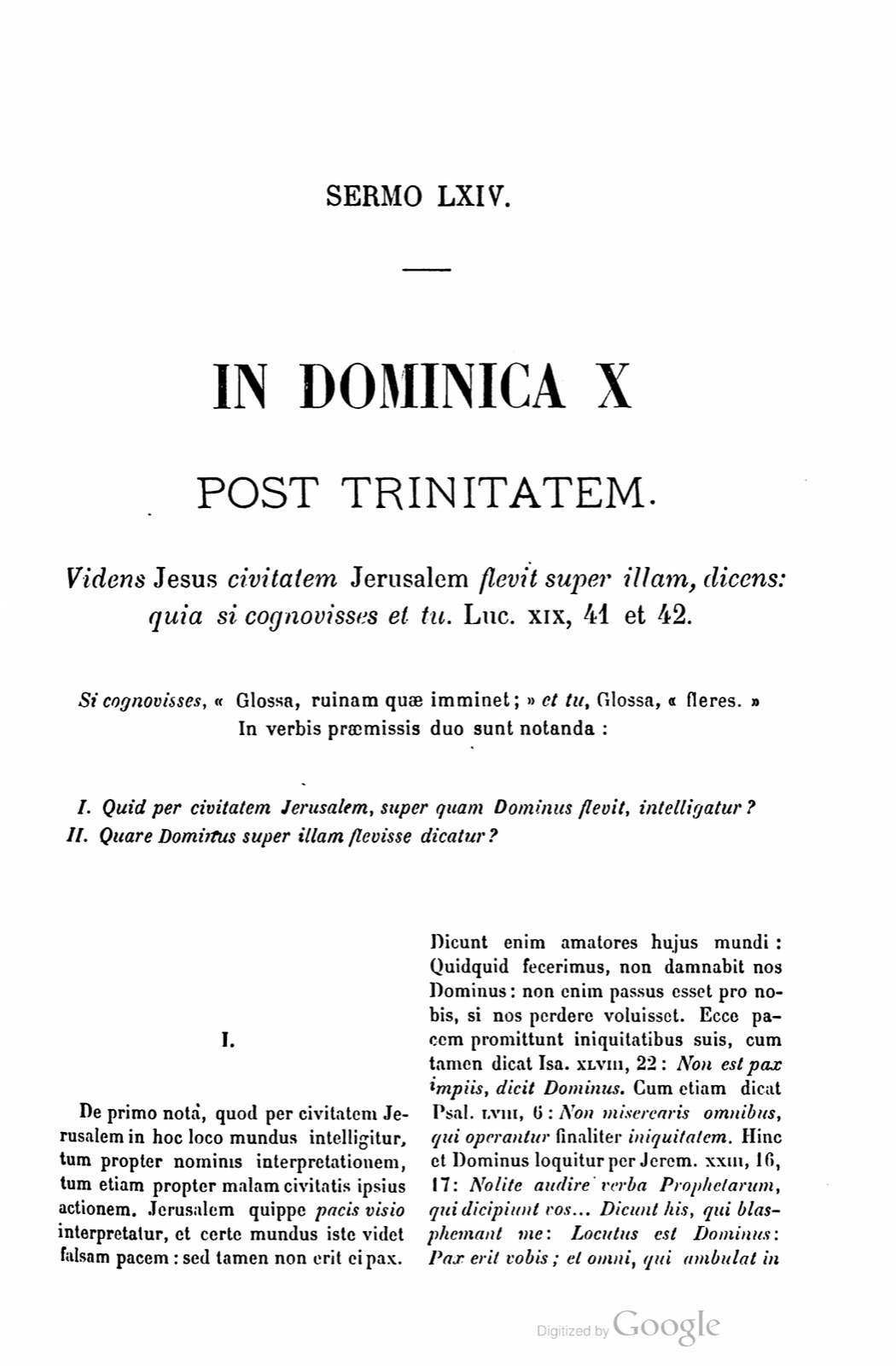
SERMO LXIV.
IN DOMINICA X POST TRINITATEM.
Videns Jesus civitatem Jerusalem flevit super illam, dicens: quia si cognovisses et tu. Luc. XIX, 41 et 42.
Si cognovisses, "Glossa, ruinam quae imminet;" et tu, Glossa, "fleres." In verbis praemissis duo sunt notanda:
I. Quid per civitatem Jerusalem, super quam Dominus flevit, intelligatur? II. Quare Dominus super illam flevisse dicatur?
I.
De primo nota, quod per civitatem Jerusalem in hoc loco mundus intelligitur, tum propter nominis interpretationem, et tum etiam propter malam civitatis ipsius actionem. Jerusalem quippe pacis visio interpretatur, et certe mundus iste videt falsam pacem: sed tamen non erit ei pax. Dicunt enim amatores hujus mundi: Quidquid fecerimus, non damnabit nos Dominus: non enim passus esset pro nobis, si nos perdere voluisset. Ecce pacem promittunt iniquitatibus suis, cum tamen dicat Isa. XLVIII, 22: Non est pax impiis, dicit Dominus. Cum etiam dicat Psal. LVIII, 6: Non miserearis omnibus, qui operantur finaliter iniquitatem. Hinc et Dominus loquitur per Jerem. XXIII, 16, 17: Nolite audire verba Prophetarum, qui dicipiunt vos.... Dicunt his, qui blasphemant me: Locutus est Dominus: Pax erit vobis; et omni, qui ambulat in pravitate cordis sui, dixerunt: Non veniet super vos malum.
Vocatur etiam mundus iste Jerusalem, propter ipsius civitatis malam actionem. Occidit enim Prophetas Domini, et lapidavit eos qui ad se missi erant: sicut improperat ei Deus, Matth. XXIII, 37. Jerusalem, Jerusalem, quae occidis Prophetas, et lapidas eos, qui ad te missi sunt. Sic et mundus iste occidit gladiis odiorum, et lapidat lapidibus detractionum Prophetas, id est, praedicatores Domini, qui missi sunt ad correctionem illius; imo et ipsum Dominum Prophetarum, id est, Jesum Christum quotidie blasphemiis et malis operibus crucifigit: sicut testatur Paulus ad Hebr. VI, 6: Rursum crucifigentes sibimetipsis Filium Dei, et ostentui habentes.
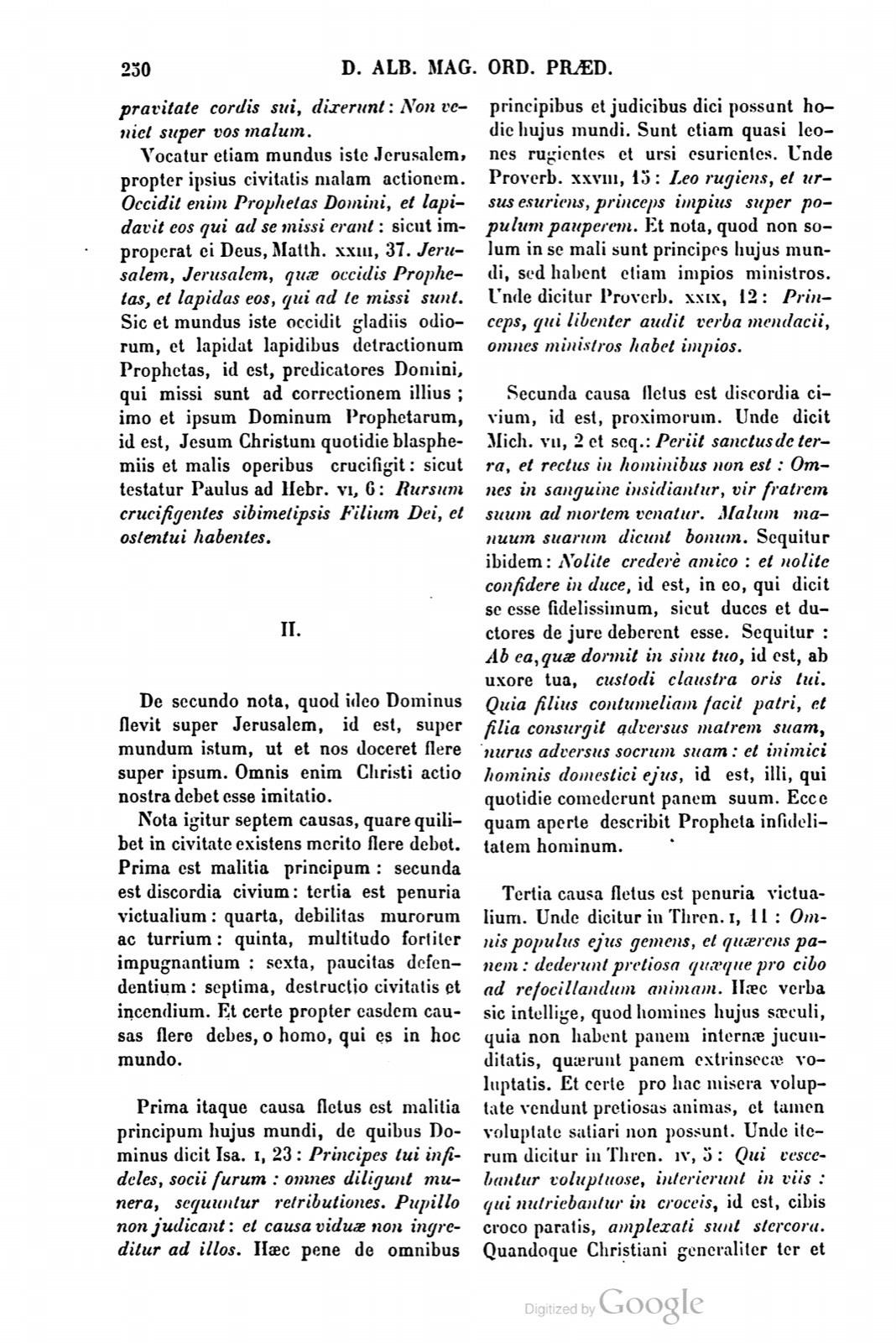
II.
De secundo nota, quod ideo Dominus flevit super Jerusalem, id est, super mundum istum, ut et nos doceret flere super ipsum. Omnis enim Christi actio nostra debet esse imitatio.
Nota igitur septem causas, quare quilibet in civitate existens merito flere debet. Prima est malitia principum: secunda est discordia civium: tertia est penuria victualium: quarta, debilitas murorum ac turrium: quinta, multitudo fortiter impugnantium: sexta, paucitas defendentium: septima, destructio civitatis et incendium. Et certe propter easdem causas flere debes, o homo, qui es in hoc mundo.
Prima itaque causa fletus est malitia principum hujus mundi, de quibus Dominus dicit Isa. I, 23: Principes tui infideles, socii furum: omnes diligunt munera, sequuntur retributiones. Pupillo non judicant: et causa viduae non ingreditur ad illos. Haec pene de omnibus principibus et judicibus dici possunt hodie hujus mundi. Sunt etiam quasi leones rugientes et ursi esurientes. Unde Proverb. XXVIII, 15: Leo rugiens, et ursus esuriens, princeps impius super populum pauperem. Et nota, quod non solum in se mali sunt principes hujus mundi, sed habent etiam impios ministros. Unde dicitur Proverb. XXIX, 12: Princeps, qui libenter audit verba mendacii, omnes ministros habet impios.
SERMON LXIV.
ON THE TENTH SUNDAY AFTER TRINITY.
Seeing the city Jerusalem, Jesus wept over it, saying: because if you also had known. Luke XIX, 41 and 42.
If you had known, "the Gloss: the ruin which threatens;" you also, the Gloss: "would weep." In the words set before us two things are to be noted:
I. What is understood by the city Jerusalem, over which the Lord wept? II. Why is the Lord said to have wept over it?
I.
Concerning the first, note that by the city Jerusalem in this place the world is understood, both because of the interpretation of the name and also because of the evil action of that city itself. For Jerusalem is interpreted vision of peace, and certainly this world sees a false peace, but nevertheless there will be no peace for it. For the lovers of this world say: Whatever we have done, the Lord will not damn us; for he would not have suffered for us if he had wished to destroy us. Behold, they promise peace to their iniquities, although Isaiah XLVIII, 22 says: There is no peace for the impious, says the Lord. Since also Psalm LVIII, 6 says: Do not have mercy on all who finally work iniquity. Hence also the Lord speaks through Jeremiah XXIII, 16, 17: Do not hear the words of the Prophets who deceive you.... They say to these who blaspheme me: The Lord has spoken: Peace will be yours; and to everyone who walks in the depravity of his heart, they have said: Evil will not come upon you.
This world is also called Jerusalem because of the evil action of that city itself. For it killed the Prophets of the Lord and stoned those who had been sent to it, just as God reproaches it, Matthew XXIII, 37: Jerusalem, Jerusalem, you who kill the Prophets and stone those who have been sent to you. So also this world kills with the swords of hatreds, and stones with the stones of detractions, the Prophets, that is, the preachers of the Lord, who have been sent for its correction; indeed it also crucifies daily, by blasphemies and evil works, the very Lord of the Prophets, that is, Jesus Christ, as Paul testifies at Hebrews VI, 6: Again crucifying to themselves the Son of God, and holding him up to contempt.
II.
Concerning the second, note that therefore the Lord wept over Jerusalem, that is, over this world, so that he might teach us also to weep over it. For every action of Christ ought to be our imitation.
Therefore note seven causes why anyone existing in the city deservedly ought to weep. The first is the malice of rulers; the second is the discord of citizens; the third is the lack of provisions; the fourth, weakness of walls and towers; the fifth, the multitude of those strongly attacking; the sixth, the fewness of defenders; the seventh, destruction of the city and burning. And certainly for the same causes you ought to weep, O human being, who are in this world.
Therefore the first cause of weeping is the malice of the rulers of this world, concerning whom the Lord says, Isaiah I, 23: Your rulers are unfaithful, companions of thieves; all love gifts, follow repayments. They do not judge for the orphan, and the cause of the widow does not enter to them. These things can be said today almost of all rulers and judges of this world. They are also like roaring lions and hungry bears. Hence Proverbs XXVIII, 15: A roaring lion and a hungry bear, an impious ruler over a poor people. And note that the rulers of this world are not only evil in themselves, but they also have impious ministers. Hence it is said in Proverbs XXIX, 12: A ruler who freely hears words of lying has all his ministers impious.
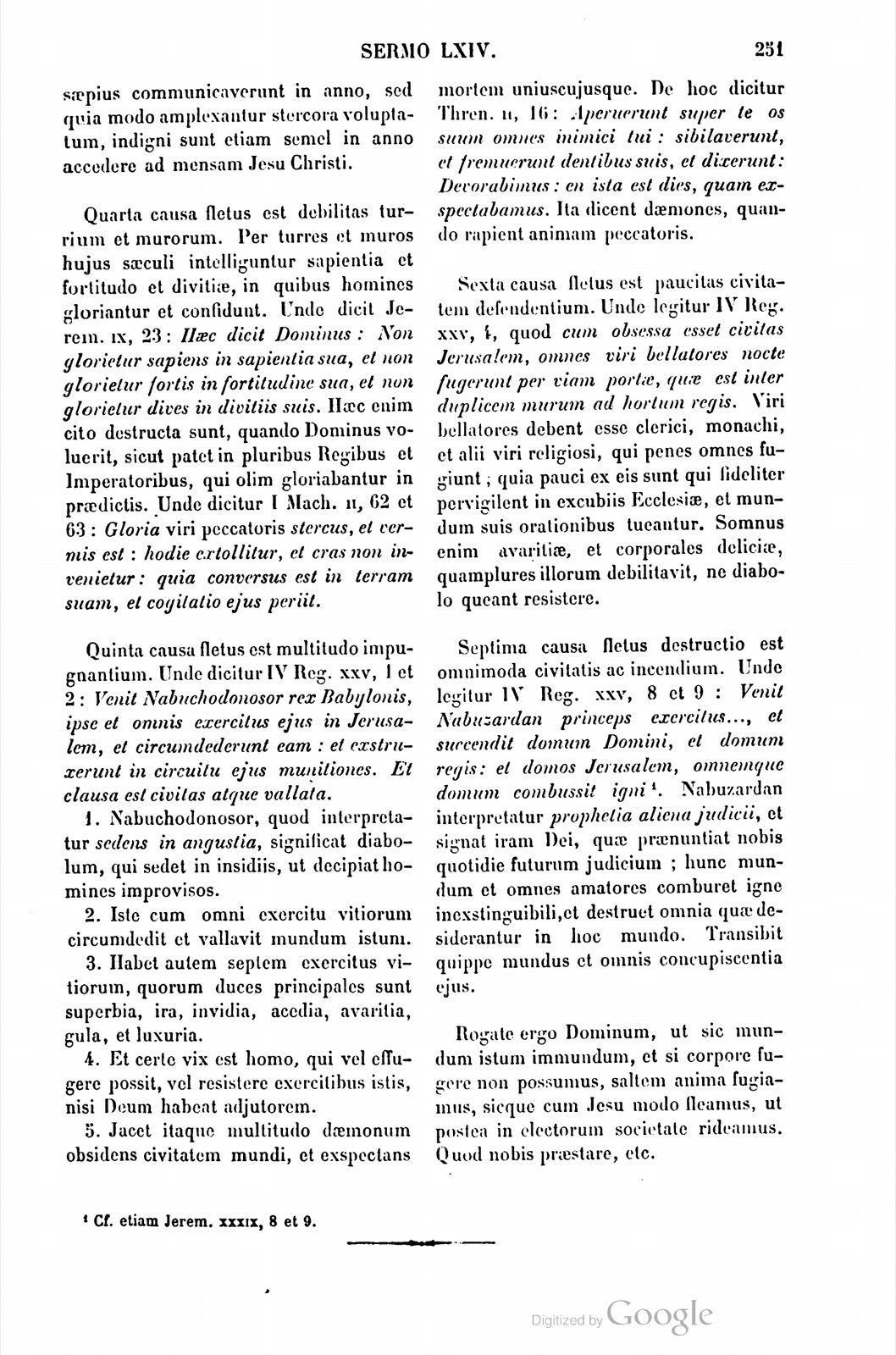
Secunda causa fletus est discordia civium, id est, proximorum. Unde dicit Mich. VII, 2 et seq.: Periit sanctus de terra, et rectus in hominibus non est: Omnes in sanguine insidiantur, vir fratrem suum ad mortem venatur. Malum manuum suarum dicunt bonum. Sequitur ibidem: Nolite credere amico: et nolite confidere in duce, id est, in eo, qui dicit se esse fidelissimum, sicut duces et ductores de jure deberent esse. Sequitur: Ab ea, quae dormit in sinu tuo, id est, ab uxore tua, custodi claustra oris tui. Quia filius contumeliam facit patri, et filia consurgit adversus matrem suam, nurus adversus socrum suam: et inimici hominis domestici ejus, id est, illi, qui quotidie comederunt panem suum. Ecce quam aperte describit Propheta infidelitatem hominum.
Tertia causa fletus est penuria victualium. Unde dicitur in Thren. I, 11: Omnis populus ejus gemens, et quaerens panem: dederunt pretiosa quaeque pro cibo ad refocillandum animam. Haec verba sic intellige, quod homines hujus saeculi, quia non habent panem internae jucunditatis, quaerunt panem extrinsecae voluptatis. Et certe pro hac misera voluptate vendunt pretiosas animas, et tamen voluptate satiari non possunt. Unde iterum dicitur in Thren. IV, 5: Qui vescebantur voluptuose, interierunt in viis: qui nutriebantur in croceis, id est, cibis croco paratis, amplexati sunt stercora. Quandoque Christiani generaliter ter et saepius communicaverunt in anno, sed quia modo amplexantur stercora voluptatum, indigni sunt etiam semel in anno accedere ad mensam Jesu Christi.
Quarta causa fletus est debilitas turrium et murorum. Per turres et muros hujus saeculi intelliguntur sapientia et fortitudo et divitiae, in quibus homines gloriantur et confidunt. Unde dicit Jerem. IX, 23: Haec dicit Dominus: Non glorietur sapiens in sapientia sua, et non glorietur fortis in fortitudine sua, et non glorietur dives in divitiis suis. Haec enim cito destructa sunt, quando Dominus voluerit, sicut patet in pluribus Regibus et Imperatoribus, qui olim gloriabantur in praedictis. Unde dicitur I Mach. II, 62 et 63: Gloria viri peccatoris stercus, et vermis est: hodie extollitur, et cras non invenietur: quia conversus est in terram suam, et cogitatio ejus periit.
The second cause of weeping is the discord of citizens, that is, of neighbors. Hence Micah VII, 2 and following says: The holy one has perished from the earth, and there is no upright one among human beings; all lie in wait in blood; a man hunts his brother to death. They call the evil of their hands good. It follows in the same place: Do not believe a friend, and do not trust in a leader, that is, in him who says that he is most faithful, just as leaders and conductors by right ought to be. It follows: From her who sleeps in your bosom, that is, from your wife, guard the closures of your mouth. Because a son does insult to his father, and a daughter rises up against her mother, a daughter-in-law against her mother-in-law; and a man's enemies are his household members, that is, those who daily ate his bread. Behold how openly the Prophet describes the faithlessness of human beings.
The third cause of weeping is lack of provisions. Hence it is said in Lamentations I, 11: All its people groaning and seeking bread; they gave each precious thing for food to refresh the soul. Understand these words thus: that human beings of this age, because they do not have the bread of inward delight, seek the bread of outward pleasure. And certainly for this miserable pleasure they sell precious souls, and nevertheless they cannot be satisfied by pleasure. Hence again it is said in Lamentations IV, 5: Those who fed luxuriously perished in the ways; those who were nourished in saffron, that is, in foods prepared with saffron, embraced dung. Once Christians generally communicated three times and more often in the year; but because now they embrace the dung of pleasures, they are unworthy even once in the year to approach the table of Jesus Christ.
The fourth cause of weeping is the weakness of towers and walls. By the towers and walls of this age are understood wisdom and strength and riches, in which human beings glory and trust. Hence Jeremiah IX, 23 says: Thus says the Lord: Let not the wise man glory in his wisdom, and let not the strong man glory in his strength, and let not the rich man glory in his riches. For these things are quickly destroyed, when the Lord shall have wished, as is clear in many Kings and Emperors who once gloried in the aforesaid things. Hence it is said in I Maccabees II, 62 and 63: The glory of a sinful man is dung and a worm: today he is lifted up, and tomorrow he will not be found, because he has been turned into his earth, and his thought has perished.
Quinta causa fletus est multitudo impugnantium. Unde dicitur IV Reg. XXV, 1 et 2: Venit Nabuchodonosor rex Babylonis, ipse et omnis exercitus ejus in Jerusalem, et circumdederunt eam: et exstruxerunt in circuitu ejus munitiones. Et clausa est civitas atque vallata.
1. Nabuchodonosor, quod interpretatur sedens in angustia, significat diabolum, qui sedet in insidiis, ut decipiat homines improvisos.
2. Iste cum omni exercitu vitiorum circumdedit et vallavit mundum istum.
3. Habet autem septem exercitus vitiorum, quorum duces principales sunt superbia, ira, invidia, acedia, avaritia, gula, et luxuria.
4. Et certe vix est homo, qui vel effugere possit, vel resistere exercitibus istis, nisi Deum habeat adjutorem.
5. Jacet itaque multitudo daemonum obsidens civitatem mundi, et exspectans mortem uniuscujusque. De hoc dicitur Thren. II, 16: Aperuerunt super te os suum omnes inimici tui: sibilaverunt, et fremuerunt dentibus suis, et dixerunt: Devorabimus: en ista est dies, quam exspectabamus. Ita dicent daemones, quando rapient animam peccatoris.
Sexta causa fletus est paucitas civitatem defendentium. Unde legitur IV Reg. XXV, 4, quod cum obsessa esset civitas Jerusalem, omnes viri bellatores nocte fugerunt per viam portae, quae est inter duplicem murum ad hortum regis. Viri bellatores debent esse clerici, monachi, et alii viri religiosi, qui penes omnes fugiunt; quia pauci ex eis sunt qui fideliter pervigilent in excubiis Ecclesiae, et mundum suis orationibus tueantur. Somnus enim avaritiae, et corporales deliciae, quamplures illorum debilitavit, ne diabolo queant resistere.
Septima causa fletus destructio est omnimoda civitatis ac incendium. Unde legitur IV Reg. XXV, 8 et 9: Venit Nabuzardan princeps exercitus..., et succendit domum Domini, et domum regis: et domos Jerusalem, omnemque domum combussit igni 1. Nabuzardan interpretatur prophetia aliena judicii, et signat iram Dei, quae praenuntiat nobis quotidie futurum judicium; hunc mundum et omnes amatores comburet igne inexstinguibili, et destruet omnia quae desiderantur in hoc mundo. Transibit quippe mundus et omnis concupiscentia ejus.
Rogate ergo Dominum, ut sic mundum istum immundum, et si corpore fugere non possumus, saltem anima fugiamus, sicque cum Jesu modo fleamus, ut postea in electorum societate rideamus. Quod nobis praestare, etc.
The fifth cause of weeping is the multitude of those attacking. Hence it is said in IV Kings XXV, 1 and 2: Nabuchodonosor king of Babylon came, he and all his army, into Jerusalem, and they surrounded it, and they built fortifications around it. And the city was closed and walled in.
1. Nabuchodonosor, which is interpreted sitting in distress, signifies the devil, who sits in ambush so that he may deceive unwary human beings.
2. He with every army of vices has surrounded and walled in this world.
3. But he has seven armies of vices, whose principal leaders are pride, anger, envy, acedia, avarice, gluttony, and lust.
4. And certainly there is hardly a human being who can either flee or resist those armies, unless he has God as helper.
5. Therefore the multitude of demons lies besieging the city of the world, and awaiting the death of each one. Concerning this it is said in Lamentations II, 16: All your enemies opened their mouth over you; they hissed and gnashed with their teeth, and said: We will devour; behold, this is the day which we were awaiting. Thus the demons will say when they seize the soul of the sinner.
The sixth cause of weeping is the fewness of those defending the city. Hence it is read in IV Kings XXV, 4, that when the city Jerusalem had been besieged, all the fighting men fled by night through the way of the gate that is between the double wall toward the garden of the king. The fighting men ought to be clerics, monks, and other religious men, who flee among all; because there are few from them who keep watch faithfully in the watches of the Church and protect the world by their prayers. For the sleep of avarice and bodily delights have weakened very many of them, so that they cannot resist the devil.
The seventh cause of weeping is the complete destruction and burning of the city. Hence it is read in IV Kings XXV, 8 and 9: Nabuzardan, the prince of the army, came..., and he burned the house of the Lord and the house of the king; and the houses of Jerusalem, and every house, he burned with fire 1. Nabuzardan is interpreted alien prophecy of judgment, and signifies the wrath of God, which daily foretells to us the future judgment; it will burn this world and all its lovers with inextinguishable fire, and will destroy all things that are desired in this world. For the world and all its concupiscence will pass away.
Therefore ask the Lord that we may so flee this unclean world, and if we cannot flee with the body, at least let us flee with the soul, and so now weep with Jesus, that afterward we may laugh in the company of the elect. May he grant this to us, etc.
Notes
- Compare also Jeremiah XXXIX, 8 and 9. (Cf. etiam Jerem. XXXIX, 8 et 9.) ↩
If a page does not appear, its photograph has not been uploaded yet.