Works › Sermons for the Seasons of the Year
Volume 13 · pp. 245–248
Sermon LXIII. On the Ninth Sunday After Trinity
A marker with ≈ is an approximate page boundary, placed by measure of the text; the page photographs remain the authority. In the paired views, clicking a page marker brings that page into view.
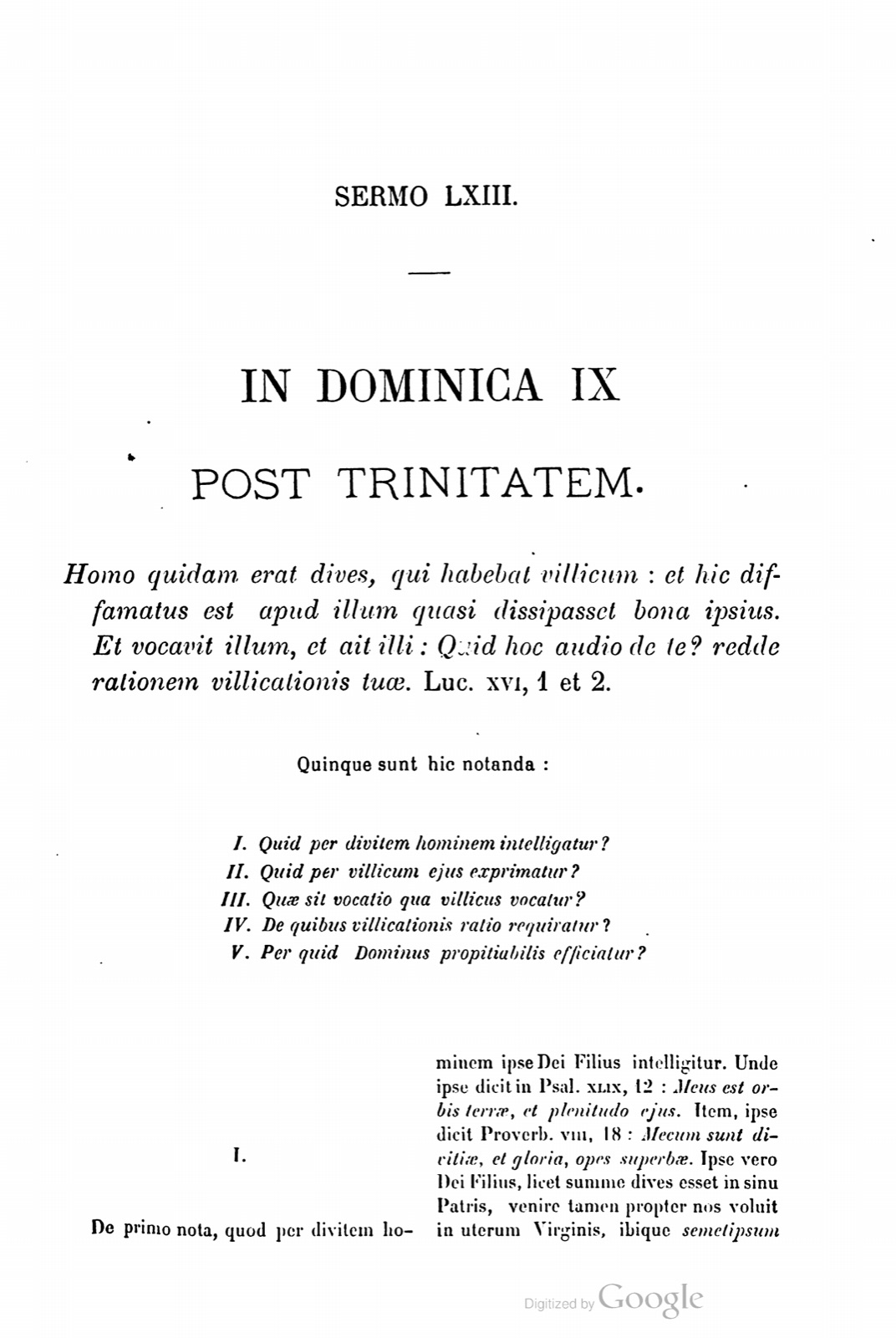
SERMO LXIII.
IN DOMINICA IX POST TRINITATEM.
Homo quidam erat dives, qui habebat villicum: et hic diffamatus est apud illum quasi dissipasset bona ipsius. Et vocavit illum, et ait illi: Quid hoc audio de te? redde rationem villicationis tuae. Luc. XVI, 1 et 2.
Quinque sunt hic notanda:
I. Quid per divitem hominem intelligatur? II. Quid per villicum ejus exprimatur? III. Quae sit vocatio qua villicus vocatur? IV. De quibus villicationis ratio requiratur? V. Per quid Dominus propitiabilis efficiatur?
I.
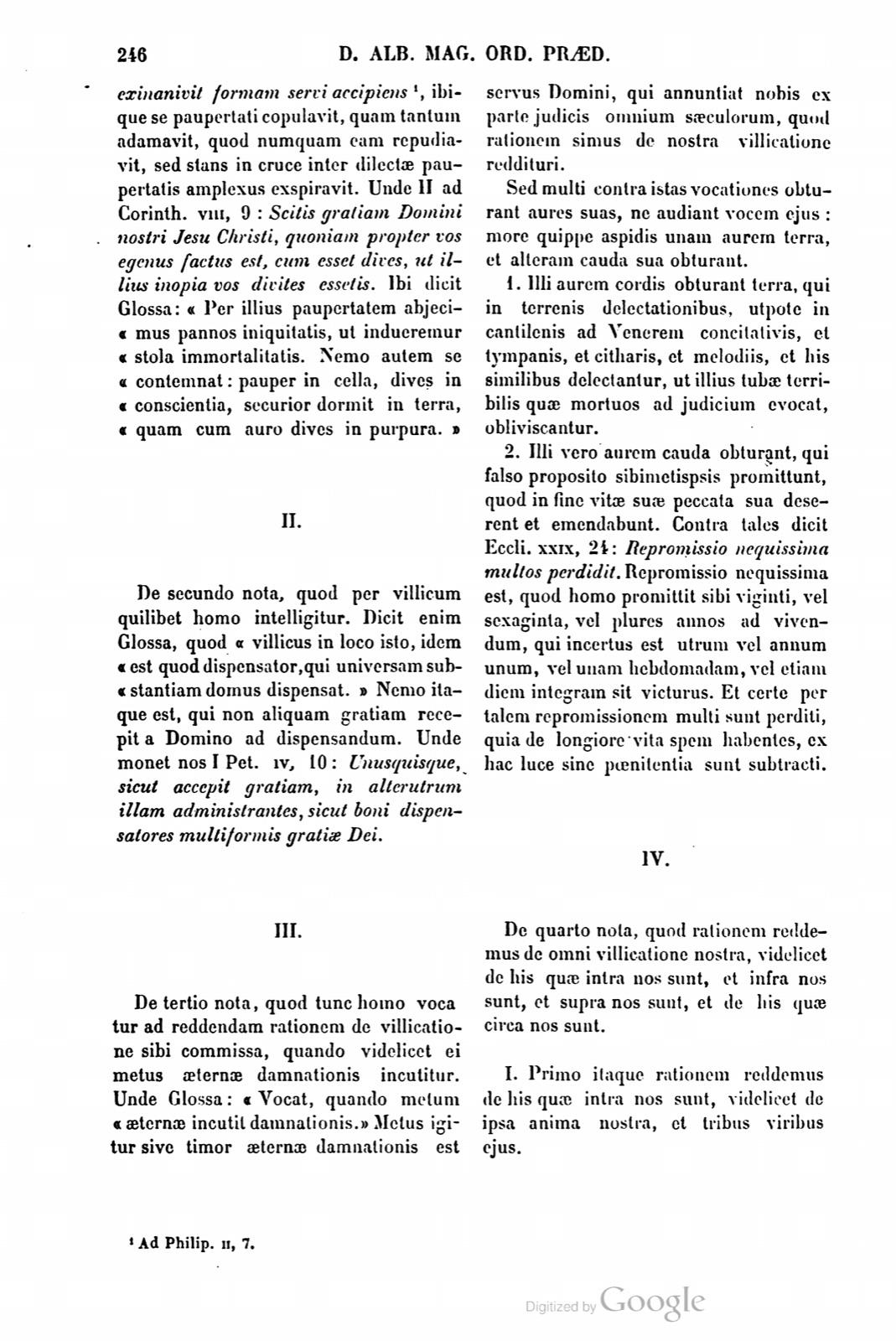
De primo nota, quod per divitem hominem ipse Dei Filius intelligitur. Unde ipse dicit in Psal. XLIX, 12: Meus est orbis terrae, et plenitudo ejus. Item, ipse dicit Proverb. VI, 18: Mecum sunt divitiae, et gloria, opes superbae. Ipse vero Dei Filius, licet summe dives esset in sinu Patris, venire tamen propter nos voluit in uterum Virginis, ibique semetipsum exinanivit formam servi accipiens 1, ibique se paupertati copulavit, quam tantum adamavit, quod numquam eam repudiavit, sed stans in cruce inter dilectae paupertatis amplexus exspiravit. Unde II ad Corinth. VIII, 9: Scitis gratiam Domini nostri Jesu Christi, quoniam propter vos egenus factus est, cum esset dives, ut illius inopia vos divites essetis. Ibi dicit Glossa: "Per illius paupertatem abjecimus pannos iniquitatis, ut indueremur stola immortalitatis. Nemo autem se contemnat: pauper in cella, dives in conscientia, securior dormit in terra, quam cum auro dives in purpura."
II.
De secundo nota, quod per villicum quilibet homo intelligitur. Dicit enim Glossa, quod "villicus in loco isto, idem est quod dispensator, qui universam substantiam domus dispensat." Nemo itaque est, qui non aliquam gratiam recepit a Domino ad dispensandum. Unde monet nos I Pet. IV, 10: Unusquisque, sicut accepit gratiam, in alterutrum illam administrantes, sicut boni dispensatores multiformis gratiae Dei.
III.
De tertio nota, quod tunc homo vocatur ad reddendam rationem de villicatione sibi commissa, quando videlicet ei metus aeternae damnationis incutitur. Unde Glossa: "Vocat, quando metum aeternae incutit damnationis." Metus igitur sive timor aeternae damnationis est servus Domini, qui annuntiat nobis ex parte judicis omnium saeculorum, quod rationem simus de nostra villicatione reddituri.
SERMON LXIII.
ON THE NINTH SUNDAY AFTER TRINITY.
There was a certain rich man who had a steward; and this man was reported to him as if he had dissipated his goods. And he called him and said to him: What is this that I hear about you? Render an account of your stewardship. Luke XVI, 1 and 2.
Five things are to be noted here:
I. What is understood by the rich man? II. What is expressed by his steward? III. What is the calling by which the steward is called? IV. Concerning what things is the account of stewardship required? V. Through what is the Lord made propitiable?
I.
Concerning the first, note that by the rich man the Son of God himself is understood. Hence he himself says in Psalm XLIX, 12: The world of the earth is mine, and its fullness. Likewise, he himself says in Proverbs VI, 18: With me are riches and glory, proud wealth. But the Son of God himself, although he was supremely rich in the bosom of the Father, nevertheless wished for our sake to come into the womb of the Virgin, and there emptied himself, taking the form of a servant 1, and there joined himself to poverty, which he loved so much that he never repudiated it, but standing on the cross among the embraces of beloved poverty he breathed out. Hence II Corinthians VIII, 9: You know the grace of our Lord Jesus Christ, because for your sake he became poor, though he was rich, so that by his poverty you might be rich. There the Gloss says: "Through his poverty we cast off the rags of iniquity, so that we might be clothed with the robe of immortality. But let no one despise himself: poor in a cell, rich in conscience, he sleeps more secure on the ground than a rich man with gold in purple."
II.
Concerning the second, note that by the steward any human being is understood. For the Gloss says that "steward in this place is the same as dispenser, who dispenses the whole substance of the house." Therefore there is no one who has not received some grace from the Lord to dispense. Hence I Peter IV, 10 admonishes us: Each one, just as he has received grace, administering it to one another, as good dispensers of the manifold grace of God.
III.
Concerning the third, note that then a human being is called to render an account concerning the stewardship committed to him, when, namely, fear of eternal damnation is struck into him. Hence the Gloss: "He calls, when he strikes in fear of eternal damnation." Therefore dread or fear of eternal damnation is the servant of the Lord, who announces to us on behalf of the judge of all ages that we are to render an account concerning our stewardship.
Sed multi contra istas vocationes obturant aures suas, ne audiant vocem ejus: more quippe aspidis unam aurem terra, et alteram cauda sua obturant.
1. Illi aurem cordis obturant terra, qui in terrenis delectationibus, utpote in cantilenis ad Venerem concitativis, et tympanis, et citharis, et melodiis, et his similibus delectantur, ut illius tubae terribilis quae mortuos ad judicium evocat, obliviscantur.
2. Illi vero aurem cauda obturant, qui falso proposito sibimetispsis promittunt, quod in fine vitae suae peccata sua deserent et emendabunt. Contra tales dicit Eccli. XXIX, 24: Repromissio nequissima multos perdidit. Repromissio nequissima est, quod homo promittit sibi viginti, vel sexaginta, vel plures annos ad vivendum, qui incertus est utrum vel annum unum, vel unam hebdomadam, vel etiam diem integram sit victurus. Et certe per talem repromissionem multi sunt perditi, quia de longiore vita spem habentes, ex hac luce sine paenitentia sunt subtracti.
IV.
De quarto nota, quod rationem reddemus de omni villicatione nostra, videlicet de his quae intra nos sunt, et infra nos sunt, et supra nos sunt, et de his quae circa nos sunt.
I. Primo itaque rationem reddemus de his quae intra nos sunt, videlicet de ipsa anima nostra, et tribus viribus ejus.
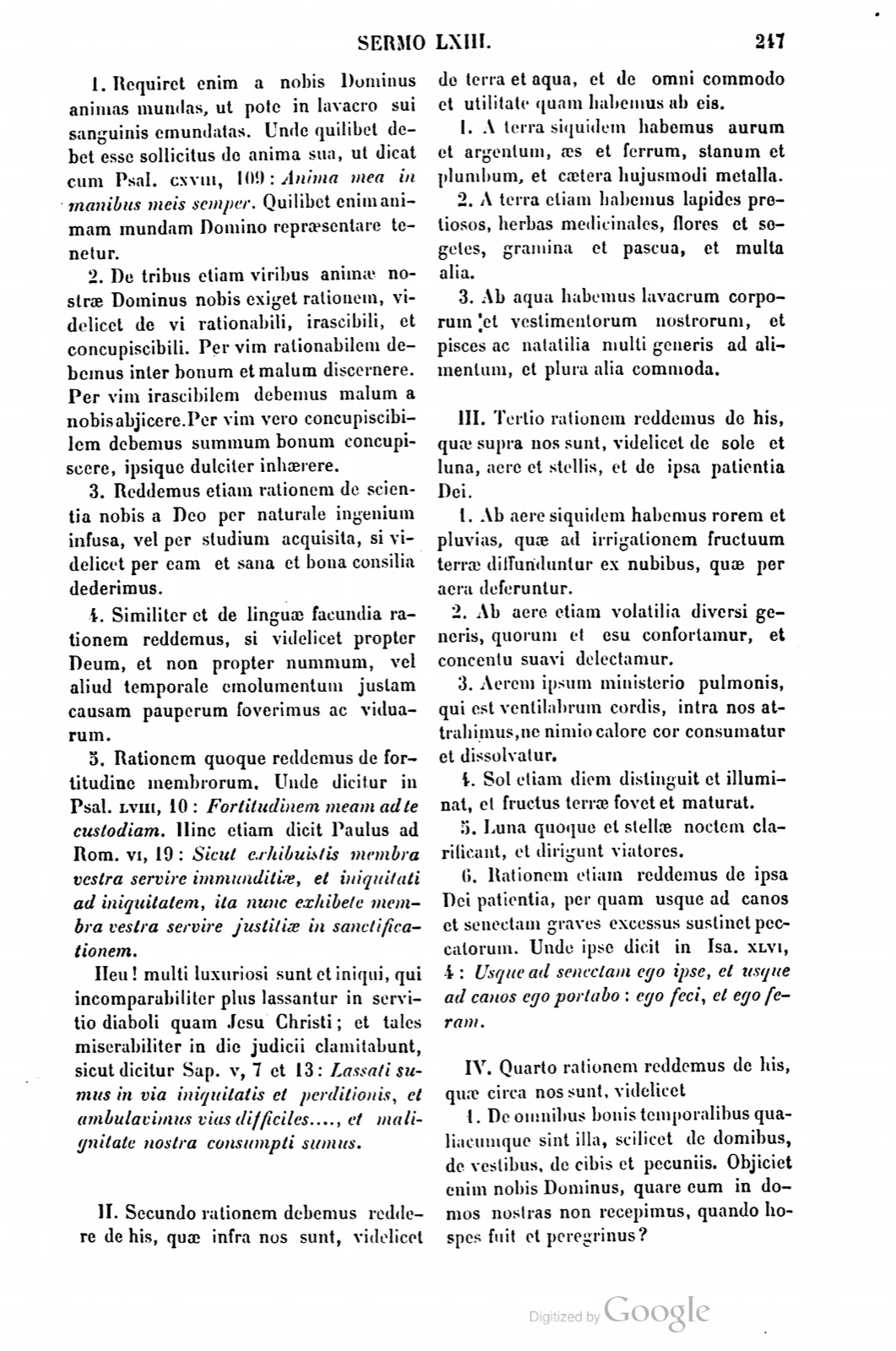
1. Requiret enim a nobis Dominus animas mundas, ut pote in lavacro sui sanguinis emundatas. Unde quilibet debet esse sollicitus de anima sua, ut dicat cum Psal. CXVIII, 109: Anima mea in manibus meis semper. Quilibet enim animam mundam Domino repraesentare tenetur.
2. De tribus etiam viribus animae nostrae Dominus nobis exiget rationem, videlicet de vi rationabili, irascibili, et concupiscibili. Per vim rationabilem debemus inter bonum et malum discernere. Per vim irascibilem debemus malum a nobis abjicere. Per vim vero concupiscibilem debemus summum bonum concupiscere, ipsique dulciter inhaerere.
3. Reddemus etiam rationem de scientia nobis a Deo per naturale ingenium infusa, vel per studium acquisita, si videlicet per eam et sana et bona consilia dederimus.
4. Similiter et de linguae facundia rationem reddemus, si videlicet propter Deum, et non propter nummum, vel aliud temporale emolumentum justam causam pauperum foverimus ac viduarum.
But many stop their ears against these callings, lest they hear his voice: for after the manner of the asp they stop one ear with earth and the other with their tail.
1. Those stop the ear of the heart with earth who delight in earthly delights, as for instance in songs provocative toward Venus, and drums, and lyres, and melodies, and things similar to these, so that they may forget that terrible trumpet which calls the dead to judgment.
2. But those stop the ear with the tail who, with a false resolve, promise themselves that at the end of their life they will abandon and amend their sins. Against such persons Ecclesiasticus XXIX, 24 says: A most wicked promise has destroyed many. A most wicked promise is that a human being promises himself twenty or sixty or more years for living, though he is uncertain whether he will live even one year, or one week, or even one whole day. And certainly through such a promise many have been destroyed, because, having hope concerning a longer life, they have been taken from this light without repentance.
IV.
Concerning the fourth, note that we will render an account concerning every stewardship of ours, namely concerning those things that are within us, and are below us, and are above us, and concerning those things that are around us.
I. Therefore first we will render an account concerning those things that are within us, namely concerning our soul itself and its three powers.
1. For the Lord will require from us clean souls, as being cleansed in the bath of his blood. Hence anyone ought to be solicitous concerning his soul, so that he may say with Psalm CXVIII, 109: My soul is always in my hands. For anyone is bound to present a clean soul to the Lord.
2. The Lord will also demand an account from us concerning the three powers of our soul, namely concerning the rational, irascible, and concupiscible power. Through the rational power we ought to discern between good and evil. Through the irascible power we ought to cast evil away from us. But through the concupiscible power we ought to desire the highest good and sweetly cling to it.
3. We will also render an account concerning knowledge infused into us by God through natural ability, or acquired through study, if, namely, through it we have given both sound and good counsels.
4. Likewise also concerning eloquence of tongue we will render an account, if, namely, for God's sake, and not for money or some other temporal advantage, we have supported the just cause of the poor and of widows.
5. Rationem quoque reddemus de fortitudine membrorum. Unde dicitur in Psal. LVIII, 10: Fortitudinem meam ad te custodiam. Hinc etiam dicit Paulus ad Rom. VI, 19: Sicut exhibuistis membra vestra servire immunditiae, et iniquitati ad iniquitatem, ita nunc exhibete membra vestra servire justitiae in sanctificationem.
Heu! multi luxuriosi sunt et iniqui, qui incomparabiliter plus lassantur in servitio diaboli quam Jesu Christi; et tales miserabiliter in die judicii clamitabunt, sicut dicitur Sap. V, 7 et 13: Lassati sumus in via iniquitatis et perditionis, et ambulavimus vias difficiles...., et malignitate nostra consumpti sumus.
II. Secundo rationem debemus reddere de his, quae infra nos sunt, videlicet de terra et aqua, et de omni commodo et utilitate quam habemus ab eis.
1. A terra siquidem habemus aurum et argentum, aes et ferrum, stanum et plumbum, et caetera hujusmodi metalla.
2. A terra etiam habemus lapides pretiosos, herbas medicinales, flores et segetes, gramina et pascua, et multa alia.
3. Ab aqua habemus lavacrum corporum et vestimentorum nostrorum, et pisces ac natatilia multi generis ad alimentum, et plura alia commoda.
III. Tertio rationem reddemus de his, quae supra nos sunt, videlicet de sole et luna, aere et stellis, et de ipsa patientia Dei.
1. Ab aere siquidem habemus rorem et pluvias, quae ad irrigationem fructuum terrae diffunduntur ex nubibus, quae per aera deferuntur.
2. Ab aere etiam volatilia diversi generis, quorum et esu confortamur, et concentu suavi delectamur.
3. Aerem ipsum ministerio pulmonis, qui est ventilabrum cordis, intra nos attrahimus, ne nimio calore cor consumatur et dissolvatur.
4. Sol etiam diem distinguit et illuminat, et fructus terrae fovet et maturat.
5. Luna quoque et stellae noctem clarificant, et dirigunt viatores.
6. Rationem etiam reddemus de ipsa Dei patientia, per quam usque ad canos et senectam graves excessus sustinet peccatorum. Unde ipse dicit in Isa. XLVI, 4: Usque ad senectam ego ipse, et usque ad canos ego portabo: ego feci, et ego feram.
IV. Quarto rationem reddemus de his, quae circa nos sunt, videlicet
1. De omnibus bonis temporalibus qualiacumque sint illa, scilicet de domibus, de vestibus, de cibis et pecuniis. Objiciet enim nobis Dominus, quare eum in domos nostras non recepimus, quando hospes fuit et peregrinus?
5. We will also render an account concerning the strength of our members. Hence it is said in Psalm LVIII, 10: I will guard my strength for you. Hence Paul also says in Romans VI, 19: As you presented your members to serve uncleanness, and iniquity unto iniquity, so now present your members to serve justice unto sanctification.
Alas! many lustful and unjust persons are incomparably more wearied in the service of the devil than of Jesus Christ; and such persons will cry out miserably on the day of judgment, as is said in Wisdom V, 7 and 13: We have been wearied in the way of iniquity and perdition, and we have walked difficult ways...., and we have been consumed by our malice.
II. Second, we ought to render an account concerning those things that are below us, namely concerning earth and water, and concerning every convenience and usefulness that we have from them.
1. From the earth indeed we have gold and silver, bronze and iron, tin and lead, and other metals of this sort.
2. From the earth also we have precious stones, medicinal herbs, flowers and crops, grasses and pastures, and many other things.
3. From water we have the washing of our bodies and of our garments, and fish and swimming things of many kinds for food, and many other conveniences.
III. Third, we will render an account concerning those things that are above us, namely concerning the sun and moon, air and stars, and concerning the very patience of God.
1. From the air indeed we have dew and rains, which are poured out from the clouds for the watering of the fruits of the earth, and the clouds are borne through the air.
2. From the air also we have winged creatures of diverse kinds, by whose eating we are strengthened and by whose sweet song we are delighted.
3. We draw the air itself within us by the service of the lung, which is the fan of the heart, lest by too much heat the heart be consumed and dissolved.
4. The sun also distinguishes and illuminates the day, and fosters and matures the fruits of the earth.
5. The moon also and the stars make the night clear and direct travelers.
6. We will also render an account concerning the very patience of God, through which he endures the grave excesses of sinners even to white hairs and old age. Hence he himself says in Isaiah XLVI, 4: Even to old age I am he, and even to white hairs I will carry: I have made, and I will bear.
IV. Fourth, we will render an account concerning those things that are around us, namely
1. Concerning all temporal goods, of whatever sort they may be, namely concerning houses, concerning garments, concerning foods and monies. For the Lord will object to us why we did not receive him into our houses when he was a guest and a pilgrim.
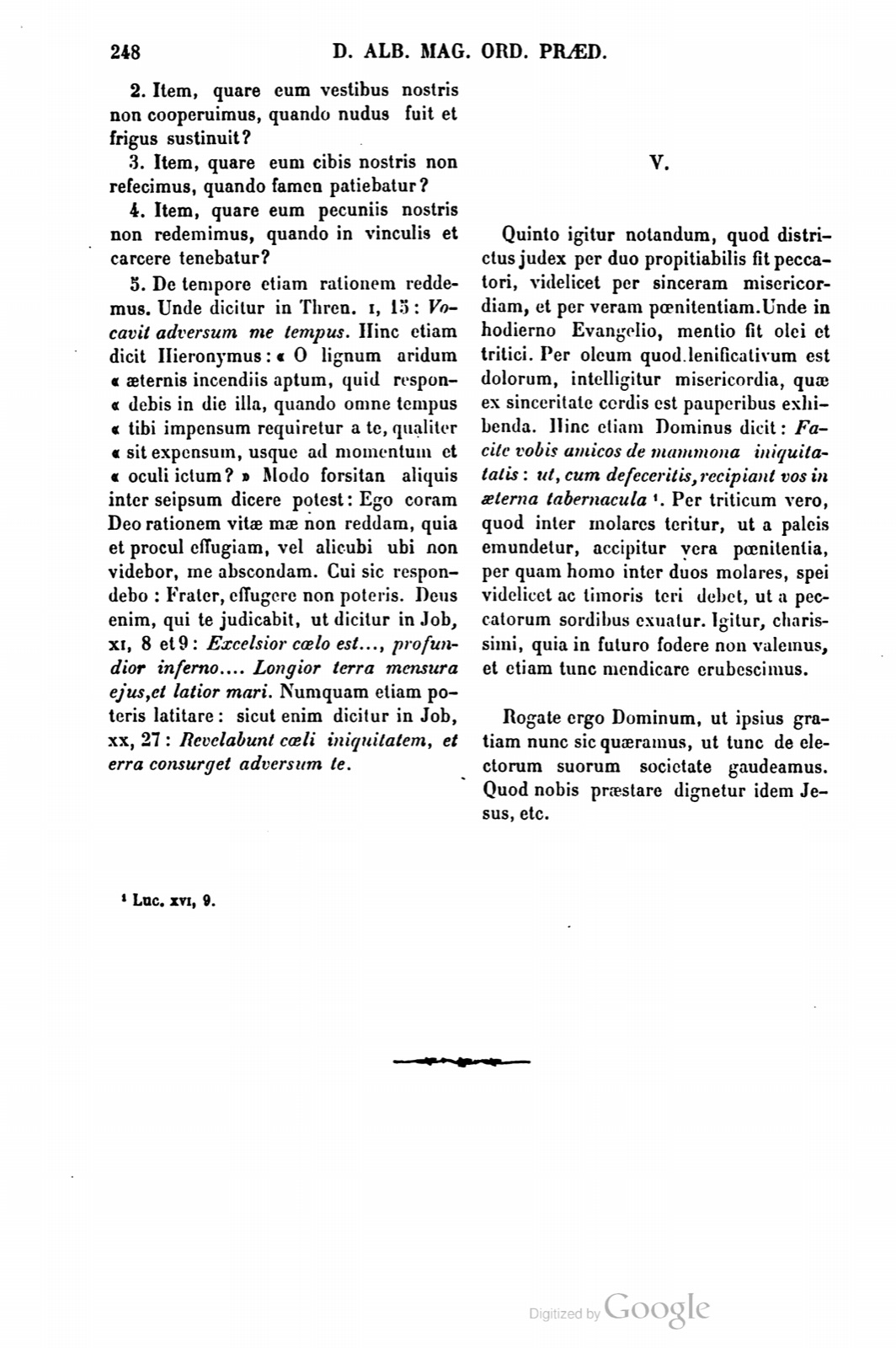
2. Item, quare eum vestibus nostris non cooperuimus, quando nudus fuit et frigus sustinuit?
3. Item, quare eum cibis nostris non refecimus, quando famem patiebatur?
4. Item, quare eum pecuniis nostris non redemimus, quando in vinculis et carcere tenebatur?
5. De tempore etiam rationem reddemus. Unde dicitur in Thren. I, 15: Vocavit adversum me tempus. Hinc etiam dicit Hieronymus: "O lignum aridum aeternis incendiis aptum, quid respondebis in die illa, quando omne tempus tibi impensum requiretur a te, qualiter sit expensum, usque ad momentum et oculi ictum?" Modo forsitan aliquis inter seipsum dicere potest: Ego coram Deo rationem vitae meae non reddam, quia et procul effugiam, vel alicubi ubi non videbor, me abscondam. Cui sic respondebo: Frater, effugere non poteris. Deus enim, qui te judicabit, ut dicitur in Job, XI, 8 et 9: Excelsior caelo est..., profundior inferno.... Longior terra mensura ejus, et latior mari. Numquam etiam poteris latitare: sicut enim dicitur in Job, XX, 27: Revelabunt caeli iniquitatem, et terra consurget adversum te.
V.
Quinto igitur notandum, quod districtus judex per duo propitiabilis fit peccatori, videlicet per sinceram misericordiam, et per veram paenitentiam. Unde in hodierno Evangelio, mentio fit olei et tritici. Per oleum quod lenificativum est dolorum, intelligitur misericordia, quae ex sinceritate cordis est pauperibus exhibenda. Hinc etiam Dominus dicit: Facite vobis amicos de mammona iniquitatis: ut, cum defeceritis, recipiant vos in aeterna tabernacula 2. Per triticum vero, quod inter molares teritur, ut a paleis emundetur, accipitur vera poenitentia, per quam homo inter duos molares, spei videlicet ac timoris teri debet, ut a peccatorum sordibus exuatur. Igitur, charissimi, quia in futuro fodere non valemus, et etiam tunc mendicare erubescimus.
Rogate ergo Dominum, ut ipsius gratiam nunc sic quaeramus, ut tunc de electorum suorum societate gaudeamus. Quod nobis praestare dignetur idem Jesus, etc.
2. Likewise, why we did not cover him with our garments when he was naked and endured cold.
3. Likewise, why we did not refresh him with our foods when he was suffering hunger.
4. Likewise, why we did not redeem him with our monies when he was held in chains and prison.
5. Concerning time also we will render an account. Hence it is said in Lamentations I, 15: He has called time against me. Hence Jerome also says: "O dry wood fitted for eternal fires, what will you answer on that day when all the time spent upon you will be required from you, how it has been spent, down to a moment and the blink of an eye?" Now perhaps someone can say within himself: I will not render before God an account of my life, because I will flee far away, or I will hide myself somewhere where I will not be seen. To him I will answer thus: Brother, you will not be able to flee. For God, who will judge you, as is said in Job XI, 8 and 9, is higher than heaven..., deeper than hell.... His measure is longer than the earth and broader than the sea. Nor will you ever be able to lie hidden; for as is said in Job XX, 27: The heavens will reveal his iniquity, and the earth will rise up against you.
V.
Therefore fifth it must be noted that the strict judge is made propitiable to the sinner through two things, namely through sincere mercy and through true repentance. Hence in today's Gospel mention is made of oil and wheat. By oil, which is soothing of pains, is understood mercy, which from sincerity of heart is to be shown to the poor. Hence the Lord also says: Make friends for yourselves from the mammon of iniquity, so that, when you have failed, they may receive you into eternal tabernacles 2. But by wheat, which is ground between millstones so that it may be cleansed from chaff, true repentance is received, through which a human being ought to be ground between two millstones, namely hope and fear, so that he may be stripped from the filths of sins. Therefore, dearest ones, because in the future we are not able to dig, and also then we blush to beg.
Therefore ask the Lord that we may now so seek his grace, that then we may rejoice concerning the company of his elect. May the same Jesus deign to grant this to us, etc.
If a page does not appear, its photograph has not been uploaded yet.