Works › Sermons for the Seasons of the Year
Volume 13 · pp. 171–174
Sermon XLI. On the Fourth Sunday After Easter
A marker with ≈ is an approximate page boundary, placed by measure of the text; the page photographs remain the authority. In the paired views, clicking a page marker brings that page into view.
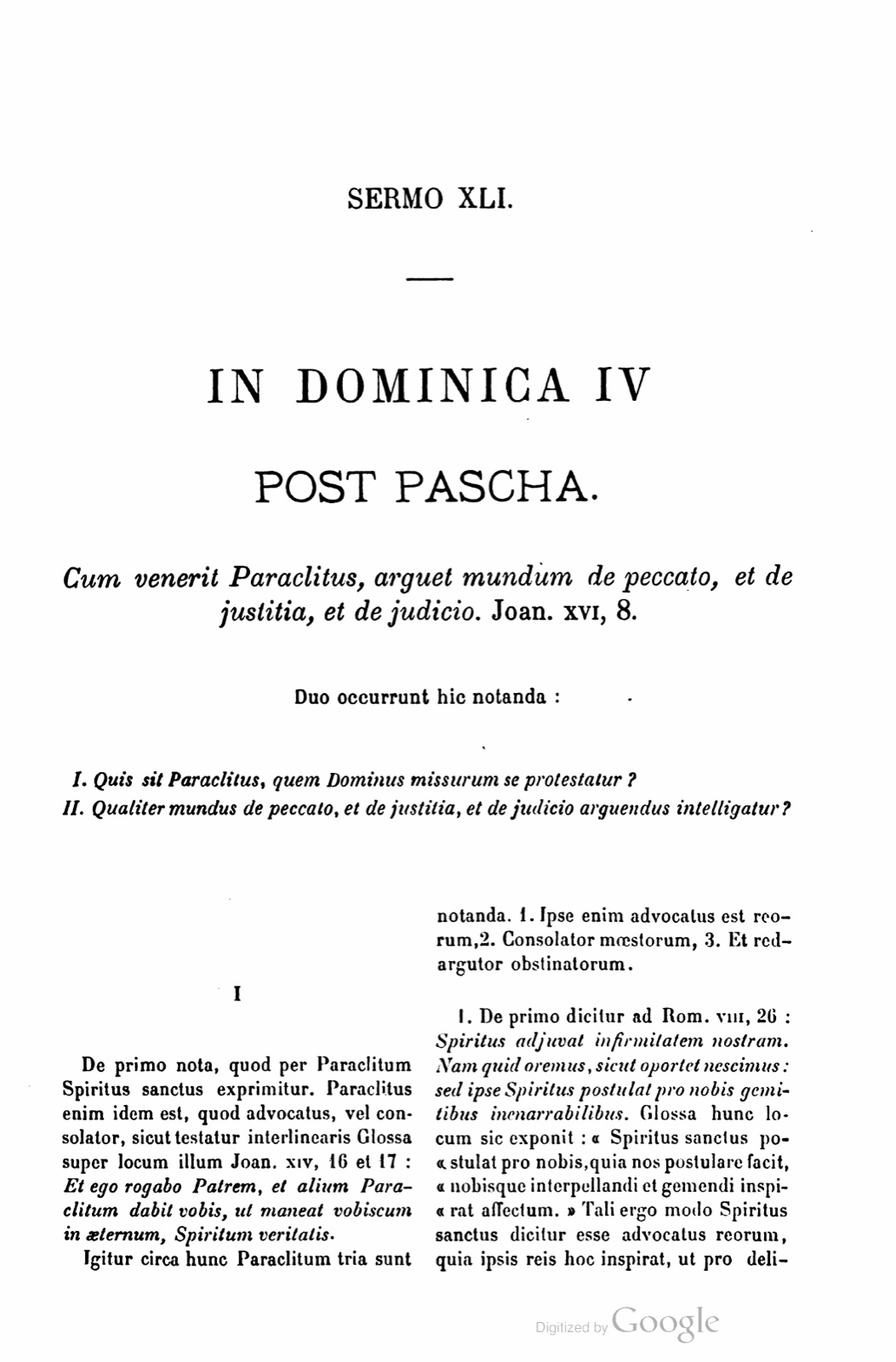
SERMO XLI. IN DOMINICA IV POST PASCHA.
Cum venerit Paraclitus, arguet mundum de peccato, et de justitia, et de judicio. Joan. xvi, 8.
Duo occurrunt hic notanda: I. Quis sit Paraclitus, quem Dominus missurum se protestatur? II. Qualiter mundus de peccato, et de justitia, et de judicio arguendus intelligatur?
I. De primo nota, quod per Paraclitum Spiritus sanctus exprimitur. Paraclitus enim idem est, quod advocatus, vel consolator, sicut testatur interlinearis Glossa super locum illum Joan. xiv, 16 et 17: Et ego rogabo Patrem, et alium Paraclitum dabit vobis, ut maneat vobiscum in æternum, Spiritum veritatis. Igitur circa hunc Paraclitum tria sunt notanda. 1. Ipse enim advocatus est reorum, 2. Consolator mæstorum, 3. Et redargutor obstinatorum.
1. De primo dicitur ad Rom. viii, 26: Spiritus adjuvat infirmitatem nostram. Nam quid oremus, sicut oportet nescimus: sed ipse Spiritus postulat pro nobis gemitibus inenarrabilibus. Glossa hunc locum sic exponit: «Spiritus sanctus postulat pro nobis, quia nos postulare facit, nobisque interpellandi et gemendi inspirat affectum.» Tali ergo modo Spiritus sanctus dicitur esse advocatus reorum, quia ipsis reis hoc inspirat, ut pro delictis suis orent, et gemitus emittant inenarrabiles.
2. De secundo cantatur in quadam Sequentia: Veni sancte spiritus. Et infra: Consolator optime, Dulcis hospes animæ, Dulce refrigerium. In labore requies, In æstu temperies, In fletu solatium.
3. De tertio, videlicet quod ipse arguet incorrigibiles et obstinatos, dicitur in Joan. xvi, 8: Cum venerit Paraclitus, arguet mundum de peccato, et de justitia, et de judicio. Et nota, quod Spiritus Domini non solum arguet impios in judicio et reprobos, imo et interficiet ipsos. Unde Isa. xi, 4: Percutiet terram virga oris sui, et spiritu labiorum suorum interficiet impium. Unde et Paulus de Antichristo dicit II ad Thess. ii, 8: Tunc revelabitur ille iniquus, quem Dominus Jesus interficiet spiritu oris sui.
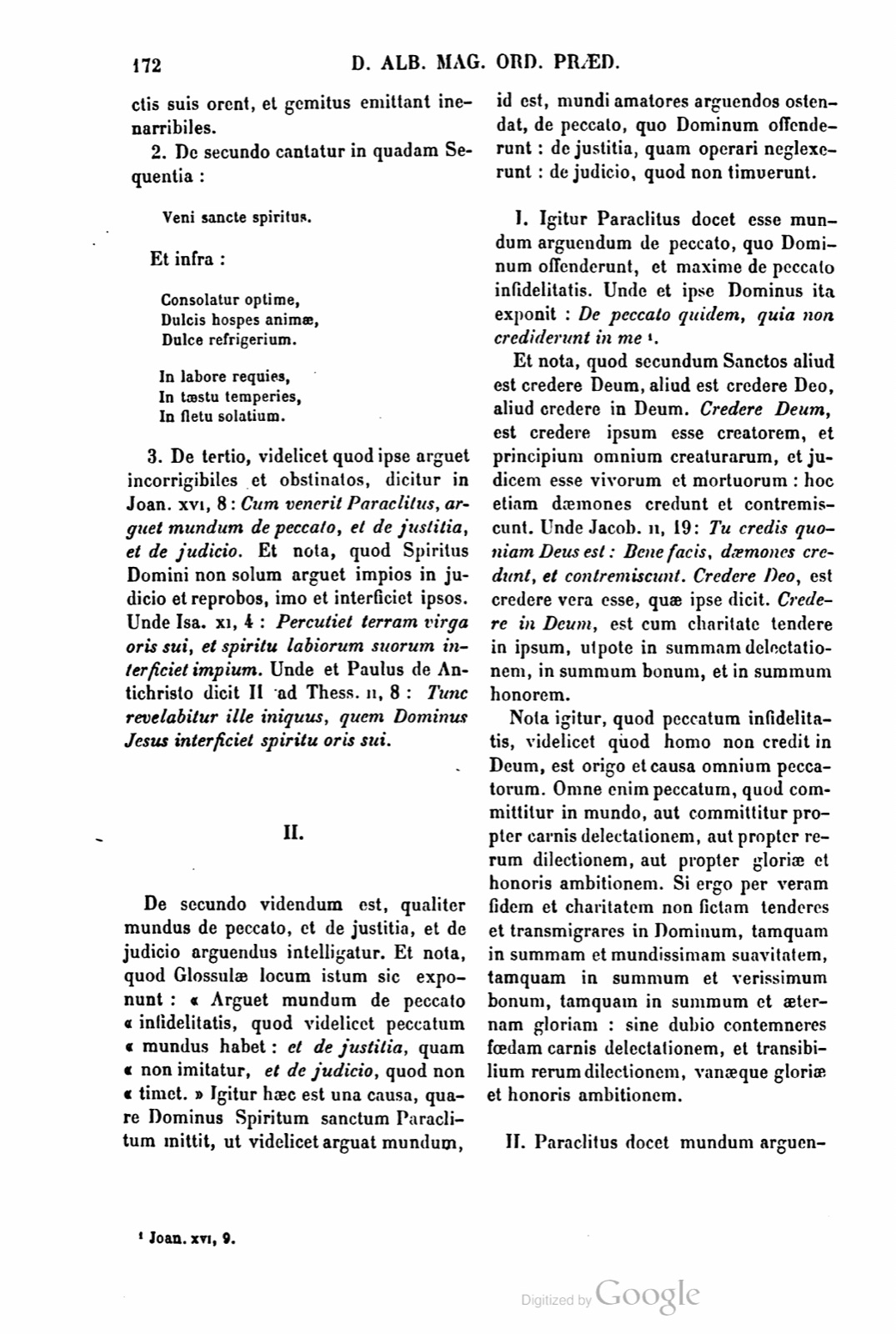
II. De secundo videndum est, qualiter mundus de peccato, et de justitia, et de judicio arguendus intelligatur. Et nota, quod Glossulæ locum istum sic exponunt: «Arguet mundum de peccato infidelitatis, quod videlicet peccatum mundus habet: et de justitia, quam non imitatur, et de judicio, quod non timet.» Igitur hæc est una causa, quare Dominus Spiritum sanctum Paraclitum mittit, ut videlicet arguat mundum, id est, mundi amatores arguendos ostendat, de peccato, quo Dominum offenderunt: de justitia, quam operari neglexerunt: de judicio, quod non timuerunt.
SERMON XLI. ON THE FOURTH SUNDAY AFTER EASTER.
When the Paraclete comes, he will argue with the world concerning sin, and concerning justice, and concerning judgment. John 16:8.
Two things occur here to be noted: I. Who is the Paraclete whom the Lord declares that he will send? II. In what manner is the world understood as to be argued with concerning sin, justice, and judgment?
I. On the first, note that by the Paraclete the Holy Spirit is expressed. For Paraclete is the same as advocate or consoler, as the interlinear Gloss testifies on John 14:16 and 17: And I will ask the Father, and he will give you another Paraclete, that he may remain with you forever, the Spirit of truth. Therefore concerning this Paraclete three things are to be noted. 1. He is the advocate of the guilty. 2. The consoler of the sorrowful. 3. And the reprover of the obstinate.
1. Concerning the first it is said in Romans 8:26: The Spirit helps our weakness. For we do not know what we should pray for as we ought, but the Spirit himself asks for us with unutterable groanings. The Gloss expounds this place thus: The Holy Spirit asks for us because he causes us to ask and inspires in us the affection of interceding and groaning. In such a way, therefore, the Holy Spirit is said to be advocate of the guilty, because he inspires in those guilty persons this very thing, that they pray for their offenses and send forth unutterable groanings.
2. On the second, it is sung in a certain Sequence: Come, Holy Spirit. And below: best consoler, sweet guest of the soul, sweet refreshment; rest in labor, tempering in heat, solace in weeping.
3. On the third, namely that he himself will reprove the incorrigible and obstinate, it is said in John 16:8: When the Paraclete comes, he will argue with the world concerning sin, and concerning justice, and concerning judgment. And note that the Spirit of the Lord will not only argue with the impious and reprobate in judgment, but even kill them. Hence Isaiah 11:4 says: He will strike the earth with the rod of his mouth, and with the spirit of his lips he will kill the impious one. Hence Paul also says concerning Antichrist in 2 Thessalonians 2:8: Then that wicked one will be revealed, whom the Lord Jesus will kill with the spirit of his mouth.
II. On the second it must be seen in what manner the world is understood as to be argued with concerning sin, justice, and judgment. And note that the small Glosses expound this place thus: He will argue with the world concerning the sin of infidelity, which sin the world has; and concerning justice, which it does not imitate; and concerning judgment, which it does not fear. Therefore this is one cause why the Lord sends the Holy Spirit, the Paraclete: namely that he may argue with the world, that is, show lovers of the world as needing to be argued with concerning the sin by which they offended the Lord, concerning the justice that they neglected to work, and concerning the judgment that they did not fear.
1. Igitur Paraclitus docet esse mundum arguendum de peccato, quo Dominum offenderunt, et maxime de peccato infidelitatis. Unde et ipse Dominus ita exponit: De peccato quidem, quia non crediderunt in me 1. Et nota, quod secundum Sanctos aliud est credere Deum, aliud est credere Deo, aliud credere in Deum. Credere Deum, est credere ipsum esse creatorem, et principium omnium creaturarum, et judicem esse vivorum et mortuorum: hoc etiam dæmones credunt et contremiscunt. Unde Jacob. ii, 19: Tu credis quoniam Deus est: Bene facis, dæmones credunt, et contremiscunt. Credere Deo, est credere vera esse, quæ ipse dicit. Credere in Deum, est cum charitate tendere in ipsum, utpote in summam delectationem, in summum bonum, et in summum honorem. Nota igitur, quod peccatum infidelitatis, videlicet quod homo non credit in Deum, est origo et causa omnium peccatorum. Omne enim peccatum, quod committitur in mundo, aut committitur propter carnis delectationem, aut propter rerum dilectionem, aut propter gloriæ et honoris ambitionem. Si ergo per veram fidem et charitatem non fictam tenderes et transmigrares in Dominum, tamquam in summam et mundissimam suavitatem, tamquam in summum et verissimum bonum, tamquam in summum et æternam gloriam: sine dubio contemneres fœdam carnis delectationem, et transibilium rerum dilectionem, vanæque gloriæ et honoris ambitionem.
II. Paraclitus docet mundum arguendum esse de justitia, quam imitari neglexerunt. Quæ autem sit hæc justitia, Dominus exponit, ita dicens: De justitia vero, quia ad Patrem vado, et jam non videbitis me 2. Quasi diceret: Ego ad Patrem vado, et si vultis venire illuc, ubi ego sum, oportet ut illam justitiam imitemini, quam et ore docui et opere exhibui. Et quæ est ista justitia? certe ut reddat quilibet quæ sunt hominis, homini: et quæ sunt Dei, Deo: unde cum Judæi, Matth. xxii, 16 et 21, Dominum commendarent, quia verax esset, et viam Dei in veritate doceret, et quærerent, si liceret censum dari Cæsari, an non? respondit: Reddite quæ sunt Cæsaris, Cæsari: et quæ sunt Dei, Deo. Conemur igitur exsequi triplicem justitiam, quam requiret a nobis Deus. Primo, ut corpus proprium disciplinis continentiæ subigamus. Hoc enim est, quod homo sibi homini debet. Secundo, ut proximis nostris sua fideliter restituamus, et nostra dum egent, misericorditer tribuamus. Hæc enim sunt, quæ homo reddere tenetur homini proximo. Tertio, ut Deo cor et omnem actum nostri corporis offeramus.
1. Therefore the Paraclete teaches that the world is to be argued with concerning the sin by which they offended the Lord, and especially concerning the sin of infidelity. Hence the Lord himself expounds it thus: concerning sin indeed, because they have not believed in me 1. And note that according to the Saints it is one thing to believe that God is, another to believe God, and another to believe in God. To believe that God is means to believe that he is the creator, the principle of all creatures, and the judge of the living and the dead; the demons also believe this and tremble. Hence James 2:19 says: You believe that God is; you do well; the demons believe and tremble. To believe God is to believe that the things he says are true. To believe in God is to tend into him with charity, as into the highest delight, the highest good, and the highest honor. Therefore note that the sin of infidelity, namely that a human being does not believe in God, is the origin and cause of all sins. For every sin committed in the world is committed either on account of delight of the flesh, or on account of love of things, or on account of ambition for glory and honor. Therefore if by true faith and unfeigned charity you tended and migrated into the Lord as into the highest and cleanest sweetness, the highest and truest good, and the highest and eternal glory, without doubt you would despise foul delight of the flesh, love of transitory things, and ambition for vain glory and honor.
II. The Paraclete teaches that the world is to be argued with concerning justice, which they neglected to imitate. But what this justice is the Lord expounds, saying thus: concerning justice, because I go to the Father and now you will not see me 2. As if he said: I go to the Father, and if you wish to come there where I am, you must imitate that justice that I taught by mouth and showed by work. And what is this justice? Certainly that each person render the things that are human to the human being, and the things that are God's to God. Hence when the Jews in Matthew 22:16 and 21 commended the Lord because he was truthful and taught the way of God in truth, and asked whether it was lawful to give tax to Caesar or not, he answered: Render the things that are Caesar's to Caesar, and the things that are God's to God. Therefore let us strive to carry out the threefold justice that God will require from us. First, that we subject our own body to the disciplines of continence. This is what a human being owes to himself as human. Second, that we faithfully restore to our neighbors their goods and mercifully give our own when they are in need. These are the things a human being is bound to render to his human neighbor. Third, that we offer to God the heart and every act of our body.
1. De primo, videlicet quod corpus nostrum disciplinis continentiæ subigamus, monet nos Spiritus sanctus in Psal. ii, 12, dicens: Apprehendite disciplinam, ne quando irascatur Dominus, et pereatis de via justa.
2. De secundo, videlicet quod ablata restituamus, et nostra egentibus tribuamus, dicit Dominus Luc. vi, 37 et 38: Dimittite, subaudi, bona quæ injuste abstulistis, et dimittemini, dicit Glossa, «peccatum.» Sequitur: Date, Glossa, «beneficia:» et dabitur vobis, Glossa, «vita æterna.»
3. De tertio, videlicet quod Deo corde et omni actu corporis serviamus, dicit Apostolus ad Coloss. iii, 17, 23 et 24: Omne, quodcumque facitis in verbo aut in opere, omnia in nomine Domini nostri Jesu Christi..... Quodcumque facitis, ex animo operamini, sicut Domino, et non hominibus: scientes quod a Domino recipietis retributionem hæreditatis.
Et nota, quod hæc triplex justitia reportat homini triplex bonum. Primum est vita gloriosa, secundum est merces fructuosa, tertium est cognitio Domini gratiosa. De his tribus Sap. v, 16: Justi in perpetuum vivent, etc. Hæc auctoritas sic intelligitur, quod videlicet, qui modo justi sunt, vitia corporis mortificando, illudque disciplinis continentiæ subigendo, vivent in perpetuum. Secundum, qui modo justi sunt, proximis ablata restituendo, et sua egentibus tribuendo, mercedem copiosam consequentur a Domino. Præterea, qui justi sunt corde, et omni tempore Domino serviendo, dignum est et quod Dominus eos semper habeat in memoria suæ benedictionis, eisque ex delicatissimis ferculis suæ mensæ transmittat.
1. On the first, namely that we subject our body to the disciplines of continence, the Holy Spirit admonishes us in Psalm 2:12, saying: Embrace discipline, lest the Lord become angry and you perish from the just way.
2. On the second, namely that we restore things taken away and give our goods to those in need, the Lord says in Luke 6:37 and 38: Forgive, understand, the goods that you have unjustly taken away, and you will be forgiven, the Gloss says, sin. It follows: Give, the Gloss says, benefits; and it will be given to you, the Gloss says, eternal life.
3. On the third, namely that we serve God with the heart and every act of the body, the Apostle says in Colossians 3:17, 23 and 24: Whatever you do in word or in deed, do all things in the name of our Lord Jesus Christ... Whatever you do, work from the soul, as for the Lord and not for human beings, knowing that from the Lord you will receive the repayment of the inheritance.
And note that this threefold justice carries back a threefold good to a human being. The first is glorious life, the second fruitful reward, the third gracious knowledge of the Lord. Concerning these three Wisdom 5:16 says: The just will live forever, and so forth. This authority is understood thus: those who are just now, by mortifying the vices of the body and subjecting it to the disciplines of continence, will live forever. Second, those who are now just by restoring to neighbors what was taken away and giving their goods to those in need will obtain abundant reward from the Lord. Moreover those who are just in heart and by serving the Lord at every time are worthy that the Lord always have them in the memory of his blessing and send to them from the most delicate dishes of his table.
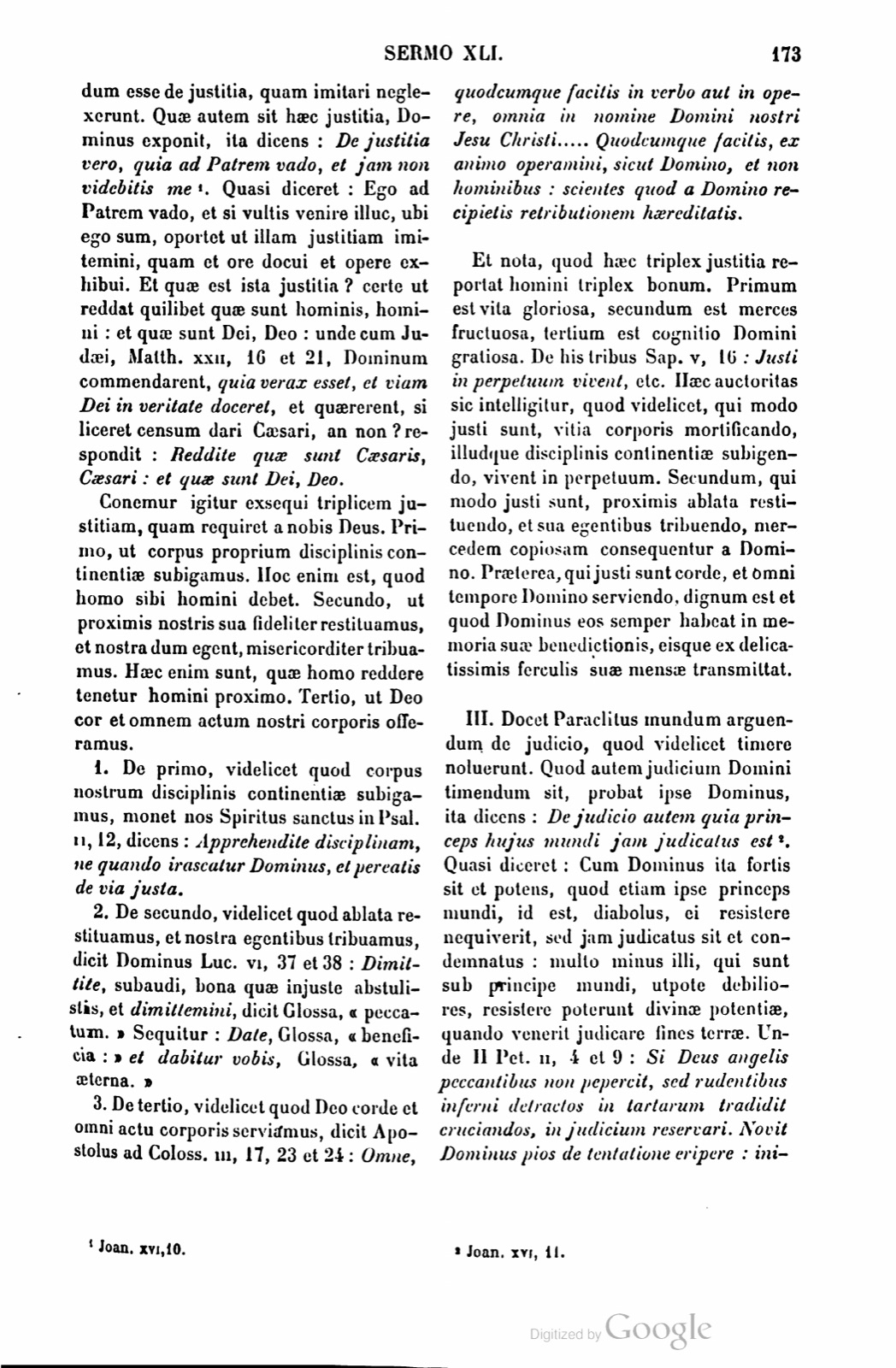
III. Docet Paraclitus mundum arguendum de judicio, quod videlicet timere noluerunt. Quod autem judicium Domini timendum sit, probat ipse Dominus, ita dicens: De judicio autem quia princeps hujus mundi jam judicatus est 3. Quasi diceret: Cum Dominus ita fortis sit et potens, quod etiam ipse princeps mundi, id est, diabolus, ei resistere nequiverit, sed jam judicatus sit et condemnatus: multo minus illi, qui sunt sub principe mundi, utpote debiliores, resistere poterunt divinæ potentiæ, quando venerit judicare fines terræ. Unde II Pet. ii, 4 et 9: Si Deus angelis peccantibus non pepercit, sed rudentibus inferni detractos in tartarum tradidit cruciandos, in judicium reservari. Novit Dominus pios de tentatione eripere: iniquos vero in diem judicii reservare cruciandos.
Timendum vero est judicium Domini propter tria. Primo, quia adventus ejus occultus erit, ut fur de nocte gradiens, et non præscietur. Secundo, quia tunc per ignem omnis peccati materia dissolvetur. Tertio, quia qui tunc in bona conversatione inventus non fuerit, punietur. Unde II Pet. iii, 10 et seq.: Adveniet dies Domini ut fur. Ecce primum. In quo cæli magno impetu transient, elementa vero calore solventur, terra autem et quæ in ipsa sunt opera, exurentur. Ecce secundum. Quales oportet vos esse in sanctis conversationibus, et pietatibus: exspectantes et properantes in adventum diei Domini. Ecce tertium.
Rogate ergo Dominum, ut sic ad extremum judicium præparemur, ut tunc cum electis salvari mereamur. Quod nobis præstare dignetur idem Jesus per sæcula sæculorum. Amen.
III. The Paraclete teaches that the world is to be argued with concerning judgment, which they refused to fear. But that the judgment of the Lord is to be feared the Lord himself proves, saying thus: concerning judgment, because the prince of this world has already been judged 3. As if he said: Since the Lord is so strong and powerful that even the prince of the world himself, that is, the devil, could not resist him, but has already been judged and condemned, much less will those who are under the prince of the world, as weaker ones, be able to resist divine power when he comes to judge the ends of the earth. Hence 2 Peter 2:4 and 9 says: If God did not spare the angels who sinned, but, dragged down by the ropes of hell, delivered them into Tartarus to be tortured and reserved for judgment, the Lord knows how to rescue the pious from temptation and to reserve the wicked for the day of judgment to be tortured.
The judgment of the Lord is to be feared for three reasons. First, because his coming will be hidden, like a thief walking by night, and will not be known beforehand. Second, because then through fire every material of sin will be dissolved. Third, because whoever is not then found in good conduct will be punished. Hence 2 Peter 3:10 and following says: The day of the Lord will come like a thief. Behold the first. In it the heavens will pass away with great force, the elements will be dissolved with heat, and the earth and the works that are in it will be burned up. Behold the second. What kind of persons ought you to be in holy conduct and pieties, expecting and hastening toward the coming of the day of the Lord. Behold the third.
Therefore pray to the Lord that we may so be prepared for the final judgment that then we may deserve to be saved with the elect. May the same Jesus deign to grant this to us through ages of ages. Amen.

If a page does not appear, its photograph has not been uploaded yet.