Works › Sermons for the Seasons of the Year
Volume 13 · pp. 169–170
Sermon XL continuation and conclusion
A marker with ≈ is an approximate page boundary, placed by measure of the text; the page photographs remain the authority. In the paired views, clicking a page marker brings that page into view.
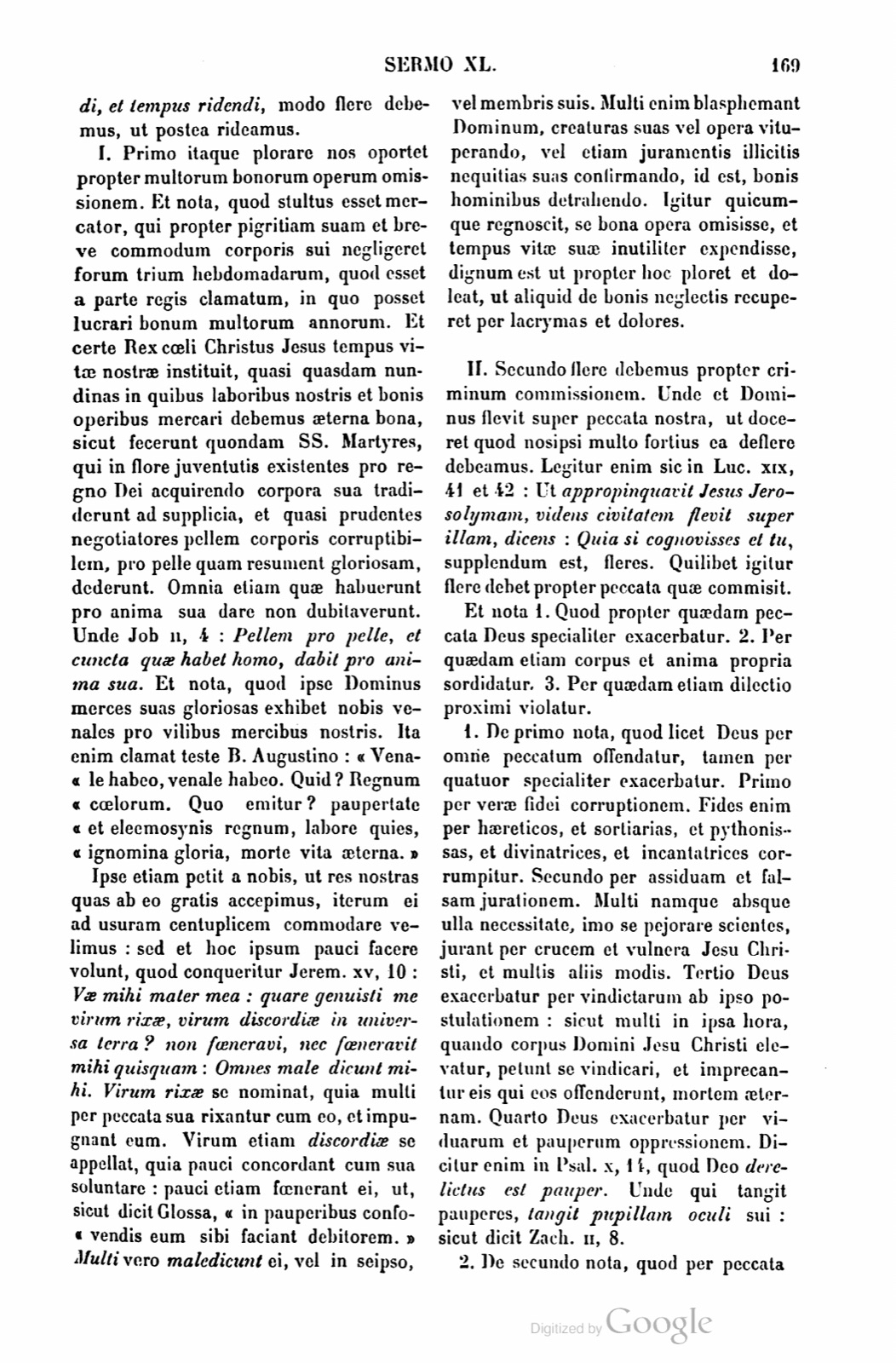
et tempus ridendi, modo flere debemus, ut postea rideamus.
I. Primo itaque plorare nos oportet propter multorum bonorum operum omissionem. Et nota, quod stultus esset mercator, qui propter pigritiam suam et breve commodum corporis sui negligeret forum trium hebdomadarum, quod esset a parte regis clamatum, in quo posset lucrari bonum multorum annorum. Et certe Rex cœli Christus Jesus tempus vitæ nostræ instituit, quasi quasdam nundinas in quibus laboribus nostris et bonis operibus mercari debemus æterna bona, sicut fecerunt quondam SS. Martyres, qui in flore juventutis existentes pro regno Dei acquirendo corpora sua tradiderunt ad supplicia, et quasi prudentes negotiatores pellem corporis corruptibilem, pro pelle quam resument gloriosam, dederunt. Omnia etiam quæ habuerunt pro anima sua dare non dubitaverunt. Unde Job ii, 4: Pellem pro pelle, et cuncta quæ habet homo, dabit pro anima sua. Et nota, quod ipse Dominus merces suas gloriosas exhibet nobis venales pro vilibus mercibus nostris. Ita enim clamat teste B. Augustino: «Venale habeo, venale habeo. Quid? Regnum cælorum. Quo emitur? paupertate et eleemosynis regnum, labore quies, ignominia gloria, morte vita æterna.» Ipse etiam petit a nobis, ut res nostras quas ab eo gratis accepimus, iterum ei ad usuram centuplicem commodare velimus: sed et hoc ipsum pauci facere volunt, quod conqueritur Jerem. xv, 10: Væ mihi mater mea: quare genuisti me virum rixæ, virum discordiæ in universa terra? non fœneravi, nec fœneravit mihi quisquam: Omnes male dicunt mihi. Virum rixæ se nominat, quia multi per peccata sua rixantur cum eo, et impugnant eum. Virum etiam discordiæ se appellat, quia pauci concordant cum sua voluntate: pauci etiam fœnerant ei, ut, sicut dicit Glossa, «in pauperibus confovendis eum sibi faciant debitorem.» Multi vero maledicunt ei, vel in seipso, vel membris suis. Multi enim blasphemant Dominum, creaturas suas vel opera vituperando, vel etiam juramentis illicitis nequitias suas confirmando, id est, bonis hominibus detrahendo. Igitur quicumque recognoscit, se bona opera omisisse, et tempus vitæ suæ inutiliter expendisse, dignum est ut propter hoc ploret et doleat, ut aliquid de bonis neglectis recuperet per lacrymas et dolores.
II. Secundo flere debemus propter criminum commissionem. Unde et Dominus flevit super peccata nostra, ut doceret quod nos ipsi multo fortius ea deflere debeamus. Legitur enim sic in Luc. xix, 41 et 42: Ut appropinquavit Jesus Jerosolymam, videns civitatem flevit super illam, dicens: Quia si cognovisses et tu, supplendum est, fleres. Quilibet igitur flere debet propter peccata quæ commisit. Et nota 1. Quod propter quædam peccata Deus specialiter exacerbatur. 2. Per quædam etiam corpus et anima propria sordidatur. 3. Per quædam etiam dilectio proximi violatur.
1. De primo nota, quod licet Deus per omne peccatum offendatur, tamen per quatuor specialiter exacerbatur. Primo per veræ fidei corruptionem. Fides enim per hæreticos, et sortiarias, et pythonissas, et divinatrices, et incantatrices corrumpitur. Secundo per assiduam et falsam jurationem. Multi namque absque ulla necessitate, imo se pejorare scientes, jurant per crucem et vulnera Jesu Christi, et multis aliis modis. Tertio Deus exacerbatur per vindictarum ab ipso postulationem: sicut multi in ipsa hora, quando corpus Domini Jesu Christi elevatur, petunt se vindicari, et imprecantur eis qui eos offenderunt, mortem æternam. Quarto Deus exacerbatur per viduarum et pauperum oppressionem. Dicitur enim in Psal. x, 14, quod Deo derelictus est pauper. Unde qui tangit pauperes, tangit pupillam oculi sui: sicut dicit Zach. ii, 8.
and a time for laughing, we ought now to weep, so that afterward we may laugh.
I. First, therefore, we ought to lament because of the omission of many good works. And note that a merchant would be foolish if, because of his laziness and the brief comfort of his body, he neglected a market of three weeks proclaimed on the king's behalf, where he could gain the good of many years. And certainly Christ Jesus, the King of heaven, has established the time of our life as certain fairs in which by our labors and good works we ought to buy eternal goods, as the holy Martyrs once did, who, existing in the flower of youth, handed over their bodies to torments to acquire the kingdom of God, and, like prudent traders, gave the skin of their corruptible body for the skin that they will receive again glorified. They also did not hesitate to give all that they had for their soul. Hence Job 2:4: Skin for skin, and all that a person has he will give for his soul. And note that the Lord himself offers his glorious wares for sale to us in exchange for our cheap wares. For thus he cries out, with Blessed Augustine as witness: I have something for sale, I have something for sale. What? The kingdom of heaven. With what is it bought? The kingdom with poverty and alms, rest with labor, glory with disgrace, eternal life with death. He also asks us to lend back to him at a hundredfold interest the things that we have received from him freely; but few are willing to do even this, as Jeremiah 15:10 complains: Woe is me, my mother; why have you borne me, a man of strife, a man of discord in the whole earth? I have not lent at interest, nor has anyone lent to me; everyone speaks evil of me. He names himself a man of strife because many by their sins quarrel with him and attack him. He also calls himself a man of discord because few agree with his will; few also lend to him, so that, as the Gloss says, by comforting him in the poor they make him their debtor. But many curse him either in himself or in his members. For many blaspheme the Lord by disparaging his creatures or works, or even by confirming their wickednesses with unlawful oaths, that is, by detracting from good people. Therefore whoever recognizes that he has omitted good works and spent the time of his life uselessly, it is fitting that because of this he lament and grieve, so that he may recover something of the neglected goods through tears and sorrows.
II. Second, we ought to weep because of the commission of crimes. Hence the Lord also wept over our sins, so that he might teach that we ourselves ought much more strongly to weep over them. For it is read thus in Luke 19:41 and 42: When Jesus drew near to Jerusalem, seeing the city he wept over it, saying: If you too had known; one must supply, you would weep. Therefore anyone ought to weep because of the sins that he has committed. And note: 1. Because of certain sins God is especially embittered. 2. Through certain sins one's own body and soul are soiled. 3. Through certain sins love of neighbor is violated.
1. On the first, note that although God is offended by every sin, nevertheless he is especially embittered by four. First, by the corruption of true faith. For faith is corrupted by heretics, sorceresses, pythonesses, diviners, and enchantresses. Second, by constant and false swearing. For many, with no necessity and even knowing that they make themselves worse, swear by the cross and wounds of Jesus Christ and in many other ways. Third, God is embittered by demands for acts of vengeance from him, as many, in the very hour when the body of the Lord Jesus Christ is elevated, ask to be avenged and call down eternal death upon those who have offended them. Fourth, God is embittered by the oppression of widows and the poor. For it is said in Psalm 10:14 that the poor person has been left to God. Hence whoever touches the poor touches the pupil of his eye, as Zechariah 2:8 says.
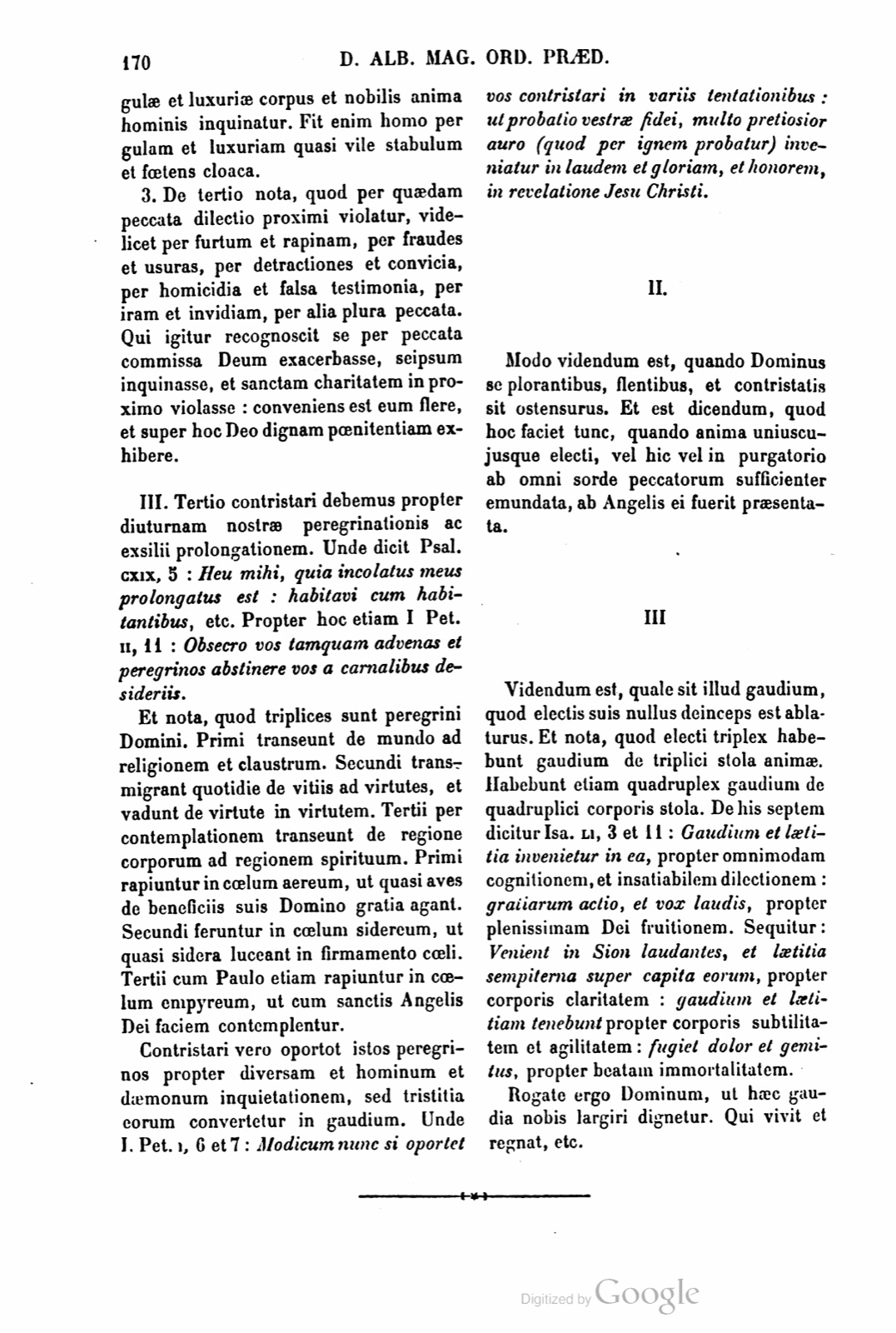
2. De secundo nota, quod per peccata gulæ et luxuriæ corpus et nobilis anima hominis inquinatur. Fit enim homo per gulam et luxuriam quasi vile stabulum et fœtens cloaca.
3. De tertio nota, quod per quædam peccata dilectio proximi violatur, videlicet per furtum et rapinam, per fraudes et usuras, per detractiones et convicia, per homicidia et falsa testimonia, per iram et invidiam, per alia plura peccata. Qui igitur recognoscit se per peccata commissa Deum exacerbasse, seipsum inquinasse, et sanctam charitatem in proximo violasse: conveniens est eum flere, et super hoc Deo dignam pœnitentiam exhibere.
III. Tertio contristari debemus propter diuturnam nostræ peregrinationis ac exsilii prolongationem. Unde dicit Psal. cxix, 5: Heu mihi, quia incolatus meus prolongatus est: habitavi cum habitantibus, etc. Propter hoc etiam I Pet. ii, 11: Obsecro vos tamquam advenas et peregrinos abstinere vos a carnalibus desideriis.
Et nota, quod triplices sunt peregrini Domini. Primi transeunt de mundo ad religionem et claustrum. Secundi transmigrant quotidie de vitiis ad virtutes, et vadunt de virtute in virtutem. Tertii per contemplationem transeunt de regione corporum ad regionem spirituum. Primi rapiuntur in cœlum aereum, ut quasi aves de beneficiis suis Domino gratias agant. Secundi feruntur in cælum sidereum, ut quasi sidera luceant in firmamento cæli. Tertii cum Paulo etiam rapiuntur in cœlum empyreum, ut cum sanctis Angelis Dei faciem contemplentur.
Contristari vero oportet istos peregrinos propter diversam et hominum et dæmonum inquietationem, sed tristitia eorum convertetur in gaudium. Unde I Pet. i, 6 et 7: Modicum nunc si oportet vos contristari in variis tentationibus: ut probatio vestræ fidei, multo pretiosior auro quod per ignem probatur, inveniatur in laudem et gloriam, et honorem, in revelatione Jesu Christi.
II. Modo videndum est, quando Dominus se plorantibus, flentibus, et contristatis sit ostensurus. Et est dicendum, quod hoc faciet tunc, quando anima uniuscujusque electi, vel hic vel in purgatorio ab omni sorde peccatorum sufficienter emundata, ab Angelis ei fuerit præsentata.
III. Videndum est, quale sit illud gaudium, quod electis suis nullus deinceps est ablaturus. Et nota, quod electi triplex habebunt gaudium de triplici stola animæ. Habebunt etiam quadruplex gaudium de quadruplici corporis stola. De his septem dicitur Isa. li, 3 et 11: Gaudium et lætitia invenietur in ea, propter omnimodam cognitionem, et insatiabilem dilectionem: gratiarum actio, et vox laudis, propter plenissimam Dei fruitionem. Sequitur: Venient in Sion laudantes, et lætitia sempiterna super capita eorum, propter corporis claritatem: gaudium et lætitiam tenebunt propter corporis subtilitatem et agilitatem: fugiet dolor et gemitus, propter beatam immortalitatem.
Rogate ergo Dominum, ut hæc gaudia nobis largiri dignetur. Qui vivit et regnat, etc.
2. On the second, note that through sins of gluttony and luxury the body and the noble soul of a human being are stained. For through gluttony and luxury a human being becomes like a vile stable and a stinking sewer.
3. On the third, note that through certain sins love of neighbor is violated, namely through theft and robbery, through frauds and usuries, through detractions and insults, through homicides and false testimonies, through anger and envy, and through many other sins. Therefore one who recognizes that by committed sins he has embittered God, stained himself, and violated holy charity in his neighbor, fittingly weeps and offers worthy penance to God over this.
III. Third, we ought to be saddened because of the long prolongation of our pilgrimage and exile. Hence Psalm 119:5 says: Woe to me, because my sojourning has been prolonged; I have dwelt with the inhabitants, and so forth. Because of this also 1 Peter 2:11 says: I beseech you as strangers and pilgrims to abstain from carnal desires.
And note that there are three kinds of the Lord's pilgrims. The first pass from the world to religion and the cloister. The second daily migrate from vices to virtues and go from virtue to virtue. The third through contemplation pass from the region of bodies to the region of spirits. The first are caught up into the aerial heaven, so that like birds they may give thanks to the Lord for his benefits. The second are carried into the starry heaven, so that like stars they may shine in the firmament of heaven. The third with Paul are also caught up into the empyrean heaven, so that they may contemplate the face of God with the holy Angels.
But these pilgrims must be saddened because of the various disquieting by both humans and demons, yet their sadness will be turned into joy. Hence 1 Peter 1:6 and 7 says: For a little while now, if it must be, you are saddened in various temptations, so that the testing of your faith, much more precious than gold that is tested by fire, may be found unto praise and glory and honor at the revelation of Jesus Christ.
II. Now it must be seen when the Lord will show himself to those lamenting, weeping, and saddened. And it must be said that he will do this when the soul of each elect person, either here or in purgatory, sufficiently cleansed from every stain of sins, has been presented to him by the Angels.
III. It must be seen what that joy is that no one henceforth will take from his elect. And note that the elect will have a threefold joy from the threefold robe of the soul. They will also have a fourfold joy from the fourfold robe of the body. Concerning these seven Isaiah 51:3 and 11 says: Joy and gladness will be found in her, because of all-encompassing knowledge and insatiable love; thanksgiving and the voice of praise, because of the fullest fruition of God. It follows: They will come into Sion praising, and everlasting joy upon their heads, because of the clarity of the body; they will hold joy and gladness because of the subtlety and agility of the body; sorrow and groaning will flee away because of blessed immortality.
Therefore pray to the Lord that he may deign to bestow these joys on us. He who lives and reigns, and so forth.
If a page does not appear, its photograph has not been uploaded yet.