Works › Sermons for the Seasons of the Year
Volume 13 · pp. 85–86
Sermon XVI continuation and conclusion
A marker with ≈ is an approximate page boundary, placed by measure of the text; the page photographs remain the authority. In the paired views, clicking a page marker brings that page into view.
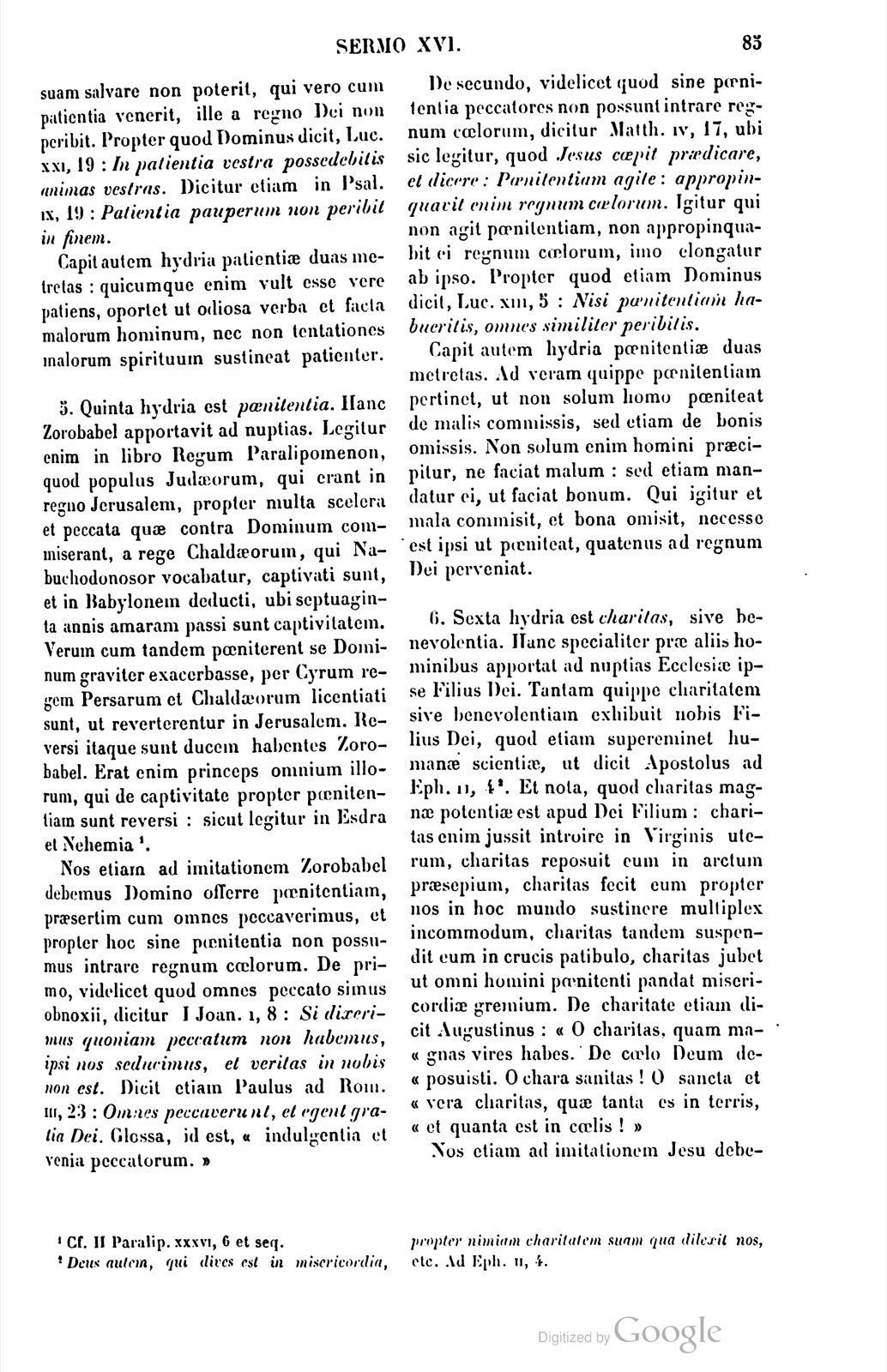
suam salvare non poterit, qui vero cum patientia venerit, ille a regno Dei non peribit. Propter quod Dominus dicit, Luc. xxi, 19: In patientia vestra possidebitis animas vestras. Dicitur etiam in Psal. ix, 19: Patientia pauperum non peribit in finem.
Capit autem hydria patientiae duas metretas: quicumque enim vult esse vere patiens, oportet ut odiosa verba et facta malorum hominum, nec non tentationes malorum spirituum sustineat patienter.
5. Quinta hydria est paenitentia. Hanc Zorobabel apportavit ad nuptias. Legitur enim in libro Regum Paralipomenon, quod populus Judaeorum, qui erant in regno Jerusalem, propter multa scelera et peccata quae contra Dominum commiserant, a rege Chaldaeorum, qui Nabuchodonosor vocabatur, captivati sunt, et in Babylonem deducti, ubi septuaginta annis amaram passi sunt captivitatem. Verum cum tandem paeniterent se Dominum graviter exacerbasse, per Cyrum regem Persarum et Chaldaeorum licentiati sunt, ut reverterentur in Jerusalem. Reversi itaque sunt ducem habentes Zorobabel. Erat enim princeps omnium illorum, qui de captivitate propter paenitentiam sunt reversi: sicut legitur in Esdra et Nehemia 1.
Nos etiam ad imitationem Zorobabel debemus Domino offerre paenitentiam, praesertim cum omnes peccaverimus, et propter hoc sine paenitentia non possumus intrare regnum caelorum. De primo, videlicet quod omnes peccato simus obnoxii, dicitur I Joan. i, 8: Si dixerimus quoniam peccatum non habemus, ipsi nos seducimus, et veritas in nobis non est. Dicit etiam Paulus ad Rom. iii, 23: Omnes peccaverunt, et egent gratia Dei. Glossa, id est, "indulgentia et venia peccatorum."
De secundo, videlicet quod sine paenitentia peccatores non possunt intrare regnum caelorum, dicitur Matth. iv, 17, ubi sic legitur, quod Jesus coepit praedicare, et dicere: Paenitentiam agite: appropinquavit enim regnum caelorum. Igitur qui non agit paenitentiam, non appropinquabit ei regnum caelorum, imo elongatur ab ipso. Propter quod etiam Dominus dicit, Luc. xiii, 5: Nisi paenitentiam habueritis, omnes similiter peribitis.
Capit autem hydria paenitentiae duas metretas. Ad veram quippe paenitentiam pertinet, ut non solum homo paeniteat de malis commissis, sed etiam de bonis omissis. Non solum enim homini praecipitur, ne faciat malum: sed etiam mandatur ei, ut faciat bonum. Qui igitur et mala commisit, et bona omisit, necesse est ipsi ut paeniteat, quatenus ad regnum Dei perveniat.
6. Sexta hydria est charitas, sive benevolentia. Hanc specialiter prae aliis hominibus apportat ad nuptias Ecclesiae ipse Filius Dei. Tantam quippe charitatem sive benevolentiam exhibuit nobis Filius Dei, quod etiam supereminet humanae scientiae, ut dicit Apostolus ad Eph. ii, 4 2. Et nota, quod charitas magnae potentiae est apud Dei Filium: charitas enim jussit introire in Virginis uterum, charitas reposuit eum in arctum praesepium, charitas fecit eum propter nos in hoc mundo sustinere multiplex incommodum, charitas tandem suspendit eum in crucis patibulo, charitas jubet ut omni homini paenitenti pandat misericordiae gremium. De charitate etiam dicit Augustinus: "O charitas, quam magnas vires habes. De caelo Deum deposuisti. O chara sanitas! O sancta et vera charitas, quae tanta es in terris, et quanta est in caelis!"
will not be able to save his soul; but the one who has come with patience, he will not perish from the kingdom of God. Because of this the Lord says, Luke 21:19: In your patience you will possess your souls. It is also said in Psalm 9:19: The patience of the poor will not perish unto the end.
But the jar of patience holds two measures: whoever wishes to be truly patient must patiently sustain the hateful words and deeds of evil human beings, and also the temptations of evil spirits.
5. The fifth jar is penance. Zorobabel brought this to the wedding. For it is read in the book of Kings, Paralipomenon, that the people of the Jews, who were in the kingdom of Jerusalem, because of many crimes and sins that they had committed against the Lord, were captured by the king of the Chaldeans, who was called Nabuchodonosor, and led into Babylon, where for seventy years they suffered a bitter captivity. But when at last they repented that they had gravely provoked the Lord, through Cyrus, king of the Persians and Chaldeans, they were granted leave to return into Jerusalem. Therefore they returned having Zorobabel as leader. For he was the prince of all those who returned from captivity because of penance, as is read in Esdras and Nehemiah 1.
We too, in imitation of Zorobabel, ought to offer penance to the Lord, especially since we all have sinned, and because of this without penance we cannot enter the kingdom of heaven. Concerning the first, namely that we all are liable to sin, it is said in 1 John 1:8: If we have said that we do not have sin, we deceive ourselves, and the truth is not in us. Paul also says in Romans 3:23: All have sinned and need the grace of God. The Gloss: that is, "the indulgence and pardon of sins."
Concerning the second, namely that without penance sinners cannot enter the kingdom of heaven, it is said in Matthew 4:17, where it is read thus, that Jesus began to preach and to say: Do penance; for the kingdom of heaven has drawn near. Therefore the one who does not do penance will not draw near to the kingdom of heaven; rather, he is drawn away from it. Because of this the Lord also says, Luke 13:5: Unless you have penance, you will all perish in like manner.
But the jar of penance holds two measures. For it belongs to true penance that a human being repent not only for evils committed but also for goods omitted. For a human being is not only instructed not to do evil, but is also commanded to do good. Therefore one who both committed evils and omitted goods must repent, so that he may come to the kingdom of God.
6. The sixth jar is charity, or benevolence. Before other human beings, the Son of God himself especially brings this to the wedding of the Church. For the Son of God displayed such great charity or benevolence to us that it even surpasses human knowledge, as the Apostle says at Ephesians 2:4 2. And note that charity is of great power with the Son of God: for charity ordered him to enter into the Virgin's womb; charity laid him in a narrow manger; charity made him sustain manifold hardship in this world for our sake; charity at last suspended him on the gibbet of the cross; charity commands him to open the bosom of mercy to every penitent human being. Augustine also says concerning charity: "O charity, what great powers you have. You brought God down from heaven. O dear health! O holy and true charity, who are as great on earth as you are in heaven!"
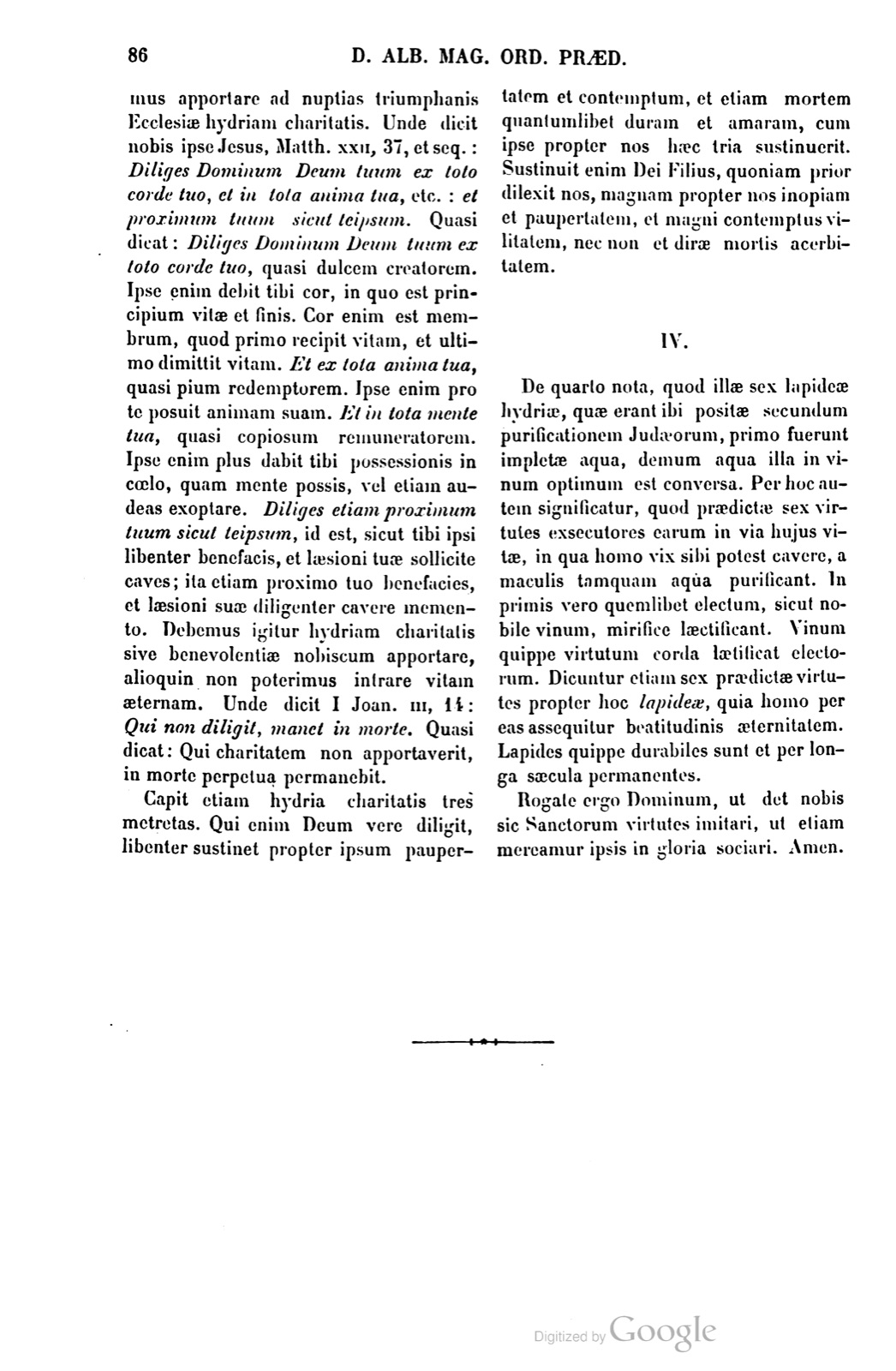
Nos etiam ad imitationem Jesu debemus apportare ad nuptias triumphantis Ecclesiae hydriam charitatis. Unde dicit nobis ipse Jesus, Matth. xxii, 37, et seq.: Diliges Dominum Deum tuum ex toto corde tuo, et in tota anima tua, etc.: et proximum tuum sicut teipsum. Quasi dicat: Diliges Dominum Deum tuum ex toto corde tuo, quasi dulcem creatorem. Ipse enim dedit tibi cor, in quo est principium vitae et finis. Cor enim est membrum, quod primo recipit vitam, et ultimo dimittit vitam. Et ex tota anima tua, quasi pium redemptorem. Ipse enim pro te posuit animam suam. Et in tota mente tua, quasi copiosum remuneratorem. Ipse enim plus dabit tibi possessionis in caelo, quam mente possis, vel etiam audeas exoptare. Diliges etiam proximum tuum sicut teipsum, id est, sicut tibi ipsi libenter benefacis, et laesioni tuae sollicite caves; ita etiam proximo tuo benefacies, et laesioni suae diligenter cavere memento. Debemus igitur hydriam charitatis sive benevolentiae nobiscum apportare, alioquin non poterimus intrare vitam aeternam. Unde dicit I Joan. iii, 14: Qui non diligit, manet in morte. Quasi dicat: Qui charitatem non apportaverit, in morte perpetua permanebit.
Capit etiam hydria charitatis tres metretas. Qui enim Deum vere diligit, libenter sustinet propter ipsum paupertatem et contemptum, et etiam mortem quantumlibet duram et amaram, cum ipse propter nos haec tria sustinuerit. Sustinuit enim Dei Filius, quoniam prior dilexit nos, magnam propter nos inopiam et paupertatem, et magni contemptus vilitatem, nec non et dirae mortis acerbitatem.
IV.
De quarto nota, quod illae sex lapideae hydriae, quae erant ibi positae secundum purificationem Judaeorum, primo fuerunt impletae aqua, demum aqua illa in vinum optimum est conversa. Per hoc autem significatur, quod praedictae sex virtutes exsecutores earum in via hujus vitae, in qua homo vix sibi potest cavere, a maculis tamquam aqua purificant. In primis vero quemlibet electum, sicut nobile vinum, mirifice laetificant. Vinum quippe virtutum corda laetificat electorum. Dicuntur etiam sex praedictae virtutes propter hoc lapideae, quia homo per eas assequitur beatitudinis aeternitatem. Lapides quippe durabiles sunt et per longa saecula permanentes.
Rogate ergo Dominum, ut det nobis sic Sanctorum virtutes imitari, ut etiam mereamur ipsis in gloria sociari. Amen.
We too, in imitation of Jesus, ought to bring the jar of charity to the wedding of the Church triumphant. Hence Jesus himself says to us, Matthew 22:37 and following: You shall love the Lord your God from your whole heart and in your whole soul, etc., and your neighbor as yourself. As if he were saying: You shall love the Lord your God from your whole heart, as a sweet creator. For he gave you the heart in which there is the beginning and end of life. For the heart is the member that first receives life and last leaves life. And from your whole soul, as a pious redeemer. For he set down his soul for you. And in your whole mind, as a plentiful rewarder. For he will give you more possession in heaven than you can in mind, or even dare, to desire. You shall also love your neighbor as yourself, that is, just as you gladly do good to yourself and carefully guard against injury to yourself, so also you shall do good to your neighbor, and remember diligently to guard against injury to him. Therefore we ought to bring with us the jar of charity or benevolence; otherwise we will not be able to enter eternal life. Hence 1 John 3:14 says: He who does not love remains in death. As if he were saying: He who has not brought charity will remain in perpetual death.
The jar of charity also holds three measures. For one who truly loves God gladly sustains for his sake poverty and contempt, and also death however hard and bitter, since he himself sustained these three things for us. For the Son of God, because he first loved us, sustained for us great want and poverty, and the vileness of great contempt, and also the bitterness of dreadful death.
IV.
Concerning the fourth, note that those six stone jars, which had been placed there according to the purification of the Jews, first were filled with water, and then that water was changed into the best wine. By this it is signified that the six aforesaid virtues purify those who carry them out, like water, from stains on the way of this life, in which a human being can scarcely guard himself. But afterward they wonderfully gladden each elect person, like noble wine. For the wine of virtues gladdens the hearts of the elect. The six aforesaid virtues are also said to be stone for this reason, because through them a human being attains the eternity of beatitude. For stones are durable and remain through long ages.
Therefore pray to the Lord that he may grant us so to imitate the virtues of the Saints that we may also merit to be joined to them in glory. Amen.
Notes
- Compare 2 Paralipomenon 36:6 and following. (Cf. II Paralip. xxxvi, 6 et seq.) ↩
- But God, who is rich in mercy, because of his exceedingly great charity with which he loved us, etc. To Ephesians 2:4. (Deus autem, qui dives est in misericordia, propter nimiam charitatem suam qua dilexit nos, etc. Ad Eph. ii, 4.) ↩
If a page does not appear, its photograph has not been uploaded yet.