Works › Sermons for the Seasons of the Year
Volume 13 · pp. 80–84
Sermon XVI. On the Second Sunday after Epiphany
A marker with ≈ is an approximate page boundary, placed by measure of the text; the page photographs remain the authority. In the paired views, clicking a page marker brings that page into view.
Sermo XVI.
In Dominica II post Epiphaniam.
Die tertia nuptiae factae sunt in Cana Galilaeae. Joan. ii, 1.
Quatuor principaliter sunt hic notanda:
I. Quid per has nuptias intelligatur? II. Quid per diem tertiam exprimatur? III. Quid per sex hydrias accipiatur? IV. Qualiter aqua in vinum in his convertatur hydriis?
I.
De primo nota, quod per has nuptias Christi et Ecclesiae conjunctio figuratur. De his nuptiis dicitur Apoc. xix, 7 et seq.: Gaudeamus, et exsultemus, et demus gloriam ei: quia venerunt nuptiae agni, et uxor ejus praeparavit se. Et datum est illi ut cooperiat se byssino splendenti, et candido. Byssinum enim justificationes sunt Sanctorum. Nota, quod praedicta verba possunt esse verba sanctorum Angelorum ita dicentium: Gaudeamus, quia Deus ad suum ministerium nos creavit: et exsultemus, quia reprobis angelis cadentibus, nos in gloria confirmavit: et demus gloriam ei, quia ut salus nostra reparetur, mortem amaritissimam toleravit: et vere dignum et justum, sicut dictum est, gaudeamus, et exsultemus, etc. quia venerunt nuptiae agni, id est, Christus sanctam Ecclesiam, quam per sanguinem suum desponsavit, cito sibi universaliter in gloria copulabit. Et hoc ideo faciet, quia uxor ejus, id est, sancta Ecclesia se praeparavit. Et quia posset dici angelis, per quid praeparavit se sponsa agni? subdunt: Datum est illi, ut cooperiat se byssino splendenti et candido, id est, praeparavit se vario virtutum vestimento, per quod et anima splendebit, et corpus candidum apparebit. Quod autem per byssinum virtutes intelligantur, ipse textus exponendo subjungit: Byssinum enim justificationes sunt Sanctorum. Quia vero tam honorificae sunt nuptiae Christi et Ecclesiae, propterea immediate subditur, quod Angelus dixit ad Joan. Scribe: Beati, qui ad caenam nuptiarum Agni vocati sunt 1.
Nota, quod sponsae duo satis odiunt, videlicet rugas in vultu, et maculas in vestitu: quocirca, ut Sancta Ecclesia, vel etiam quaelibet fidelis anima non haberet rugas aut maculas, venit ipse sponsus, et extendi se permisit in cruce: ut auferret Sanctae Ecclesiae, vel cuilibet fideli animae rugas vetustatis. Sanguinem quoque et aquam lancea percussus in latere profudit, ut ablueret ab Ecclesia, vel a qualibet anima maculas foeditatis. Unde dicit Apostolus ad Eph. v, 25 et seq.: Christus dilexit Ecclesiam, et seipsum tradidit pro ea, ut illam sanctificaret, mundans eam lavacro aquae in verbo vitae, id est, in seipso, qui est verbum vitae: ut exhiberet ipse sibi gloriosam Ecclesiam, non habentem maculam, aut rugam, aut aliquid hujusmodi; sed ut sit sancta et immaculata.
II.
De secundo nota, quod per diem tertiam futura gloria designatur, in qua nuptiae Christi et Ecclesiae consummantur. Tres enim dies habemus. Primus est dies irae. Secundus dies gratiae. Tertius dies gloriae. Diem irae intrat infantulus statim cum in matris utero vivificatur. In peccatis enim originalibus concipitur quilibet puer, et nascitur in hoc mundo. Unde dicit Apostolus ad Eph. ii, 3, quod omnes natura sumus filii irae. De die vero irae transit in diem gratiae, cum in aquis baptismi a peccato originali emundatur. Permanet autem in die gratiae usque in finem vitae, nisi forsitan excidat a gratia per peccatum mortale: currit enim dies gratiae per totum tempus praesentis vitae. Tunc enim homo secundum animam intrat in diem gloriae, quando emancipata fuerit anima ipsius a corporali carcere. In diem gloriae venire cupiebat Apostolus qui dicit ad Rom. vii, 24: Infelix ego homo, quis me liberabit de corpore mortis hujus? Igitur in die tertia, hoc est, in die futurae gloriae consummabuntur nuptiae Christi et Ecclesiae.
Sermon XVI.
On the Second Sunday after Epiphany.
On the third day a wedding was made in Cana of Galilee. John 2:1.
Four things are principally to be noted here:
I. What is understood by these nuptials? II. What is expressed by the third day? III. What is received by the six water-jars? IV. How water is changed into wine in these jars?
I.
Concerning the first, note that by these nuptials the union of Christ and the Church is figured. Concerning these nuptials Apocalypse 19:7 and following says: Let us rejoice and exult and give glory to him, because the nuptials of the Lamb have come, and his wife has prepared herself. And it was given to her that she should cover herself with shining and white fine linen. For the fine linen is the justifications of the Saints. Note that the aforesaid words can be the words of the holy Angels saying thus: Let us rejoice, because God created us for his ministry; and let us exult, because, when the reprobate angels fell, he confirmed us in glory; and let us give glory to him, because, so that our salvation might be repaired, he tolerated a most bitter death. And truly it is worthy and just, as has been said, that we rejoice and exult, etc., because the nuptials of the Lamb have come, that is, Christ will soon unite to himself universally in glory the holy Church that he espoused through his blood. And he will do this because his wife, that is, holy Church, has prepared herself. And because it could be said to the angels, By what has the bride of the Lamb prepared herself? they add: It was given to her that she should cover herself with shining and white fine linen, that is, she prepared herself with the varied garment of virtues, through which both the soul will shine and the body will appear white. But that virtues are understood by the fine linen, the text itself explains by adding: For the fine linen is the justifications of the Saints. But because the nuptials of Christ and the Church are so honorable, therefore immediately it is added that the Angel said to John: Write: Blessed are those who have been called to the supper of the nuptials of the Lamb 1.
Note that brides hate two things enough, namely wrinkles in the face and stains in the garment. Therefore, so that holy Church, or also any faithful soul, would not have wrinkles or stains, the bridegroom himself came and permitted himself to be stretched out on the cross, so that he might take away from holy Church or from any faithful soul the wrinkles of oldness. Also, struck by the lance in the side, he poured forth blood and water, so that he might wash from the Church, or from any soul, the stains of foulness. Hence the Apostle says in Ephesians 5:25 and following: Christ loved the Church and handed himself over for her, that he might sanctify her, cleansing her by the washing of water in the word of life, that is, in himself, who is the word of life, so that he himself might present to himself a glorious Church, not having spot or wrinkle or anything of this sort, but that she might be holy and immaculate.
II.
Concerning the second, note that by the third day future glory is designated, in which the nuptials of Christ and the Church are consummated. For we have three days. The first is the day of wrath. The second is the day of grace. The third is the day of glory. The little infant enters the day of wrath as soon as he is enlivened in the mother's womb. For every child is conceived in original sins and is born in this world. Hence the Apostle says in Ephesians 2:3 that we are all by nature children of wrath. But he passes from the day of wrath into the day of grace when in the waters of baptism he is cleansed from original sin. He remains in the day of grace until the end of life, unless perhaps he falls away from grace through mortal sin, for the day of grace runs through the whole time of the present life. For then a human being according to the soul enters the day of glory, when his soul has been emancipated from the bodily prison. The Apostle desired to come into the day of glory when he says in Romans 7:24: Unhappy man that I am, who will free me from the body of this death? Therefore on the third day, that is, on the day of future glory, the nuptials of Christ and the Church will be consummated.
Celebrabuntur autem hae nuptiae gloriosae in Cana Galilaeae, id est, in aeternitatis amore. Cana enim zelus dicitur, et Galilaea rota interpretatur. Zelus autem idem est quod amor, et per rotam notatur aeternitas, qui in rota non est finem recipere. Fient itaque nuptiae Christi et sacrosanctae Ecclesiae in aeternitatis amore: quia Deus sanctam Ecclesiam numquam repudiabit; sed semper eam amplexabitur, et amabit. Et nota, quod in his nuptiis dapifer erit ipse sponsus Jesus Christus: unde dicitur in praesenti Evangelio, quod vocatus est Jesus ad nuptias. Quod autem ipse dapifer sit futurus, testatur per semetipsum, Luc. xii, 37: Amen, inquit, dico vobis, quod praecinget se et faciet illos discumbere, et transiens ministrabit illis. Erit etiam propinatrix in his nuptiis ipsa caelestis Imperatrix Virgo Maria: dicitur enim in Evangelio: Et erat mater Jesu ibi. Unde ipsa dicit in Cant. ii, 4: Introduxit me Rex in cellam vinariam, ordinavit in me charitatem. Quasi diceret: Rex caelestis introduxit me in cellam vinariam, faciens me primo degustare cujuslibet vini sui nobilitatem, et deinde dans mihi cellarii sui plenissimam potestatem: ordinavit etiam in me charitatem, id est, injunxit mihi ut cuilibet animae propinem plus vel minus, secundum quod requisierit operis ejus effectus, vel cordis affectus. Multum enim amans, et magna operans, plus meretur caelestis consolationis, quam minus diligens, et minus operis exhibens. Propter hoc dicit Dominus Joan. xiv, 2: In domo Patris mei mansiones multae sunt.
III.
De tertio nota, quod per sex hydrias sex virtutes intelliguntur, quas sex personae in sex aetatibus sive temporibus hujus mundi ad Ecclesiae nuptias obtulerunt. Singulae vero hydriae capiunt metretas binas vel ternas. Prima hydria est innocentia, secunda justitia, tertia obedientia, quarta patientia, quinta poenitentia, sexta charitas sive benevolentia.
1. Igitur prima hydria est innocentia. Hanc obtulit Abel ad nuptias Christi. Haec autem innocentia signabatur per illum agnum, quem Abel dicitur obtulisse. Sicut enim agnus innocens est et mundus, ita et Abel innocens fuit manibus et mundo corde. Hunc autem Abel et nos imitari debemus, ut innocentiam ad Christi nuptias deportemus. Nullus enim ad illas nuptias recipitur, nisi apportet hydriam innocentiae. Unde dicit quilibet electus in Psal. xxv, 11: Ego in innocentia mea ingressus sum. Item in Psal. c, 2: Perambulabam in innocentia cordis mei, in medio domus meae. Quasi diceret: Perambulavi, id est, omnia caeli pertransivi ostia, et hoc per innocentiam cordis mei, quod videlicet cor est in medio domus meae, id est, circa medium corporis mei. Capit autem hydria innocentiae duas metretas. In duobus enim consistit innocentia. Primum est, ne homo faciat miserum. Secundum, ne deserat miserum: unde dicit Augustinus: "Duobus modis nocet homo, in quantum in ipso est, aut faciendo miserum, aut deserendo miserum. Quis est qui facit miseros? qui infert violentias, insidias, rapit res alienas, opprimit pauperes, furatur, aliena conjugia sollicitat, calumniosus est, vult inferre hominibus, quod doleant studio malevolentiae. Quis est qui deserit miseros? Qui vidit inopem aliquo auxilio egentem, et cum habeat quod praestet, contemnit, despicit, alienat ab eo cor suum." Cum igitur secundum praedicta verba Augustini nocens sit ille qui facit miserum, vel qui deserit miserum, per locum a contrariis, innocens est ille qui miserum non facit, nec miserum deserit, id est, qui nulli homini nocet, sed omnibus libenter prodest.
But these glorious nuptials will be celebrated in Cana of Galilee, that is, in the love of eternity. For Cana is called zeal, and Galilee is interpreted as wheel. But zeal is the same as love, and by a wheel eternity is marked, which on a wheel does not receive an end. Therefore the nuptials of Christ and the most holy Church will take place in the love of eternity, because God will never repudiate holy Church, but will always embrace and love her. And note that in these nuptials the steward will be the bridegroom himself, Jesus Christ; hence it is said in the present Gospel that Jesus was called to the wedding. But that he himself will be the steward he testifies through himself, Luke 12:37: Amen, I say to you, that he will gird himself and make them recline, and passing by will minister to them. The heavenly Empress, the Virgin Mary herself, will also be the cup-bearer in these nuptials, for it is said in the Gospel: And the mother of Jesus was there. Hence she herself says in Song 2:4: The King introduced me into the wine-cellar; he ordered charity in me. As if she were saying: The heavenly King introduced me into the wine-cellar, making me first taste the nobility of any of his wines, and then giving me the fullest power of his cellar; he also ordered charity in me, that is, he commanded me to pour more or less to any soul, according as the effect of its work or the affection of its heart has required. For one loving much and working great things merits more heavenly consolation than one loving less and showing less work. Because of this the Lord says in John 14:2: In my Father's house there are many mansions.
III.
Concerning the third, note that by the six jars six virtues are understood, which six persons in six ages or times of this world offered to the Church's nuptials. But the individual jars hold two or three measures. The first jar is innocence, the second justice, the third obedience, the fourth patience, the fifth penance, the sixth charity or benevolence.
1. Therefore the first jar is innocence. Abel offered this to the nuptials of Christ. This innocence was signified by that lamb that Abel is said to have offered. For as a lamb is innocent and clean, so also Abel was innocent in hands and clean in heart. We too ought to imitate this Abel, so that we may carry innocence to the nuptials of Christ. For no one is received to those nuptials unless he brings the jar of innocence. Hence each elect person says in Psalm 25:11: I have entered in my innocence. Likewise in Psalm 100:2: I walked in the innocence of my heart in the midst of my house. As if he were saying: I walked through, that is, I passed through all the gates of heaven, and this through the innocence of my heart, which heart is in the midst of my house, that is, near the middle of my body. But the jar of innocence holds two measures. For innocence consists in two things. The first is that a human being not make someone wretched. The second, that he not abandon someone wretched. Hence Augustine says: "In two ways a human being harms, insofar as it is in him, either by making someone wretched or by abandoning someone wretched. Who is the one who makes people wretched? The one who inflicts violence and snares, seizes others' things, oppresses the poor, steals, solicits others' marriages, is calumnious, and wishes to bring upon human beings what they grieve over by the zeal of malevolence. Who is the one who abandons the wretched? The one who sees a needy person in need of some help and, when he has what he could provide, contemns, despises, and alienates his heart from him." Therefore, since according to the aforesaid words of Augustine the one who makes someone wretched or abandons someone wretched is harmful, by the contrary place the innocent one is he who does not make anyone wretched and does not abandon anyone wretched, that is, he who harms no human being but gladly benefits all.
2. Secunda hydria est justitia. Hanc Noe obtulit ad nuptias Christi. De justitia namque Noe dicitur Gen. vi, 9: Noe vir justus atque perfectus fuit in generationibus suis, et cum Deo ambulavit. Dominus etiam cum testatur justum fuisse, propter quod et dixit illi, Gen. vii, 1: Ingredere tu, et omnis domus tua in arcam: te enim vidi justum coram me. Nos etiam ad imitationem hujus justi Noe offerre debemus justitiam. Qui enim non venerit cum hydria justitiae, numquam videbit regem gloriae; sed intrans cum justitia, cernet Deum in gloria: unde dicitur in Psal. xvi, 15: Ego autem in justitia apparebo conspectui tuo: satiabor cum apparuerit gloria tua. Capit autem hydria justitiae ternas metretas, quia per justitiam debet homo unicuique reddere quod suum est, videlicet proximo, sibimetipsi, et Deo. Proximo debet bonitatem, ut videlicet bonitatem exerceat circa proximum suum cogitatu, verbo, et facto. Disciplinam sibimetipsi debet impendere, ut corpus suum et animam sub disciplina castitatis regat et custodiat. Scientiam debet Deo persolvere, ut videlicet quaecumque scit Deo placere, libenter cogitet, loquatur, et agat. De his tribus dicitur in Psalm. cxviii, 66: Bonitatem, et disciplinam, et scientiam doce me.
3. Tertia hydria est obedientia. Hanc Abraham repraesentat ad nuptias Christi. Legitur quod Abraham eximiae fuit obedientiae. Unde habetur Gen. xxii, 2, quod Dominus ad emendationem sequentium tentans obedientiam Abrahae dixit ad eum: Tolle filium tuum unigenitum, quem diligis Isaac, et vade in terram visionis: atque ibi offeres eum in holocaustum super unum montium quem monstravero tibi. Nota, quod multa dicuntur hic, quae aggravant obedientiam Abrahae, eamque mirabiliter commendabilem reddunt. Primum est, quod dicit: Tolle filium tuum. Non dicit: Tolle servum tuum alterius hominis filium. Secundum est, quod addit: Unigenitum. Non enim alterum habebat de legitima uxore sua Sara. Tertium est, quod subjungit: Quem diligis Isaac. Promissum enim fuit Abrahae quod ex Isaac multi reges essent nascituri, et etiam ipse Christus ex ejus semine sperabatur nasciturus. Praeterea in senectute sua genuerat eum. Quartum est, quod non jubetur tantum offerre partem filii sui, videlicet pedem unum, vel manum, vel auriculam, sed totum ipsum praecipitur in frusta concidere, et igne cremare: unde additur: Et offeres eum in holocaustum. Si enim filius tantum pedem unum, vel manum amisisset, aut oculum, adhuc poterat filios procreasse, et sic posteritas Abrahae non periisset. Quintum est, quod non jubetur statim filium occidere; sed dicitur ei: Vade in terram visionis, etc. Si enim ipsum statim in ipso fervore obedientiae jussus fuisset interimere, non tantum dolorem hoc patri intulisset, quem post dies aliquos exspectavit: unde dicit Glossa: "Non statim jussus est Abraham occidere filium, sed triduo ad immolandum ducere, ut longitudine temporis tentatio augeretur. Per triduum crescentibus curis paterna viscera cruciantur, et prolixo spatio pater filium intuetur, cibum cum eo sumit, tot noctibus pendet puer in amplexu patris, cubat in gremio, et per singula momenta in paterno affectu dolor occidendi filii incumulatur." Licet ergo Abraham timere posset, quod ex occisione dilecti filii sui Isaac tota posteritas sua deleretur, ipse tamen etiam in die tertio in ejusdem obedientiae vigore permansit, quem habuit in prima hora jussionis divinae, propter hoc Abraham ab obedientia mirabiliter commendatur.
2. The second jar is justice. Noah offered this to the nuptials of Christ. Concerning Noah's justice Genesis 6:9 says: Noah was a just and perfect man in his generations and walked with God. The Lord also testifies that he was just, on account of which he said to him in Genesis 7:1: Enter, you and all your house, into the ark, for I have seen you just before me. We too, in imitation of this just Noah, ought to offer justice. For whoever has not come with the jar of justice will never see the king of glory; but entering with justice, he will see God in glory. Hence it is said in Psalm 16:15: But I in justice will appear before your sight; I will be satisfied when your glory appears. But the jar of justice holds three measures, because through justice a human being ought to render to each one what is his, namely to neighbor, to himself, and to God. He owes goodness to his neighbor, namely that he exercise goodness toward his neighbor in thought, word, and deed. He ought to bestow discipline upon himself, so that he rule and guard his body and soul under the discipline of chastity. He ought to pay knowledge to God, namely that whatever he knows to please God, he gladly think, speak, and do. Concerning these three it is said in Psalm 118:66: Teach me goodness and discipline and knowledge.
3. The third jar is obedience. Abraham represents this at the nuptials of Christ. It is read that Abraham was of outstanding obedience. Hence Genesis 22:2 has it that the Lord, testing Abraham's obedience for the correction of those following, said to him: Take your only-begotten son, Isaac, whom you love, and go into the land of vision; and there offer him as a holocaust upon one of the mountains that I will show you. Note that many things are said here that make Abraham's obedience heavy and render it wonderfully commendable. The first is that he says: Take your son. He does not say: Take your servant, the son of another man. The second is that he adds: Only-begotten. For he had no other from his lawful wife Sarah. The third is that he adds: Isaac, whom you love. For it was promised to Abraham that from Isaac many kings would be born, and even Christ himself was hoped to be born from his seed. Moreover he had begotten him in his old age. The fourth is that he is not commanded only to offer part of his son, namely one foot, or hand, or little ear, but he is commanded to cut him wholly into pieces and burn him with fire; hence it is added: And you will offer him as a holocaust. For if the son had lost only one foot, or hand, or eye, he still could have procreated sons, and thus Abraham's posterity would not have perished. The fifth is that he is not commanded to kill the son immediately, but it is said to him: Go into the land of vision, etc. For if he had been ordered to kill him immediately in the very fervor of obedience, it would not have brought so much sorrow to the father as what he awaited after some days. Hence the Gloss says: "Abraham was not immediately ordered to kill his son, but to lead him for three days to be sacrificed, so that the temptation might be increased by length of time. Through three days, as cares grew, the father's inward parts are tortured, and for a long space the father looks at the son, eats food with him, for so many nights the boy hangs in the father's embrace and lies in his lap, and through each moment in the father's affection the sorrow of killing the son is heaped up." Therefore, although Abraham could fear that from the killing of his beloved son Isaac all his posterity would be destroyed, nevertheless even on the third day he remained in the same vigor of obedience that he had in the first hour of the divine command; because of this Abraham is wonderfully commended for obedience.
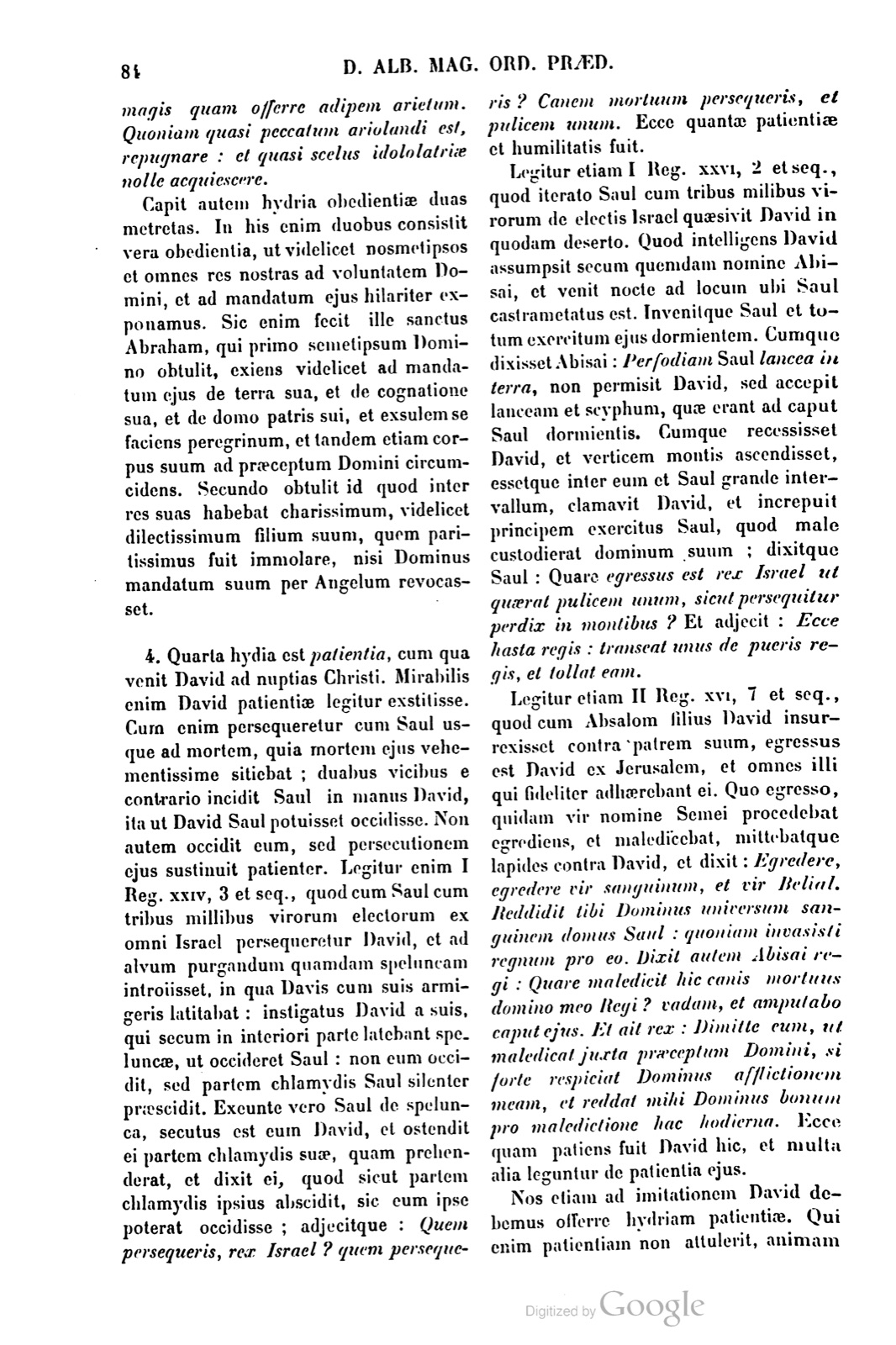
Nos etiam ad imitationem Abrahae debemus obedientiam apportare ad nuptias Christi, alioquin non intrabimus in regnum Dei. Obedientia namque aperit portam paradisi, quae extrusa obedientia clausa fuit. Unde dicit quidam sanctus in vita S. Patrum: "Obedientia est caelos aperiens, et hominem de terra levans." Et nota, quod obedientia tam nobilis est virtus, ut omnibus materialibus sacrificiis anteferatur. Hinc est, quod dicit Samuel ad Saul I Reg. xv, 22 et 23: Melior est obedientia quam victimae: et auscultare magis quam offerre adipem arietum. Quoniam quasi peccatum ariolandi est, repugnare: et quasi scelus idololatriae nolle acquiescere. Capit autem hydria obedientiae duas metretas. In his enim duobus consistit vera obedientia, ut videlicet nosmetipsos et omnes res nostras ad voluntatem Domini, et ad mandatum ejus hilariter exponamus. Sic enim fecit ille sanctus Abraham, qui primo semetipsum Domino obtulit, exiens videlicet ad mandatum ejus de terra sua, et de cognatione sua, et de domo patris sui, et exsulem se faciens peregrinum, et tandem etiam corpus suum ad praeceptum Domini circumcidens. Secundo obtulit id quod inter res suas habebat charissimum, videlicet dilectissimum filium suum, quem paratissimus fuit immolare, nisi Dominus mandatum suum per Angelum revocasset.
We too, in imitation of Abraham, ought to bring obedience to the nuptials of Christ; otherwise we will not enter into the kingdom of God. For obedience opens the gate of paradise, which was closed when obedience was driven out. Hence a certain saint says in the life of the Fathers: "Obedience opens the heavens and lifts a human being from the earth." And note that obedience is so noble a virtue that it is preferred to all material sacrifices. Hence Samuel says to Saul in 1 Kings 15:22 and 23: Obedience is better than victims, and to listen is more than to offer the fat of rams. For to resist is like the sin of divination, and to be unwilling to acquiesce is like the crime of idolatry. But the jar of obedience holds two measures. For true obedience consists in these two things: that we gladly expose ourselves and all our things to the will of the Lord and to his command. For that holy Abraham did so, who first offered himself to the Lord, namely going forth at his command from his land and kindred and father's house, making himself an exile and pilgrim, and finally also circumcising his body at the Lord's command. Secondly, he offered what among his things he held dearest, namely his most beloved son, whom he was most ready to sacrifice, unless the Lord had revoked his command through the Angel.
4. Quarta hydria est patientia, cum qua venit David ad nuptias Christi. Mirabilis enim David patientiae legitur exstitisse. Cum enim persequeretur eum Saul usque ad mortem, quia mortem ejus vehementissime sitiebat; duabus vicibus e contrario incidit Saul in manus David, ita ut David Saul potuisset occidisse. Non autem occidit eum, sed persecutionem ejus sustinuit patienter. Legitur enim I Reg. xxiv, 3 et seq., quod cum Saul cum tribus millibus virorum electorum ex omni Israel persequeretur David, et ad alvum purgandum quamdam speluncam introisset, in qua David cum suis armigeris latitabat: instigatus David a suis, qui secum in interiori parte latebant speluncae, ut occideret Saul: non eum occidit, sed partem chlamydis Saul silenter praescidit. Exeunte vero Saul de spelunca, secutus est eum David, et ostendit ei partem chlamydis suae, quam prehenderat, et dixit ei, quod sicut partem chlamydis ipsius abscidit, sic eum ipse poterat occidisse; adjecitque: Quem persequeris, rex Israel? quem persequeris? Canem mortuum persequeris, et pulicem unum. Ecce quantae patientiae et humilitatis fuit. Legitur etiam I Reg. xxvi, 2 et seq., quod iterato Saul cum tribus milibus virorum de electis Israel quaesivit David in quodam deserto. Quod intelligens David assumpsit secum quemdam nomine Abisai, et venit nocte ad locum ubi Saul castrametatus est. Invenitque Saul et totum exercitum ejus dormientem. Cumque dixisset Abisai: Perfodiam Saul lancea in terra, non permisit David, sed accepit lanceam et scyphum, quae erant ad caput Saul dormientis. Cumque recessisset David, et verticem montis ascendisset, essetque inter eum et Saul grande intervallum, clamavit David, et increpuit principem exercitus Saul, quod male custodierat dominum suum; dixitque Saul: Quare egressus est rex Israel ut quaerat pulicem unum, sicut persequitur perdix in montibus? Et adjecit: Ecce hasta regis: transeat unus de pueris regis, et tollat eam. Legitur etiam II Reg. xvi, 7 et seq., quod cum Absalom filius David insurrexisset contra patrem suum, egressus est David ex Jerusalem, et omnes illi qui fideliter adhaerebant ei. Quo egresso, quidam vir nomine Semei procedebat egrediens, et maledicebat, mittebatque lapides contra David, et dixit: Egredere, egredere vir sanguinum, et vir Belial. Reddidit tibi Dominus universum sanguinem domus Saul: quoniam invasisti regnum pro eo. Dixit autem Abisai regi: Quare maledicit hic canis mortuus domino meo Regi? vadam, et amputabo caput ejus. Et ait rex: Dimitte eum, ut maledicat juxta praeceptum Domini, si forte respiciat Dominus afflictionem meam, et reddat mihi Dominus bonum pro maledictione hac hodierna. Ecce quam patiens fuit David hic, et multa alia leguntur de patientia ejus. Nos etiam ad imitationem David debemus offerre hydriam patientiae. Qui enim patientiam non attulerit, animam
4. The fourth jar is patience, with which David came to the nuptials of Christ. For David is read to have existed of wonderful patience. For when Saul pursued him even to death, because he very vehemently thirsted for his death, on the contrary Saul fell twice into David's hands, so that David could have killed Saul. But he did not kill him, but patiently sustained his persecution. For it is read in 1 Kings 24:3 and following that when Saul with three thousand chosen men from all Israel pursued David and entered a certain cave to purge his bowels, in which David was hiding with his armor-bearers, David, urged by his men who were hiding with him in the inner part of the cave to kill Saul, did not kill him, but silently cut off part of Saul's cloak. But when Saul went out of the cave, David followed him and showed him the part of his cloak that he had taken, and said to him that just as he had cut off the part of his cloak, so he could have killed him; and he added: Whom are you pursuing, king of Israel? whom are you pursuing? You are pursuing a dead dog and one flea. Behold how great this was of patience and humility. It is also read in 1 Kings 26:2 and following that Saul a second time with three thousand men from the chosen of Israel sought David in a certain desert. Understanding this, David took with him a certain man by the name of Abishai and came by night to the place where Saul was encamped. He found Saul and his whole army sleeping. And when Abishai had said, I will pierce Saul with the spear into the earth, David did not permit it, but took the spear and cup that were at the head of Saul sleeping. And when David had withdrawn and had ascended the summit of the mountain, and there was a great interval between him and Saul, David cried out and rebuked the prince of Saul's army because he had guarded his lord badly; and Saul said: Why has the king of Israel gone out to seek one flea, as a partridge is pursued in the mountains? And he added: Behold the king's spear; let one of the king's boys cross over and take it. It is also read in 2 Kings 16:7 and following that when Absalom, David's son, had risen against his father, David went out from Jerusalem, and all those who faithfully adhered to him. When he had gone out, a certain man named Shimei proceeded, going out and cursing, and he was throwing stones against David, and said: Go out, go out, man of blood and man of Belial. The Lord has returned to you all the blood of the house of Saul, because you invaded the kingdom in his place. But Abishai said to the king: Why does this dead dog curse my lord the king? I will go and cut off his head. And the king said: Let him alone, that he may curse according to the command of the Lord, if perhaps the Lord may look upon my affliction and the Lord may return good to me for this curse today. Behold how patient David was here, and many other things are read about his patience. We too, in imitation of David, ought to offer the jar of patience. For whoever has not brought patience, the soul
Notes
- Apocalypse 19:9. (Apoc. xix, 9.) ↩
If a page does not appear, its photograph has not been uploaded yet.