Works › Sermons for the Seasons of the Year
Volume 13 · pp. 87–91
Sermon XVII. On the Third Sunday after Epiphany
A marker with ≈ is an approximate page boundary, placed by measure of the text; the page photographs remain the authority. In the paired views, clicking a page marker brings that page into view.
Sermo XVII.
In Dominica III post Epiphaniam.
Cum descendisset Jesus de monte, ecce leprosus veniens, adorabat eum, dicens: Domine, si vis, potes me mundare. Matth. viii, 1 et 2.
Quatuor sunt hic principaliter notanda:
I. Quid per hoc, quod Jesus a monte descendit, intelligatur? II. Quid per leprosum moraliter ostendatur? III. Quid hoc sit, quod leprosus a Domino mundari precatur? IV. Quot ad emundationem leprosi requirantur?
I.
De primo nota, quod Jesus propter hoc de monte descendit, ut ostendat sese libenter velle peccatoribus misereri, si velint veniam postulare. Mons enim significat eminentem austeritatem justitiae: vallis autem exprimit suavem sinum misericordiae. Monet igitur nos ipse Dominus, Is. xlv, 22 et 23, ut quamdiu est in valle misericordiae, convertamur ad ipsum. Dicit autem: Convertimini ad me, et salvi eritis omnes fines terrae: quia ego Deus, et non est alius. In memetipso juravi. Quasi dicat: Quamdiu vobis patet sinus misericordiae, venite, convertimini ad me omnes peccatores, in quibusnam etiam sitis finibus terrae. Ego enim Dominus sum, qui possum vos salvare, et non est alius, qui possit ab ira mea vos protegere. Quod autem velim vos salvare, si ad me conversi fueritis, per hoc probare potestis, quod hoc juravi in memetipso, id est, ac si juraverim certum ostendi per sanguinem meum, quem ex corpore pro vobis effudi. Convertantur itaque ad Dominum, quamdiu est in planitie misericordiae: quia cum iterum ascenderit montem justitiae, non parcet alicui peccatori: sed secundum merita uniuscujusque justitias judicabit, sicut ipse dicit in Ps. lxxiv, 3: Cum accepero tempus, ego justitias judicabo.
II.
De secundo nota, quod per leprosum quilibet peccator exprimitur. Sicut enim corpus per lepram corrumpitur, ita etiam anima per peccatum inficitur. Et sicut lepra quatuor mala importat homini: videlicet quod facit eum immundum, deformem, foetidum, et raucum: ita et peccatum animam immundat, deformat, foetidam reddit, et mutam.
1. De primo, quod anima per peccatum immundetur, dicit Jerem. in Thren. i, 9 et 17, et loquitur sic de anima peccatrice: Sordes ejus pedibus in ejus. Quasi dicat: Ita est repleta immunditiis peccatorum, ut a capite usque ad pedes sit involuta sordibus. Item Jerem. dicit ibidem: In circuitu ejus hostes ejus, facta est Jerusalem quasi polluta menstruis inter eos. Quasi dicat: Hostes animae peccatricis, id est, daemones sunt in circuitu ejus, defoedantes eam peccatis. Unde ipsa est inter eos, id est, daemones, ita immunda, ac si menstruis sit polluta.
2. De secundo, quod anima per peccatum non solum immundetur, sed etiam deformetur, dicit Jerem. in Thren. i, 6: Egressus est a filia Sion omnis decor ejus. Quasi dicat: Ab anima peccatrice, quae olim fuit filia Sion, id est, filia gratiae, per peccata quae commisit, omnis decor ejus exiit, id est, totam pulchritudinem membrorum amisit. Lepra enim quandoque est violenta, quod totum vultum hominis deturpat, auferens ei labia, nasum, oculos, et alia membra. Unde et peccator potest hoc dicere, quod dicitur Thren. iii, 4: Vetustam fecit pellem meam, et carnem meam; contrivit ossa mea. Per pellem sive cutem, quae ornatura est corporis, intelligitur nitor divinae gratiae. Per carnem intelliguntur opera misericordiae. Per ossa notantur corporales labores, utpote jejunia, peregrinationes, vigiliae, quae omnia diabolus aufert homini, et dissipat per peccatum.
Sermon XVII.
On the Third Sunday after Epiphany.
When Jesus had come down from the mountain, behold, a leper coming adored him, saying: Lord, if you will, you can make me clean. Matthew 8:1 and 2.
Four things are principally to be noted here:
I. What is understood by this, that Jesus came down from the mountain? II. What is shown morally by the leper? III. What is this, that the leper prays to be cleansed by the Lord? IV. How many things are required for the cleansing of the leper?
I.
Concerning the first, note that Jesus came down from the mountain for this reason, that he might show that he willingly wishes to have mercy on sinners if they wish to ask pardon. For a mountain signifies the eminent austerity of justice, but a valley expresses the sweet bosom of mercy. Therefore the Lord himself admonishes us, Isaiah 45:22 and 23, that as long as he is in the valley of mercy, we should be converted to him. But he says: Be converted to me, and you will be saved, all ends of the earth, because I am God and there is no other. I have sworn by myself. As if he were saying: As long as the bosom of mercy lies open to you, come, be converted to me, all sinners, in whatever ends of the earth you may be. For I am the Lord, who can save you, and there is no other who can protect you from my wrath. But that I wish to save you, if you have been converted to me, you can prove by this, that I swore this by myself, that is, as if I had sworn that I showed it certain through my blood, which I poured forth from my body for you. Therefore let them be converted to the Lord as long as he is in the plain of mercy, because when he has again ascended the mountain of justice, he will spare no sinner, but according to the merits of each one he will judge justices, as he himself says in Psalm 74:3: When I have received the time, I will judge justices.
II.
Concerning the second, note that by the leper any sinner is expressed. For just as the body is corrupted by leprosy, so also the soul is infected by sin. And just as leprosy brings four evils upon a human being, namely that it makes him unclean, deformed, foul-smelling, and hoarse, so also sin makes the soul unclean, deforms it, renders it foul-smelling, and makes it mute.
1. Concerning the first, that the soul is made unclean through sin, Jeremiah says in Lamentations 1:9 and 17, and speaks thus about the sinful soul: Its filth is on its feet. As if he were saying: It is so filled with the uncleannesses of sins that from head to feet it is wrapped in filth. Likewise Jeremiah says in the same place: Its enemies are around it; Jerusalem has been made as one polluted with menstruation among them. As if he were saying: The enemies of the sinful soul, that is, demons, are around it, defiling it with sins. Hence it is among them, that is, among demons, as unclean as if it were polluted with menstruation.
2. Concerning the second, that the soul through sin is not only made unclean but also deformed, Jeremiah says in Lamentations 1:6: All its beauty has gone out from the daughter of Sion. As if he were saying: From the sinful soul, which once was a daughter of Sion, that is, a daughter of grace, through the sins that it committed all its beauty went out, that is, it lost all the beauty of its members. For leprosy is sometimes so violent that it disfigures a human being's whole face, taking away his lips, nose, eyes, and other members. Hence the sinner too can say this, which is said in Lamentations 3:4: He has made my skin and my flesh old; he has broken my bones. By skin or hide, which is the adornment of the body, the brightness of divine grace is understood. By flesh the works of mercy are understood. By bones bodily labors are marked, such as fasts, pilgrimages, vigils, all of which the devil takes away from a human being and scatters through sin.
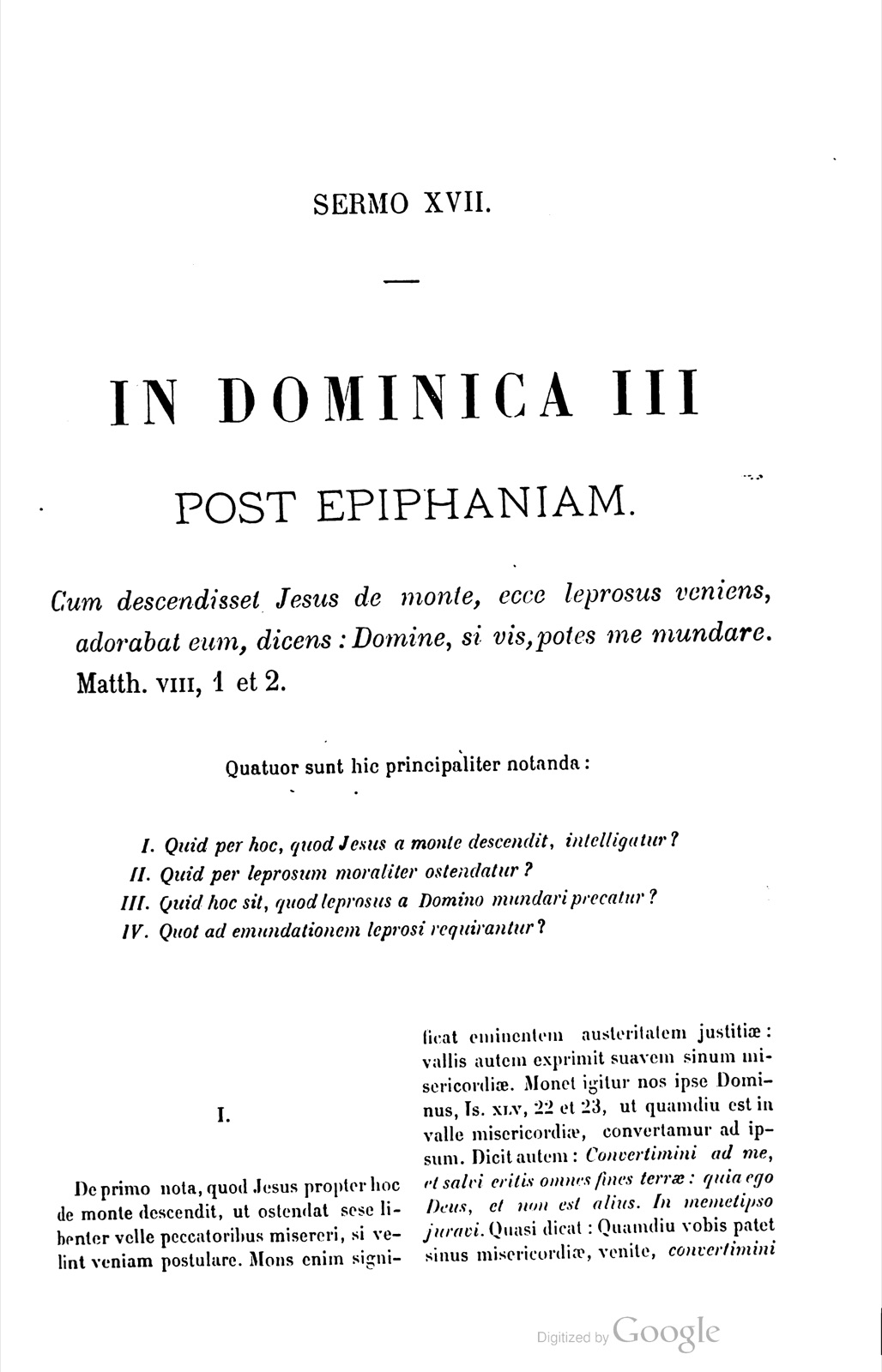
3. De tertio, quod peccatum foetere faciat animam, dicitur Isa. xxxiv, 3: Interfecti eorum projicientur, et de cadaveribus eorum ascendet foetor. Per interfectos intelliguntur peccatores, quos diabolus gladio iniquitatis interficit: propter quod projiciuntur a sinu gratiae, et de cadaveribus eorum, id est, de animabus peccato involutis et corruptis ascendit foetor, quem Deus et Angeli ejus sustinere non possunt. Dicit etiam Joel, ii, 20: Ascendet foetor ejus, et ascendet putredo ejus, quia superbe egit. Haec dicuntur de peccatore, qui quoniam superbe agit, Deum peccatis suis audens impugnare, propterea ascendens est foetor ejus et putredo nares divinae ultionis. Hinc etiam dicit Anselmus: "O quam tolerabilius canis putridus foetet hominibus, quam anima peccatrix Deo!"
4. De quarto, quod peccatum raucam, imo mutam reddit animam, dicitur in Psal. xxxvii, 14. Et loquitur ibi Psalmista in persona peccatoris: Ego tamquam surdus non audiebam: et sicut mutus non aperiens os suum. Quotidie Dominus aeterna supplicia comminatur peccatoribus, nec tamen hanc comminationem percipiunt aure cordis. Surdos enim fecit eos amor terrenorum, et delectatio peccatorum. Peccatores etiam licet sciant se in ira Domini constitutos, non tamen aperiunt os suum, ut cum vera contritione misericordiam Domini deprecentur. Raucos quippe, imo mutos diabolus eos fecit per peccatum. Unde dicitur Matth. xii, 22, et Luc. xi, 14, quod Jesus de quodam obsesso daemonium ejecit, quod erat mutum, id est, quod faciebat illum mutum esse, quem obsederat. Utinam Dominus daemonium istud longe pellat a nobis!
Igitur per leprosum intelligitur omnis homo cui septem principalia vitia dominantur, videlicet superbia, ira, acedia, invidia, avaritia, gula, et luxuria. Unde dicuntur esse septem species leprae, quae septem peccatis mortalibus adaptantur.
Prima species dicitur allopecia: et haec generatur ex impuro sanguine. Per hanc autem superbia figuratur. Superbi quippe semper elevantur, quod ex alto sanguine, id est, ex nobili descenderint parentela. Dicitur autem allopecia, quasi vulpina. Alopex enim vulpes dicitur, et bene superbi vulpibus comparantur. Superbi quippe semper ad modum vulpium magnam post se gestiunt trahere caudam famulorum. Superbae etiam mulieres magnam sibi faciunt caudam vestimentorum.
3. Concerning the third, that sin makes the soul stink, it is said in Isaiah 34:3: Their slain will be thrown out, and from their corpses a stench will ascend. By the slain sinners are understood, whom the devil kills with the sword of iniquity; because of this they are thrown out from the bosom of grace, and from their corpses, that is, from souls wrapped up and corrupted by sin, a stench ascends that God and his Angels cannot endure. Joel 2:20 also says: His stench will ascend, and his rottenness will ascend, because he acted proudly. These things are said about the sinner who, because he acts proudly, daring to attack God with his sins, for that reason his ascending stench and rottenness reach the nostrils of divine vengeance. Hence Anselm also says: "O how much more tolerably a rotten dog stinks to human beings than a sinful soul to God!"
4. Concerning the fourth, that sin renders the soul hoarse, indeed mute, it is said in Psalm 37:14. And there the Psalmist speaks in the person of the sinner: I, like a deaf man, did not hear; and like a mute man not opening his mouth. Daily the Lord threatens eternal punishments to sinners, and yet they do not perceive this threat with the ear of the heart. For love of earthly things and delight in sins have made them deaf. Sinners also, although they know themselves placed in the Lord's wrath, nevertheless do not open their mouth so that with true contrition they may beseech the Lord's mercy. For the devil has made them hoarse, indeed mute, through sin. Hence it is said in Matthew 12:22 and Luke 11:14 that Jesus cast out from a certain possessed man a demon that was mute, that is, that made the one whom it possessed be mute. Would that the Lord drive that demon far away from us!
Therefore by the leper is understood every human being over whom the seven principal vices rule, namely pride, anger, acedia, envy, avarice, gluttony, and luxury. Hence there are said to be seven species of leprosy, which are adapted to the seven mortal sins.
The first species is called allopecia, and this is generated from impure blood. By this pride is figured. For proud persons are always elevated because they have descended from high blood, that is, from noble parentage. But it is called allopecia, as if fox-like. For alopex means fox, and proud persons are well compared to foxes. For proud persons always, in the manner of foxes, desire to drag a great tail of servants after themselves. Proud women also make a great tail for themselves from garments.
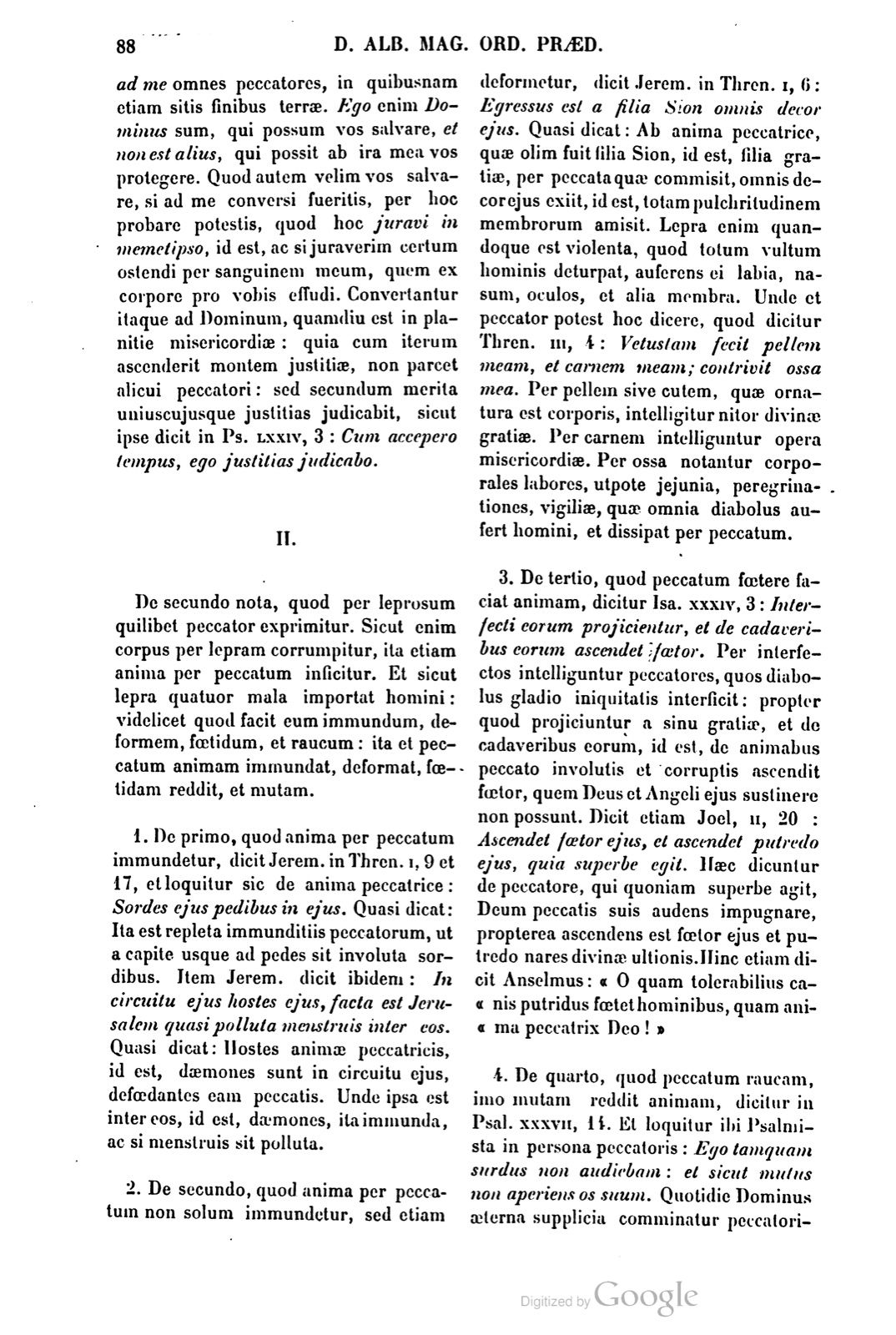
Secunda species leprae dicitur elephantia. Haec nascitur ex melancholia, et signat acediam et avaritiam. Acediosi quippe et tamquam melancholici pigri sunt, et ponderosi in obsequio Christi. Melancholia etiam multum habet de natura terrestri, et propter hoc signat avaros. Avari namque semper terram, et terrena sitiunt et concupiscunt.
Tertia species leprae dicitur leonina. Haec nascitur ex cholera, et signat iram et odium, sive invidiam. Iracundi quippe, quia multum habent de cholera diaboli, qui tamquam leo rugiens circuit quaerens quem devoret 1, semper exardescunt in furorem et iram, quae ira cum se sufficienter ulcisci non potest, in odium et invidiam commutatur. Unde dicit Augustinus: "Quid est ira? ardor et libido vindictae. Quid est odium? ira inveterata."
Quarta species leprae tyriasis appellatur. Haec nascitur ex phlegmate, et signat gulam et luxuriam. In gulosis namque et luxuriosis multum phlegma turpitudinis dominatur et luxuriae. Et propter hoc tamquam leprosi a Deo et sanctis Angelis devitantur.
III.
De tertio nota, quod non sine causa leprosus iste rogabat Dominum, ut mundaret eum. Quicumque enim in lege Mosaica leprae adjudicatus erat, quinque propter hoc damna sive incommoda sustinebat. Primum erat, quod habebat dissutum vestimentum. Secundum, quod debebat habere caput nudum. Tertium, quod habuit os veste contectum. Quartum, quod clamabat se sordidum et contaminatum. Quintum, quod solus extra castra filiorum Israel habebat habitaculum. De istis quinque dicitur Levit. xiii, 44 et seq.: Quicumque maculatus fuerit lepra, et separatus est ad arbitrium sacerdotis, habebit vestimenta dissuta, caput nudum, os veste contectum, contaminatum ac sordidum se clamabit. Omni tempore quo leprosus est, et immundus, solus habitabit extra castra.
Haec quinque damnatis peccatoribus exprimuntur.
1. Primo enim peccatores, quoniam stolam innocentiae sibi in baptismo concessam per peccata sua laceraverunt et inquinaverunt, nec eam acu paenitentiae reconsuerunt, nec eam suis lacrymis abluerunt: propterea semper lacerata et immunda in inferno deferent indumenta: nec dabitur eis illa vestis nuptialis, qua omnes filii Dei vestientur.
2. Secundo, quia omnes peccatores propter scelera sua coronam regni caelestis perdiderunt, propter hoc habebunt caput nudum. Unde et ipsi dicunt in Thren. v, 16: Cecidit corona capitis nostri: vae nobis, quia peccavimus.
3. Tertio, damnati peccatores os veste contectum habebunt: quia non admittentur ad concentum Angelorum et omnium electorum, ubi "Gloria in excelsis Deo:" et "Alleluia:" et "Sanctus, Sanctus, Sanctus:" et "Te Deum," perpetuo concinetur.
The second species of leprosy is called elephantia. This arises from melancholy and signifies acedia and avarice. For the acedious, as melancholics, are lazy and heavy in the service of Christ. Melancholy also has much of an earthly nature, and for this reason it signifies the avaricious. For the avaricious always thirst for and desire the earth and earthly things.
The third species of leprosy is called leonine. This arises from choler and signifies anger and hatred, or envy. For the angry, because they have much of the choler of the devil, who goes around like a roaring lion seeking whom he may devour 1, always blaze up into fury and anger; and when this anger cannot avenge itself sufficiently, it is changed into hatred and envy. Hence Augustine says: "What is anger? The heat and desire of vengeance. What is hatred? Inveterate anger."
The fourth species of leprosy is called tyriasis. This arises from phlegm and signifies gluttony and luxury. For in gluttonous and luxurious persons much phlegm of foulness and luxury rules. And because of this they are avoided by God and the holy Angels as lepers.
III.
Concerning the third, note that not without cause did that leper ask the Lord to cleanse him. For whoever in the Mosaic law was judged to have leprosy sustained five losses or inconveniences on account of this. The first was that he had a torn garment. The second, that he had to have his head bare. The third, that he had his mouth covered by a garment. The fourth, that he cried out that he was filthy and contaminated. The fifth, that alone outside the camp of the children of Israel he had his dwelling. Concerning these five things Leviticus 13:44 and following says: Whoever has been stained with leprosy and has been separated at the judgment of the priest will have torn garments, a bare head, a mouth covered by a garment; he will cry out that he is contaminated and filthy. During the whole time in which he is leprous and unclean, he alone will dwell outside the camp.
These five things are expressed in damned sinners.
1. First, because sinners tore and stained by their sins the robe of innocence granted to them in baptism, and neither sewed it together again with the needle of penance nor washed it with their tears, for that reason in hell they will always wear garments torn and unclean; nor will that wedding garment be given to them with which all the sons of God will be clothed.
2. Secondly, because all sinners through their crimes lost the crown of the heavenly kingdom, on account of this they will have the head bare. Hence they themselves say in Lamentations 5:16: The crown of our head has fallen; woe to us, because we have sinned.
3. Thirdly, damned sinners will have the mouth covered by a garment, because they will not be admitted to the harmony of the Angels and of all the elect, where "Glory to God in the highest," and "Alleluia," and "Holy, Holy, Holy," and "We praise you, O God," will be sung perpetually.
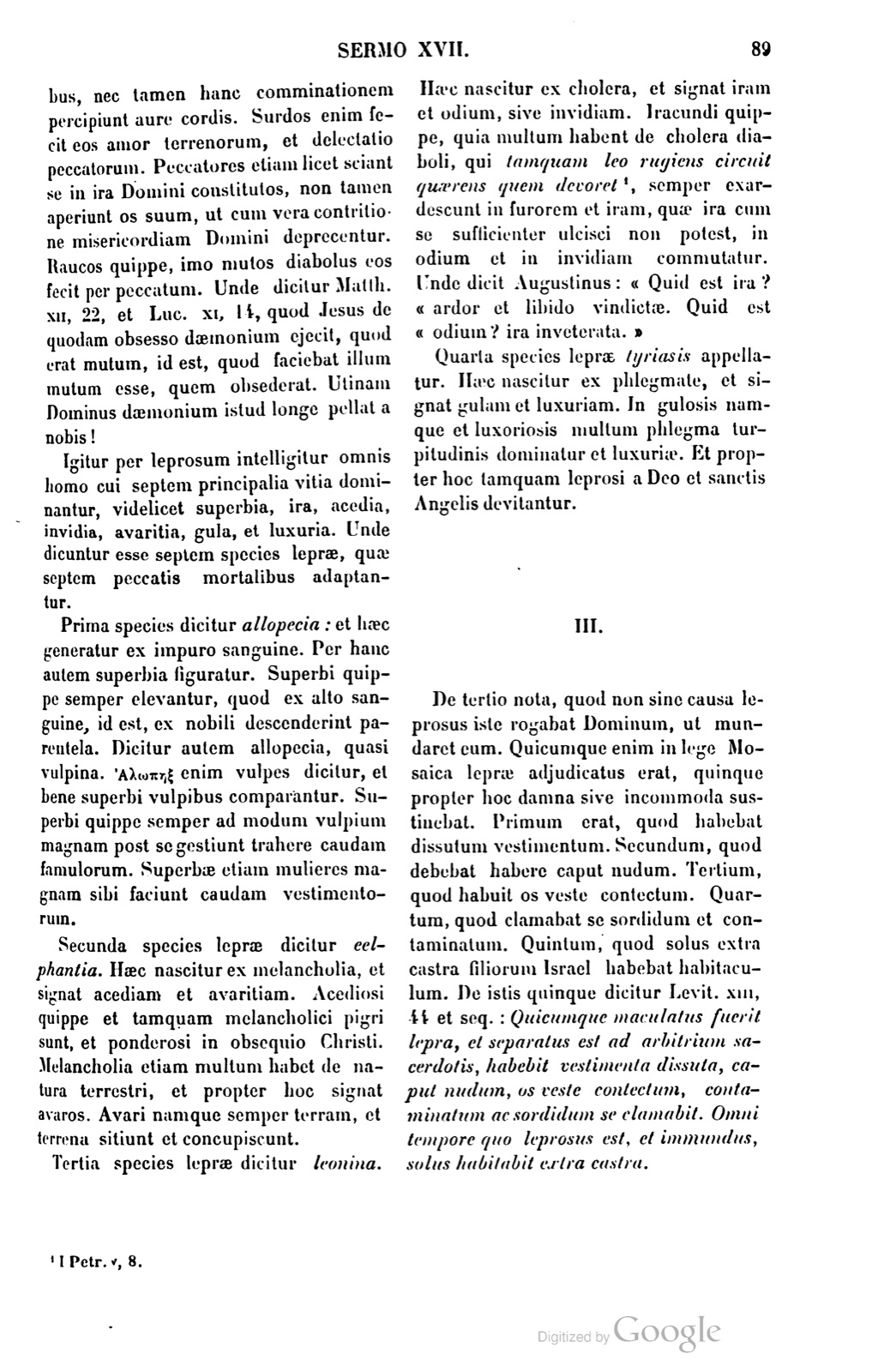
4. Quarto, miseri peccatores clamabunt se sordidos et contaminatos. Crudelitas enim aeterni ignis faciet eos protestari cum dolore, quod sordidi sunt et immundi.
5. Quinto etiam, peccatores a Deo reprobati soli habitabunt extra castra filiorum Israel: quia tunc non habebunt spem, quod ad electorum consortium admittantur. Propter haec quae praedicta sunt, Dominus dicit ad damnatos, Isa. lxv, 13 et 14: Ecce servi mei comedent, et vos esurietis: ecce servi mei bibent, et vos sitietis: ecce servi mei laetabuntur, et vos confundemini: ecce servi mei laudabunt prae exsultatione cordis, et vos clamabitis prae dolore cordis, et prae contritione spiritus ululabitis. Ecce quatuor in una auctoritate, quae patientur illi, qui extra electorum consortium ejecti fuerint. Patientur enim famis acerbitatem, sitis intolerabilitatem, aeternam confusionem, et cordis ac spiritus contritionem.
Igitur quia leprosus, id est, peccator, tot damna patietur ac mala, nisi a peccatorum sordibus fuerit emendatus; propter hoc debet ire in occursum Domini, quamdiu est in campo misericordiae. Debet, inquam, ire per jugem memoriam mortis suae. Ille namque vadit in occursum Domini, qui mortis suae jugiter recordatur. In morte etenim nostra praesentabimur aeterno judici, prout in corpore gessimus, recepturi sive bonum sive malum fuerit. Debet etiam leprosus, id est, peccator occurrens Domino, sic orare: Domine, si vis, potes me mundare. Quasi dicat: Domine, ego miser peccator tam graviter te offendi, quod non audeo te pro emundatione mea interpellare: verumtamen scio, quod si vis, potes per tuam misericordiam me mundare.
IV.
De quarto nota, quod ad hoc ut leprosus, id est, peccator quilibet emundetur, tria sunt principaliter necessaria. Primum est, ut manu Domini contingatur. Secundum est, ut Sacerdoti se ostendere non vereatur. Tertium est, ut ab ipso hoc munus quod praecepit Moyses, offeratur. Per primum notatur vera contritio. Per secundum exprimitur pura confessio. Per tertium intelligitur paenitentialis satisfactio.
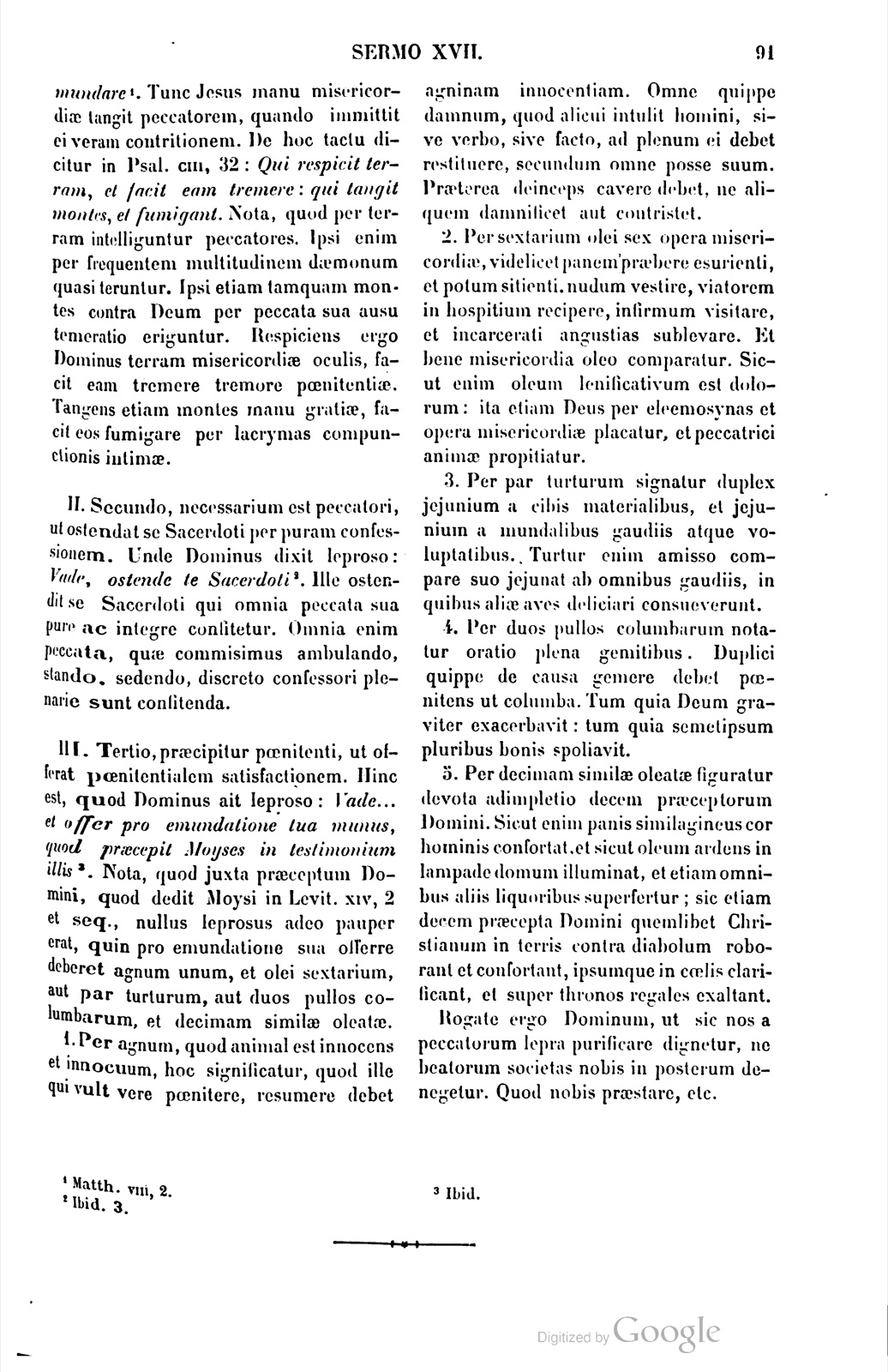
I. Primo itaque necesse est peccatori, ut manu Domini contingatur. Unde dicitur in praesenti Evangelio: Extendens Jesus manum tetigit eum, dicens: Volo, mundare 2. Tunc Jesus manu misericordiae tangit peccatorem, quando immittit ei veram contritionem. De hoc tactu dicitur in Psal. ciii, 32: Qui respicit terram, et facit eam tremere: qui tangit montes, et fumigant. Nota, quod per terram intelliguntur peccatores. Ipsi enim per frequentem multitudinem daemonum quasi teruntur. Ipsi etiam tamquam montes contra Deum per peccata sua ausu temeratio eriguntur. Respiciens ergo Dominus terram misericordiae oculis, facit eam tremere tremore paenitentiae. Tangens etiam montes manu gratiae, facit eos fumigare per lacrymas compunctionis intimae.
4. Fourthly, wretched sinners will cry out that they are filthy and contaminated. For the cruelty of eternal fire will make them protest with sorrow that they are filthy and unclean.
5. Fifthly also, sinners rejected by God will dwell alone outside the camp of the children of Israel, because then they will not have hope that they may be admitted to the company of the elect. Because of these things that have been said before, the Lord says to the damned, Isaiah 65:13 and 14: Behold, my servants will eat and you will hunger; behold, my servants will drink and you will thirst; behold, my servants will rejoice and you will be confounded; behold, my servants will praise because of exultation of heart, and you will cry out because of sorrow of heart, and because of contrition of spirit you will howl. Behold four things in one authority that those will suffer who have been cast outside the company of the elect. For they will suffer the bitterness of hunger, the unbearableness of thirst, eternal confusion, and contrition of heart and spirit.
Therefore because the leper, that is, the sinner, will suffer so many losses and evils unless he has been amended from the filths of sins, for this reason he ought to go to meet the Lord as long as he is in the field of mercy. He ought, I say, to go through continual remembrance of his death. For that person goes to meet the Lord who continually remembers his death. For in our death we will be presented to the eternal judge, about to receive according as we have done in the body, whether good or evil. The leper also, that is, the sinner meeting the Lord, ought to pray thus: Lord, if you will, you can make me clean. As if he were saying: Lord, I a wretched sinner have offended you so gravely that I do not dare to intercede with you for my cleansing; nevertheless I know that if you will, you can cleanse me through your mercy.
IV.
Concerning the fourth, note that for this, that the leper, that is, any sinner, be cleansed, three things are principally necessary. The first is that he be touched by the hand of the Lord. The second is that he not fear to show himself to the Priest. The third is that by him this gift that Moses commanded be offered. By the first true contrition is marked. By the second pure confession is expressed. By the third penitential satisfaction is understood.
I. First, therefore, it is necessary for the sinner that he be touched by the hand of the Lord. Hence it is said in the present Gospel: Jesus, stretching out his hand, touched him, saying: I will; be made clean 2. Then Jesus touches the sinner with the hand of mercy when he sends true contrition into him. Concerning this touch it is said in Psalm 103:32: He who looks upon the earth and makes it tremble; he who touches the mountains and they smoke. Note that by the earth sinners are understood. For they are as it were worn down by the frequent multitude of demons. They also, like mountains, are raised up against God by their sins with rash daring. Therefore the Lord, looking upon the earth with the eyes of mercy, makes it tremble with the trembling of penance. Also touching the mountains with the hand of grace, he makes them smoke through the tears of inward compunction.
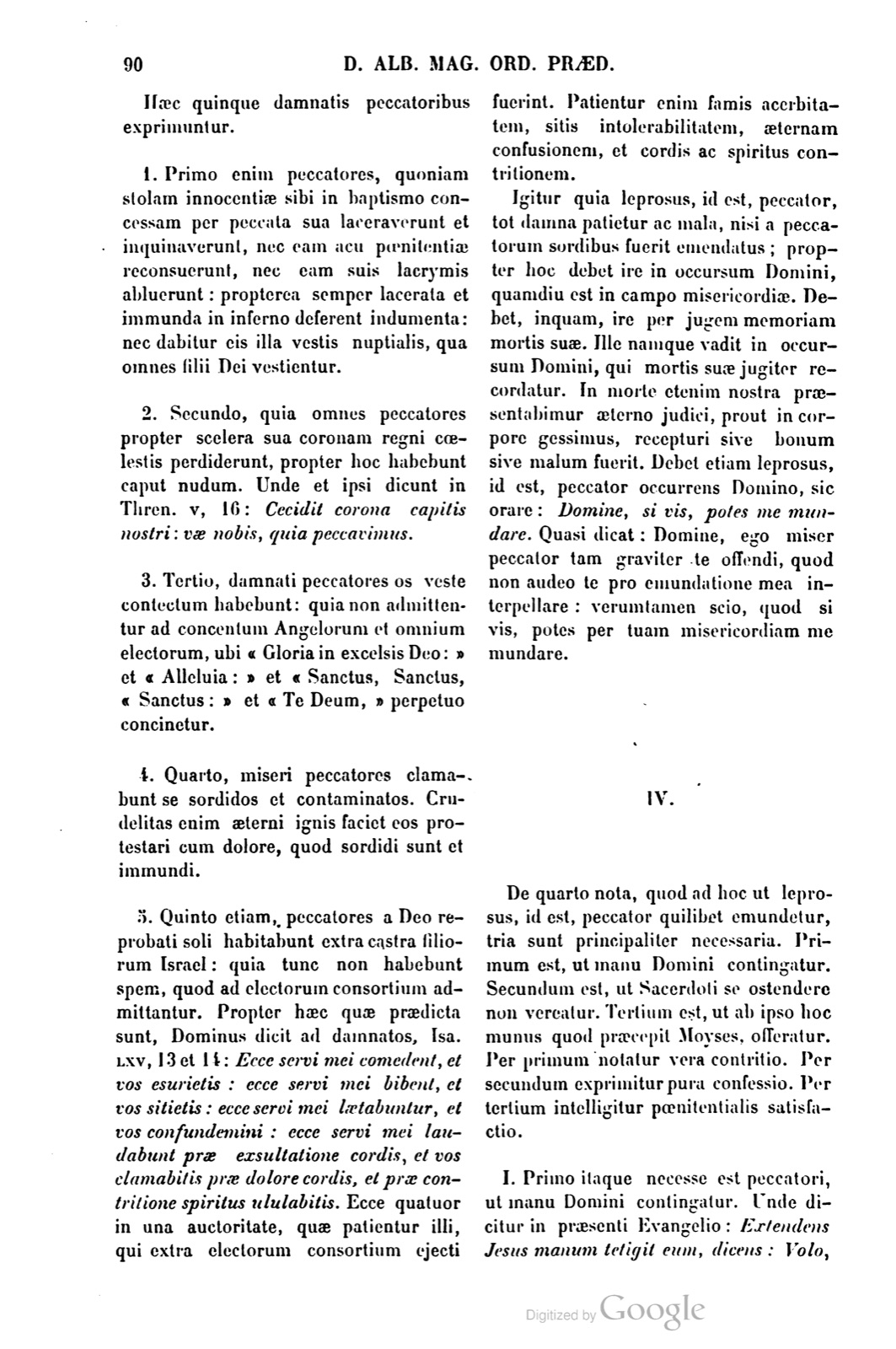
II. Secundo, necessarium est peccatori, ut ostendat se Sacerdoti per puram confessionem. Unde Dominus dixit leproso: Vade, ostende te Sacerdoti 3. Ille ostendit se Sacerdoti qui omnia peccata sua pure ac integre confitetur. Omnia enim peccata, quae commisimus ambulando, stando, sedendo, discreto confessori plenarie sunt confitenda.
III. Tertio, praecipitur paenitenti, ut offerat paenitentialem satisfactionem. Hinc est, quod Dominus ait leproso: Vade... et offer pro emundatione tua munus, quod praecepit Moyses in testimonium illis 4. Nota, quod juxta praeceptum Domini, quod dedit Moysi in Levit. xiv, 2 et seq., nullus leprosus adeo pauper erat, quin pro emundatione sua offerre deberet agnum unum, et olei sextarium, aut par turturum, aut duos pullos columbarum, et decimam similae oleatae.
1. Per agnum, quod animal est innocens et innocuum, hoc significatur, quod ille qui vult vere paenitere, resumere debet agninam innocentiam. Omne quippe damnum, quod alicui intulit homini, sive verbo, sive facto, ad plenum ei debet restituere, secundum omne posse suum. Praeterea deinceps cavere debet, ne aliquem damnificet aut contristet.
2. Per sextarium olei sex opera misericordiae, videlicet panem praebere esurienti, et potum sitienti, nudum vestire, viatorem in hospitium recipere, infirmum visitare, et incarcerati angustias sublevare. Et bene misericordia oleo comparatur. Sicut enim oleum lenificativum est dolorum: ita etiam Deus per eleemosynas et opera misericordiae placatur, et peccatrici animae propitiatur.
3. Per par turturum signatur duplex jejunium a cibis materialibus, et jejunium a mundalibus gaudiis atque voluptatibus. Turtur enim amisso compare suo jejunat ab omnibus gaudiis, in quibus aliae aves deliciari consueverunt.
4. Per duos pullos columbarum notatur oratio plena gemitibus. Duplici quippe de causa gemere debet paenitens ut columba. Tum quia Deum graviter exacerbavit: tum quia semetipsum pluribus bonis spoliavit.
5. Per decimam similae oleatae figuratur devota adimpletio decem praeceptorum Domini. Sicut enim panis similagineus cor hominis confortat, et sicut oleum ardens in lampade domum illuminat, et etiam omnibus aliis liquoribus superfertur; sic etiam decem praecepta Domini quemlibet Christianum in terris contra diabolum roborant et confortant, ipsumque in caelis clarificant, et super thronos regales exaltant.
Rogate ergo Dominum, ut sic nos a peccatorum lepra purificare dignetur, ne beatorum societas nobis in posterum denegetur. Quod nobis praestare, etc.
II. Secondly, it is necessary for the sinner that he show himself to the Priest through pure confession. Hence the Lord said to the leper: Go, show yourself to the Priest 3. The one who shows himself to the Priest is he who confesses all his sins purely and wholly. For all the sins that we have committed while walking, standing, sitting, are to be confessed fully to a discreet confessor.
III. Thirdly, the penitent is instructed to offer penitential satisfaction. Hence it is that the Lord says to the leper: Go... and offer for your cleansing the gift that Moses commanded, for a testimony to them 4. Note that according to the commandment of the Lord that he gave to Moses in Leviticus 14:2 and following, no leper was so poor that for his cleansing he ought not to offer one lamb, and a sextary of oil, or a pair of turtledoves, or two young pigeons, and a tenth of oiled fine flour.
1. By the lamb, which is an innocent and harmless animal, this is signified: that one who wishes truly to repent ought to resume lamb-like innocence. For every loss that he inflicted on any human being, whether by word or by deed, he ought fully to restore to him, according to all his power. Besides this, henceforth he ought to take care not to damage or grieve anyone.
2. By the sextary of oil are signified the six works of mercy, namely to provide bread to the hungry and drink to the thirsty, to clothe the naked, to receive the traveler into hospitality, to visit the sick, and to relieve the straits of the imprisoned. And mercy is well compared to oil. For just as oil is soothing of pains, so also God is placated through alms and works of mercy, and is made propitious to the sinful soul.
3. By the pair of turtledoves is signified a twofold fasting from material foods and fasting from worldly joys and pleasures. For the turtledove, when its mate has been lost, fasts from all joys in which other birds are accustomed to delight.
4. By the two young pigeons is marked prayer full of groans. For from a twofold cause the penitent ought to groan like a dove: both because he has gravely provoked God, and because he has despoiled himself of many goods.
5. By the tenth of oiled fine flour is figured devoted fulfillment of the ten commandments of the Lord. For just as wheaten bread strengthens the heart of a human being, and just as oil burning in a lamp illuminates a house and is also carried above all other liquids, so also the ten commandments of the Lord strengthen and comfort any Christian on earth against the devil, and glorify him in heaven and exalt him above royal thrones.
Therefore pray to the Lord that he may deign so to purify us from the leprosy of sins that the society of the blessed may not be denied to us hereafter. May he grant this to us, etc.
If a page does not appear, its photograph has not been uploaded yet.