Works › Sermons for the Seasons of the Year
Volume 13 · pp. 39–42
Sermon VIII. On the Circumcision of the Lord
A marker with ≈ is an approximate page boundary, placed by measure of the text; the page photographs remain the authority. In the paired views, clicking a page marker brings that page into view.
SERMO VIII.
DE CIRCUMCISIONE DOMINI.
Postquam consummati sunt dies octo, ut circumcideretur puer, etc. Luc. II, 21.
II 1.
Cum in praedicto sermone dictum sit, quid per circumcisionem pueri figuretur: modo dicendum est, quid per octo dies spiritualiter intelligatur. Et nota, quod sicut Sancti tradunt, Dominus natus est in nocte Dominicae diei, est etiam in die Dominica circumcisus. Nota etiam, quod dies Dominicus in vulgari idem sonat, quod dies pacis, vel dies solis, sive dies filii. Spiritualiter igitur consummari, id est, compleri debent in nobis dies octo, ut nobis hoc nomen Jesus imponatur. Primus itaque dies est dies Dominicus, id est, dies pacis. Secundus dies Lunae. Tertius dies Martis. Quartus dies Mercurii. Quintus dies Jovis. Sextus Veneris. Septimus dies Sabbati vel dies Saturni. Octavus idem dies Dominicus, id est, dies solis, vel dies filii.
Primo diem pacis agere debemus: ut scilicet Deo, quem peccatis graviter offendimus, per paenitentiam reconciliemur, et sic pacem faciamus cum ipso. Et licet peccatores Deum multipliciter impugnant, tamen per duo peccata Dominus specialiter conqueritur crucifigi se a peccatoribus: videlicet per decimarum subtractionem, et pauperum oppressionem.
1. De primo, dicit per Malach. III, 8 et 10: Vos configitis me. Et dixistis: in quo configimus te? In decimis, et in primitiis. Quasi dicat, per hoc, quod mihi decimas subtrahitis, vos me configitis. Unde sequitur: Inferte omnem decimam in horreum, et sit cibus in domo mea.
2. De secundo, scilicet de pauperum oppressione et spoliatione, dicit Dominus Zachar. II, 8: Qui tetigerit vos, o pauperes, tangit pupillam oculi mei.
Igitur qui Domino decimas suas subtraxerunt, et bona pauperum rapuerunt, nisi per paenitentiam, et ablati restitutionem, pacem cum Deo faciant, confundentur et inconsolabiliter lugebunt, quando adspicient eum, quem tam acriter confixerunt. Unde dicit Dominus, Zacha. XII, 10 et 11: Adspicient ad me, quem confixerunt. In die illa magnus erit planctus in Jerusalem. Hinc etiam dicit Joannes in Apoc. I, 7: Ecce venit cum nubibus, et videbit eum omnis oculus, et qui eum pupugerunt. Et plangent se super eum omnes tribus terrae. Tunc etiam hi, qui olim Dominum confixerunt, configentur. Unde dicitur Proverb. XXII, 23: Non facias violentiam pauperi, quia pauper est: neque conteras egenum in porta: quia judicabit Dominus causam ejus, et configet eos, qui confixerunt animam ejus. Igitur ne in die judicii contingat nos plorare et etiam configi in conspectu Filii Dei, pacem modo cum ipso faciamus, subtractas decimas persolvendo, et pauperibus ablata restituendo. Ad hoc monet nos Apostolus ad Rom. V, 1: Justificati ex fide, pacem habeamus ad Deum. Dicit etiam Apostolus II ad Cor. V, 20: Obsecramus pro Christo, reconciliamini Deo.
Secundo debemus agere diem Lunae. Per defectum nostrarum considerationum luna quippe defectum patitur. Et nota quod ad minus in quatuor magnum possumus considerare defectum nostrum, scilicet, in vitae hujus brevitate, in corporis fragilitate, in rerum instabilitate, et in amicorum fidelium paucitate.
SERMON VIII.
ON THE CIRCUMCISION OF THE LORD.
After eight days were completed, so that the child might be circumcised, etc. Luke II, 21.
II 1.
Since in the preceding sermon it has been said what is figured by the circumcision of the child, now it must be said what is understood spiritually by the eight days. And note that, as the Saints hand down, the Lord was born in the night of the Lord's day and was also circumcised on the Lord's day. Note also that the Lord's day in common speech sounds the same as a day of peace, or day of the sun, or day of the son. Therefore spiritually eight days ought to be consummated, that is, completed in us, so that this name Jesus may be imposed on us. Thus the first day is the Lord's day, that is, the day of peace. The second is the day of the Moon. The third is the day of Mars. The fourth is the day of Mercury. The fifth is the day of Jove. The sixth is Venus's day. The seventh is the Sabbath day or the day of Saturn. The eighth is the same Lord's day, that is, the day of the sun or day of the son.
First we ought to keep the day of peace: namely, that through penance we may be reconciled to God, whom we have gravely offended by sins, and thus make peace with him. And although sinners attack God in many ways, nevertheless in two sins especially the Lord complains that he is crucified by sinners: namely through the withholding of tithes and the oppression of the poor.
1. Concerning the first, he says through Malachi III, 8 and 10: You crucify me. And you have said: In what do we crucify you? In tithes and in firstfruits. As though he said: by this, that you withhold tithes from me, you crucify me. Hence it follows: Bring every tithe into the barn, and let there be food in my house.
2. Concerning the second, namely concerning the oppression and spoliation of the poor, the Lord says in Zechariah II, 8: He who has touched you, O poor, touches the pupil of my eye.
Therefore those who have withheld their tithes from the Lord and have seized the goods of the poor, unless through penance and restitution of what was taken they make peace with God, will be confounded and will mourn inconsolably when they look upon him whom they have so sharply crucified. Hence the Lord says, Zechariah XII, 10 and 11: They will look upon me whom they have crucified. On that day there will be great lamentation in Jerusalem. Hence John also says in Apocalypse I, 7: Behold, he comes with clouds, and every eye will see him, and those who pierced him. And all the tribes of the earth will mourn over him. Then also those who once crucified the Lord will be crucified. Hence Proverbs XXII, 23 says: Do not do violence to the poor because he is poor, nor crush the needy in the gate, because the Lord will judge his cause and will crucify those who crucified his soul. Therefore lest on the day of judgment it happen to us to weep and also to be crucified in the sight of the Son of God, let us now make peace with him by paying the withheld tithes and by restoring to the poor what was taken. To this the Apostle admonishes us in Romans V, 1: Justified by faith, let us have peace toward God. The Apostle also says in II Corinthians V, 20: We beseech you for Christ: be reconciled to God.
Second, we ought to keep the day of the Moon. For the moon suffers defect through the defect of our considerations. And note that in at least four things we can consider our great defect, namely in the brevity of this life, in the frailty of the body, in the instability of things, and in the scarcity of faithful friends.
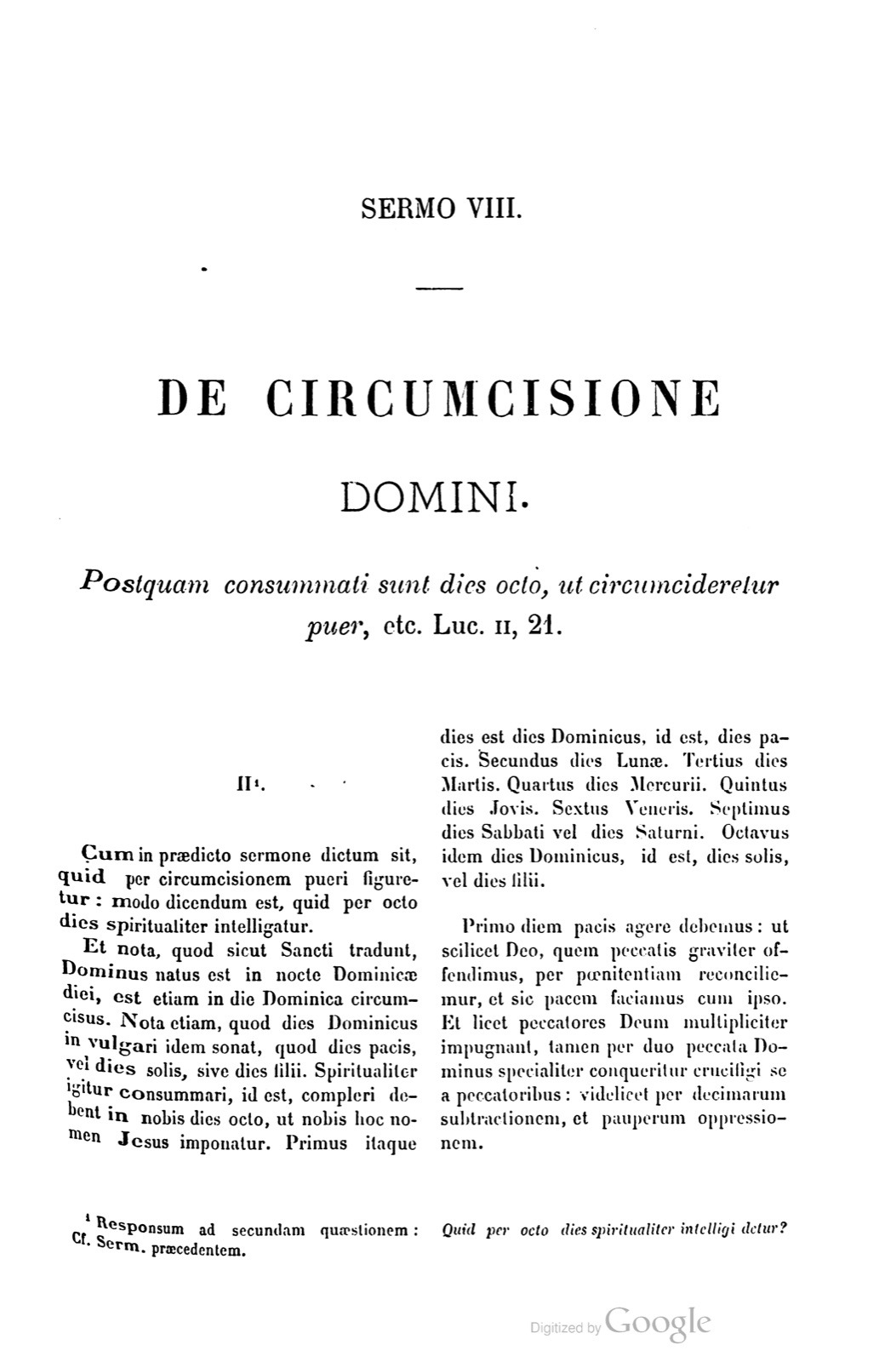
1. De primo, scilicet de vitae nostrae brevitate dicit Job VII, 6 et 7: Dies mei velocius transierunt quam a texente tela succiditur. Memento quia ventus est vita mea. Dicit etiam Job XIV, 1 et 2: Homo natus de muliere, brevi vivens tempore, repletur multis miseriis. Qui quasi flos egreditur, et conteritur, et fugit velut umbra, et numquam in eodem statu permanet. Dicit etiam Jac. IV, 15: Quid est vita nostra? vapor est ad modicum parens, id est, apparens, et deinceps exterminabitur. Dicit etiam Seneca: «Punctum est, quod vivimus, et adhuc puncto minus.»
2. De secundo, scilicet de corporis fragilitate dicit ipse Dominus Genes. III, 19: Pulvis es, et in pulverem reverteris. Dicit etiam Bernardus: «Nihil aliud est caro nisi spuma caro facta, fragili vestita decore: sed erit cadaver miserum, et putridum, et cibus vermium. Nam quantumcumque excolatur, semper caro est. Si diligenter consideres, quid per os, et nares, caeterosque meatus corporis egrediatur, vilius sterquilinium numquam vidisti.»
3. De tertio, scilicet de rerum temporalium instabilitate, ipsi qui olim divites fuerunt in saeculo, sed modo pauperes sunt in inferno, ita dicunt in libro Sap. V, 8 et seq.: Quid nobis profuit superbia? divitiarum jactantia quid contulit nobis? transierunt omnia illa tamquam umbra, et tamquam fumus, qui a vento diffusus est. Leguntur etiam isti versus de bono Thoma Cantuariensi in legenda ipsius:
Nil dixit proprium quod puncto mobilis horae, nunc prece, nunc pretio, nunc vi, nunc morte suprema permutat Dominus, et cedat in altera jura.
4. De quarto, videlicet de fidelium amicorum paucitate dicitur Proverb. XIX, 4 et seq.: Divitiae addunt amicos plurimos: a paupere autem et hi, quos habuit, separantur.... Multi colunt personam potentis, et amici sunt dona tribuentis. Fratres hominis pauperis oderunt eum: insuper et amici procul recesserunt ab eo. Eccli. VI, 10: Est amicus socius mensae, et non permanebit in die necessitatis. Multi igitur videntur esse amici, et non sunt veri amici. Verus enim amicus propter nullum hujus vitae infortunium derelinquit amicum suum, quin etiam assistat ei post obitum suum: unde dicitur Proverb. XVII, 17: Omni tempore diligit qui amicus est: et frater in angustiis comprobatur. Quod etiam pauci sunt veri amici, dicit Tullius in libro de Amicitia: «Sunt, inquit, amici firmi, et stabiles, et constantes eligendi: cujus generis est maxima penuria.» Quia igitur pauci sunt veri amici, propter hoc dicit Eccli. XXV, 12: Beatus, qui invenit amicum verum. Amico enim fideli nulla est comparatio, ut dicit Eccli. VI, 15.
Tertio debemus agere diem Martis, qui Deus belli olim dicebatur. Debemus, inquam, agere diem Martis: ut videlicet diabolo resistamus, qui nobis in tam multiplici defectu constitutis etiam ipsam animam auferre conatur, propter quod legitur Gen. XIV, 21, quod rex Sodomorum, per quem diabolus figuratur, dixit ad Abram: Da mihi animas, caetera tolle tibi. Ad hoc autem ut diabolo resistamus, monet nos Jacob. IV, 7: Resistite diabolo, et fugiet a vobis. Hortatur etiam nos I Pet. V, 8 et 9: Adversarius vester diabolus tamquam leo rugiens circuit, quaerens quem devoret: cui resistite fortes in fide. In duello vero quod cum diabolo debemus inire, tria nobis sunt praecipue necessaria, clypeus sanctae crucis, et gladius charitatis, et robur Spiritus sancti. Quicumque enim constanti fide se Crucifixo commisit, et charitatem Dei et proximi in manu sua, hoc est, in operibus tenuerit, et semper robur sancti Spiritus postulaverit, sine dubio diabolum superabit.
1. Concerning the first, namely concerning the brevity of our life, Job VII, 6 and 7 says: My days have passed more swiftly than cloth is cut off by one weaving. Remember that my life is wind. Job XIV, 1 and 2 also says: Man born of woman, living for a short time, is filled with many miseries. He comes forth like a flower and is crushed, and flees like a shadow, and never remains in the same state. James IV, 15 also says: What is our life? It is a vapor appearing for a little while, that is, appearing, and thereafter it will be exterminated. Seneca also says: "That which we live is a point, and still less than a point."
2. Concerning the second, namely concerning the frailty of the body, the Lord himself says in Genesis III, 19: You are dust, and into dust you will return. Bernard also says: "Flesh is nothing other than foam made flesh, clothed with fragile beauty; but it will be a miserable and putrid corpse and food of worms. For however much it is cultivated, it is always flesh. If you carefully consider what goes forth through the mouth and nostrils and the other passages of the body, you have never seen a more vile dungheap."
3. Concerning the third, namely concerning the instability of temporal things, those who once were rich in the world but now are poor in hell speak thus in the book of Wisdom V, 8 and following: What did pride profit us? What did the boasting of riches bring to us? All those things passed away like a shadow and like smoke scattered by the wind. These verses are also read concerning good Thomas of Canterbury in his legend:
He called nothing his own which, in the point of a movable hour, now by prayer, now by price, now by force, now by final death, the Lord changes, and which yields into the laws of another.
4. Concerning the fourth, namely concerning the scarcity of faithful friends, Proverbs XIX, 4 and following says: Riches add very many friends; but from the poor even those whom he had are separated.... Many cultivate the person of the powerful, and are friends of one giving gifts. The brothers of a poor man hate him; moreover even friends have withdrawn far from him. Ecclesiasticus VI, 10: There is a friend who is a companion of the table, and he will not remain in the day of necessity. Therefore many seem to be friends and are not true friends. For a true friend does not abandon his friend because of any misfortune of this life; indeed he assists him even after his death. Hence Proverbs XVII, 17 says: He who is a friend loves at every time, and a brother is proved in distresses. That there are few true friends Tullius also says in the book On Friendship: "Friends firm, stable, and constant are to be chosen, he says; of this kind there is the greatest scarcity." Therefore because there are few true friends, on account of this Ecclesiasticus XXV, 12 says: Blessed is he who finds a true friend. For there is no comparison to a faithful friend, as Ecclesiasticus VI, 15 says.
Third, we ought to keep the day of Mars, who once was called the god of war. We ought, I say, to keep the day of Mars, namely so that we may resist the devil, who, when we are established in so manifold a defect, attempts to take away even the soul itself, on account of which Genesis XIV, 21 reads that the king of Sodom, by whom the devil is figured, said to Abram: Give me the souls; take the rest for yourself. But so that we may resist the devil, James IV, 7 admonishes us: Resist the devil, and he will flee from you. I Peter V, 8 and 9 also exhorts us: Your adversary the devil goes about like a roaring lion, seeking whom he may devour; resist him, strong in faith. But in the duel which we ought to enter with the devil, three things are especially necessary to us: the shield of the holy cross, and the sword of charity, and the strength of the Holy Spirit. For whoever with constant faith has committed himself to the Crucified One, and has held charity of God and neighbor in his hand, that is, in works, and has always sought the strength of the Holy Spirit, without doubt will overcome the devil.
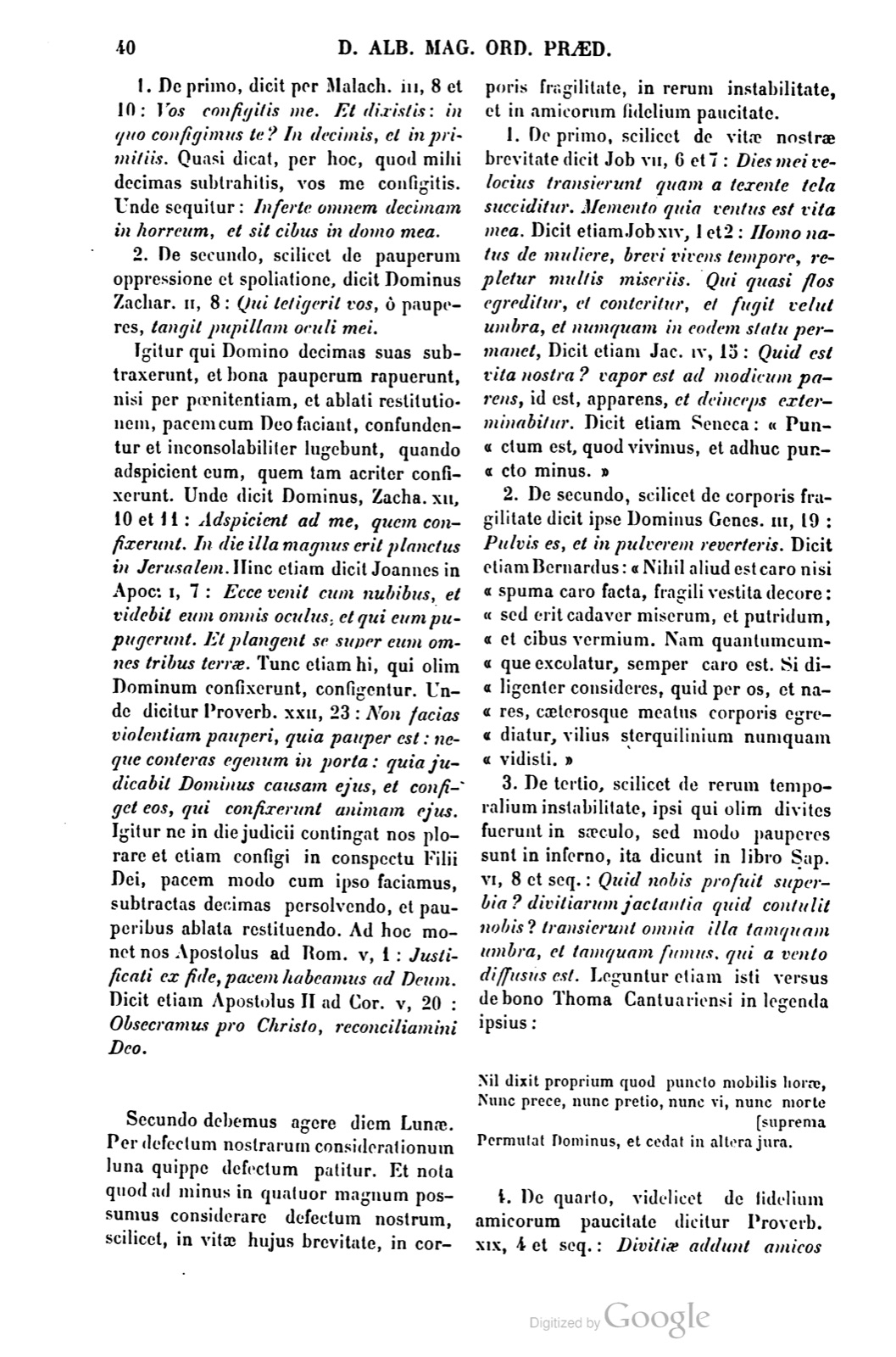
Quarto debemus agere diem Mercurii, qui dicebatur olim esse Deus mercatorum: dicitur enim Mercurius quasi merces curans. Debemus, inquam, agere diem Mercurii, ut videlicet, quia triplex est defectus noster, quamdiu sumus in foro praesentis vitae, pro aeternis bonis fideliter laboremus. Unde Dominus dicit in Evangelio, Luc. XIX, 12 et 13: Homo quidam nobilis, vocatis servis suis, dedit eis decem mnas, et ait ad illos: Negotiamini dum venio. Per decem mnas intelliguntur tria, quae Deo specialiter offeruntur: et septem, quae propter Dominum pauperibus exhibentur. Tria, quae Deo specialiter offeruntur, sunt haec, videlicet carnis maceratio, supplex oratio, et devota ploratio. Septem, quae propter Deum pauperibus exhibentur, sunt septem opera misericordiae, videlicet peregrinos in hospitium recipere, sitienti potum exhibere, esurientes cibo reficere, captivos redimere, nudos vestire, infirmos visitare, mortuos sepelire. Haec septem notantur in uno versiculo:
Colligo, poto, cibo, redimo, tego, visito, condo.
Igitur per praedicta negotiari debemus, ut decem mnas, id est denarium perpetuae retributionis acquiramus.
Quinto debemus agere diem Jovis, qui in vulgari dicitur dies tonitrui. Debemus, inquam, diem illius magni et extremi, id est, diem judicii semper in mente habere, ut eo ferventius aeternis bonis acquirendis insistamus, et ut etiam ea bona, quae jam acquisivimus, per stultitiam et negligentiam non amittamus. Dies itaque judicii est dies tonitrui. Tunc enim tonitruo divinae potentiae percutiet Deus peccatores, quando dicet Dominus: Discedite a me maledicti in ignem aeternum 2. De hoc tonitruo dicitur Eccli. XLIII, 18: Vox tonitrui ejus verberabit terram. Hunc ergo diem semper habeamus in mente, ne per vanam gloriam et jactantiam, si qua jam bona fecimus, amittamus. Nihil quippe tunc quantumcumque justo bonis operibus supererit, sed potius sibi deesse timebit.
Sexto debemus agere diem Veneris, quae putabatur olim esse dea amoris. Debemus, inquam, agere diem Veneris, ut quia divino judicio tanto timore adstabimus, multos tunc inveniamus amicos. Necessarium igitur nobis est, ut ipsius sanctae Trinitatis, ac Beatae Virginis, nec non et Angelorum, Patriarcharum, Prophetarum, Apostolorum, Martyrum, Confessorum, Virginum, et omnium aliorum electorum conquiramus amicitias. Unde dicitur in Proverb. XXV, 10: Gratia et amicitia liberant: quas tibi serva, ne exprobrabilis fias. Exprobrabilis, id est, vituperabilis in die judicii. Dicitur etiam Sap. VI, 18: In amicitia illius, id est, Filii Dei, est delectatio bona.
Fourth, we ought to keep the day of Mercury, who once was said to be the god of merchants; for Mercury is said as though caring for merchandise. We ought, I say, to keep the day of Mercury, namely so that, because our defect is threefold as long as we are in the marketplace of the present life, we may labor faithfully for eternal goods. Hence the Lord says in the Gospel, Luke XIX, 12 and 13: A certain noble man, having called his servants, gave them ten minas and said to them: Trade until I come. By the ten minas are understood three things which are offered especially to God and seven which are shown to the poor on account of the Lord. The three which are offered especially to God are these, namely maceration of the flesh, suppliant prayer, and devout weeping. The seven which are shown to the poor on account of God are the seven works of mercy, namely to receive pilgrims into lodging, to offer drink to the thirsty, to refresh the hungry with food, to redeem captives, to clothe the naked, to visit the sick, to bury the dead. These seven are noted in one little verse:
I gather, I give drink, I feed, I redeem, I cover, I visit, I bury.
Therefore through the aforesaid things we ought to trade, so that we may acquire the ten minas, that is, the denarius of perpetual repayment.
Fifth, we ought to keep the day of Jove, which in common speech is called the day of thunder. We ought, I say, always to have in mind the day of that great and final one, that is, the day of judgment, so that with so much more fervor we may apply ourselves to acquiring eternal goods, and so that we may not lose through foolishness and negligence even those goods which we have already acquired. Therefore the day of judgment is the day of thunder. For then with the thunder of divine power God will strike sinners, when the Lord will say: Depart from me, cursed ones, into eternal fire 2. Concerning this thunder Ecclesiasticus XLIII, 18 says: The voice of his thunder will scourge the earth. Therefore let us always have this day in mind, lest through vain glory and boasting we lose any good things which we have already done. For then nothing, however much, will be left over for the just man from good works, but rather he will fear that it is lacking to him.
Sixth, we ought to keep Venus's day, who once was thought to be the goddess of love. We ought, I say, to keep Venus's day, so that, because we will stand before divine judgment with so great a fear, we may then find many friends. Therefore it is necessary for us to seek the friendships of the holy Trinity itself, and of the Blessed Virgin, and also of Angels, Patriarchs, Prophets, Apostles, Martyrs, Confessors, Virgins, and all the other elect. Hence Proverbs XXV, 10 says: Grace and friendship free; keep them for yourself, lest you become reproachable. Reproachable, that is, blameworthy on the day of judgment. Wisdom VI, 18 also says: In friendship with him, that is, with the Son of God, there is good delight.
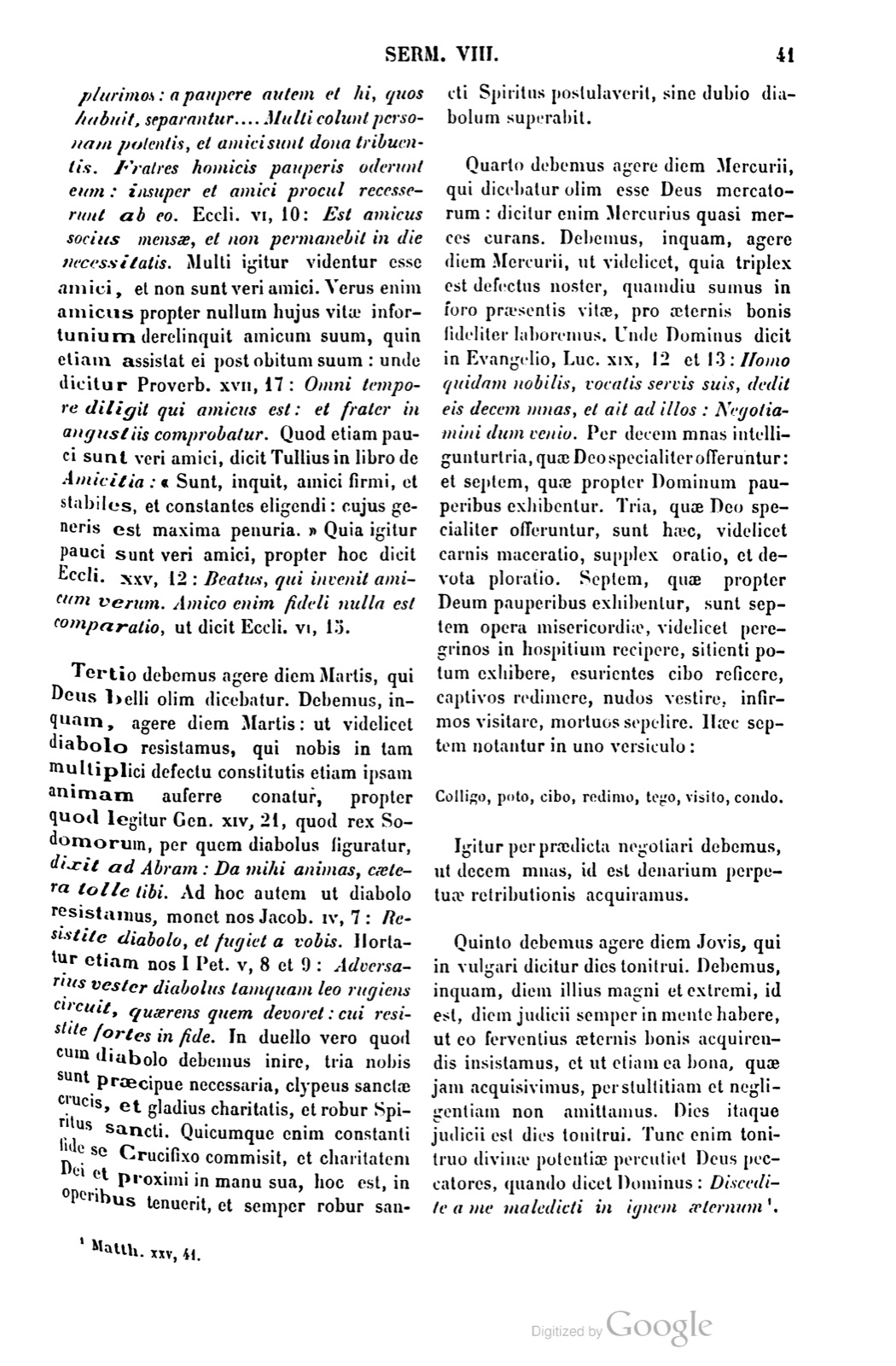
Et nota, quod per tria, scilicet per paenitentiam, et cordis munditiam, ac eleemosynam possumus acquirere amicitiam Dei et sanctorum ejus. De primo, scilicet de paenitentia dicitur Proverb. XVII, 9: Qui celat delictum, quaerit amicitias. Qui igitur pallio paenitentiae celat delicta sua, quaerit amicitiam Dei. De secundo, scilicet de cordis munditia dicitur Proverb. XXII, 11: Qui diligit cordis munditiam, habebit amicum regem, scilicet Jesum Christum. De tertio, scilicet de eleemosyna dicit Dominus Luc. XVI, 9: Facite vobis amicos de mammona iniquitatis: ut cum defeceritis, recipiant vos in aeterna tabernacula.
Qui igitur sex praedictos dies complevit, scilicet Deo se per paenitentiam reconciliando, defectus suos et inopiam considerando, hostes animae, id est, daemones expugnando, pro bonis aeternis studiose negotiando, diei judicii jugiter recordando, et Sanctorum sibi amicitias operando: talis transibit, scilicet, ad requiem animarum et Sabbatum delicatum.
Et bene dies septimus, id est, tempus post hanc vitam Sabbatum appellatur. Sicut enim Judaeis in sabbato operari non licebat: ita etiam electorum animae cum transierint ex hac vita, deinceps non laborabunt, sed tantum visioni divinae cum suavitate vacabunt. Quod autem beatorum animae post hanc vitam non laborabunt, dicitur Apoc. XIV, 13: Scribe: Beati mortui, qui in Domino moriuntur. Amodo jam dicit Spiritus, ut requiescant a laboribus suis. Glossa: «Quod etiam tunc divinae visioni cum suavitate vacabunt, dicitur in Psalm. XXVIII, 9: Gustate, et videte quoniam suavis est Dominus.» Hoc enim erit animarum officium, gustare et videre suavissimum Dominum. De hoc sabbato dicit Isa. LXVI, 23: Erit sabbatum ex sabbato. Quasi dicat: ex sabbato gratiae erit sabbatum gloriae.
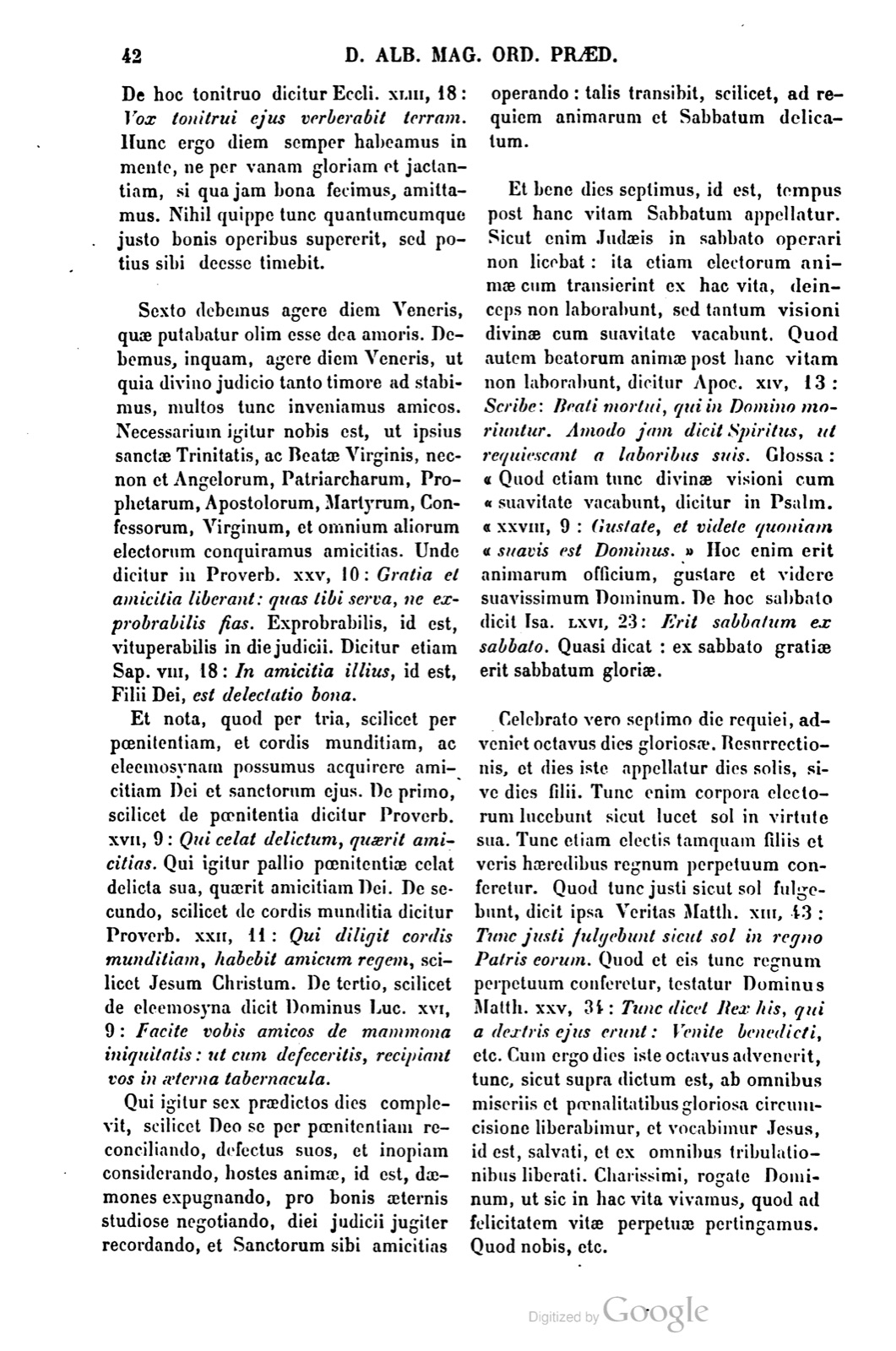
Celebrato vero septimo die requiei, adveniet octavus dies gloriosae Resurrectionis, et dies iste appellatur dies solis, sive dies filii. Tunc enim corpora electorum lucebunt sicut lucet sol in virtute sua. Tunc etiam electis tamquam filiis et veris haeredibus regnum perpetuum conferetur. Quod tunc justi sicut sol fulgebunt, dicit ipsa Veritas Matth. XIII, 43: Tunc justi fulgebunt sicut sol in regno Patris eorum. Quod et eis tunc regnum perpetuum conferetur, testatur Dominus Matth. XXV, 34: Tunc dicet Rex his, qui a dextris ejus erunt: Venite benedicti, etc. Cum ergo dies iste octavus advenerit, tunc, sicut supra dictum est, ab omnibus miseriis et paenalitatibus gloriosa circumcisione liberabimur, et vocabimur Jesus, id est, salvati, et ex omnibus tribulationibus liberati. Charissimi, rogate Dominum, ut sic in hac vita vivamus, quod ad felicitatem vitae perpetuae pertingamus. Quod nobis, etc.
And note that through three things, namely through penance, purity of heart, and almsgiving, we can acquire the friendship of God and of his saints. Concerning the first, namely concerning penance, Proverbs XVII, 9 says: He who conceals a fault seeks friendships. Therefore he who conceals his faults with the cloak of penance seeks the friendship of God. Concerning the second, namely concerning purity of heart, Proverbs XXII, 11 says: He who loves purity of heart will have the king as friend, namely Jesus Christ. Concerning the third, namely concerning almsgiving, the Lord says in Luke XVI, 9: Make friends for yourselves from the mammon of iniquity, so that when you fail they may receive you into eternal tabernacles.
Therefore he who has completed the six aforesaid days, namely by reconciling himself to God through penance, by considering his defects and need, by fighting against the enemies of the soul, that is, demons, by trading zealously for eternal goods, by remembering the day of judgment continually, and by producing friendships of the Saints for himself: such a one will pass, namely, to the rest of souls and the delicate Sabbath.
And rightly the seventh day, that is, the time after this life, is called Sabbath. For just as it was not lawful for the Jews to work on the Sabbath, so also when the souls of the elect have passed from this life, thereafter they will not labor, but will have leisure only for the divine vision with sweetness. That the souls of the blessed will not labor after this life is said in Apocalypse XIV, 13: Write: Blessed are the dead who die in the Lord. From now on, the Spirit now says, that they may rest from their labors. The Gloss: "That also then they will have leisure for the divine vision with sweetness is said in Psalm XXVIII, 9: Taste and see that the Lord is sweet." For this will be the office of souls: to taste and see the sweetest Lord. Concerning this Sabbath Isaiah LXVI, 23 says: There will be Sabbath from Sabbath. As though he said: from the Sabbath of grace there will be the Sabbath of glory.
But when the seventh day of rest has been celebrated, the eighth day of the glorious Resurrection will arrive, and this day is called the day of the sun or the day of the son. For then the bodies of the elect will shine as the sun shines in its strength. Then also the perpetual kingdom will be conferred on the elect as on sons and true heirs. That then the just will shine like the sun Truth itself says in Matthew XIII, 43: Then the just will shine like the sun in the kingdom of their Father. That the perpetual kingdom will then be conferred on them, the Lord testifies in Matthew XXV, 34: Then the King will say to those who will be at his right hand: Come, blessed ones, etc. Therefore when that eighth day has arrived, then, as was said above, by glorious circumcision we will be freed from all miseries and penalties, and we will be called Jesus, that is, saved and freed from all tribulations. Dearest ones, pray to the Lord that we may live in this life in such a way that we may reach the happiness of perpetual life. This to us, etc.
If a page does not appear, its photograph has not been uploaded yet.