Works › Sermons for the Seasons of the Year
Volume 13 · pp. 37–38
Sermon VII, Conclusion
A marker with ≈ is an approximate page boundary, placed by measure of the text; the page photographs remain the authority. In the paired views, clicking a page marker brings that page into view.
Eccli. XXVIII, 28: Sepi aures tuas spinis, linguam nequam noli audire. Igitur in memoria spinarum illarum, quae caput Domini confixerunt, aures nostras sepire debemus, ne linguam nequam, id est, linguam hominis turpiter loquentis aut cantantis audiamus.
4. Quarto lingua, quae, sicut Jacobus dicit III, 8, inquietum est malum, plena veneno mortifero, circumcidenda est ab octo peccatis, in quibus saepe delinquit: ne scilicet proferat turpiloquium, dolum, mendacium, perjurium, adulationem, detractionem, derisionem, et maledictionem. Propter hoc monet nos Spiritus sanctus I Reg. II, 3: Recedant, inquit, vetera de ore vestro: quia Deus scientiarum, Dominus est, et ipsi praeparantur cogitationes. Quasi diceret: Vetera, id est, mala verba, quae veterascere faciunt animam, recedant de ore vestro, quia Dominus haec vindicabit: cui non tantum patent verba, sed etiam cogitationes hominum.
Contra primum, videlicet turpiloquium, dicit Apostolus ad Eph. V, 3 et 4: Omnis immunditia nec nominetur in vobis, sicut decet Sanctos: aut turpitudo, aut stultiloquium, aut scurrilitas.
Contra secundum, scilicet dolum, dicit I Pet. II, 1 et 2: Deponentes omnem malitiam, et omnem dolum..., sicut modo geniti infantes, rationabile, sine dolo lac, id est, consolationem divinam, concupiscite: ut in eo crescatis in salutem.
Contra tertium, videlicet mendacium, dicit Apostolus ad Eph. IV, 25: Deponentes mendacium, loquimini veritatem unusquisque cum proximo suo.
Contra quartum, scilicet juramentum et perjurium, dicitur Ecclesiast. XXIII, 9 et 12: Jurationi non assuescat os tuum: multi enim casus in illa.... Vir multum jurans implebitur iniquitate, et non discedet a domo illius plaga. Glossa, id est, «de corpore plaga vindictae.»
Contra quintum, scilicet adulationem, dicit Apostolus I ad Thes. II, 5: Neque enim aliquando fuimus in sermone adulationis: sicut scitis. Item Ecclesiast. VII, 6: Melius est a sapiente corripi, quam stultorum adulatione decipi.
Contra sextum, scilicet detractionem, dicitur Sap. I, 11: Custodite vos a murmuratione, quia nihil prodest, et a detractione parcite linguae, quoniam sermo obscurus in vacuum non ibit: os autem quod mentitur, occidit animam.
Contra septimum, videlicet irrisionem simplicium et bonorum, dicitur Eccli. VII, 12: Non irrideas hominem in amaritudine animae. Dicit etiam Job XII, 4: Qui deridetur ab amico suo sicut ego, invocabit Deum et exaudiet eum: deridetur enim justi simplicitas. Cavere igitur debes, ne aliquem irrideas: quia sicut dicit Psal. Qui habitat in caelis 1, etc.
Contra octavum, videlicet maledictionem, dicit Apostolus ad Rom. XII, 14: Benedicite persequentibus vos; benedicite et nolite maledicere. Dicit etiam Job. XXXI, 30: Non dedi ad peccandum guttur meum, ut expeterem maledicens animam ejus, qui me oderat.
5. Quinto circumcidendae sunt manus a quatuor, videlicet a tactu lascivo, a furto, a rapina, ab usura.
Ecclesiasticus XXVIII, 28: Hedge your ears with thorns; do not hear a wicked tongue. Therefore, in memory of those thorns which fixed the Lord's head, we ought to hedge our ears, lest we hear a wicked tongue, that is, the tongue of a man speaking or singing shamefully.
4. Fourth, the tongue, which, as James says III, 8, is a restless evil, full of deadly poison, must be circumcised from eight sins in which it often offends: namely, lest it utter filthy speech, deceit, falsehood, perjury, flattery, detraction, derision, and cursing. On account of this the Holy Spirit admonishes us in I Kings II, 3: Let old things depart, he says, from your mouth, because the Lord is the God of knowledges, and thoughts are prepared for him. As though he said: Old things, that is, evil words, which make the soul grow old, should depart from your mouth, because the Lord will avenge these things; to him not only words are open, but also the thoughts of men.
Against the first, namely filthy speech, the Apostle says in Ephesians V, 3 and 4: Let no uncleanness even be named among you, as befits the Saints; or foulness, or foolish talk, or buffoonery.
Against the second, namely deceit, I Peter II, 1 and 2 says: Laying aside all malice and all deceit..., as newborn infants, desire rational milk without deceit, that is, divine consolation, so that in it you may grow into salvation.
Against the third, namely falsehood, the Apostle says in Ephesians IV, 25: Laying aside falsehood, let each one speak truth with his neighbor.
Against the fourth, namely swearing and perjury, it is said in Ecclesiasticus XXIII, 9 and 12: Let not your mouth become accustomed to an oath; for there are many falls in it.... A man swearing much will be filled with iniquity, and the plague will not depart from his house. The Gloss: that is, "from the body the plague of vengeance."
Against the fifth, namely flattery, the Apostle says in I Thessalonians II, 5: For neither were we at any time in speech of flattery, as you know. Likewise Ecclesiastes VII, 6: It is better to be corrected by a wise man than to be deceived by the flattery of fools.
Against the sixth, namely detraction, it is said in Wisdom I, 11: Keep yourselves from murmuring, because it profits nothing, and spare the tongue from detraction, since obscure speech will not go into emptiness; but the mouth that lies kills the soul.
Against the seventh, namely derision of the simple and good, it is said in Ecclesiasticus VII, 12: Do not mock a man in bitterness of soul. Job XII, 4 also says: He who is mocked by his friend, as I am, will call upon God and he will hear him; for the simplicity of the just man is mocked. Therefore you ought to beware lest you mock anyone, because as the Psalm says, He who dwells in the heavens 1, etc.
Against the eighth, namely cursing, the Apostle says in Romans XII, 14: Bless those persecuting you; bless and do not curse. Job XXXI, 30 also says: I did not give my throat to sin, so that cursing I would seek the soul of him who hated me.
5. Fifth, the hands must be circumcised from four things, namely from lascivious touch, from theft, from robbery, from usury.
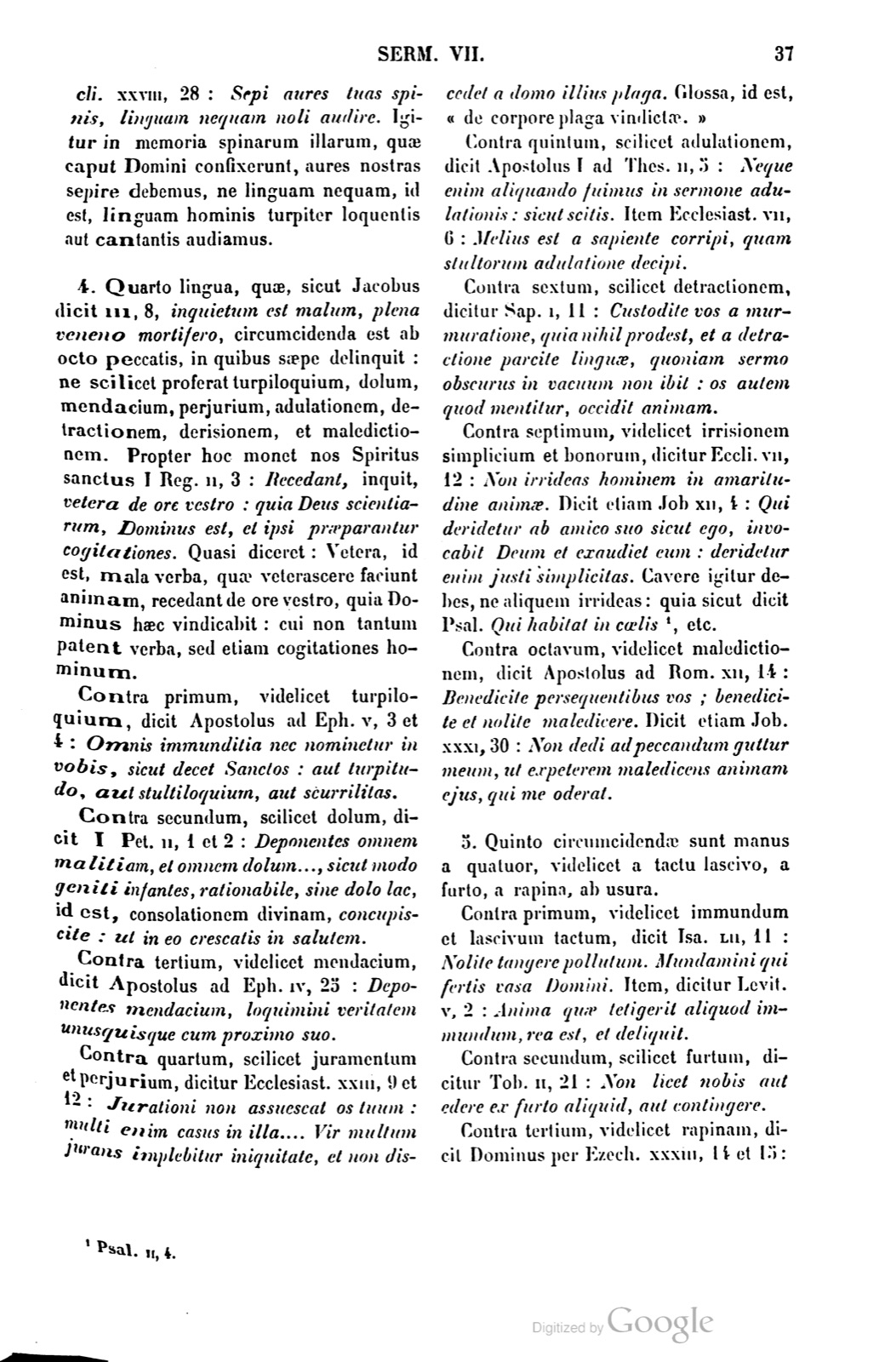
Contra primum, videlicet immundum et lascivum tactum, dicit Isa. LII, 11: Nolite tangere pollutum. Mundamini qui fertis vasa Domini. Item, dicitur Levit. V, 2: Anima quae tetigerit aliquod immundum, rea est, et deliquit.
Contra secundum, scilicet furtum, dicitur Tob. II, 21: Non licet nobis aut edere ex furto aliquid, aut contingere.
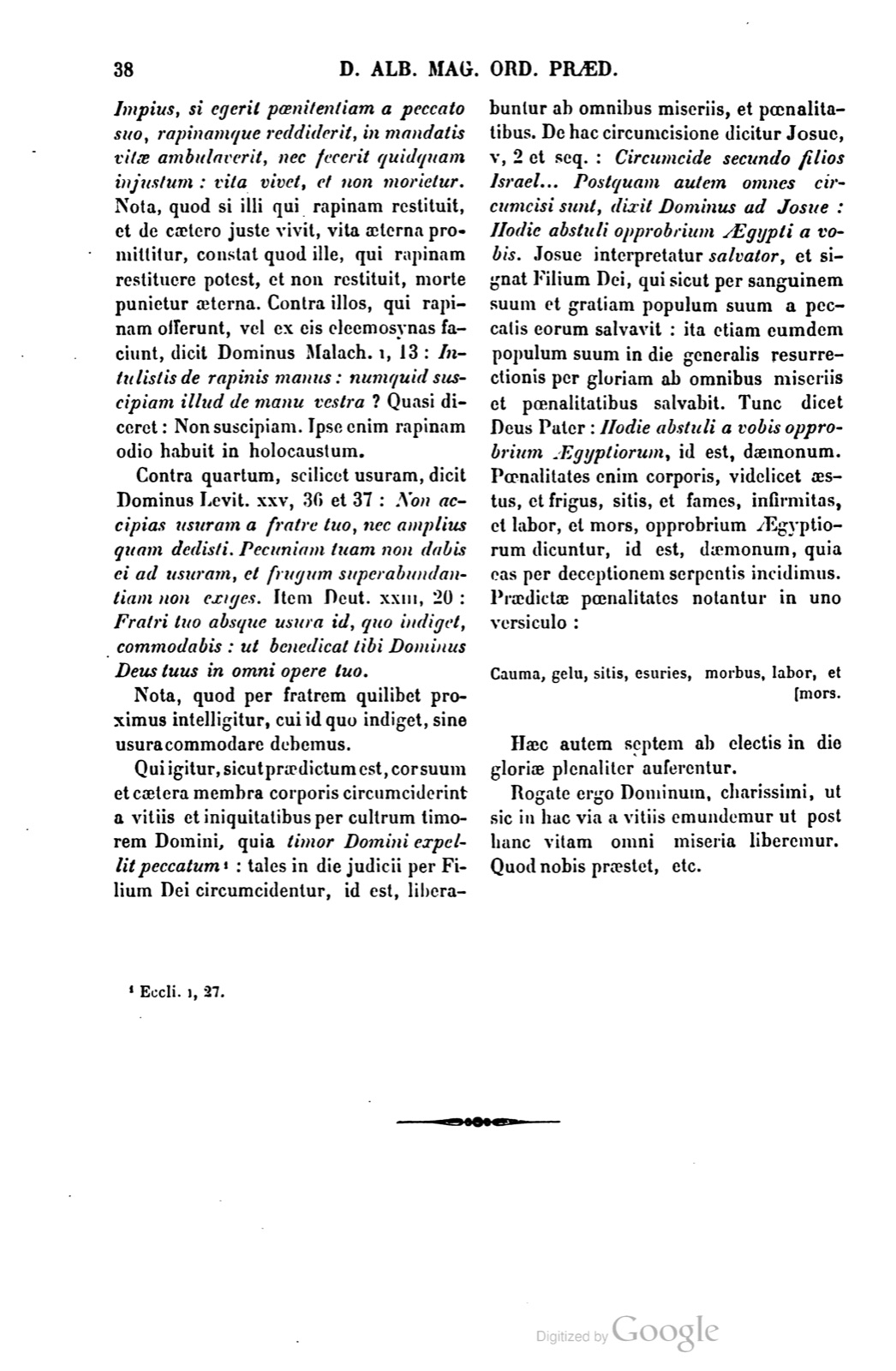
Contra tertium, videlicet rapinam, dicit Dominus per Ezech. XXXIII, 14 et 15: Impius, si egerit paenitentiam a peccato suo, rapinamque reddiderit, in mandatis vitae ambulaverit, nec fecerit quidquam injustum: vita vivet, et non morietur. Nota, quod si illi qui rapinam restituit, et de caetero juste vivit, vita aeterna promittitur, constat quod ille, qui rapinam restituere potest, et non restituit, morte punietur aeterna. Contra illos, qui rapinam offerunt, vel ex eis eleemosynas faciunt, dicit Dominus Malach. I, 13: Intulistis de rapinis manus: numquid suscipiam illud de manu vestra? Quasi diceret: Non suscipiam. Ipse enim rapinam odio habuit in holocaustum.
Contra quartum, scilicet usuram, dicit Dominus Levit. XXV, 36 et 37: Non accipias usuram a fratre tuo, nec amplius quam dedisti. Pecuniam tuam non dabis ei ad usuram, et frugum superabundantiam non exiges. Item Deut. XXIII, 20: Fratri tuo absque usura id, quo indiget, commodabis: ut benedicat tibi Dominus Deus tuus in omni opere tuo. Nota, quod per fratrem quilibet proximus intelligitur, cui id quo indiget, sine usura commodare debemus.
Qui igitur, sicut praedictum est, cor suum et caetera membra corporis circumciderint a vitiis et iniquitatibus per cultrum timorem Domini, quia timor Domini expellit peccatum 2: tales in die judicii per Filium Dei circumcidentur, id est, liberabuntur ab omnibus miseriis, et paenalitatibus. De hac circumcisione dicitur Josue, V, 2 et seq.: Circumcide secundo filios Israel... Postquam autem omnes circumcisi sunt, dixit Dominus ad Josue: Hodie abstuli opprobrium Aegypti a vobis. Josue interpretatur salvator, et signat Filium Dei, qui sicut per sanguinem suum et gratiam populum suum a peccatis eorum salvavit: ita etiam eumdem populum suum in die generalis resurrectionis per gloriam ab omnibus miseriis et paenalitatibus salvabit. Tunc dicet Deus Pater: Hodie abstuli a vobis opprobrium Aegyptiorum, id est, daemonum. Paenalitates enim corporis, videlicet aestus, et frigus, sitis, et fames, infirmitas, et labor, et mors, opprobrium Aegyptiorum dicuntur, id est, daemonum, quia eas per deceptionem serpentis incidimus. Praedictae paenalitates notantur in uno versiculo:
Cauma, gelu, sitis, esuries, morbus, labor, et mors.
Haec autem septem ab electis in die gloriae plenaliter auferentur. Rogate ergo Dominum, charissimi, ut sic in hac via a vitiis emundemur ut post hanc vitam omni miseria liberemur. Quod nobis praestet, etc.
Against the first, namely unclean and lascivious touch, Isaiah LII, 11 says: Do not touch what is polluted. Be cleansed, you who bear the vessels of the Lord. Likewise, Leviticus V, 2 says: The soul that touches something unclean is guilty and has offended.
Against the second, namely theft, Tobit II, 21 says: It is not lawful for us either to eat anything from theft or to touch it.
Against the third, namely robbery, the Lord says through Ezekiel XXXIII, 14 and 15: If the impious man has done penance for his sin, and has returned robbery, has walked in the commandments of life, and has done nothing unjust, he will live by life and will not die. Note that if eternal life is promised to the one who restores robbery and afterward lives justly, it is clear that the one who is able to restore robbery and does not restore it will be punished by eternal death. Against those who offer robbery or make alms from it, the Lord says in Malachi I, 13: You have brought in from robberies by your hands; shall I receive that from your hand? As though he said: I shall not receive it. For he himself has hated robbery in holocaust.
Against the fourth, namely usury, the Lord says in Leviticus XXV, 36 and 37: Do not receive usury from your brother, nor more than you gave. You shall not give your money to him at usury, and you shall not exact an overabundance of crops. Likewise Deuteronomy XXIII, 20: To your brother you shall lend without usury that which he needs, so that the Lord your God may bless you in every work of yours. Note that by brother any neighbor is understood, to whom we ought to lend without usury that which he needs.
Therefore those who, as was said before, have circumcised their heart and the other members of the body from vices and iniquities by the knife, the fear of the Lord, because the fear of the Lord drives out sin 2: such persons on the day of judgment will be circumcised by the Son of God, that is, they will be freed from all miseries and penalties. Concerning this circumcision it is said in Joshua V, 2 and following: Circumcise the children of Israel a second time... But after all had been circumcised, the Lord said to Joshua: Today I have taken away from you the reproach of Egypt. Joshua is interpreted "savior" and marks the Son of God, who, just as by his blood and grace he saved his people from their sins, so also on the day of the general resurrection by glory he will save that same people of his from all miseries and penalties. Then God the Father will say: Today I have taken away from you the reproach of the Egyptians, that is, of demons. For the penalties of the body, namely heat and cold, thirst and hunger, sickness and labor and death, are called the reproach of the Egyptians, that is, of demons, because we fell into them through the deception of the serpent. The aforesaid penalties are noted in one little verse:
Heat, frost, thirst, hunger, disease, labor, and death.
But these seven will be taken away fully from the elect on the day of glory. Therefore pray to the Lord, dearest ones, that in this way we may be cleansed from vices on this road, so that after this life we may be freed from every misery. May he grant this to us, etc.
If a page does not appear, its photograph has not been uploaded yet.