Volume 13 · pp. 517–518
Sermon XXVI. On the Same Feast of Saint Mary Magdalene
A marker with ≈ is an approximate page boundary, placed by measure of the text; the page photographs remain the authority. In the paired views, clicking a page marker brings that page into view.
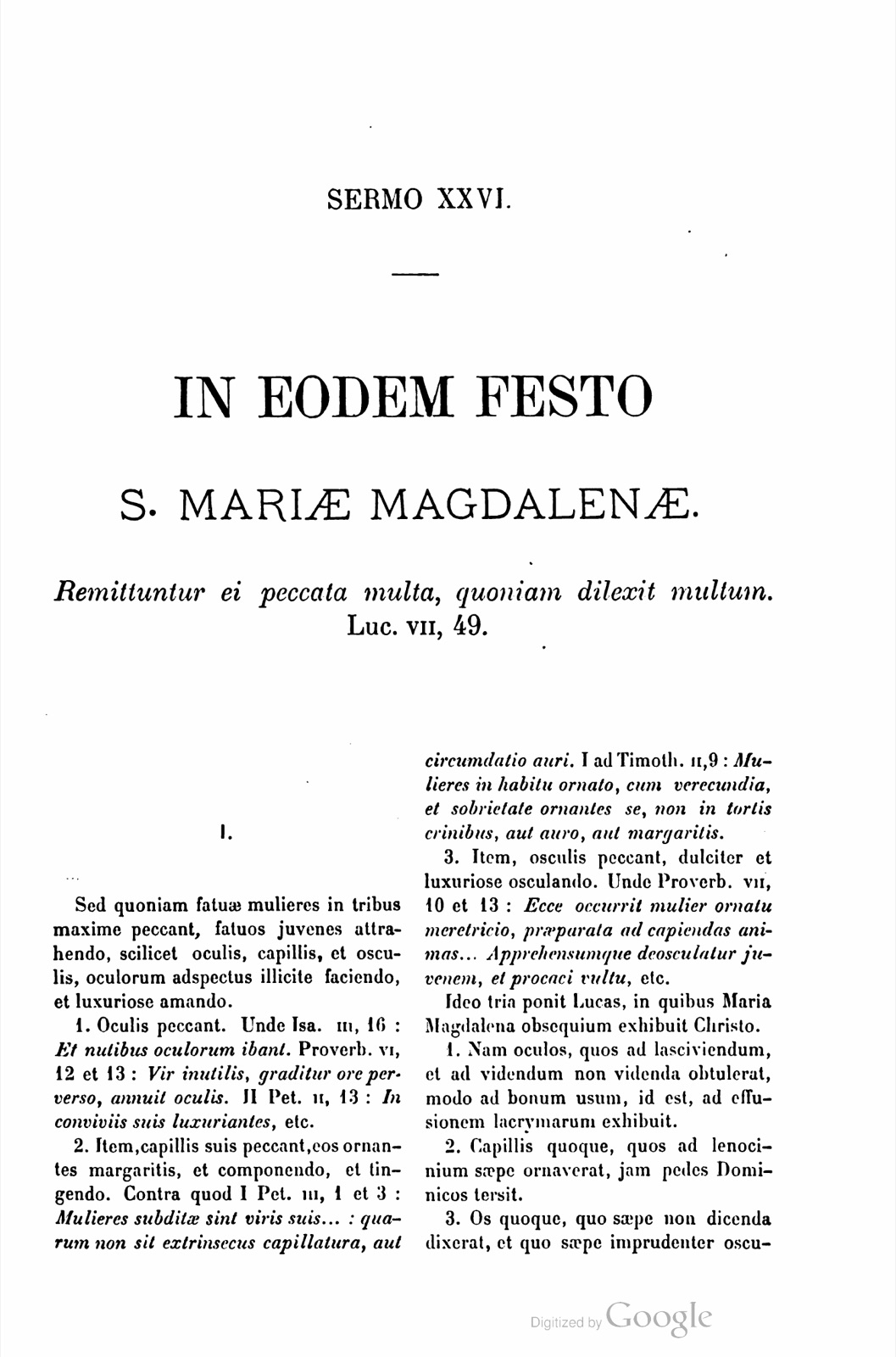
SERMO XXVI.
IN EODEM FESTO S. MARIÆ MAGDALENÆ.
Remittuntur ei peccata multa, quoniam dilexit multum. Luc. VII, 49.
I.
Sed quoniam fatuæ mulieres in tribus maxime peccant, fatuos juvenes attrahendo, scilicet oculis, capillis, et osculis, oculorum adspectus illicite faciendo, et luxuriose amando.
1. Oculis peccant. Unde Isa. III, 16: Et nutibus oculorum ibant. Proverb. VI, 12 et 13: Vir inutilis, graditur ore perverso, annuit oculis. II Pet. II, 13: In conviviis suis luxuriantes, etc.
2. Item, capillis suis peccant, eos ornantes margaritis, et componendo, et tingendo. Contra quod I Pet. III, 1 et 3: Mulieres subditæ sint viris suis...: quarum non sit extrinsecus capillatura, aut circumdatio auri. I ad Timoth. II, 9: Mulieres in habitu ornato, cum verecundia, et sobrietate ornantes se, non in tortis crinibus, aut auro, aut margaritis.
3. Item, osculis peccant, dulciter et luxuriose osculando. Unde Proverb. VII, 10 et 13: Ecce occurrit mulier ornatu meretricio, præparata ad capiendas animas... Apprehensumque deosculatur juvenem, et procaci vultu, etc.
Ideo tria ponit Lucas, in quibus Maria Magdalena obsequium exhibuit Christo.
1. Nam oculos, quos ad lasciviendum, et ad videndum non videnda obtulerat, modo ad bonum usum, id est, ad effusionem lacrymarum exhibuit.
2. Capillis quoque, quos ad lenocinium sæpe ornaverat, jam pedes Dominicos tersit.
3. Os quoque, quo sæpe non dicenda dixerat, et quo sæpe imprudenter osculata fuerat, jam ad osculandos pedes Domini humiliabat, sicque adimplevit in se illud Apostoli ad Rom. VI, 19: Sicut exhibuistis membra vestra, etc.
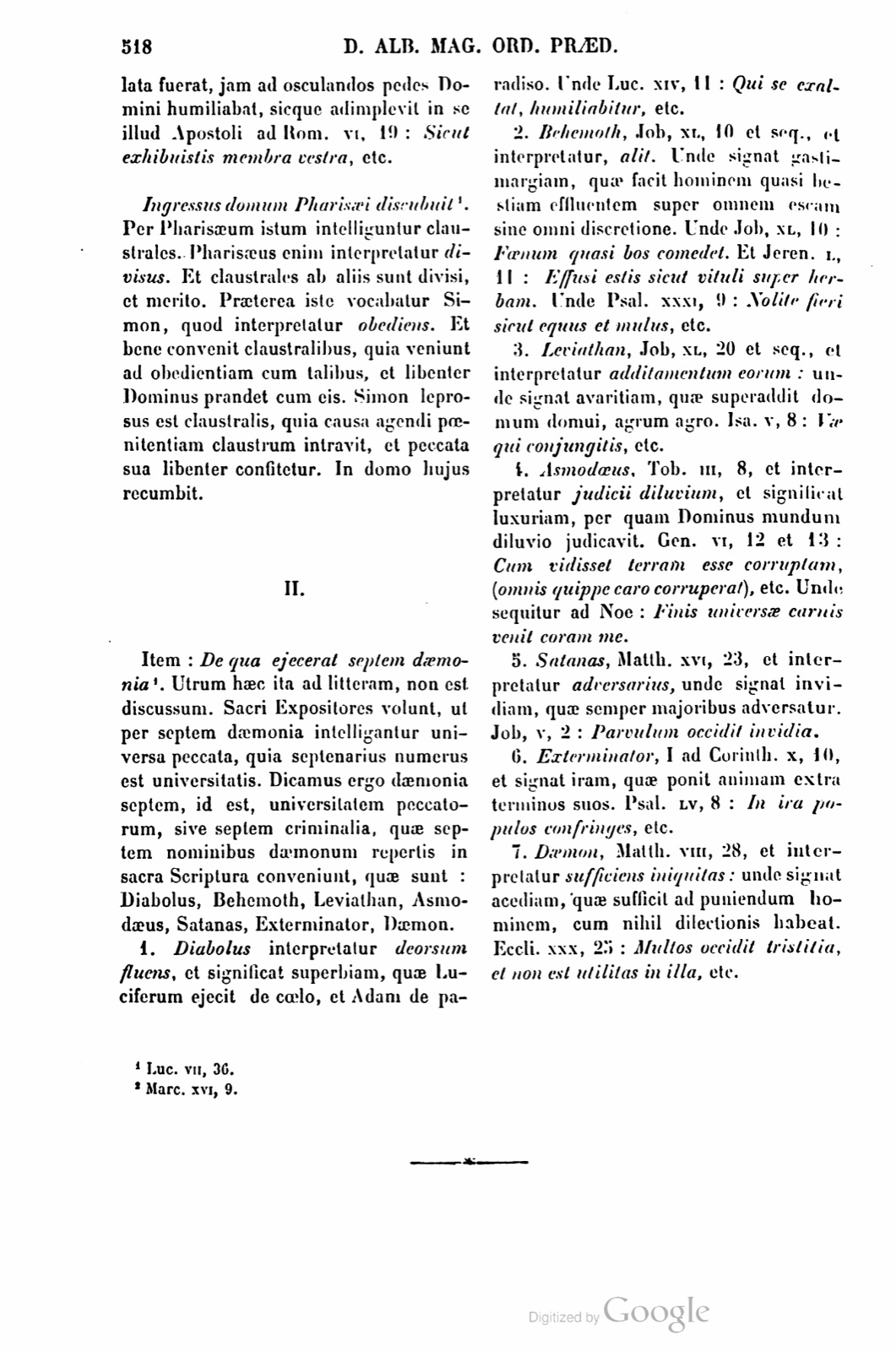
Ingressus domum Pharisæi discubuit 1. Per Pharisæum istum intelliguntur claustrales. Pharisæus enim interpretatur divisus. Et claustrales ab aliis sunt divisi, et merito. Præterea iste vocabatur Simon, quod interpretatur obediens. Et bene convenit claustralibus, quia veniunt ad obedientiam cum talibus, et libenter Dominus prandet cum eis. Simon leprosus est claustralis, quia causa agendi pœnitentiam claustrum intravit, et peccata sua libenter confitetur. In domo hujus recumbit.
SERMON XXVI.
ON THE SAME FEAST OF SAINT MARY MAGDALENE.
Many sins are forgiven her, because she loved much. Luke 7:49.
I.
But since foolish women sin especially in three things by attracting foolish young men, namely with eyes, hair, and kisses, by making illicit sights of the eyes and by loving luxuriously.
1. They sin with the eyes. Hence Isaiah 3:16 says: And they walked with beckonings of the eyes. Proverbs 6:12 and 13: A useless man walks with a perverse mouth; he winks with the eyes. 2 Peter 2:13: Reveling in their banquets, etc.
2. Likewise, they sin with their hair by adorning it with pearls, and by arranging and dyeing it. Against this 1 Peter 3:1 and 3 says: Let women be subject to their husbands... whose adornment should not be outward braiding of hair or encircling with gold. 1 Timothy 2:9: Women adorning themselves in ornate dress with modesty and sobriety, not with twisted hairs, or gold, or pearls.
3. Likewise, they sin with kisses, by kissing sweetly and lustfully. Hence Proverbs 7:10 and 13 says: Behold, a woman meets him in the clothing of a harlot, prepared for capturing souls... and having seized the young man she kisses him, and with shameless face, etc.
Therefore Luke sets down three things in which Mary Magdalene showed service to Christ.
1. For the eyes that she had offered for wantoning and for seeing things not to be seen, now she displayed for a good use, that is, for the outpouring of tears.
2. With the hair also, which she had often adorned for enticement, she now wiped the Lord's feet.
3. The mouth also, by which she had often said things not to be said, and by which she had often been kissed imprudently, she now humbled for kissing the Lord's feet, and thus fulfilled in herself that word of the Apostle at Romans 6:19: As you have presented your members, etc.
He entered the house of the Pharisee and reclined 1. By this Pharisee cloistered persons are understood. For Pharisee is interpreted divided. And cloistered persons are divided from others, and deservedly. Moreover this one was called Simon, which is interpreted obedient. And it agrees well with cloistered persons, because they come to obedience with such persons, and the Lord willingly dines with them. Simon the leper is a cloistered person, because for the sake of doing penance he entered the cloister and willingly confesses his sins. He reclines in this one's house.
II.
Item: De qua ejecerat septem dæmonia 2. Utrum hæc ita ad litteram, non est discussum. Sacri Expositores volunt, ut per septem dæmonia intelligantur universa peccata, quia septenarius numerus est universitatis. Dicamus ergo dæmonia septem, id est, universitatem peccatorum, sive septem criminalia, quæ septem nominibus dæmonum repertis in sacra Scriptura conveniunt, quæ sunt: Diabolus, Behemoth, Leviathan, Asmodæus, Satanas, Exterminator, Dæmon.
1. Diabolus interpretatur deorsum fluens, et significat superbiam, quæ Luciferum ejecit de cælo, et Adam de paradiso. Unde Luc. XIV, 11: Qui se exaltat, humiliabitur, etc.
2. Behemoth, Job, XL, 10 et seq., et interpretatur, alit. Unde signat gastimargiam, quæ facit hominem quasi bestiam effluentem super omnem escam sine omni discretione. Unde Job, XL, 10: Fænum quasi bos comedet. Et Jerem. L, 11: Effusi estis sicut vituli super herbam. Unde Psal. XXXI, 9: Nolite fieri sicut equus et mulus, etc.
3. Leviathan, Job, XL, 20 et seq., et interpretatur additamentum eorum: unde signat avaritiam, quæ superaddit domum domui, agrum agro. Isa. V, 8: Væ qui conjungitis, etc.
4. Asmodæus, Tob. III, 8, et interpretatur judicii diluvium, et significat luxuriam, per quam Dominus mundum diluvio judicavit. Gen. VI, 12 et 13: Cum vidisset terram esse corruptam, (omnis quippe caro corruperat), etc. Unde sequitur ad Noe: Finis universæ carnis venit coram me.
5. Satanas, Matth. XVI, 23, et interpretatur adversarius, unde signat invidiam, quæ semper majoribus adversatur. Job, V, 2: Parvulum occidit invidia.
6. Exterminator, I ad Corinth. X, 10, et signat iram, quæ ponit animam extra terminos suos. Psal. LV, 8: In ira populos confringes, etc.
7. Dæmon, Matth. VIII, 28, et interpretatur sufficiens iniquitas: unde signat acediam, quæ sufficit ad puniendum hominem, cum nihil dilectionis habeat. Eccli. XXX, 25: Multos occidit tristitia, et non est utilitas in illa, etc.
II.
Likewise: From whom he had cast out seven demons 2. Whether this is so according to the letter has not been discussed. Sacred Expositors wish that through the seven demons all sins be understood, because the number seven is the number of universality. Therefore let us call them seven demons, that is, the universality of sins, or the seven criminal sins, which correspond to the seven names of demons found in sacred Scripture, which are: Diabolus, Behemoth, Leviathan, Asmodeus, Satan, Exterminator, Demon.
1. Diabolus is interpreted flowing downward, and signifies pride, which cast Lucifer out of heaven and Adam out of paradise. Hence Luke 14:11 says: He who exalts himself will be humbled, etc.
2. Behemoth, Job 40:10 and following, is interpreted, he nourishes. Hence he signifies gluttony, which makes a man like a beast pouring itself out over every food without any discretion. Hence Job 40:10 says: He will eat hay like an ox. And Jeremiah 50:11: You have poured yourselves out like calves upon the grass. Hence Psalm 31:9: Do not become like horse and mule, etc.
3. Leviathan, Job 40:20 and following, is interpreted their addition; hence he signifies avarice, which adds house to house and field to field. Isaiah 5:8: Woe to you who join, etc.
4. Asmodeus, Tobit 3:8, is interpreted flood of judgment, and signifies lust, through which the Lord judged the world by the flood. Genesis 6:12 and 13: When he had seen that the earth was corrupted (for all flesh had corrupted), etc. Hence it follows to Noah: The end of all flesh has come before me.
5. Satan, Matthew 16:23, is interpreted adversary; hence he signifies envy, which always opposes greater persons. Job 5:2: Envy kills the little one.
6. Exterminator, 1 Corinthians 10:10, signifies anger, which sets the soul outside its boundaries. Psalm 55:8: In wrath you will break peoples, etc.
7. Demon, Matthew 8:28, is interpreted sufficient iniquity; hence he signifies sloth, which is sufficient for punishing a man, since it has nothing of love. Ecclesiasticus 30:25: Sorrow has killed many, and there is no usefulness in it, etc.
If a page does not appear, its photograph has not been uploaded yet.