Volume 13 · pp. 514–516
Sermon XXV. On the Feast of Saint Mary Magdalene, Opening
A marker with ≈ is an approximate page boundary, placed by measure of the text; the page photographs remain the authority. In the paired views, clicking a page marker brings that page into view.
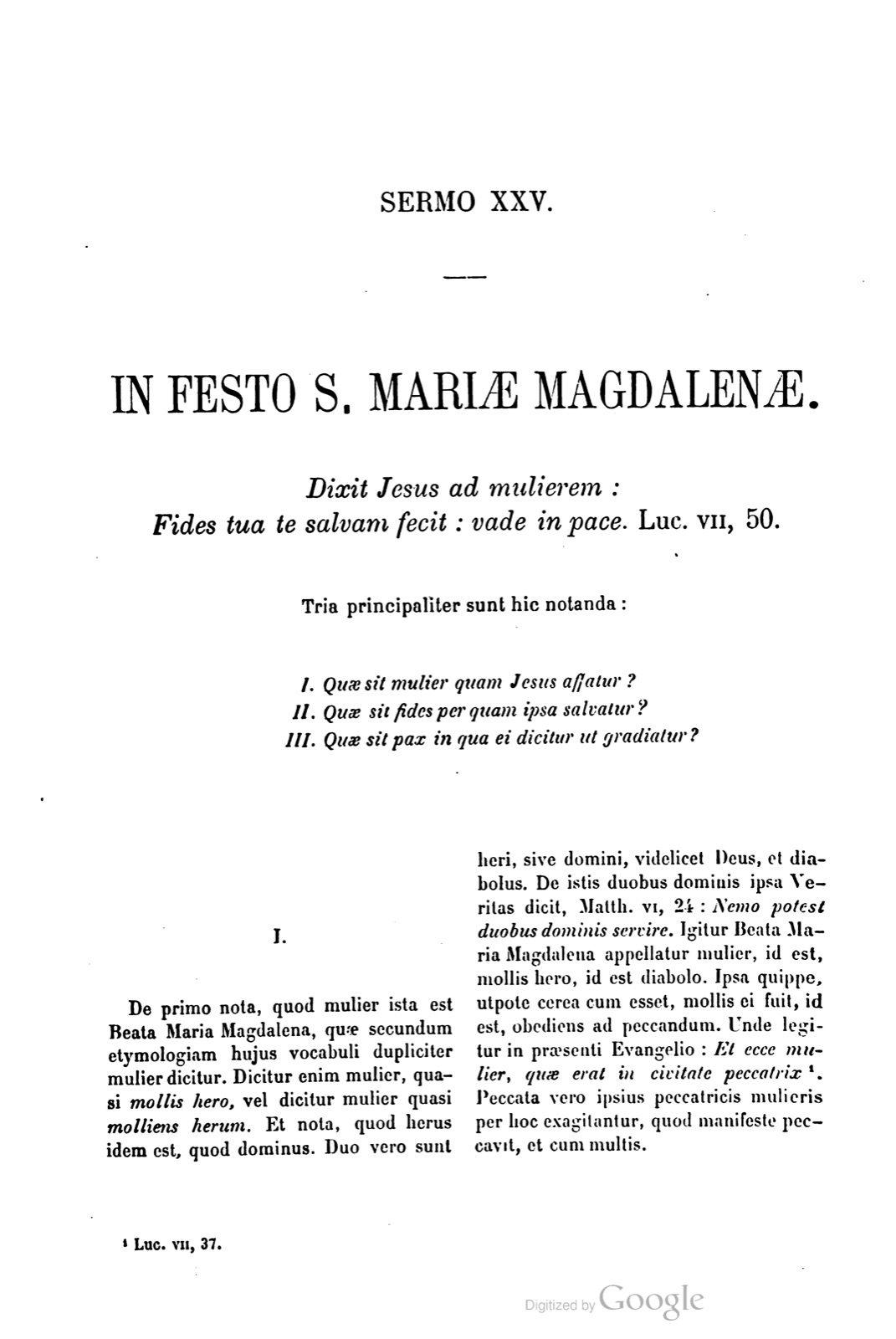
SERMO XXV.
IN FESTO S. MARIÆ MAGDALENÆ.
Dixit Jesus ad mulierem: Fides tua te salvam fecit: vade in pace. Luc. VII, 50.
Tria principaliter sunt hic notanda:
I. Quæ sit mulier quam Jesus affatur? II. Quæ sit fides per quam ipsa salvatur? III. Quæ sit pax in qua ei dicitur ut gradiatur?
I.
De primo nota, quod mulier ista est Beata Maria Magdalena, quæ secundum etymologiam hujus vocabuli dupliciter mulier dicitur. Dicitur enim mulier, quasi mollis hero, vel dicitur mulier quasi molliens herum. Et nota, quod herus idem est, quod dominus. Duo vero sunt heri, sive domini, videlicet Deus, et diabolus. De istis duobus dominis ipsa Veritas dicit, Matth. VI, 24: Nemo potest duobus dominis servire. Igitur Beata Maria Magdalena appellatur mulier, id est, mollis hero, id est diabolo. Ipsa quippe, utpote cerea cum esset, mollis ei fuit, id est, obediens ad peccandum. Unde legitur in præsenti Evangelio: Et ecce mulier, quæ erat in civitate peccatrix 1. Peccata vero ipsius peccatricis mulieris per hoc exagitantur, quod manifeste peccavit, et cum multis.
SERMON XXV.
ON THE FEAST OF SAINT MARY MAGDALENE.
Jesus said to the woman: Your faith has made you safe; go in peace. Luke 7:50.
Principally three things are to be noted here:
I. What is the woman whom Jesus addresses? II. What is the faith through which she is saved? III. What is the peace in which she is told to walk?
I.
On the first, note that this woman is Blessed Mary Magdalene, who according to the etymology of this word is called woman in two ways. For woman is said as if soft to the master, or woman is said as if softening the master. And note that master is the same as lord. But there are two masters, or lords, namely God and the devil. Concerning these two lords Truth itself says, Matthew 6:24: No one can serve two lords. Therefore Blessed Mary Magdalene is called woman, that is, soft to the master, that is, to the devil. For she herself, since she was as wax, was soft to him, that is, obedient for sinning. Hence one reads in the present Gospel: And behold, a woman who was a sinner in the city 1. But the sins of this sinful woman are sharpened by this, that she sinned manifestly and with many persons.
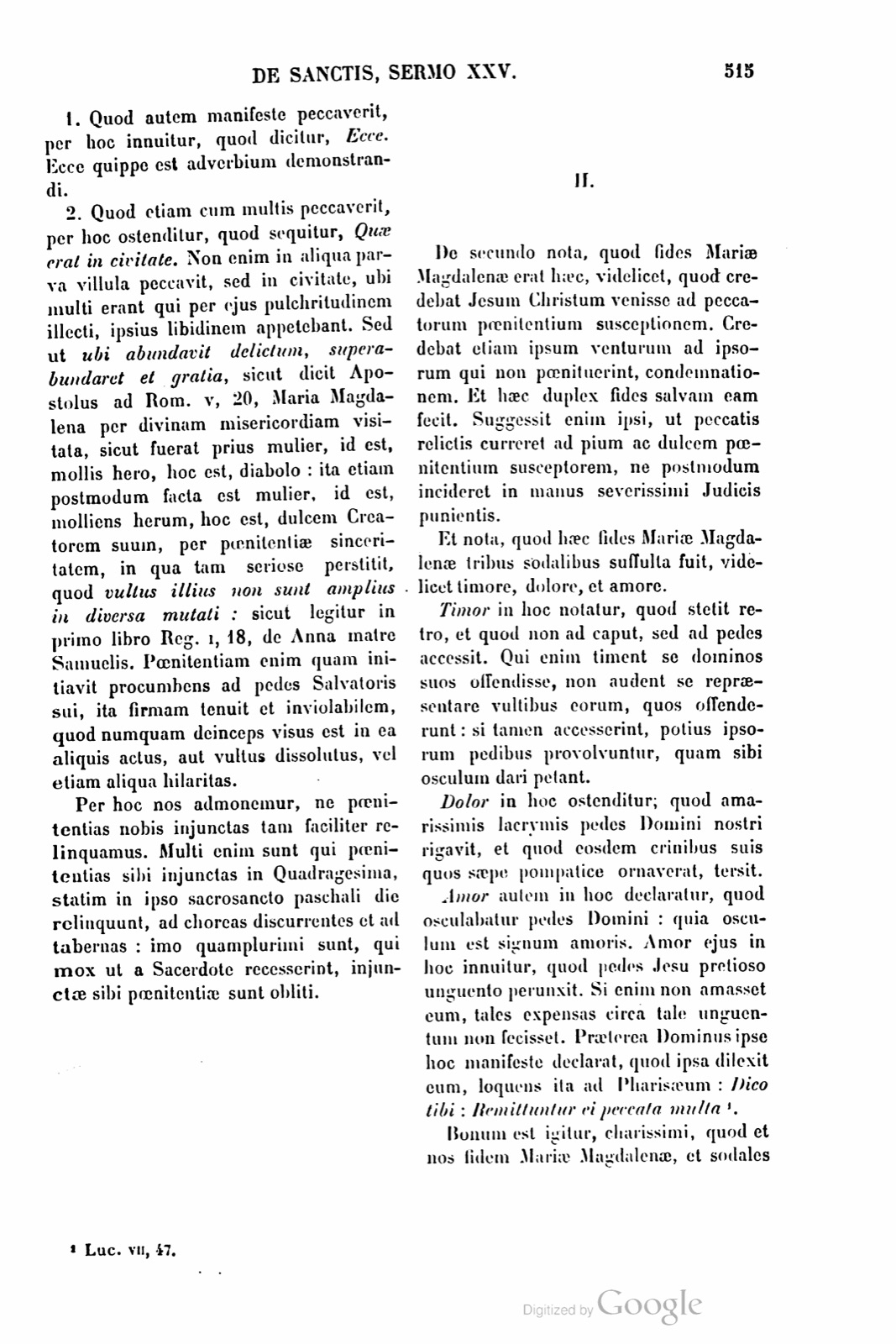
1. Quod autem manifeste peccaverit, per hoc innuitur, quod dicitur, Ecce. Ecce quippe est adverbium demonstrandi.
2. Quod etiam cum multis peccaverit, per hoc ostenditur, quod sequitur, Quæ erat in civitate. Non enim in aliqua parva villula peccavit, sed in civitate, ubi multi erant qui per ejus pulchritudinem illecti, ipsius libidinem appetebant. Sed ut ubi abundavit delictum, superabundaret et gratia, sicut dicit Apostolus ad Rom. V, 20, Maria Magdalena per divinam misericordiam visitata, sicut fuerat prius mulier, id est, mollis hero, hoc est, diabolo: ita etiam postmodum facta est mulier, id est, molliens herum, hoc est, dulcem Creatorem suum, per pœnitentiæ sinceritatem, in qua tam seriose perstitit, quod vultus illius non sunt amplius in diversa mutati: sicut legitur in primo libro Reg. I, 18, de Anna matre Samuelis. Pœnitentiam enim quam initiavit procumbens ad pedes Salvatoris sui, ita firmam tenuit et inviolabilem, quod numquam deinceps visus est in ea aliquis actus, aut vultus dissolutus, vel etiam aliqua hilaritas.
Per hoc nos admonemur, ne pœnitentias nobis injunctas tam faciliter relinquamus. Multi enim sunt qui pœnitentias sibi injunctas in Quadragesima, statim in ipso sacrosancto paschali die relinquunt, ad choreas discurrentes et ad tabernas: imo quamplurimi sunt, qui mox ut a Sacerdote recesserint, injunctæ sibi pœnitentiæ sunt obliti.
II.
De secundo nota, quod fides Mariæ Magdalenæ erat hæc, videlicet, quod credebat Jesum Christum venisse ad peccatorum pœnitentium susceptionem. Credebat etiam ipsum venturum ad ipsorum qui non pœnituerint, condemnationem. Et hæc duplex fides salvam eam fecit. Suggessit enim ipsi, ut peccatis relictis curreret ad pium ac dulcem pœnitentium susceptorem, ne postmodum incideret in manus severissimi Judicis punientis.
Et nota, quod hæc fides Mariæ Magdalenæ tribus sodalibus suffulta fuit, videlicet timore, dolore, et amore.
Timor in hoc notatur, quod stetit retro, et quod non ad caput, sed ad pedes accessit. Qui enim timent se dominos suos offendisse, non audent se repræsentare vultibus eorum, quos offenderunt: si tamen accesserint, potius ipsorum pedibus provolvuntur, quam sibi osculum dari petant.
Dolor in hoc ostenditur; quod amarissimis lacrymis pedes Domini nostri rigavit, et quod eosdem crinibus suis quos sæpe pompatice ornaverat, tersit.
Amor autem in hoc declaratur, quod osculabatur pedes Domini: quia osculum est signum amoris. Amor ejus in hoc innuitur, quod pedes Jesu pretioso unguento perunxit. Si enim non amasset eum, tales expensas circa tale unguentum non fecisset. Præterea Dominus ipse hoc manifeste declarat, quod ipsa dilexit eum, loquens ita ad Pharisæum: Dico tibi: Remittuntur ei peccata multa 2.
Bonum est igitur, charissimi, quod et nos fidem Mariæ Magdalenæ, et sodales fidei ipsius habeamus, videlicet ut credamus Dominum paratum ad receptionem peccatorum, si ex toto corde ad ipsum conversi fuerint: credamus etiam eum jam accinctum ad ultionem peccatorum, si ad ipsum per pœnitentiam mature redire noluerint. Primum ad hoc valebit, ne ex consolatione facinorum in desperationem cadamus. Secundum nos admonebit, ne per nimiam præsumptionem de divina misericordia de die in diem nostram pœnitentiam differamus.
1. But that she sinned manifestly is suggested by this, that it is said, Behold. For behold is an adverb of demonstrating.
2. That she also sinned with many persons is shown by this, that there follows, Who was in the city. For she did not sin in some small little village, but in a city, where there were many who, enticed by her beauty, desired her lust. But so that where offense abounded grace might superabound, as the Apostle says at Romans 5:20, Mary Magdalene, visited by divine mercy, just as she had previously been woman, that is, soft to the master, that is, to the devil, so also afterward was made woman, that is, softening the master, that is, her sweet Creator, through the sincerity of penance, in which she persisted so seriously that her countenances were no longer changed into diverse things, as one reads in the first book of Kings 1:18 concerning Hannah, the mother of Samuel. For the penance that she began by falling down at the feet of her Savior she held so firm and inviolate that thereafter no dissolute act or countenance, or even any hilarity, was ever seen in her.
By this we are admonished not to abandon so easily the penances enjoined on us. For there are many who, immediately on the very most holy Paschal day, abandon the penances enjoined on them in Lent, running off to dances and to taverns; indeed, there are very many who, as soon as they have withdrawn from the Priest, have forgotten the penance enjoined on them.
II.
On the second, note that the faith of Mary Magdalene was this, namely that she believed Jesus Christ had come for receiving penitent sinners. She also believed that he would come for the condemnation of those who have not done penance. And this twofold faith made her safe. For it suggested to her that, with sins left behind, she should run to the kind and sweet receiver of penitents, lest afterward she fall into the hands of the most severe Judge punishing.
And note that this faith of Mary Magdalene was supported by three companions, namely by fear, sorrow, and love.
Fear is noted in this, that she stood behind, and that she approached not the head but the feet. For those who fear that they have offended their masters do not dare to present themselves before the faces of those whom they offended; yet if they have approached, they are cast down rather at their feet than ask that a kiss be given to them.
Sorrow is shown in this, that she watered the feet of our Lord with most bitter tears, and that she wiped those same feet with her hairs, which she had often adorned pompously.
But love is declared in this, that she kissed the feet of the Lord, because a kiss is a sign of love. Her love is suggested in this, that she anointed the feet of Jesus with precious ointment. For if she had not loved him, she would not have made such expenses around such an ointment. Moreover the Lord himself clearly declares that she loved him, speaking thus to the Pharisee: I say to you: Many sins are forgiven her 2.
Therefore it is good, dearest ones, that we too have the faith of Mary Magdalene and the companions of her faith, namely that we believe the Lord is ready for the reception of sinners, if they have been converted to him from the whole heart; let us also believe that he is already girded for vengeance on sinners, if they have been unwilling to return maturely to him through penance. The first will have power for this, that from the consolation of crimes we may not fall into despair. The second will admonish us not to defer our penance from day to day through too much presumption concerning divine mercy.
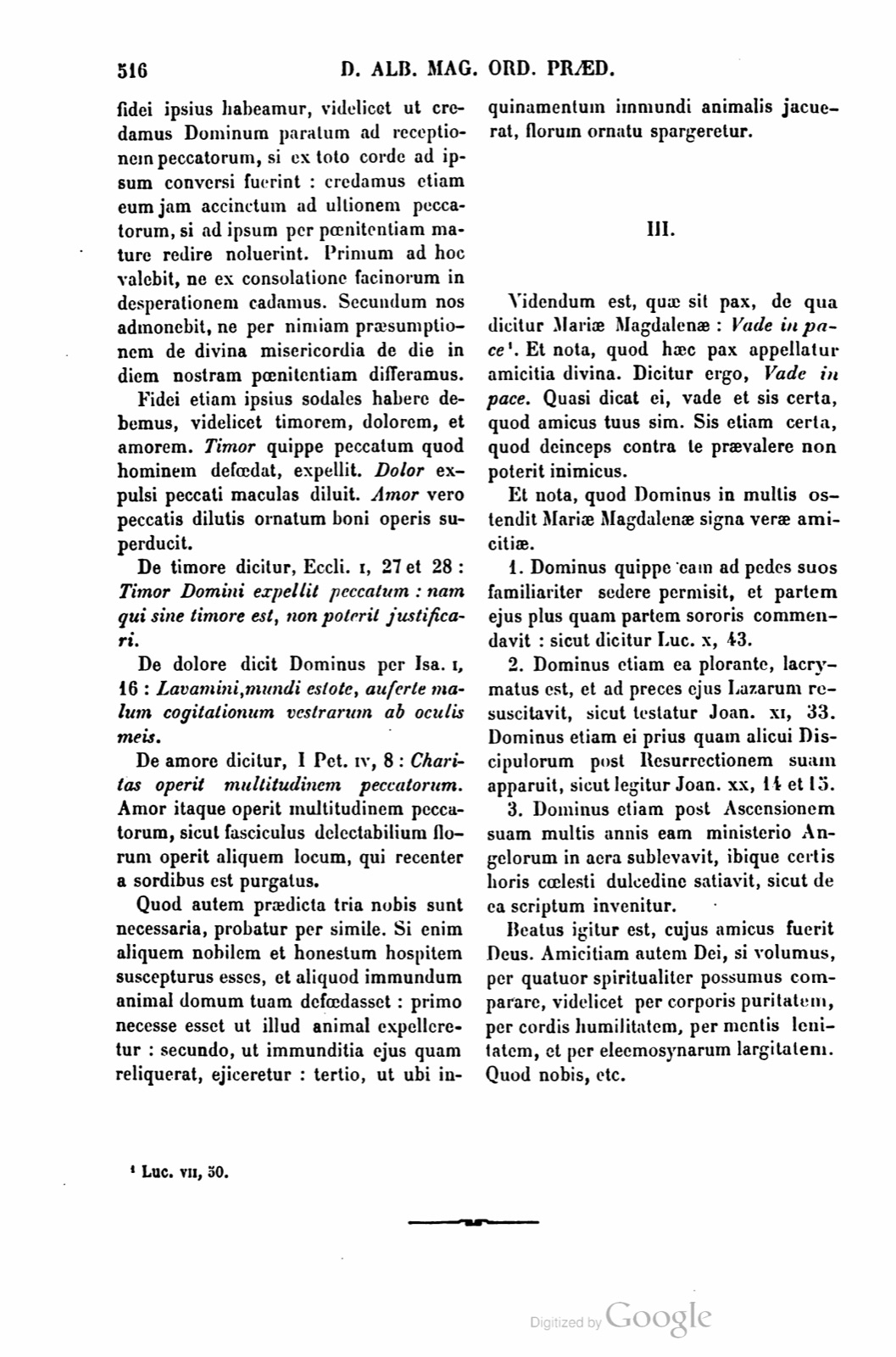
Fidei etiam ipsius sodales habere debemus, videlicet timorem, dolorem, et amorem. Timor quippe peccatum quod hominem defœdat, expellit. Dolor expulsi peccati maculas diluit. Amor vero peccatis dilutis ornatum boni operis superducit.
De timore dicitur, Eccli. I, 27 et 28: Timor Domini expellit peccatum: nam qui sine timore est, non poterit justificari.
De dolore dicit Dominus per Isa. I, 16: Lavamini, mundi estote, auferte malum cogitationum vestrarum ab oculis meis.
De amore dicitur, I Pet. IV, 8: Charitas operit multitudinem peccatorum. Amor itaque operit multitudinem peccatorum, sicut fasciculus delectabilium florum operit aliquem locum, qui recenter a sordibus est purgatus.
Quod autem prædicta tria nobis sunt necessaria, probatur per simile. Si enim aliquem nobilem et honestum hospitem suscepturus esses, et aliquod immundum animal domum tuam defœdasset: primo necesse esset ut illud animal expelleretur: secundo, ut immunditia ejus quam reliquerat, ejiceretur: tertio, ut ubi inquinamentum immundi animalis jacuerat, florum ornatu spargeretur.
III.
Videndum est, quæ sit pax, de qua dicitur Mariæ Magdalenæ: Vade in pace 3. Et nota, quod hæc pax appellatur amicitia divina. Dicitur ergo, Vade in pace. Quasi dicat ei, vade et sis certa, quod amicus tuus sim. Sis etiam certa, quod deinceps contra te prævalere non poterit inimicus.
Et nota, quod Dominus in multis ostendit Mariæ Magdalenæ signa veræ amicitiæ.
1. Dominus quippe eam ad pedes suos familiariter sedere permisit, et partem ejus plus quam partem sororis commendavit: sicut dicitur Luc. X, 43.
2. Dominus etiam ea plorante, lacrymatus est, et ad preces ejus Lazarum resuscitavit, sicut testatur Joan. XI, 33. Dominus etiam ei prius quam alicui Discipulorum post Resurrectionem suam apparuit, sicut legitur Joan. XX, 14 et 15.
3. Dominus etiam post Ascensionem suam multis annis eam ministerio Angelorum in aera sublevavit, ibique certis horis cœlesti dulcedine satiavit, sicut de ea scriptum invenitur.
Beatus igitur est, cujus amicus fuerit Deus. Amicitiam autem Dei, si volumus, per quatuor spiritualiter possumus comparare, videlicet per corporis puritatem, per cordis humilitatem, per mentis lenitatem, et per eleemosynarum largitatem. Quod nobis, etc.
We ought also to have the companions of her faith, namely fear, sorrow, and love. For fear expels sin, which fouls a man. Sorrow washes away the stains of expelled sin. But love, once sins have been washed away, brings upon them the adornment of good work.
Concerning fear it is said, Ecclesiasticus 1:27 and 28: The fear of the Lord expels sin; for he who is without fear will not be able to be justified.
Concerning sorrow the Lord says through Isaiah 1:16: Wash yourselves, be clean, take away the evil of your thoughts from my eyes.
Concerning love it is said, 1 Peter 4:8: Charity covers a multitude of sins. Therefore love covers a multitude of sins, as a little bundle of delightful flowers covers some place that has recently been cleansed from filths.
But that the aforesaid three things are necessary for us is proved by a likeness. For if you were about to receive some noble and honorable guest, and some unclean animal had fouled your house, first it would be necessary that that animal be expelled; secondly, that the uncleanness it had left behind be cast out; thirdly, that where the defilement of the unclean animal had lain, the place be strewn with an adornment of flowers.
III.
One must see what the peace is concerning which it is said to Mary Magdalene: Go in peace 3. And note that this peace is called divine friendship. Therefore it is said: Go in peace. As if he were saying to her: go and be certain that I am your friend. Be certain also that henceforth the enemy will not be able to prevail against you.
And note that in many things the Lord showed Mary Magdalene the signs of true friendship.
1. For the Lord allowed her familiarly to sit at his feet, and commended her part more than the part of her sister, as is said in Luke 10:43.
2. The Lord also, when she was weeping, wept, and at her prayers raised Lazarus, as John 11:33 bears witness. The Lord also appeared to her after his Resurrection before any of the Disciples, as one reads in John 20:14 and 15.
3. The Lord also, for many years after his Ascension, lifted her into the air by the ministry of Angels, and there at certain hours satisfied her with heavenly sweetness, as is found written concerning her.
Therefore blessed is he whose friend God has been. But if we wish, we can spiritually purchase the friendship of God through four things, namely through purity of body, humility of heart, mildness of mind, and largess of alms. May he grant this to us, etc.
If a page does not appear, its photograph has not been uploaded yet.