Volume 13 · pp. 519–521
Sermon XXVII. On the Feast of Saint James the Apostle
A marker with ≈ is an approximate page boundary, placed by measure of the text; the page photographs remain the authority. In the paired views, clicking a page marker brings that page into view.
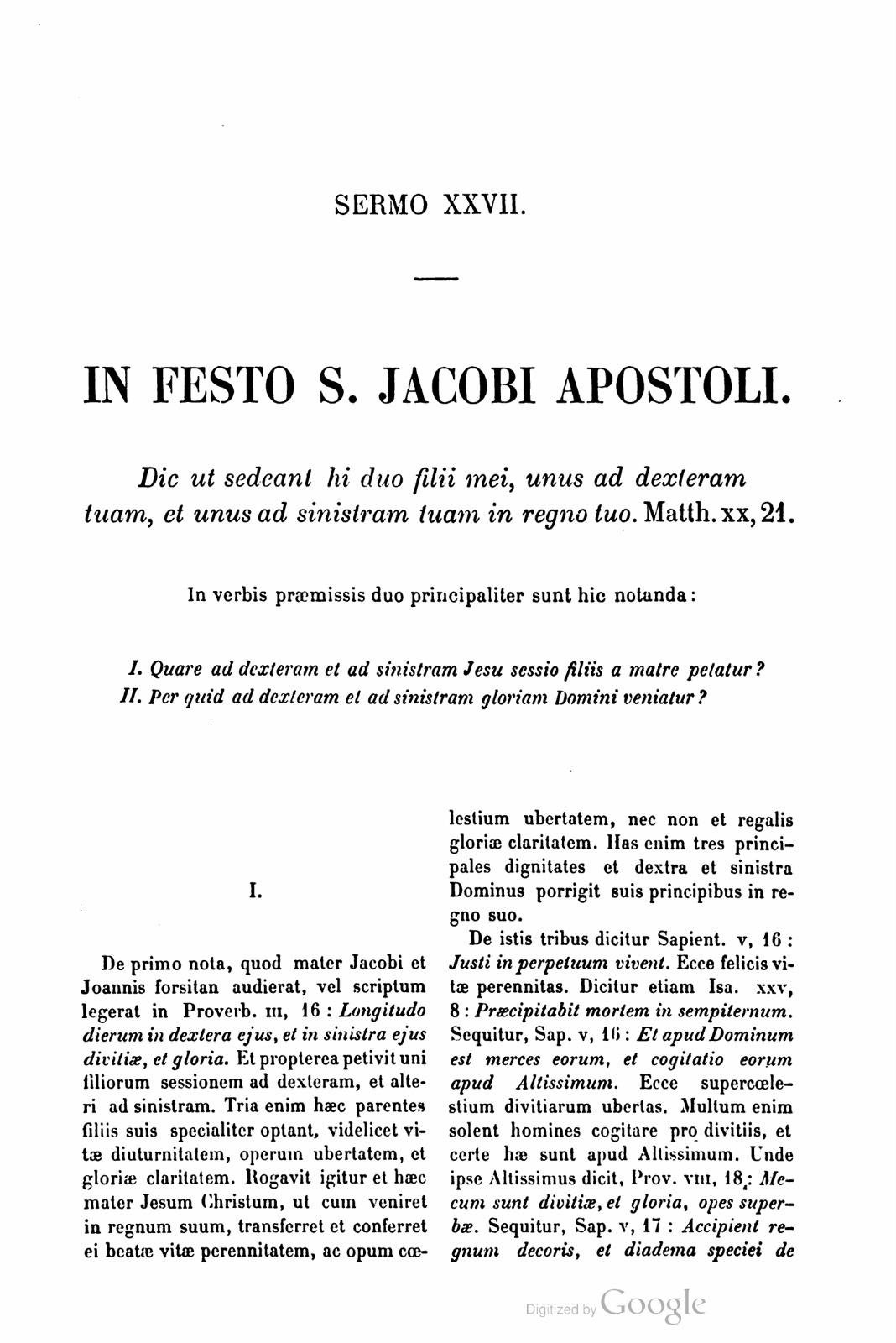
SERMO XXVII.
IN FESTO S. JACOBI APOSTOLI.
Dic ut sedeant hi duo filii mei, unus ad dexteram tuam, et unus ad sinistram tuam in regno tuo. Matth. XX, 21.
In verbis præmissis duo principaliter sunt hic notanda:
I. Quare ad dexteram et ad sinistram Jesu sessio filiis a matre petatur? II. Per quid ad dexteram et ad sinistram gloriam Domini veniatur?
I.
De primo nota, quod mater Jacobi et Joannis forsitan audierat, vel scriptum legerat in Proverb. III, 16: Longitudo dierum in dextera ejus, et in sinistra ejus divitiæ, et gloria. Et propterea petivit uni filiorum sessionem ad dexteram, et alteri ad sinistram. Tria enim hæc parentes filiis suis specialiter optant, videlicet vitæ diuturnitatem, operum ubertatem, et gloriæ claritatem. Rogavit igitur et hæc mater Jesum Christum, ut cum veniret in regnum suum, transferret et conferret ei beatæ vitæ perennitatem, ac opum cœlestium ubertatem, nec non et regalis gloriæ claritatem. Has enim tres principales dignitates et dextra et sinistra Dominus porrigit suis principibus in regno suo.
De istis tribus dicitur Sapient. V, 16: Justi in perpetuum vivent. Ecce felicis vitæ perennitas. Dicitur etiam Isa. XXV, 8: Præcipitabit mortem in sempiternum. Sequitur, Sap. V, 16: Et apud Dominum est merces eorum, et cogitatio eorum apud Altissimum. Ecce supercælestium divitiarum ubertas. Multum enim solent homines cogitare pro divitiis, et certe hæ sunt apud Altissimum. Unde ipse Altissimus dicit, Prov. VIII, 18: Mecum sunt divitiæ, et gloria, opes superbæ. Sequitur, Sap. V, 17: Accipient regnum decoris, et diadema speciei de manu Domini. Ecce regalis gloriæ claritas.
Et nota e converso, quod illi miseri qui cadent a dextra et sinistra Domini: Cadent enim a latere ejus mille, et decem millia a dextris ejus 1, quod, inquam, illi miseri cadent in acerbæ mortis æternitatem, in paupertatis ac inediæ gravitatem, in contemptus ac vilitatis interminabilitatem. De istis tribus dicitur Apoc. XVIII, 8: In una die venient plagæ ejus, mors, et luctus, et fames, et igne comburetur. Hæc dicuntur de anima peccatrice.
1. Dicit ergo, In una die, id est, in die judicii, venient plagæ ejus, mors. Ecce sævæ mortis æternitas. De morte autem dicitur in Psal. LXXVII, 50: Viam fecit semitæ iræ suæ, non pepercit a morte animabus eorum. Nota, quod modo ira Dei, quasi in semita est: quia modo quasi capta est, et reposita in vincula misericordiæ Dei nostri. Verumtamen in die judicii solvetur, et tunc de semita intrabit in viam. Tunc enim late se expandet ad ultionem inimicorum suorum. Et certe tunc non parcet a morte animabus impiorum.
SERMON XXVII.
ON THE FEAST OF SAINT JAMES THE APOSTLE.
Say that these two sons of mine may sit, one at your right hand and one at your left hand in your kingdom. Matthew 20:21.
In the words set forth there are two things principally to be noted here:
I. Why is sitting at the right and at the left of Jesus sought for the sons by their mother? II. Through what does one come to the right and left glory of the Lord?
I.
On the first, note that the mother of James and John had perhaps heard, or had read written in Proverbs 3:16: Length of days is in her right hand, and in her left hand riches and glory. And on account of this she sought for one of her sons a seat at the right, and for the other at the left. For parents especially wish these three things for their sons, namely long duration of life, abundance of works, and brightness of glory. Therefore this mother also asked Jesus Christ that, when he came into his kingdom, he would transfer and confer on her the permanence of blessed life, the abundance of heavenly riches, and also the brightness of royal glory. For the Lord extends these three principal dignities, both right hand and left hand, to his princes in his kingdom.
Concerning these three things it is said in Wisdom 5:16: The just will live forever. Behold the permanence of happy life. It is also said in Isaiah 25:8: He will cast death down forever. It follows, Wisdom 5:16: And their reward is with the Lord, and the thought of them is with the Most High. Behold the abundance of super-heavenly riches. For men are accustomed to think much for riches, and certainly these are with the Most High. Hence the Most High himself says, Proverbs 8:18: With me are riches and glory, proud wealth. It follows, Wisdom 5:17: They will receive the kingdom of beauty and the diadem of loveliness from the hand of the Lord. Behold the brightness of royal glory.
And note conversely that those wretched ones who will fall from the right and left of the Lord, for a thousand will fall from his side and ten thousand from his right hand 1, that, I say, those wretched ones will fall into the eternity of bitter death, into the weight of poverty and hunger, into the endlessness of contempt and vileness. Concerning these three things it is said in Apocalypse 18:8: In one day her plagues will come, death and mourning and famine, and she will be burned with fire. These things are said concerning the sinful soul.
1. Therefore he says, In one day, that is, on the day of judgment, her plagues will come, death. Behold the eternity of savage death. But concerning death it is said in Psalm 77:50: He made a way for the path of his wrath; he did not spare their souls from death. Note that now the wrath of God is, as it were, in a path, because now it is, as it were, captured and laid away in the chains of the mercy of our God. Nevertheless on the day of judgment it will be loosed, and then from the path it will enter into the way. For then it will spread itself widely for vengeance on its enemies. And certainly then it will not spare the souls of the impious from death.
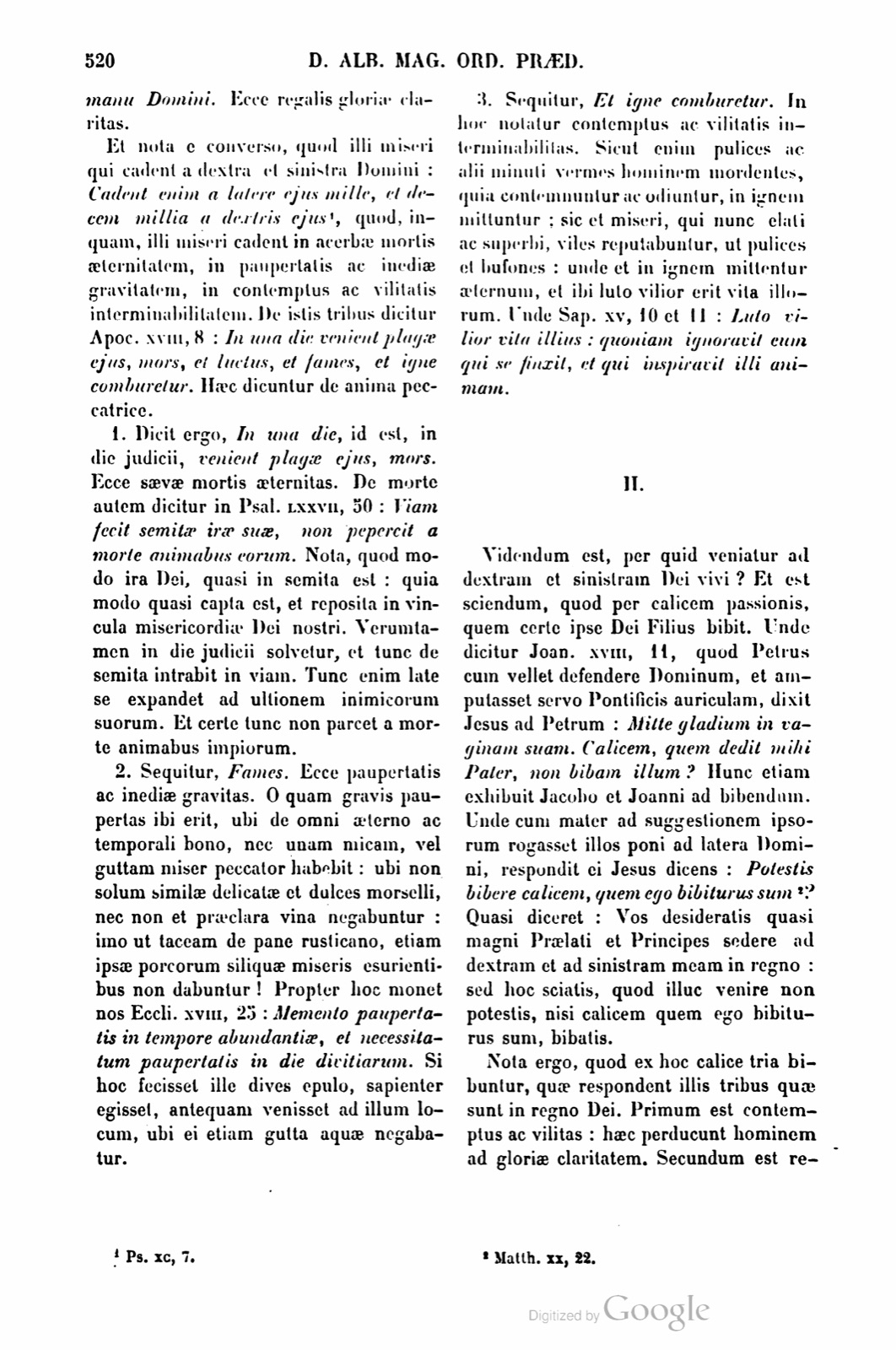
2. Sequitur, Fames. Ecce paupertatis ac inediæ gravitas. O quam gravis paupertas ibi erit, ubi de omni æterno ac temporali bono, nec unam micam, vel guttam miser peccator habebit: ubi non solum similæ delicatæ et dulces morselli, nec non et præclara vina negabuntur: imo ut taceam de pane rusticano, etiam ipsæ porcorum siliquæ miseris esurientibus non dabuntur! Propter hoc monet nos Eccli. XVIII, 25: Memento paupertatis in tempore abundantiæ, et necessitatum paupertatis in die divitiarum. Si hoc fecisset ille dives epulo, sapienter egisset, antequam venisset ad illum locum, ubi ei etiam gutta aquæ negabatur.
3. Sequitur, Et igne comburetur. In hoc notatur contemptus ac vilitatis interminabilitas. Sicut enim pulices ac alii minuti vermes hominem mordentes, quia contemnuntur ac odiuntur, in ignem mittuntur; sic et miseri, qui nunc elati ac superbi, viles reputabuntur, ut pulices et bufones: unde et in ignem mittentur æternum, et ibi luto vilior erit vita illorum. Unde Sap. XV, 10 et 11: Luto vilior vita illius: quoniam ignoravit eum qui se finxit, et qui inspiravit illi animam.
II.
Videndum est, per quid veniatur ad dextram et sinistram Dei vivi? Et est sciendum, quod per calicem passionis, quem certe ipse Dei Filius bibit. Unde dicitur Joan. XVIII, 11, quod Petrus cum vellet defendere Dominum, et amputasset servo Pontificis auriculam, dixit Jesus ad Petrum: Mitte gladium in vaginam suam. Calicem, quem dedit mihi Pater, non bibam illum? Hunc etiam exhibuit Jacobo et Joanni ad bibendum. Unde cum mater ad suggestionem ipsorum rogasset illos poni ad latera Domini, respondit ei Jesus dicens: Potestis bibere calicem, quem ego bibiturus sum 2? Quasi diceret: Vos desideratis quasi magni Prælati et Principes sedere ad dextram et ad sinistram meam in regno: sed hoc sciatis, quod illuc venire non potestis, nisi calicem quem ego bibiturus sum, bibatis.
Nota ergo, quod ex hoc calice tria bibuntur, quæ respondent illis tribus quæ sunt in regno Dei. Primum est contemptus ac vilitas: hæc perducunt hominem ad gloriæ claritatem. Secundum est rerum paupertas: hæc perducit hominem ad divitiarum ubertatem. Tertium est mortis acerbitas: hæc perducit hominem ad jucundæ vitæ perennitatem.
2. It follows, Famine. Behold the weight of poverty and hunger. O how grave poverty will be there, where from every eternal and temporal good the wretched sinner will not have even one crumb or drop; where not only delicate flour and sweet morsels, and also excellent wines, will be denied, but, to say nothing of rustic bread, even the pods of swine will not be given to the wretched who hunger! On account of this Ecclesiasticus 18:25 admonishes us: Remember poverty in the time of abundance, and the necessities of poverty in the day of riches. If that rich feaster had done this, he would have acted wisely before he came to that place where even a drop of water was denied him.
3. It follows, And she will be burned with fire. In this is noted the endlessness of contempt and vileness. For just as fleas and other tiny worms biting a man are thrown into the fire because they are contemned and hated, so also the wretched who now, elated and proud, will be reckoned vile like fleas and toads; hence they too will be sent into eternal fire, and there their life will be viler than mud. Hence Wisdom 15:10 and 11 says: His life is viler than mud, because he did not know him who fashioned him and who breathed a soul into him.
II.
One must see through what one comes to the right and left of the living God. And one must know that it is through the chalice of suffering, which certainly the Son of God himself drank. Hence it is said in John 18:11 that when Peter wished to defend the Lord and had cut off the little ear of the High Priest's servant, Jesus said to Peter: Put the sword into its sheath. Shall I not drink the chalice that the Father has given me? He also offered this chalice to James and John to drink. Hence when their mother, at their suggestion, had asked that they be placed at the sides of the Lord, Jesus answered her, saying: Are you able to drink the chalice that I am about to drink 2? As if he were saying: You desire to sit, as great Prelates and Princes, at my right and at my left in the kingdom; but know this, that you cannot come there unless you drink the chalice that I am about to drink.
Therefore note that from this chalice three things are drunk, which correspond to those three things that are in the kingdom of God. The first is contempt and vileness; these lead a man to the brightness of glory. The second is poverty of things; this leads a man to abundance of riches. The third is the bitterness of death; this leads a man to the permanence of joyful life.
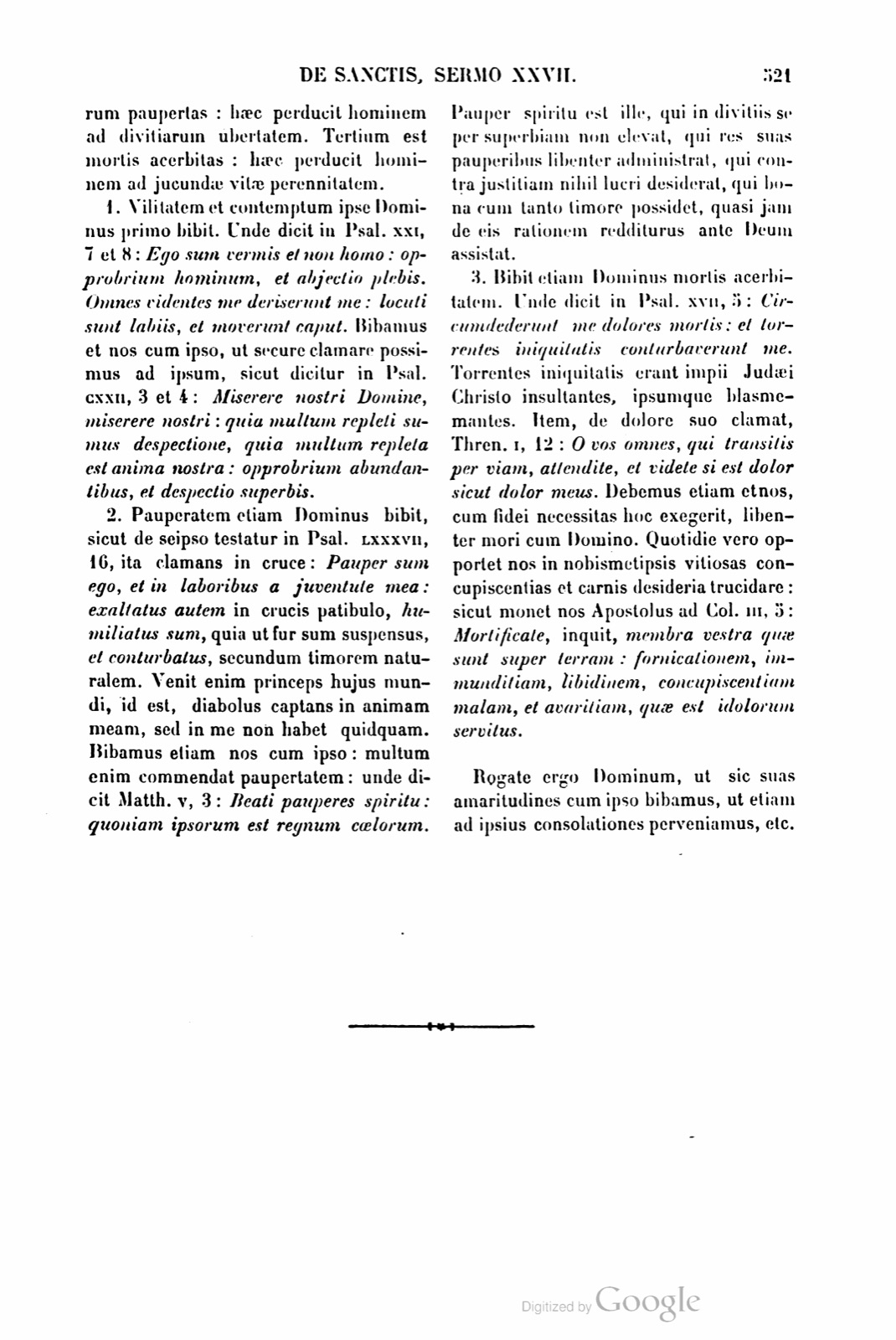
1. Vilitatem et contemptum ipse Dominus primo bibit. Unde dicit in Psal. XXI, 7 et 8: Ego sum vermis et non homo: opprobrium hominum, et abjectio plebis. Omnes videntes me deriserunt me: locuti sunt labiis, et moverunt caput. Bibamus et nos cum ipso, ut secure clamare possimus ad ipsum, sicut dicitur in Psal. CXXI, 3 et 4: Miserere nostri Domine, miserere nostri: quia multum repleti sumus despectione, quia multum repleta est anima nostra: opprobrium abundantibus, et despectio superbis.
2. Paupertatem etiam Dominus bibit, sicut de seipso testatur in Psal. LXXXVII, 16, ita clamans in cruce: Pauper sum ego, et in laboribus a juventute mea: exaltatus autem in crucis patibulo, humiliatus sum, quia ut fur sum suspensus, et conturbatus, secundum timorem naturalem. Venit enim princeps hujus mundi, id est, diabolus captans in animam meam, sed in me non habet quidquam. Bibamus etiam nos cum ipso: multum enim commendat paupertatem: unde dicit Matth. V, 3: Beati pauperes spiritu: quoniam ipsorum est regnum cælorum. Pauper spiritu est ille, qui in divitiis se per superbiam non elevat, qui res suas pauperibus libenter administrat, qui contra justitiam nihil lucri desiderat, qui bona cum tanto timore possidet, quasi jam de eis rationem redditurus ante Deum assistat.
3. Bibit etiam Dominus mortis acerbitatem. Unde dicit in Psal. XVII, 5: Circumdederunt me dolores mortis: et torrentes iniquitatis conturbaverunt me. Torrentes iniquitatis erant impii Judæi Christo insultantes, ipsumque blasphemantes. Item, de dolore suo clamat, Thren. I, 12: O vos omnes, qui transitis per viam, attendite, et videte si est dolor sicut dolor meus. Debemus etiam et nos, cum fidei necessitas hoc exegerit, libenter mori cum Domino. Quotidie vero oportet nos in nobismetipsis vitiosas concupiscentias et carnis desideria trucidare: sicut monet nos Apostolus ad Col. III, 5: Mortificate, inquit, membra vestra quæ sunt super terram: fornicationem, immunditiam, libidinem, concupiscentiam malam, et avaritiam, quæ est idolorum servitus.
Rogate ergo Dominum, ut sic suas amaritudines cum ipso bibamus, ut etiam ad ipsius consolationes perveniamus, etc.
1. The Lord himself first drank vileness and contempt. Hence he says in Psalm 21:7 and 8: I am a worm and not a man, the reproach of men and the rejection of the people. All who saw me mocked me; they spoke with lips and shook the head. Let us too drink with him, so that we may securely cry out to him, as is said in Psalm 121:3 and 4: Have mercy on us, O Lord, have mercy on us, because we have been greatly filled with disdain, because our soul has been greatly filled: reproach to those abounding and disdain to the proud.
2. The Lord also drank poverty, as he testifies concerning himself in Psalm 87:16, thus crying out on the cross: I am poor and in labors from my youth; but exalted on the gibbet of the cross, I have been humbled, because I have been suspended as a thief, and troubled according to natural fear. For the prince of this world has come, that is, the devil catching at my soul, but in me he has nothing. Let us too drink with him, for he commends poverty greatly; hence Matthew 5:3 says: Blessed are the poor in spirit, for theirs is the kingdom of heaven. Poor in spirit is the one who in riches does not lift himself up through pride, who willingly administers his goods to the poor, who desires no gain against justice, who possesses goods with such great fear, as if he were already standing before God to render an account concerning them.
3. The Lord also drank the bitterness of death. Hence he says in Psalm 17:5: The pains of death surrounded me, and the torrents of iniquity troubled me. The torrents of iniquity were the impious Jews insulting Christ and blaspheming him. Likewise, concerning his sorrow he cries out in Lamentations 1:12: O all you who pass through the way, attend and see if there is sorrow like my sorrow. We also, when the necessity of faith has required this, ought willingly to die with the Lord. But daily it is necessary for us to slaughter in ourselves vicious concupiscences and desires of the flesh, as the Apostle admonishes us at Colossians 3:5: Mortify, he says, your members that are upon the earth: fornication, uncleanness, lust, evil concupiscence, and avarice, which is the service of idols.
Therefore pray to the Lord that we may so drink his bitternesses with him that we may also come to his consolations, etc.
If a page does not appear, its photograph has not been uploaded yet.