Volume 13 · pp. 480–483
Sermon XV. On the Annunciation of Blessed Mary
A marker with ≈ is an approximate page boundary, placed by measure of the text; the page photographs remain the authority. In the paired views, clicking a page marker brings that page into view.
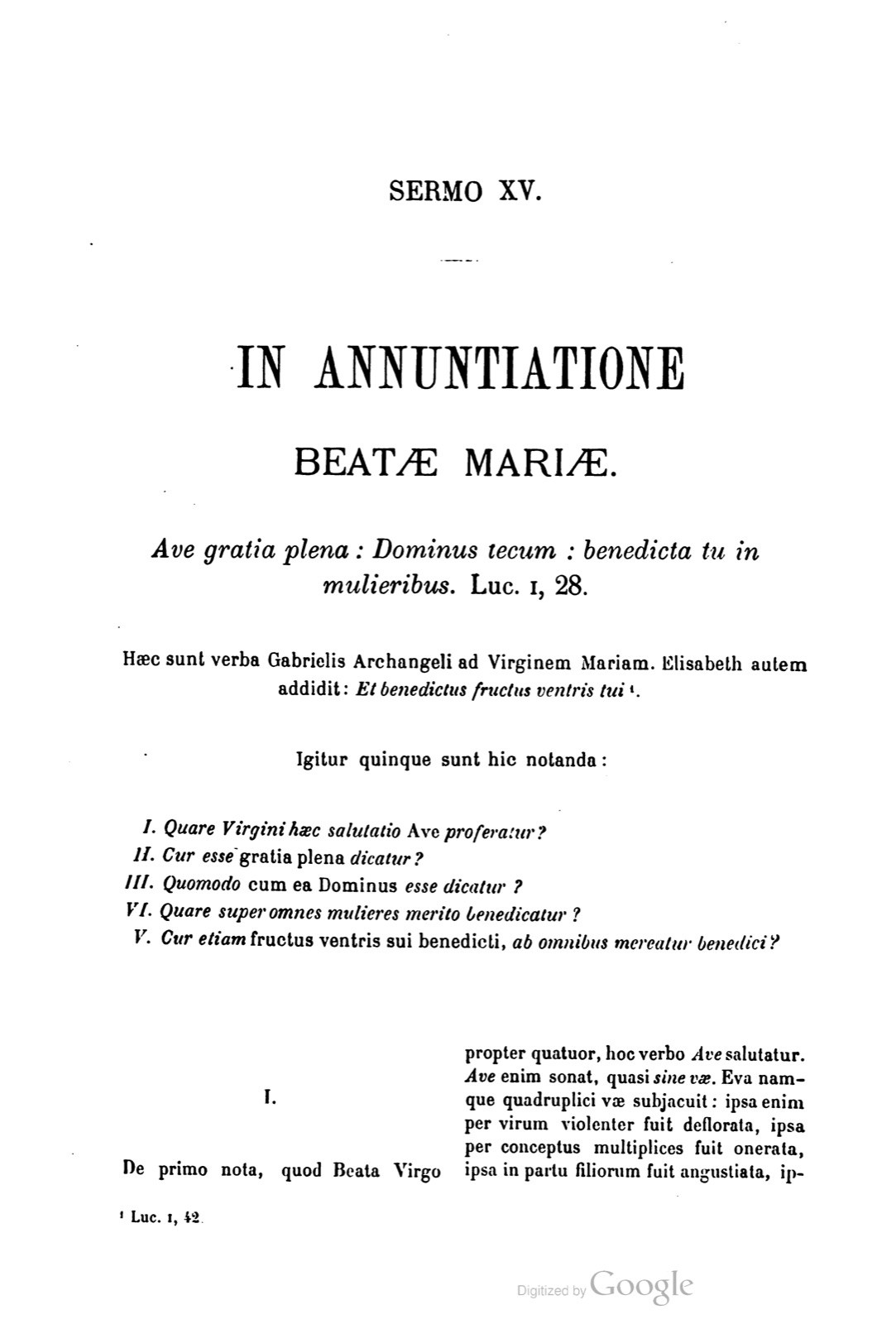
SERMO XV.
IN ANNUNTIATIONE BEATÆ MARIÆ.
Ave gratia plena: Dominus tecum: benedicta tu in mulieribus. Luc. I, 28.
Hæc sunt verba Gabrielis Archangeli ad Virginem Mariam. Elisabeth autem addidit: Et benedictus fructus ventris tui 1.
Igitur quinque sunt hic notanda:
I. Quare Virgini hæc salutatio Ave proferatur? II. Cur esse gratia plena dicatur? III. Quomodo cum ea Dominus esse dicatur? VI. Quare super omnes mulieres merito benedicatur? V. Cur etiam fructus ventris sui benedicti, ab omnibus mereatur benedici?
I.
De primo nota, quod Beata Virgo propter quatuor, hoc verbo Ave salutatur. Ave enim sonat, quasi sine væ. Eva namque quadruplici væ subjacuit: ipsa enim per virum violenter fuit deflorata, ipsa per conceptus multiplices fuit onerata, ipsa in partu filiorum fuit angustiata, ipsa etiam tandem fuit in pulverem resoluta. Unde propter prædicta dixit ei Dominus, Gen. III, 16: Sub viri potestate eris, et ipse dominabitur tui, quantum ad violentiam deflorationis. Multiplicabo ærumnas tuas et conceptus tuos, quantum ad onera conceptionis. In dolore paries filios tuos, ecce dolor in partus effusione. Sequuntur verba quæ Dominus dixit ad virum, quæ etiam intelliguntur dicta ad mulierem: Pulvis es, et in pulverem reverteris 2. Ecce testimonium de incineratione.
Beata igitur Virgo ab hoc væ quadruplici immunis fuit. Ipsa enim per Dei conceptionem virginitate non fuit spoliata: ipsa per eum quem conceperat, non fuit aliquo modo gravata: ipsa etiam post mortem, secundum fidem laudabilem, non fuit incinerata. Sicut enim Eva quæ fuit ex ossibus Adæ, et caro de carne ejus, cum conjuge suo participavit maledictionem corruptionis et incinerationis: ita e converso dignum fuit, ut Beata Virgo cum Filio (de qua ex ejus carne et sanguine carnem assumpserat et sanguinem) participaret benedictionem incorruptionis. Sicut enim caro Filii non vidit incorruptionem, sic nec caro matris.
SERMON XV.
ON THE ANNUNCIATION OF BLESSED MARY.
Hail, full of grace: the Lord is with you: blessed are you among women. Luke 1:28.
These are the words of Gabriel the Archangel to the Virgin Mary. But Elizabeth added: And blessed is the fruit of your womb 1.
Therefore five things are to be noted here:
I. Why is this salutation Hail brought forth to the Virgin? II. Why is she said to be full of grace? III. How is the Lord said to be with her? VI. Why is she deservedly blessed above all women? V. Why does she also merit that the blessed fruit of her womb be blessed by all?
I.
On the first, note that the Blessed Virgin, for four reasons, is saluted by this word Hail. For Ave sounds as if without woe. For Eve lay under a fourfold woe: she herself was violently deflowered by a man; she herself was burdened through multiple conceptions; she herself was distressed in the bearing of children; she herself also at last was dissolved into dust. Hence on account of the aforesaid things the Lord said to her, Genesis 3:16: You will be under the power of the man, and he will rule over you, with respect to the violence of defloration. I will multiply your hardships and your conceptions, with respect to the burdens of conception. In pain you will bear your sons, behold the pain in the pouring forth of birth. There follow the words which the Lord said to the man, which are also understood as said to the woman: You are dust, and into dust you will return 2. Behold the testimony concerning incineration.
Therefore the Blessed Virgin was immune from this fourfold woe. For she was not despoiled of virginity through the conception of God; she was not in any way weighed down through him whom she had conceived; she also after death, according to praiseworthy faith, was not incinerated. For just as Eve, who was from the bones of Adam and flesh from his flesh, participated with her spouse in the curse of corruption and incineration, so on the contrary it was fitting that the Blessed Virgin with the Son, from whom, from her flesh and blood, he had assumed flesh and blood, should participate in the blessing of incorruption. For just as the flesh of the Son did not see incorruption, so neither did the flesh of the mother.
II.
De secundo nota, quod Beata Virgo propter quatuor dicitur esse gratia plena. Fuit enim mundissima, vacuissima, solidissima, et quietissima. Sicut enim quatuor ad minus ad hoc requiruntur, quod materiale vas, vel dignum sit, vel possit impleri: videlicet ut sit mundum, sit capax seu vacuum, sit solidum, id est, non ruptum: sit quietum, id est, non moveatur, dum liquor infunditur.
1. Ita et Beata Virgo fuit mundissima ab omni labe vitiorum. Numquam enim mortaliter, vel etiam venialiter peccavit; sed semper in cogitatu suo, et verbo, et opere merebatur. Et certe hoc quasi plusquam homo hic. Non est enim homo, qui non peccet. Unde I Joan. I, 8: Si dixerimus quoniam peccatum non habemus, ipsi nos seducimus, et veritas in nobis non est.
2. Fuit etiam vacuissima ab omni desiderio terrenorum. Non enim cor suum et animum habuit circa ista terrena et inferiora; sed semper desiderio circa supercœlestia versabatur. Ipsa siquidem temporalia, quæ avari summo studio colunt, contemptibilia et quasi stercora reputabat.
3. Fuit etiam solidissima et integerrima per omnium virtutum ordinatam et individuam custodiam. Omnes enim virtutes circa ipsam aggregatæ, ita solidam et integram eam conservaverunt, ut non posset lædi aliquo tentationis impulsu.
4. Fuit etiam quietissima per pacem cordis, et omnium affectuum tranquillitatem. Pacem enim quam filius suus dedit discipulis, ipsa præcipue conservavit: ipsa etiam numquam indebite vel concupivit, aut timuit: nec doluit, aut gavisa fuit indebite.
III.
II.
On the second, note that the Blessed Virgin is said to be full of grace for four reasons. For she was most clean, most empty, most solid, and most quiet. For just as at least four things are required for this, that a material vessel either be worthy or be able to be filled, namely that it be clean, be capacious or empty, be solid, that is, not broken, and be quiet, that is, not moved while liquid is poured in:
1. So too the Blessed Virgin was most clean from every stain of vices. For she never sinned mortally or even venially, but always merited in her thought and word and work. And certainly this is as it were more than a human being here. For there is no human being who does not sin. Hence 1 John 1:8: If we have said that we do not have sin, we seduce ourselves, and the truth is not in us.
2. She was also most empty of every desire for earthly things. For she did not have her heart and mind about those earthly and lower things, but was always occupied by desire about the superheavenly things. Indeed she reckoned temporal things, which the avaricious cultivate with the greatest zeal, contemptible and as if dung.
3. She was also most solid and most entire through the ordered and undivided custody of all the virtues. For all the virtues gathered around her preserved her so solid and entire that she could not be harmed by any impulse of temptation.
4. She was also most quiet through peace of heart and the tranquillity of all affections. For the peace which her Son gave to the disciples, she especially preserved; she also never unduly either desired or feared, nor was she unduly sorrowful or glad.
III.
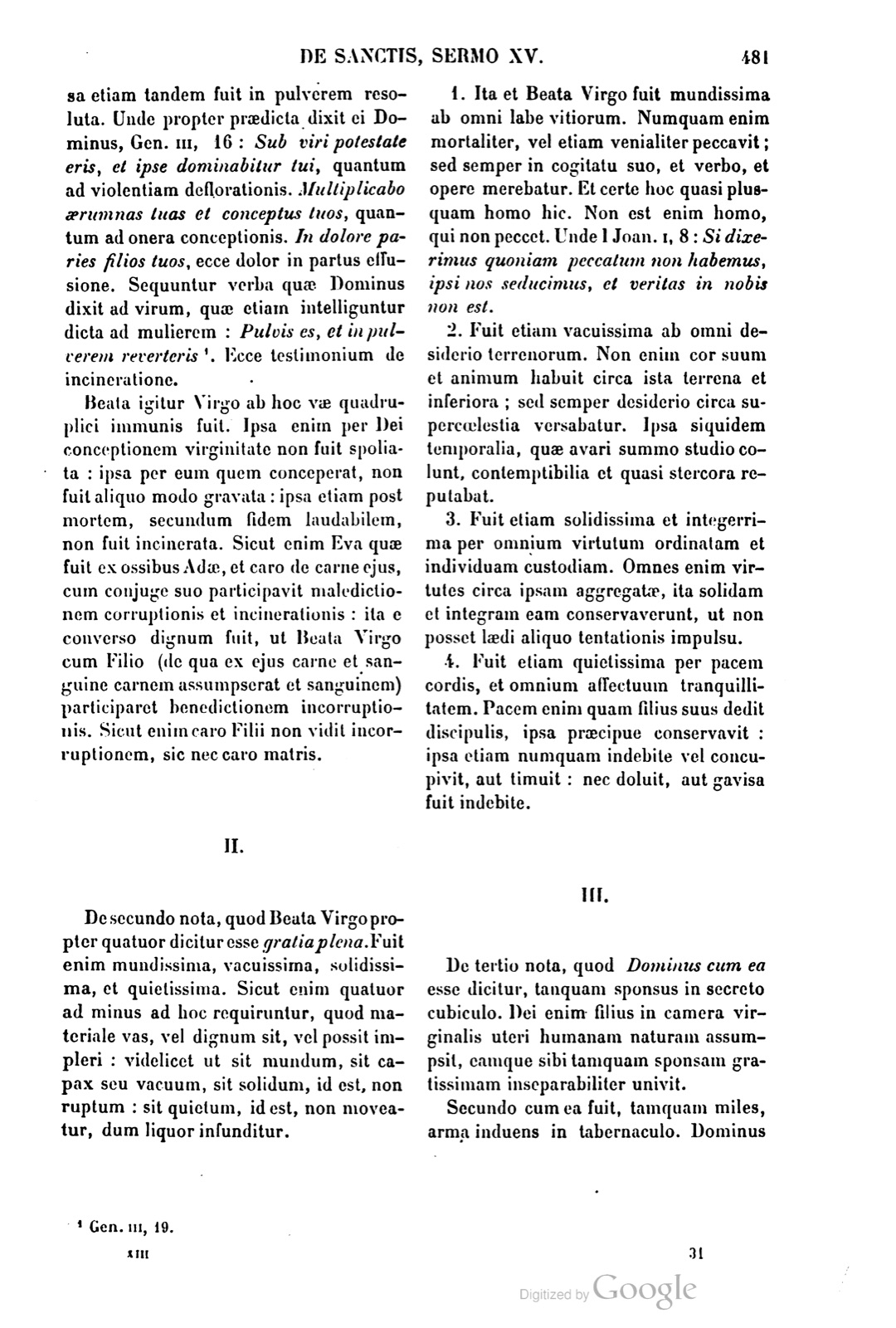
De tertio nota, quod Dominus cum ea esse dicitur, tanquam sponsus in secreto cubiculo. Dei enim filius in camera virginalis uteri humanam naturam assumpsit, eamque sibi tamquam sponsam gratissimam inseparabiliter univit.
Secundo cum ea fuit, tamquam miles, arma induens in tabernaculo. Dominus enim congressurus cum diabolo, tunicam carnis nostræ in sanctissimo tabernaculo virginei corporis induit, quæ cum in passione per flagella, et spinas, et clavos, ac lanceam laceraretur, et perforaretur; virtus divinitatis, quæ sub ea occulta fuerat, stravit diabolum.
Tertio Dominus cum ea fuit, tamquam rex in throni sui consistorio. Dei enim Filius utpote verus Salomon, id est, rex pacificus, sedit in ipsa tamquam in reali solio, judicans omnes fines terræ. Medio siquidem tempore, quo in Virginis utero gestabatur, non minus ea quæ sursum erant in cœlo, et quæ in terra deorsum, prudentissime gubernavit.
Quarto cum ea fuit, tamquam hospes prandens in triclinio. Sedens enim infantulus in Virginis utero, et Patre plenissime fruebatur, et mundis affectibus matris, ac sanctis operibus delectabiliter pascebatur.
IV.
De quarto nota, quod propter quatuor in mulieribus dicitur benedicta.
Primo, quia serpenti non obaudivit. Cum enim et ipse Dei Filius tentatus fuerit, verisimile est quod Beata Virgo quandoque etiam tentata fuit, sed ipsa numquam diabolicæ tentationi assensit.
Secundo, quia opprobrium fœminarum diluit et abstersit. Sicut enim Eva causa exstitit perditionis humanæ: ita et Maria causa fuit nostræ redemptionis. Unde mulieres deinceps verecundari non debent, tamquam per fæminam genus humanum sit amissum, cum et per fœminam fuerit recuperatum.
Tertio dicitur benedicta, quia per fructum vitæ, quem edidit suspendendum in ligno crucis, vitam restituit. Eva namque per pomum vetitum, quod decerpsit ab arbore, et sibi et universæ parentelæ suæ mortem propinavit: Maria vero pretiosum fructum ventris sui mundo edidit, qui pro salute generis humani in patibulo suspensus fuit, et sic mortem fugavit, ac vitam restituit.
On the third, note that the Lord is said to be with her as a bridegroom in a secret chamber. For the Son of God in the chamber of the virginal womb assumed human nature and inseparably united it to himself as a most pleasing bride.
Secondly, he was with her as a soldier putting on armor in a tent. For the Lord, about to engage with the devil, put on the tunic of our flesh in the most holy tent of the virginal body; when that tunic was torn and pierced in the Passion through scourges and thorns and nails and the lance, the power of divinity, which had been hidden beneath it, laid the devil low.
Thirdly, the Lord was with her as a king in the assembly-hall of his throne. For the Son of God, as the true Solomon, that is, the peaceful king, sat in her as on a royal throne, judging all the ends of the earth. Indeed in the middle time during which he was carried in the womb of the Virgin, he most prudently governed no less those things which were above in heaven and those which were below on earth.
Fourthly, he was with her as a guest dining in a dining room. For, sitting as a little infant in the womb of the Virgin, he both enjoyed the Father most fully and was delightfully fed by the clean affections and holy works of the mother.
IV.
On the fourth, note that she is said to be blessed among women for four reasons.
First, because she did not obey the serpent. For since even the Son of God himself was tempted, it is probable that the Blessed Virgin was also tempted at some time, but she never consented to diabolical temptation.
Secondly, because she washed away and wiped away the disgrace of women. For just as Eve existed as the cause of human perdition, so also Mary was the cause of our redemption. Hence women thereafter ought not to be ashamed, as though the human race had been lost through a woman, since it was also recovered through a woman.
Thirdly, she is said to be blessed because through the fruit of life, whom she brought forth to be hung on the wood of the cross, she restored life. For Eve, through the forbidden apple which she plucked from the tree, offered death both to herself and to all her parentage; but Mary brought forth to the world the precious fruit of her womb, who was hung on the gibbet for the salvation of the human race, and thus put death to flight and restored life.
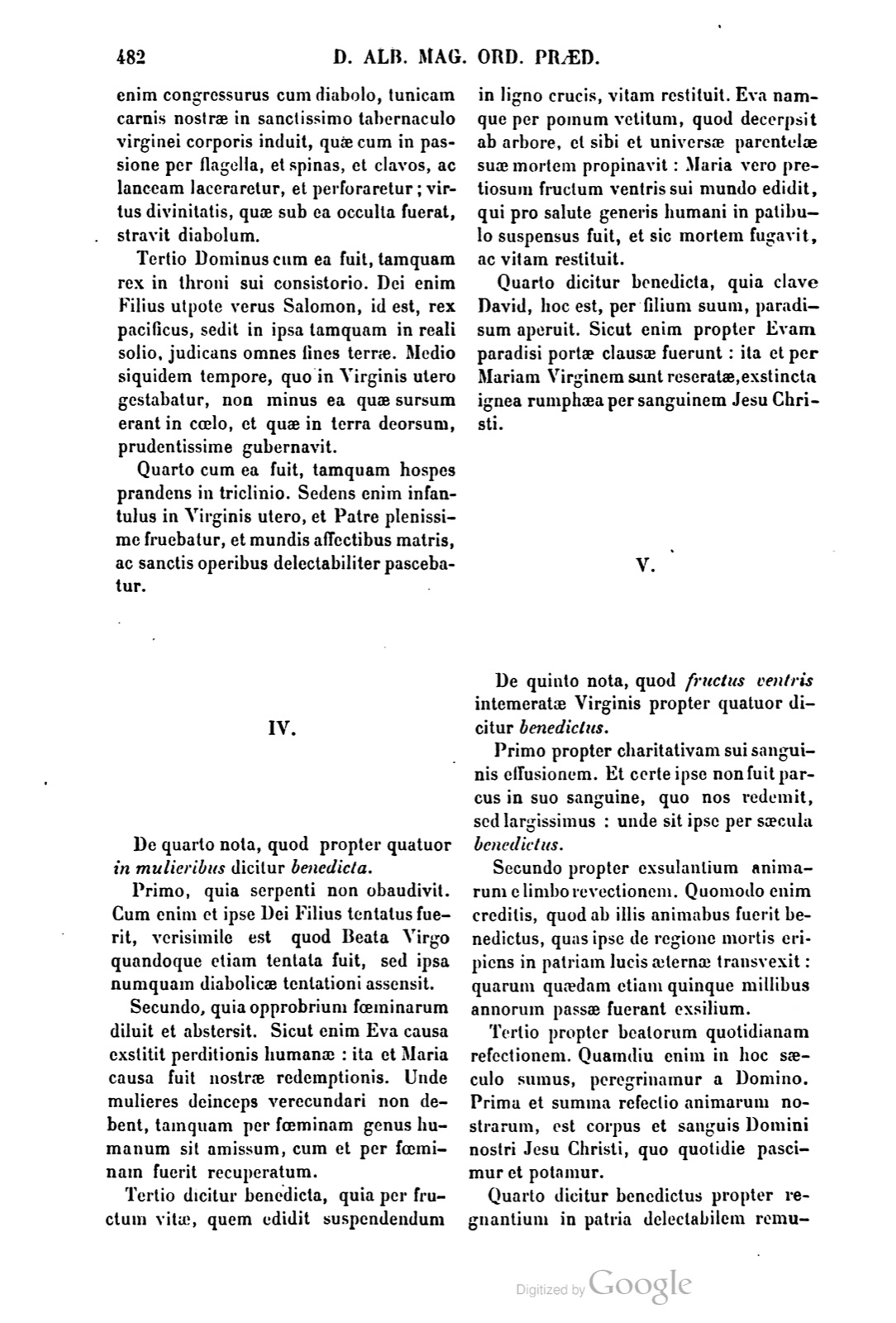
Quarto dicitur benedicta, quia clave David, hoc est, per filium suum, paradisum aperuit. Sicut enim propter Evam paradisi portæ clausæ fuerunt: ita et per Mariam Virginem sunt reseratæ, exstincta ignea rumphæa per sanguinem Jesu Christi.
V.
De quinto nota, quod fructus ventris intemeratæ Virginis propter quatuor dicitur benedictus.
Primo propter charitativam sui sanguinis effusionem. Et certe ipse non fuit parcus in suo sanguine, quo nos redemit, sed largissimus: unde sit ipse per sæcula benedictus.
Secundo propter exsulantium animarum e limbo revectionem. Quomodo enim creditis, quod ab illis animabus fuerit benedictus, quas ipse de regione mortis eripiens in patriam lucis æternæ transvexit: quarum quædam etiam quinque millibus annorum passæ fuerant exsilium.
Tertio propter beatorum quotidianam refectionem. Quamdiu enim in hoc sæculo sumus, peregrinamur a Domino. Prima et summa refectio animarum nostrarum, est corpus et sanguis Domini nostri Jesu Christi, quo quotidie pascimur et potamur.
Quarto dicitur benedictus propter regnantium in patria delectabilem remunerationem. Ibi enim merces omnium filiorum Dei, est gloriosus fructus ventris immaculatæ Virginis Mariæ.
Rogate ergo Dominum, ut a vitiis emundati meritis Beatæ Virginis sic in hac vita Dei gratia repleamur, ut post hanc vitam gloriosum fructum ventris sui in præmium assequamur. Quod nobis, etc.
Fourthly, she is said to be blessed because by the key of David, that is, through her Son, she opened paradise. For just as the gates of paradise were closed because of Eve, so also through the Virgin Mary they were opened again, the fiery sword having been extinguished through the blood of Jesus Christ.
V.
On the fifth, note that the fruit of the womb of the undefiled Virgin is said to be blessed for four reasons.
First, on account of the charitable shedding of his blood. And certainly he was not sparing in his blood, by which he redeemed us, but most lavish; hence may he be blessed through the ages.
Secondly, on account of the carrying back of exiled souls from limbo. For how do you believe that he was blessed by those souls whom he, snatching them from the region of death, carried across into the fatherland of eternal light, some of whom had even suffered exile for five thousand years?
Thirdly, on account of the daily refreshment of the blessed. For as long as we are in this age, we are pilgrims away from the Lord. The first and highest refreshment of our souls is the body and blood of our Lord Jesus Christ, by which we are daily fed and given drink.
Fourthly, he is said to be blessed on account of the delightful remuneration of those reigning in the fatherland. For there the reward of all the sons of God is the glorious fruit of the womb of the immaculate Virgin Mary.
Therefore pray to the Lord, that, cleansed from vices by the merits of the Blessed Virgin, we may be so filled with the grace of God in this life, that after this life we may obtain as reward the glorious fruit of her womb. May he grant this to us, etc.

If a page does not appear, its photograph has not been uploaded yet.