Volume 13 · pp. 484–489
Sermon XVI. Likewise, On the Same Feast of the Annunciation of the B. V. M.
A marker with ≈ is an approximate page boundary, placed by measure of the text; the page photographs remain the authority. In the paired views, clicking a page marker brings that page into view.
SERMO XVI.
ITEM, IN EODEM FESTO ANNUNTIATIONIS B. V. M.
Ave gratia plena. Luc. I, 28.
Nota, quod hæc sunt verba, quibus Angelus alloquitur Virginem Mariam. Et nota, quod sicut munda pixis nobili electuario repletur, ita etiam Beata Virgo tamquam aurea pixis, gratia repleta fuit. Dicit ergo Angelus ad eam, Ave gratia plena. Quasi diceret: Ave virgo sanctissima, quia tu es pixis aurea, quæ nobili electuario gratiæ usquequam a summo pigmentario es impleta. Quod autem Beata Virgo sit vas gratiæ, testatur Sequentia, in qua sic cantatur: « Salve mater Salvatoris, vas electum, vas honorabile, vas cœlestis gratiæ. »
Duo igitur principaliter sunt hic notanda:
I. Quæ virtus huic electuario quod gratia vocatur, inesse credatur? II. Ex quibus speciebus electuarium conficiatur?
I.
De primo nota, quod hoc electuarium, quod gratia vocatur, quatuor egregias virtutes habere probatur. Prima virtus est, quod homo per gratiam ab omni peccati ægritudine liberatur. Secunda, quod homo ad virtutum exercitia per gratiam mirifice roboratur. Tertia, quod homo per gratiam bonis supercælestibus locupletatur. Quarta, quod homo per gratiam in regno Dei honorifice sublimatur.
1. Prima igitur virtus hujus electuarii, quod gratia vocatur, in hoc consistit, quod homo per illud ab omni peccati languore curatur. Beata igitur Virgo Maria tantam abundantiam gratiæ consecuta est a Domino, quod etiam in matris utero ab originali peccato exstitit emundata, et quod omnis ægritudo fomitis in ea penitus est exstincta. Unde scribit Beatus Bernardus ad Canonicos Lugdunenses: « Quod vel paucis mortalium constat fuisse collatum, ut videlicet sancti exirent ex utero, fas non est suspicari tantæ Virgini esse negatum, per quam omnis mortalitas emersit ad vitam: ego puto, quod et copiosior sanctificationis benedictio in ea descenderit, quæ ipsius non solum sanctificaret ortum, sed et vitam deinceps ab omni peccato custodiret, quod nemini alteri in natis quidem mulierum, creditur esse donatum. »
Nos etiam, charissimi, cum simus peccatores, necessarium nobis est electuarium gratiæ, ut per illud a peccatorum infirmitatibus liberemur. Unde gratiam nobis optat Apostolus ad Rom. I, 7: Gratia, inquit, vobis, et pax a Deo Patre nostro, et Domino Jesu Christo. Glossa: « Per gratiam liberamur a peccatis: per pacem autem reconciliamur Deo. » Hinc etiam scribit Apostolus ad Eph. II, 4 et 5: Deus, qui dives est in misericordia, propter nimiam charitatem suam, qua dilexit nos: et cum essemus mortui peccatis, convivificavit nos Christo (cujus gratia estis salvati). Per gratiam itaque Christi salvamur a peccatis, quæ animam faciunt graviter infirmari. Propter quod necesse est, ut electuarium gratiæ mundificativum jugiter a Deo postulemus.
SERMON XVI.
LIKEWISE, ON THE SAME FEAST OF THE ANNUNCIATION OF THE B. V. M.
Hail, full of grace. Luke 1:28.
Note that these are the words with which the Angel addresses the Virgin Mary. And note that just as a clean pyx is filled with a noble electuary, so also the Blessed Virgin, as a golden pyx, was filled with grace. Therefore the Angel says to her: Hail, full of grace. As if he were saying: Hail, most holy virgin, because you are a golden pyx, which has been filled in every way with the noble electuary of grace by the highest compounder. But that the Blessed Virgin is a vessel of grace, the Sequence testifies, in which it is sung thus: "Hail, mother of the Savior, chosen vessel, honorable vessel, vessel of heavenly grace."
Therefore two things are principally to be noted here:
I. What power is believed to be in this electuary that is called grace? II. From what ingredients is the electuary made?
I.
On the first, note that this electuary, which is called grace, is proved to have four excellent powers. The first power is that through grace a man is freed from every sickness of sin. The second, that through grace a man is wonderfully strengthened for the exercises of virtues. The third, that through grace a man is enriched with superheavenly goods. The fourth, that through grace a man is honorably exalted in the kingdom of God.
1. Therefore the first power of this electuary, which is called grace, consists in this: that through it a man is healed from every weakness of sin. Therefore the Blessed Virgin Mary obtained such an abundance of grace from the Lord that even in her mother's womb she existed as cleansed from original sin, and every sickness of the tinder was utterly extinguished in her. Hence Blessed Bernard writes to the Canons of Lyons: "What is known to have been granted to even a few mortals, namely that they went forth holy from the womb, it is not right to suspect to have been denied to so great a Virgin, through whom all mortality emerged to life. I think that a more abundant blessing of sanctification also descended in her, which would sanctify not only her birth, but would henceforth guard her life from every sin, which is believed to have been given to no other among those born of women."
We also, dearest ones, since we are sinners, have need of the electuary of grace, so that through it we may be freed from the infirmities of sins. Hence the Apostle wishes grace for us at Romans 1:7: Grace, he says, to you, and peace from God our Father and the Lord Jesus Christ. The Gloss says: "Through grace we are freed from sins; but through peace we are reconciled to God." Hence also the Apostle writes at Ephesians 2:4 and 5: God, who is rich in mercy, on account of his exceeding charity, by which he loved us, even when we were dead in sins, brought us to life together with Christ, by whose grace you have been saved. Thus through the grace of Christ we are saved from sins, which make the soul seriously ill. On account of this it is necessary that we continually ask from God for the cleansing electuary of grace.
2. Secunda virtus hujus electuarii, hæc est, ut videlicet per illud deperdita restaurentur, et totus homo per hoc ad virtutum exercitia roboretur. Beata igitur Maria, quidquid Eva per culpam amiserat, recuperavit per gratiam toti mundo. Ipsa etiam tamquam mulier fortis, manus mittens ad fortia, viriliter in virtutum exercitiis desudavit. Unde dicitur Luc. I, 39, 40, 56: quod post salutationem angelicam, exsurgens Maria abiit in montana cum festinatione in civitatem Juda. Et intravit in domum Zachariæ, et salutavit Elisabeth. Apud quam etiam mansit quasi mensibus tribus, ministrans ei in nativitate Joannis præcursoris Domini. Super prædictum locum dicit Glossa, quod « Beata Virgo ita fortis et robusta fuerit per gratiam, ut eam asperitas itineris non retardarit. »
Nos etiam ut fortes in bonis operibus existamus, indigemus electuario gratiæ restaurativo atque confortativo. Unde dicit Apostolus ad Hebr. XIII, 9: Optimum est gratia stabilire cor, non escis: quæ non profuerunt ambulantibus in eis. Ipse etiam Beatus Paulus fortis fuit et strenuus per gratiam: unde dicit de semetipso, I ad Cor. XV, 10: Gratia Dei sum id quod sum, et gratia ejus in me vacua non fuit, sed abundantius illis omnibus laboravi. Monet etiam nos, II ad Cor. VI, 1: Ne in vacuum gratiam Dei recipiamus. Ille in vacuum gratiam Dei recipit, qui secundum gratiam a Deo acceptam in bonis operibus non desudat.
3. Tertia virtus est hujus electuarii, quod hominem bonis supercœlestibus locupletat. Quia igitur Beata Virgo per gratiam fuit emundata, propterea summo et vero bono spiritualiter et corporaliter fuit adimpleta. Erat enim nobile triclinium totius Trinitatis, fuit nihilominus camera sive hospitale sanctæ humanitatis. Ipsa enim Dei Filium secundum carnem concepit, et in utero suo mundissimo novem mensibus bajulavit. Unde cantatur de ipsa: « Salve mater pietatis, et totius Trinitatis nobile triclinium: Verbi tamen incarnati spirituale majestati præparans hospitium. » Quod autem vero et summo bono fuerit adimpleta, testatur in cantico suo ubi ait: Magnificat anima mea Dominum, etc. Et infra: Esurientes implevit bonis 1. Ipsa quippe summum et verum bonum esuriit, propter quod et eo usque ad summum repleta fuit. Non est dubium quin in cælis, in latere Filii residens, bonis omnibus repleatur. Consentaneum quippe rationi est, quod filius matrem suam filiali affectu honorans, plenam ei super omnia bona sua dederit potestatem.
Nos etiam electuarium gratiæ devotissimis precibus postulare debemus, ut ipsius beneficio bonorum supercœlestium participes effici mereamur. Eis enim qui in gratia fuerint constituti, bona supercælestia conferentur. Unde dicitur Eccli. XL, 17: Gratia sicut paradisus in benedictionibus. Hinc etiam est, quod Dominus latroni pœnitenti, quem in gratiam suam receperat, omnia bona paradisi communicavit, dicens Luc. XXIII, 43: Amen dico tibi: Hodie mecum eris in paradiso.
2. The second power of this electuary is this: namely that through it things lost are restored, and through this the whole man is strengthened for the exercises of virtues. Therefore Blessed Mary recovered for the whole world through grace whatever Eve had lost through fault. She also, as a strong woman, putting her hands to strong things, manfully sweated in the exercises of virtues. Hence it is said in Luke 1:39, 40, and 56 that after the angelic salutation, Mary, rising, went into the hill country with haste into a city of Judah. And she entered into the house of Zacharias and saluted Elizabeth. With her she also remained about three months, serving her in the birth of John, the precursor of the Lord. On the aforesaid place the Gloss says that "the Blessed Virgin was so strong and robust through grace that the roughness of the journey did not delay her."
We also, that we may exist as strong in good works, need the electuary of grace, restorative and strengthening. Hence the Apostle says at Hebrews 13:9: It is best that the heart be established by grace, not by foods, which have not profited those walking in them. Blessed Paul himself also was strong and strenuous through grace; hence he says concerning himself, 1 Corinthians 15:10: By the grace of God I am what I am, and his grace in me was not empty, but I labored more abundantly than all of them. He also admonishes us, 2 Corinthians 6:1: Let us not receive the grace of God in vain. He receives the grace of God in vain who, according to the grace received from God, does not sweat in good works.
3. The third power of this electuary is that it enriches a man with superheavenly goods. Therefore because the Blessed Virgin was cleansed through grace, on that account she was spiritually and corporally filled with the highest and true good. For she was the noble dining room of the whole Trinity; nevertheless she was the chamber or hostelry of the holy humanity. For she conceived the Son of God according to the flesh and carried him for nine months in her most clean womb. Hence it is sung concerning her: "Hail, mother of piety, and noble dining room of the whole Trinity; yet preparing for the spiritual majesty of the incarnate Word a lodging." But that she was filled with the true and highest good, she testifies in her canticle where she says: My soul magnifies the Lord, etc. And below: He has filled the hungry with goods 1. Indeed she hungered for the highest and true good, on account of which she was filled by him even to the highest degree. There is no doubt that in the heavens, residing at the side of the Son, she is filled with all goods. For it is consonant with reason that the Son, honoring his mother with filial affection, has given her full power over all his goods.
We also ought to ask with most devout prayers for the electuary of grace, so that by its benefit we may merit to be made participants of superheavenly goods. For to those who have been established in grace, superheavenly goods will be conferred. Hence it is said in Ecclesiasticus 40:17: Grace is like a paradise in blessings. Hence also it is that the Lord communicated all the goods of paradise to the penitent thief, whom he had received into his grace, saying in Luke 23:43: Amen I say to you: Today you will be with me in paradise.
4. Quarta virtus hujus electuarii, quod hominem glorificat et sublimat. Beata igitur Virgo Maria, quia plena fuit gratia, propterea super omnes choros Angelorum est exaltata, et digna est vocari cælorum Regina. De exaltatione vero Mariæ matris misericordiæ sic legitur Esther, II, 15, 16 et 17: Erat Esther formosa valde, et incredibili pulchritudine, omnium oculis gratiosa et amabilis videbatur. Ducta est itaque ad cubiculum regis Assueri..., et amavit eam Rex plus quam omnes mulieres, habuitque gratiam et misericordiam coram eo super omnes mulieres, et posuit diadema regni in capite ejus.
Esther interpretatur præparata in tempore, et signat Beatam Virginem, quam Deus Pater ad hoc præparavit, ut Filius suus unigenitus ex ea conciperetur, et nasceretur, quando advenit tempus miserendi ejus. Assuerus interpretatur beatitudo, et signat Filium Dei, a quo tamquam a fonte beatitudinis lucidissimo profluit omne bonum. Esther itaque, id est, Beata Virgo formosa erat per immaculatam virginitatem, erat etiam incredibilis pulchritudinis per virtutum omnium venustatem. Omnes siquidem virtutes in ea aggregatæ mirabiliter venustaverant eam. Omnium quoque et Angelorum, et hominum oculis gratiosa et amabilis videbatur per viscerosam charitatem. Hæc itaque Virgo in assumptione Angelorum comitatu, ad cubiculum Regis æterni solemniter est adducta: et quoniam gratiam apud Deum invenerat, super omnes mulieres, id est, super omnes fideles animas, est amata, et diademate regni cœlestis honorifice coronata. Necessarium etiam nobis est electuarium gratiæ in terris, ut per illud gloriam mereamur adipisci in cælis. Unde dicitur in Psal. LXXXII, 12: Gratiam, et gloriam dabit Dominus. Hic manifeste innuitur, quod per gratiam pervenitur ad gloriam. Primo enim Dominus dat gratiam, et postea his qui perseveraverint in gratia, superaddit et gloriam.
II.
De secundo nota, quod nobilissimum gratiæ electuarium ex sex speciebus conficitur. Hæ autem sex species sunt virtutes, propter quas gratia spiritualiter obtinetur. Prima est castitas. Secunda, bonitas. Tertia, pietas. Quarta, veritas. Quinta, humilitas. Sexta, patientia sive æquanimitas. Has sex virtutes habuit dulcis Virgo Maria, quas etiam nos ad imitationem sui debemus habere.
4. The fourth power of this electuary is that it glorifies and exalts a man. Therefore the Blessed Virgin Mary, because she was full of grace, was on that account exalted above all the choirs of Angels and is worthy to be called Queen of the heavens. But concerning the exaltation of Mary, mother of mercy, it is read thus in Esther 2:15, 16, and 17: Esther was very beautiful and of incredible loveliness; to the eyes of all she seemed gracious and lovable. Therefore she was led to the chamber of King Ahasuerus..., and the King loved her more than all women, and she had grace and mercy before him above all women, and he placed the diadem of the kingdom on her head.
Esther is interpreted prepared in time, and signifies the Blessed Virgin, whom God the Father prepared for this, that his only-begotten Son would be conceived from her and born, when the time of having mercy on him came. Ahasuerus is interpreted beatitude, and signifies the Son of God, from whom, as from a most bright fountain of beatitude, every good flows forth. Therefore Esther, that is, the Blessed Virgin, was beautiful through immaculate virginity; she was also of incredible loveliness through the beauty of all the virtues. Indeed all the virtues gathered in her had marvelously beautified her. To the eyes also of all Angels and men she seemed gracious and lovable through deep charity. Therefore this Virgin, in the Assumption, with a company of Angels, was solemnly led to the chamber of the eternal King; and because she had found grace before God, she was loved above all women, that is, above all faithful souls, and was honorably crowned with the diadem of the heavenly kingdom. We also have need of the electuary of grace on earth, so that through it we may merit to attain glory in the heavens. Hence it is said in Psalm 82:12: The Lord will give grace and glory. Here it is manifestly suggested that through grace one comes to glory. For first the Lord gives grace, and afterward to those who have persevered in grace he adds glory besides.
II.
On the second, note that the most noble electuary of grace is made from six ingredients. But these six ingredients are virtues, on account of which grace is spiritually obtained. The first is chastity. The second, goodness. The third, piety. The fourth, truth. The fifth, humility. The sixth, patience or equanimity. The sweet Virgin Mary had these six virtues, which we also ought to have in imitation of her.
1. Prima igitur species ex qua conficitur electuarium gratiæ, est castitas. Unde dicitur Eccli. XXVI, 19: Gratia super gratiam mulier sancta, et pudorata. Beata Virgo sancta fuit mente, et pudorata corpore: propter quod gratiam habuit in omni abundantia.
Debet etiam quilibet Christianus sanctus esse mente, et pudoratus corpore, si desiderat Dei gratiam possidere. Gratia enim Spiritus sancti non habitabit in corpore subdito peccatis luxuriæ et impudicitiæ 2.
2. Secunda species est bonitas. Unde dicitur Prov. XII, 2: Qui bonus est, hauriet gratiam a Domino. Nota, quod bonitas in hoc consistit, quod homo omnibus prodesse appetat: neminem autem lædat aut offendat. Bona igitur et valde bona fuit Virgo Maria: omnibus enim prodesse appetiit: nullum vero vel verbo, vel facto læsit, aut offendit. Unde et ipsa eum qui essentialiter bonus est, concipere meruit, et huic mundo proferre.
Nos etiam ad imitationem Beatæ Virginis boni esse debemus, ut videlicet omnibus prodesse appetamus, nullique malum, vel verbo, vel opere faciamus. Ille quippe, qui malum non facit proximo suo, in monte sancto Dei sub umbra divinæ gratiæ requiescet.
3. Tertia species est misericordia sive pietas. Unde dicitur Eccli. XLIV, 27: Conservavit homines misericordiæ, invenientes gratiam in oculis omnis carnis. Nota, quod Dominus conservabat homines misericordiæ et pietatis quorum non defuit numerus. Inveniunt enim gratiam in oculis omnis carnis, id est, oculis illius, qui carnem suam in cibum, et sanguinem suum in potum fidelibus administrat. Quia igitur Beata Virgo eximiæ pietatis erat ac misericordiæ, propterea gratiam excellentissimam apud Deum inveniens, mater meruit effici pietatis. Quod autem magnæ pietatis sive misericordiæ fuerit Beata Maria, probari potest in Joan. II, 3, ubi deficiente vino in nuptiis, dicit mater Jesu ad eum: Vinum non habent. Super hunc locum dicit Bernardus: « Compassa est eorum verecundiæ, sicut misericors, sicut benignissima. » Quid de fonte pietatis procedet, nisi pietas? Quid, inquam, mirum, si pietatem exhibent viscera pietatis? Nonne qui pomum in manu sua tenuerit dimidia die, reliqua dici parte pomi servabit odorem? Quantum igitur viscera illa virtus pietatis affecit, in quibus novem mensibus requievit? Nam et ante mentem replevit, quam ventrem: et cum processit ex utero, non recessit ab animo.
Nos etiam ad exemplum piæ Virginis pii et misericordes esse debemus, quatenus gratiam apud Dei misericordiam in extremæ necessitatis tempore consequamur. Dicitur enim Jac. II, 13, quod erit judicium sine misericordia illi, qui non fecit misericordiam.
1. Therefore the first ingredient from which the electuary of grace is made is chastity. Hence it is said in Ecclesiasticus 26:19: Grace upon grace is a holy and modest woman. The Blessed Virgin was holy in mind and modest in body; on account of this she had grace in all abundance.
Every Christian also ought to be holy in mind and modest in body if he desires to possess the grace of God. For the grace of the Holy Spirit will not dwell in a body subject to the sins of lust and immodesty 2.
2. The second ingredient is goodness. Hence it is said in Proverbs 12:2: He who is good will draw grace from the Lord. Note that goodness consists in this: that a man desires to profit all and harms or offends no one. Therefore the Virgin Mary was good and very good, for she desired to profit all; but she harmed or offended no one either by word or by deed. Hence she herself merited to conceive him who is essentially good and to bring him forth to this world.
We also, in imitation of the Blessed Virgin, ought to be good, namely so that we desire to profit all and do evil to no one either by word or by work. Indeed he who does not do evil to his neighbor will rest on the holy mountain of God under the shade of divine grace.
3. The third ingredient is mercy or piety. Hence it is said in Ecclesiasticus 44:27: He preserved men of mercy, finding grace in the eyes of all flesh. Note that the Lord was preserving men of mercy and piety, of whom there was no lack in number. For they find grace in the eyes of all flesh, that is, in the eyes of him who administers his flesh as food and his blood as drink to the faithful. Therefore because the Blessed Virgin was of exceptional piety and mercy, on that account, finding most excellent grace before God, she merited to be made the mother of piety. But that Blessed Mary was of great piety or mercy can be proved in John 2:3, where, when wine was lacking at the wedding, the mother of Jesus says to him: They have no wine. On this place Bernard says: "She suffered with their shame, as merciful, as most kindly." What will proceed from the fountain of piety except piety? What, I say, is wonderful if the inward parts of piety display piety? Does not one who has held an apple in his hand for half a day preserve the odor of the apple for the remaining part of the day? How much therefore did that power of piety affect those inward parts, in which he rested for nine months? For it filled her mind before her womb; and when he went forth from the womb, he did not depart from her soul.
We also, after the example of the pious Virgin, ought to be pious and merciful, so that we may obtain grace before the mercy of God in the time of extreme necessity. For it is said in James 2:13 that judgment will be without mercy for him who has not done mercy.
4. Quarta species est veritas. Unde dicitur Proverb. III, 3 et 4: Misericordia, et veritas non te deserant..., et invenies gratiam, et disciplinam bonam coram Deo et hominibus. Quia igitur Beata Virgo verax fuit, et veritatem in omni verbo, et facto servavit: propter hoc digna facta facta est, ut mater fieret veritatis. Ipse enim Jesus Virginis veracis Filius dicit de semetipso, Joan. XIV, 6: Ego sum veritas. Verum, quia in multiloquio sæpe declinatur a via veritatis, et incurritur periculum falsitatis: propterea non multiloqua, sed tardiloqua fuit B. Virgo Maria. Quod probari potest, Luc. II, 16 et seq., ubi legitur, quod in nativitate Jesu, cum venissent pastores, et invenissent Mariam et Joseph, et infantem positum in præsepio, videntes cognoverunt de verbo, quod dictum erat illis ab Angelo de puero hoc. Et omnes, qui audierunt, mirati sunt: et de his, quæ dicta erant a pastoribus ad ipsos. Et statim subditur: Maria autem conservabat omnia verba hæc, conferens in corde suo. Legitur etiam, Luc. II, 42, et seq., quod Jesus cum esset annorum duodecim, et remansisset in Jerusalem, et cum dixisset ei mater sua: Fili, quid fecisti nobis sic? ecce pater tuus et ego dolentes quærebamus te. Cui etiam cum responderet: Quid est, quod me quærebatis? Nesciebatis quia in his, quæ Patris mei sunt, oportet me esse? Subditur, quod mater ejus conservabat omnia verba hæc in corde suo. Quia igitur Beata Virgo tam sollicite verba quæ audivit, conservabat in corde, nec ad ea respondit: patet evidenter eam non multiloquam fuisse, et per hoc omne mendacium declinasse. Præterea cum Angelus eam, ut hodie legitur, tam magnifice salutasset; non statim respondit, sed turbata est in sermone, et cogitabat qualis esset ista salutatio 3.
Nos etiam, ut per veritatem gratiam Dei obtinere possimus, non solum mendacium, sed et multiloquium, quod seminarium est mendacii, fugiamus; dicitur enim Proverb. X, 19: In multiloquio non deerit peccatum. Dicit etiam Philosophus: « Tardiloquum te esse jubeo, et prope erit tibi Deus. »
5. Quinta species est humilitas. Unde dicitur Eccli. III, 20: Quanto magnus es, humilia te in omnibus, et coram Deo invenies gratiam. Dicit etiam Jacob. IV, 6: Deus superbis resistit, humilibus autem dat gratiam. Ait etiam I Pet. V, 5: Omnes invicem humilitatem insinuate, quia Deus superbis resistit, humilibus autem dat gratiam. Magnæ humilitatis fuit Virgo Maria. Cum enim Angelus eam gratia plenam, et Dominum cum ea, et ipsam inter mulieres benedicendam assereret: cumque eam etiam concepturam et filium parituram, qui magnus esset futurus, et in domo Jacob in æternum regnaturus; respondit humiliter: Ecce ancilla Domini, fiat mihi secundum verbum tuum 4. Per humilitatem etiam ad Elisabeth, quam jam gravidam esse cognoverat, pedibus suis ambulavit, eamque prior salutavit, ipsi quoque fideliter ministravit.
4. The fourth ingredient is truth. Hence it is said in Proverbs 3:3 and 4: Let mercy and truth not desert you..., and you will find grace and good discipline before God and men. Therefore because the Blessed Virgin was truthful and preserved truth in every word and deed, on account of this she was made worthy, made worthy, to become the mother of truth. For Jesus himself, Son of the truthful Virgin, says concerning himself, John 14:6: I am truth. But because in much speaking one is often turned aside from the way of truth and incurs the danger of falsehood, therefore the Blessed Virgin Mary was not much-speaking, but slow-speaking. This can be proved from Luke 2:16 and following, where it is read that at the birth of Jesus, when the shepherds had come and had found Mary and Joseph and the infant placed in the manger, seeing, they knew concerning the word that had been spoken to them by the Angel about this child. And all who heard wondered at the things that had been said by the shepherds to them. And immediately it is added: But Mary was preserving all these words, putting them together in her heart. It is also read, Luke 2:42 and following, that when Jesus was twelve years old and had remained in Jerusalem, and when his mother had said to him: Son, why have you done thus to us? behold, your father and I, sorrowing, were seeking you. When he also had answered her: What is it, that you were seeking me? Did you not know that I must be in those things which are my Father's? It is added that his mother preserved all these words in her heart. Therefore because the Blessed Virgin so carefully preserved the words that she heard in her heart and did not respond to them, it is evidently clear that she was not much-speaking, and through this declined every lie. Moreover, when the Angel, as is read today, had saluted her so magnificently, she did not answer immediately, but was troubled at the speech and thought what sort of salutation this might be 3.
We also, so that we may be able to obtain the grace of God through truth, should flee not only a lie but also much speaking, which is the seedbed of a lie; for it is said in Proverbs 10:19: In much speaking sin will not be lacking. The Philosopher also says: "I bid you to be slow-speaking, and God will be near to you."
5. The fifth ingredient is humility. Hence it is said in Ecclesiasticus 3:20: The greater you are, humble yourself in all things, and before God you will find grace. James 4:6 also says: God resists the proud, but gives grace to the humble. 1 Peter 5:5 also says: All of you instill humility into one another, because God resists the proud, but gives grace to the humble. The Virgin Mary was of great humility. For when the Angel asserted that she was full of grace, and that the Lord was with her, and that she herself was to be blessed among women, and when he asserted also that she would conceive and bear a Son who would be great in the future and would reign in the house of Jacob forever, she answered humbly: Behold the handmaid of the Lord; let it be done to me according to your word 4. Through humility also she walked on her feet to Elizabeth, whom she had known was already pregnant, and greeted her first, and faithfully served her too.
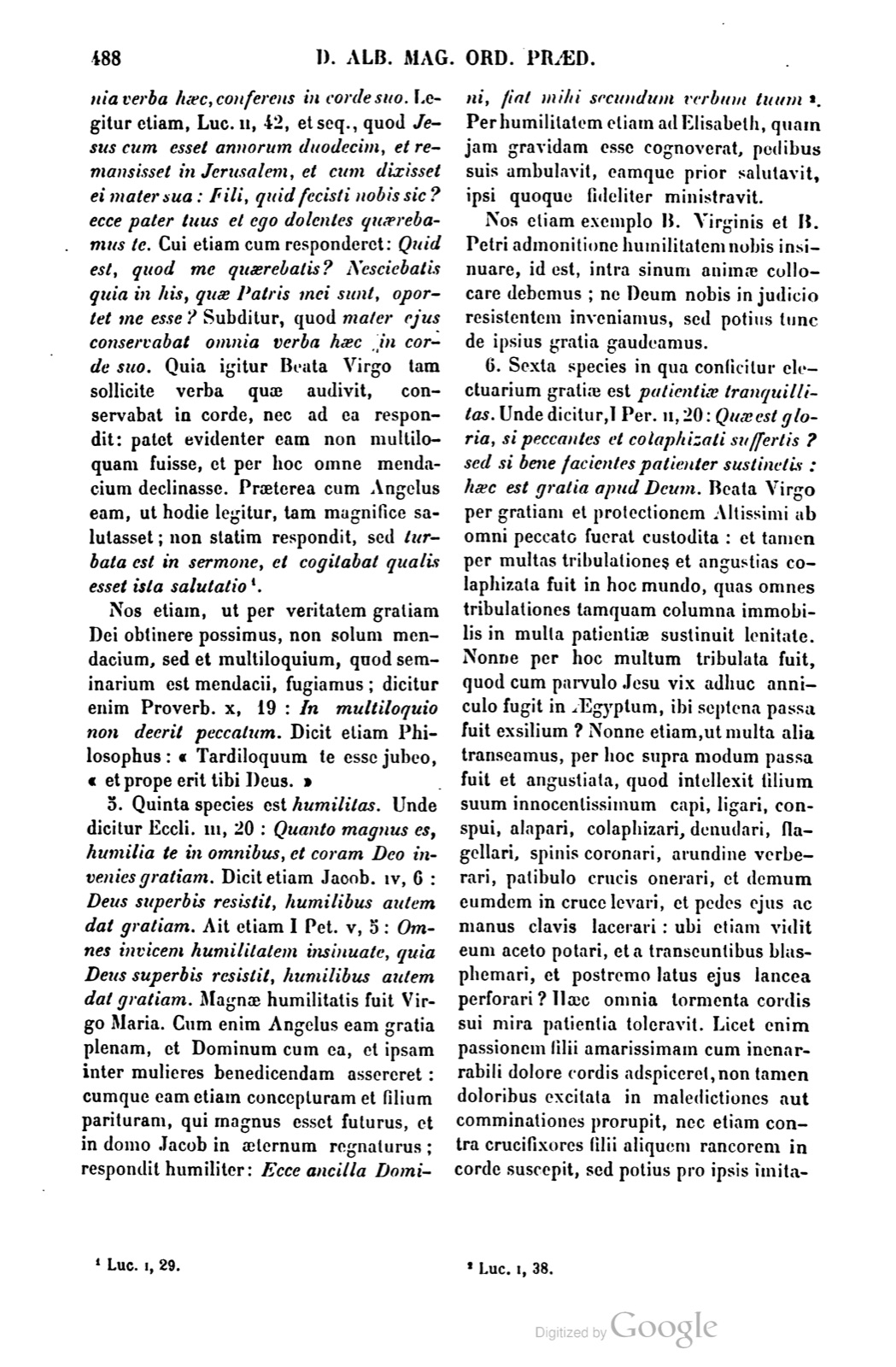
Nos etiam exemplo B. Virginis et B. Petri admonitione humilitatem nobis insinuare, id est, intra sinum animæ collocare debemus; ne Deum nobis in judicio resistentem inveniamus, sed potius tunc de ipsius gratia gaudeamus.
6. Sexta species in qua conficitur electuarium gratiæ est patientiæ tranquillitas. Unde dicitur, I Pet. II, 20: Quæ est gloria, si peccantes et colaphizati suffertis? sed si bene facientes patienter sustinetis: hæc est gratia apud Deum. Beata Virgo per gratiam et protectionem Altissimi ab omni peccato fuerat custodita: et tamen per multas tribulationes et angustias colaphizata fuit in hoc mundo, quas omnes tribulationes tamquam columna immobilis in multa patientiæ sustinuit lenitate. Nonne per hoc multum tribulata fuit, quod cum parvulo Jesu vix adhuc anniculo fugit in Ægyptum, ibi septena passa fuit exsilium? Nonne etiam, ut multa alia transeamus, per hoc supra modum passa fuit et angustiata, quod intellexit filium suum innocentissimum capi, ligari, conspui, alapari, colaphizari, denudari, flagellari, spinis coronari, arundine verberari, patibulo crucis onerari, et demum eumdem in cruce levari, et pedes ejus ac manus clavis lacerari: ubi etiam vidit eum aceto potari, et a transeuntibus blasphemari, et postremo latus ejus lancea perforari? Hæc omnia tormenta cordis sui mira patientia toleravit. Licet enim passionem filii amarissimam cum inenarrabili dolore cordis adspiceret, non tamen doloribus excitata in maledictiones aut comminationes prorupit, nec etiam contra crucifixores filii aliquem rancorem in corde suscepit, sed potius pro ipsis imitatione filii, ut ad pænitentiam converterentur, oravit.
Nos etiam exemplo istius patientissimæ Virginis omnes adversitates, quæ nobis adveniunt in hoc mundo, cum patientia toleremus. Oremus etiam pro persequentibus, et calumniantibus nos, sicut monet nos ipse Dominus, Matth. V, 44, 45: Diligite inimicos vestros, benefacite his, qui oderunt vos: et orate pro persequentibus, et calumniantibus vos: ut sitis filii Patris vestri, qui in cælis est.
Rogate ergo, charissimi, istam gloriosam Virginem omni gratia plenam, ut piis ejus intercessionibus nobis aliquam portiunculam gratiæ et gloriæ a filio impetrare dignetur. Quod nobis, etc.
We also, by the example of the Blessed Virgin and by the admonition of Blessed Peter, ought to instill humility into ourselves, that is, to place it within the bosom of the soul, lest we find God resisting us in judgment, but rather rejoice then concerning his grace.
6. The sixth ingredient in which the electuary of grace is made is the tranquillity of patience. Hence it is said, 1 Peter 2:20: What glory is there if, sinning and being struck, you endure it? But if, doing good, you patiently sustain it, this is grace before God. The Blessed Virgin, through the grace and protection of the Most High, had been guarded from every sin; and nevertheless she was struck in this world through many tribulations and distresses, all of which tribulations, like an immovable column, she sustained in great mildness of patience. Was she not greatly troubled through this, that with the little child Jesus, scarcely yet a little year old, she fled into Egypt and there suffered exile for seven years? Was she not also, to pass over many other things, through this suffering beyond measure and distressed, that she understood that her most innocent Son was seized, bound, spat upon, slapped, struck, stripped, scourged, crowned with thorns, beaten with a reed, burdened with the gibbet of the cross, and finally raised on that same cross, and his feet and hands torn by nails, where she also saw him given vinegar to drink, and blasphemed by passersby, and lastly his side pierced by a lance? All these torments of her heart she endured with wonderful patience. For although she looked upon the most bitter Passion of her Son with unutterable sorrow of heart, nevertheless, stirred by griefs, she did not break forth into curses or threats, nor did she receive any rancor in her heart against the crucifiers of the Son, but rather for them, in imitation of the Son, she prayed that they might be converted to penance.
We also, by the example of that most patient Virgin, should tolerate with patience all adversities that come to us in this world. Let us also pray for those persecuting and slandering us, as the Lord himself admonishes us, Matthew 5:44, 45: Love your enemies, do good to those who hate you, and pray for those persecuting and slandering you, so that you may be sons of your Father who is in heaven.
Therefore pray, dearest ones, to that glorious Virgin full of every grace, that by her pious intercessions she may deign to obtain for us from the Son some small portion of grace and glory. May he grant this to us, etc.

If a page does not appear, its photograph has not been uploaded yet.